
Influence of Terrestrial LiDAR Scanning Conditions on Registration Results for Physical AI Development
ⓒ 2026. KIEAE all rights reserved.
Abstract
This study investigates the effects of indoor scanning geometry on target-based registration behavior through variations in target centroid estimation in terrestrial laser scanning (TLS) for physical AI development. The manuscript argues that, in feature-poor interior environments, registration reliability depends more strongly on scan distance and viewing geometry—which govern the consistency of target centroid estimation—than on nominal ranging precision.
A controlled lecture-room experiment was conducted using a Leica RTC 360 and four targets mounted on a planar interior wall. Scans were repeatedly collected under a structured matrix comprising two distances (5m and 10m), four scanner heights, and multiple lateral scan positions, with three repetitions per scan configuration. Target-based registration was performed for each repetition, and registration outcomes were analyzed by calculating Euclidean displacements between corresponding target centroids, without using external control points.
Scanning distance and lateral scan position were identified as the primary factors influencing target centroid displacement behavior, whereas scanner height showed no systematic effect. Increased scanning distance produced larger displacement magnitudes and greater dispersion, while moderate off-axis positioning was associated with reduced displacement, which is due to the reduced scanner-to-target distance rather than different geometric configurations, leading to increased target centroid consistency. These findings provide practical guidance for scan planning in indoor architectural TLS.
Keywords:
Terrestrial Laser Scanning, Target-Based Registration, Physical AI, Relative Registration1. Introduction
1.1. Research Background
Physical AI systems depend highly on spatial perception obtained from physical sensor data to support digital twin perception and environment aware decision making. Within this context, terrestrial laser scanning (TLS) has become a primary source for indoor data collecting for multiple architectural purposes. Because of Physical AI’s direct connection to sensor and registration processes, the reliability of TLS based data becomes fundemental on perception stability and performance.
Terrestrial laser scanning (TLS) has become a leading method of acquiring high-density three-dimensional spatial data in the fields of architecture and built environment surveying due to its ability to efficiently capture dense geometric information. Within the context of architectural practice, TLS enables interior space documentation [28], scan-to-BIM workflows, and facility management. These applications normally require multiple scan stations to be placed in enclosed interior areas, after which the point clouds produced need to be registered into a coherent coordinate system before they can be interpreted. While the technical specifications of TLS instruments often emphasize ranging precision, the reliability of indoor TLS surveys depends strongly on the stability of the scan registration rather than on single scans alone. Interior environments often contain large areas of planar surfaces and a limited number of distinctive geometric features, which reduces the available geometric constraints for alignment. Consequently, registration protocols usually rely on the installation of artificial reference targets attached to walls or structural elements. The consistency of registration results is therefore determined by how reliably such targets are detected and localized across scans acquired from different scan configurations.
Earlier investigations have shown that scan geometry influences measurement behavior through changes in footprint size, sampling density, and signal characteristics. The distance between the scanner and the object, the viewing perspective, and the lateral position of the scan co-determine the quality of target observation and the spatial distribution of points on the target surface. These effects directly influence on the estimation of target centroids, which results in uncertain scan data and ultimately point cloud networks.
For indoor surveys in which scan locations are constrained by room geometry, variations in scan geometry may introduce systematic deviations in the estimated centroids of targets. When such issues accumulate, it can result in unstable registration.
Within the framework of Physical AI and the use of digital-twin based intelligence systems, sensor based uncertainties and registration instability is directly transferred to perception, learning and decision making processed. Because Physical AI relies on the spatial data collected by physical sensors as its input source, the operation of TLS, such as scan distance, geometry and positioning strategy, becomes a critical factor to determine the reliability of the system itself. Therefore quantitative evaluation of the sensor conditions is essential to geometric documentation and even more so in the reliability of spatial measurements performed in the context of Physical AI.
1.2. Research Gap
Although target-based registration is routinely applied in indoor terrestrial laser scanning (TLS) surveys, a systematic quantification of how scanning geometry influences relative registration has not yet been conducted. Existing studies have primarily examined absolute ranging accuracy or surface-based error indicators, whereas relatively few have investigated the consistency of the registration process itself.
Controlled indoor experiments that isolate the individual effects of scanning distance, scanner height, and lateral scan position are commonly conducted in separate studies. However, the lack of an integrated assessment of these factors presents a critical limitation for Physical AI and digital twin–based sensing applications. To address this gap, the present study experimentally evaluates the effects of scanning geometry on the consistency of target-based registration in an indoor TLS application. A series of carefully controlled scan acquisitions were performed, and relative displacement metrics (derived from the centroid positions of registered targets) were analyzed to determine the influence of individual geometric parameters. Beyond establishing the relative importance of these factors, this study aims to provide insight on planning for scanning indoor architectural TLS workflows for the application of the data towards the development of Physical AI based on awareness and learning.
1.3. Research Objectives and Hypotheses
The overall goal of this study is to quantitatively evaluate the effects of scanning distance, scanner height, and scanner position on geometry-driven variation in target centroid coordinates after target-based registration, using repeatedly acquired datasets obtained under systematically different scan configurations in indoor terrestrial laser scanning surveys.
To fulfill this purpose, the following hypotheses are formulated and tested.
- H1: The scanning distance has a significant impact on the variation of target centroid displacement, such that as scanning distance increases, the magnitude and dispersion of target displacement increase.
- H2: The scanner position has a significant impact on the variation of target centroid displacement, such that scan configurations with smaller scan angles result in reduced target centroid displacement.
- H3: The scanner height has a significant impact on the variation of target centroid displacement.
These hypotheses are intended to distinguish the relative effects of distance, lateral positioning, and scanner height on registration performance within a controlled indoor environment.
1.4. Scope and Limitations
The experiment was conducted under a controlled lecture-room setup using a single TLS instrument (Leica RTC 360) and a fixed set of artificial targets attached to an interior wall. Environmental variables, including illumination and occupancy, were controlled as far as practicable to isolate the effect of scanning geometry. The analysis focuses on relative differences between scan configurations in terms of the consistency of target coordinates, rather than on absolute geometric accuracy.
Accordingly, the results are interpreted in relation to the stability and registration of the scans, which are directly relevant to the TLS workflow and the Physical AI spatial perception.
Absolute ranging accuracy, surface-derived error measures, and material-related effects are beyond the scope of this research. Although the findings can be directly applied to indoor TLS surveys that rely on artificial targets, caution is required when generalizing the results to different scanning strategies, material conditions, and geometric configurations [11].
Further research is required to assess generalization in other environments and alternative registration approaches. Future studies in relation to complex geometries and outdoor environments are yet to be studied for more concise validation of the data.
2. Literature Review
2.1. TLS in Architectural & Indoor Applications
In built-environment sensing, four major modalities can be identified, namely airborne laser scanning (ALS), mobile laser scanning (MLS), terrestrial laser scanning (TLS), and satellite-borne LiDAR platforms. Operating at regional to metropolitan spatial scales, ALS and satellite-based systems are used mainly for terrain modeling, the generation of digital elevation models, and large-scale urban morphological analysis. Empirical research [20], suggests that although these platforms are well suited to macro-scale assessment, their acquisition geometry and spatial resolution limit their suitability for detailed architectural documentation.
In comparison, TLS and MLS are designed for street and building scale applications. TLS acquires dense three dimensional point clouds from stationary tripod positions and supports indoor documentation, scan-to-BIM workflows, and facility management. Compared to MLS, TLS enables more controlled acquisition and higher point density in interior environments and, thus, is especially suited to architectural scale surveys.
Within architectural practice, TLS is increasingly used for as-built documentation, dimensional verification, deformation monitoring, and facility management [20]. In such situations, the reliability of the registered point cloud is of paramount importance, since the registered scan network constitutes the geometric foundation of any further measurement and interpretation.
Although TLS instruments are often characterized by manufacturer-specified ranging precision, multiple studies emphasize that the effective reliability of indoor TLS surveys is primarily governed by registration stability rather than by single-scan ranging performance alone [2,9,26]. This dependency is particularly pronounced in indoor environments, where feature-poor geometry limits natural constraints for robust scan alignment.
2.2. Enhanced Target-Based Registration and Repeatability Metrics
Target-based registration represents a typical method of aligning multiple TLS scans in architectural documentation, particularly in indoor environments where distinct geometric features may be limited or repetitive. Common targets include spheres, checkerboards, and circular markers, which provide well-defined reference points for estimating the spatial transformation between scans [3,6].
To gain the manufacturer level of accuracy, [9] show that it requires not only accurate ranging but also a good target network with sufficient spatial distribution and redundancy [4,9]. Poorly distributed or coplanar targets may affect the registration solution causing systematic distortions even for high-quality individual scan measurements. [1] agree that the location of targets and overlap needs to be considered together with the location of scan stations to ensure robust registration in construction environments.
TLS accuracy is commonly evaluated based on target residuals, inter-target distances, and the stability of target centroid coordinates across different scan configurations [5,10,15]. [2] for instance, performed evaluation of the Leica RTC 360 with comparator tracks and target-based measurements that showed distance biases of the order of 1~2mm under controlled laboratory conditions. Such studies validate the ability of modern TLS instruments to meet nominal accuracy specifications but also highlight the influence of scan geometry and target configuration on the practical performance of such instruments.
Unlike wall- or surface-based metrics, target-based consistency reflects the combined effects of ranging noise, incidence geometry, and registration stability [12,13,25]. Accordingly, several authors have argued that target-based metrics provide a practical and interpretable approach for evaluating registration performance in target-based TLS workflows [18].
2.3. Geometric Effects & Building Constraints
Scanning distance influences TLS performance through both physical and geometric mechanisms. As distance increases, laser beam divergence enlarges the footprint size on the target surface and point spacing increases for a fixed angular resolution. Experimental studies on planar targets report that noise measurement and residual variance increase systematically with distance, even when mean distance bias remains relatively small [17].
Degradation caused by distance is a critical issue in target-based registration processes, as it reduces the accuracy of target centroid estimation and introduces uncertainty into scan-to-scan transformations. Empirical studies have shown that modern TLS instruments maintain millimeter-scale bias across typical indoor ranges; however, the consistency of results declines as scanning distance increases. This effect is particularly pronounced in short-range indoor environments, where even minor geometric distortions can disproportionately influence overall alignment [2,9].
Incidence angle is defined as the angle between the laser beam and the surface. The incidence angle has a determining effect on the stability of the range and centroid estimation [22,23]. When the incidence angle becomes larger, both the effective return strength and the sampling geometry change, which increases ranging uncertainty and reduces centroid stability [8,17,21]. Earlier research characterizes incidence-angle effects as continuous and geometry-driven, as opposed to exhibiting discrete threshold behavior [16].
Regarding registration, changes in horizontal scan position modify the symmetry and diversity of viewing geometry among successive scans. However, changes in scan position can also alter the effective scanner–target distance for individual targets, especially in planar and feature-poor environments where target distinguishability is limited. As a result, improvements in consistency observed in laterally offset scans should be interpreted in relation to the geometric relationship between the target and the scanner, rather than being attributed solely to off-axis viewing effects.
Scanner height affects scan geometry by modifying the vertical component of the scan-to-target relationship. However, previous studies generally report weak or inconsistent height-related effects compared to the dominant influences of distance and horizontal geometry. In typical indoor architectural contexts, where vertical offsets are small relative to scanning range, scanner height is commonly regarded as a secondary planning parameter rather than a primary determinant of registration stability [9].
Indoor environments characterized by planar, feature-poor surfaces such as lecture rooms and corridors present additional challenges for TLS registration. Limited natural features increase reliance on artificial targets and planar constraints, and unfavorable combinations of distance and viewing geometry may accumulate uncertainty across scan networks. These characteristics indicate that evaluating TLS performance solely at the level of single scans is insufficient and that repeatability across registered scan networks must also be explicitly examined [17].
2.4. Implications for Research Design
Although the accurate range-finding capability of TLS, impact of material and laboratory-based performance testing studies have been carried out on a large scale, comparatively fewer studies have focused on the impact of scan geometry on target - based relative registration in realistic indoor architectural settings. Existing work typically uses special fields for testing, comparator tracks or isolated planar panels, which do not account for the spatial constraints and planning decisions of everyday architectural work [7].
There is a lack of controlled experiments that systematically vary scanning distance, scanner height, and horizontal scan position within a confined indoor space, while evaluating accuracy using target-based consistency as opposed to idealized surface metrics [19,27]. This gap is particularly relevant for instruments that are commonly deployed, for which laboratory performance is well documented, but whose behavior under short-range, room-scale geometric variations remains less well quantified [14].
The present study addresses this shortfall by using a very short and replicable experimental protocol using a representative lecture room environment [24]. By controlling material and environmental conditions and systematically varying distance, height, and scan position, the experiment isolates the geometric factors that affect the target-based accuracy and registration stability. In this it offers empirical evidence that is directly relevant to scan planning decisions in architectural and urban TLS applications.
3. Experimental Design and Methods
3.1. Experimental Setting and Instrumentation
The experiment was performed in a lecture room in Engineering Building Room 369 of Korea University. The space was chosen to be prototypical of an indoor architectural environment where terrestrial laser scanning surveys are routinely conducted for documentation and as-constructed purposes. The lecture room has a rectangular plan with a long interior wall which allows repetitive scanning acquisition from different positions with retention of line-of-sight view of wall mounted targets.
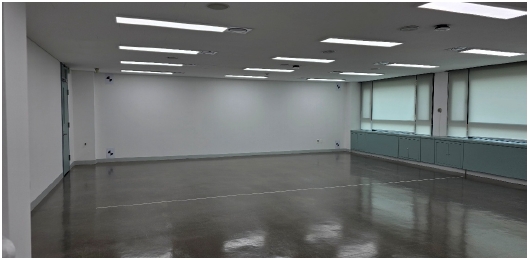
Korea University engineering building room 369
The indoor environment is controlled in terms of lighting and little change of atmosphere. Artificial ceiling lighting provided uniform lighting during the experiment, and no direct solar radiation fell on the targets. During the data acquisition the room was not inhabited except for the operator and thus minimized occlusions and dynamic disturbances. These conditions were monitored all the time to be sure that observed variations in registration behavior could be attributed mostly to scanning geometry and not to environmental noise.
Scanning targets downloaded from the REGISTAR 360 program were placed on an inside wall in the lecture room. The surface of the wall was covered with a consistent white coating to cover the wall, and a background for consistent target detection. The selection of a simple and planar mounting surface was made to ensure reliable visibility of the target in all configurations of the scan.
It should be noted that here the wall itself is not an evaluation object of this study. Rather, it is a stable support for the artificial targets used for the registration. By keeping the surface and the environment in constant condition, the effect of scanning geometry on target-based relative registration is isolated in the experiment.
All the scans were acquired using a Leica RTC 360 terrestrial laser scanner. The RTC 360 is a phase-based TLS widely used in architectural and engineering applications due to its rapid acquisition rate and compatibility with target-based registration workflows. This scanner was used for its suitable dense point cloud colletion in architectural-scales. Each scan was recorded using three dimensional Cartesian coordinates (X, Y, Z) and corresponding intensity values representing the returned laser signal strength.
For this study, a fixed set of instrument settings were used for all the scan configurations to ensure consistency. Scan resolution and quality parameters were chosen to provide adequate spatial sampling resolution for reliable target detection across short and long indoor scanning distances. No change of instrument configuration between scans were made between the scans.
Prior to acquisition of data, the RTC 360 is checked as per standard lab and manufacturer procedures. At the start of each measurement session, the scanner was switched on and left to warm up until internal operating conditions became steady.
The scanner was mounted on a rigid tripod with adjustable legs which offered several reproducible height configurations of the scanner. Before each scan, the instrument has been leveled by the in-built electronic leveling system supported by an integrated inertial measurement unit (IMU) sensor, which continuously tracks scanner orientation and applies tilt compensation to ensure horizontal alignment of the acquired data. Mechanical stability of the tripod and scanner was carefully maintained during the scan acquisition.
3.2. Scan Geometric Setup
Scanning distance was defined as horizontal standoff between scanner and wall mounted targets and two distances were selected. A condition of 5m was used for typical short range indoor survey conditions, while 10m was used for typical longer indoor distance limited by room geometry. These distances were chosen to evaluate the influence of scanner-to-target range and corresponding variations in laser incidence angle on target observation stability, followed by the assessment of relative registration under geometrically identical but spatially shifted scanner positions.
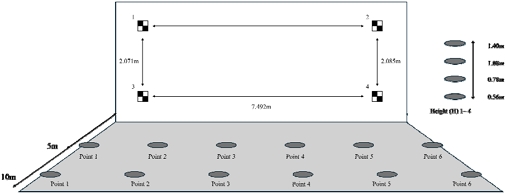
Wall scan setting setup
Scanner height was varied by adjusting four discrete tripod settings denoted as H1 through H4 from lowest height to highest. These height levels were chosen to reflect realistic choices by the operator during indoor surveys and include levels ranging from lower positions to high positions.
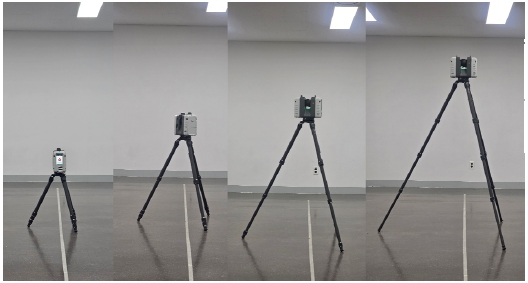
LiDAR RTC 360 height setup (H1-H4)
Scanner height affects mostly the vertical component in the observation geometry and may have an impact on the angular distribution of light incidents on targets. The experiment involves varying height to determine if such effects are an appreciable cause of relative registration.
A series of six scan positions were defined along the lecture room roughly parallel to the target - mounted wall. These positions are marked P1 to P6 running from near one end of the wall to the other. Moving the scanner in the lateral direction around the room changes the viewing geometry and effective observation angles to the targets. By combining different scan positions with two distances and four heights the experiment produces a structured set of scan geometries that is a representation of practical indoor TLS survey situations.
3.3. Framework for Target Configuration and Registration
Four artificial targets were installed on the interior wall in a rectangular configuration covering a substantial portion of the measurement area. The targets were positioned to ensure visibility across all scan positions, distances, and scanner heights considered in the experiment. The target center points were used as reference locations to evaluate registration consistency across different scanner positions, while simultaneously supporting target-based registration. This setup was designed to assess both relative registration and the practical feasibility of target-based registration workflows under realistic indoor scanning conditions. No other targets or natural features were used for the alignment.
Registration was done using centroids of the four targets detected in each scan. Within each experimental run, scans were aligned into a common local coordinate system by selecting one scan as the reference and aligning all other scans to it. No external control points were employed as the objective of the study was to assess relative registration behavior rather than absolute positioning accuracy. The consistency of the registration results was evaluated by comparing the coordinate differences of the same physical targets between scans after registration.
3.4. Data Aquisition Method
The experiment was performed in three separate runs, which were labelled T1, T2, and T3. Each run had the same scan configuration protocol, an identical target layout, instrument settings, and fixed definitions of scan geometry. Within each run, the scanner was moved successively to the predefined scan positions (P1-P6), the stand-off distance was set at either 5m or 10m and scans were taken at each of the four scanner heights (H1-H4) before the scanner moved to the next scan position and the procedure was repeated.
3.5. Registered Data Analysis
All scans were imported into the Leica Cyclone REGISTER 360. A target recognition program within REGISTER 360 was used to automatically identify the targets in every scan. Target-based registration was then carried out separately for each acquisition run (T1–T3) using the identified centroid coordinates of these markers. Where appropriate, a minor refinement step was applied to improve alignment stability by aligning each scan by scan angle, height and position.
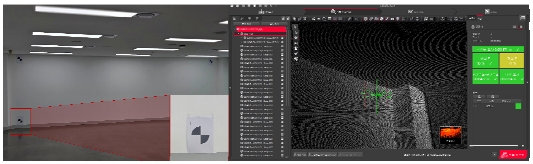
LiDAR target setup and recognition via REGISTER 360 PLUS
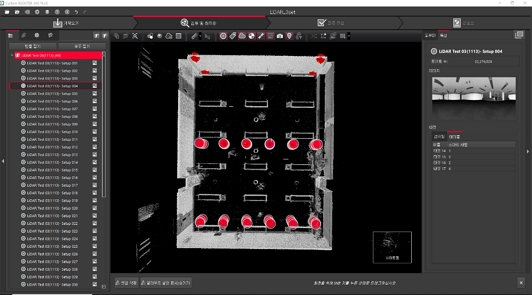
Cyclone REGISTER 360 PLUS scanning data
The research focused on evaluating the relative behavior of target-based registration using target-centric measures and did not assess absolute geometric fidelity, surface accuracy, or wall-inferred error, but instead examined geometry-driven variation in target centroid estimates. Because the registration workflow is based on centroid consistency, the analysis was performed by comparing the centroid coordinates of targets across registered scans to examine variations in registration outcomes. For each scan, the centroid of each target was represented by a three-dimensional coordinate vector .
| (Eq. 1) |
The vector was obtained through automatic target recognition following target-based registration, where i denotes the target index and s scan configuration index within an experimental run. No external reference frames or ground-truth coordinates were used. For any two registered scans s and t, the displacement of the same physical target was defined as the Euclidean distance between the corresponding target centroids to quantify relative centroid variation between scan configurations.
| (Eq. 2) |
This displacement represents the relative positional difference of the same physical target between two scan configurations after registration. Comparisons were performed within each experimental repetition. All valid target displacements across scan pairs, targets, and repetitions were pooled to form the analysis dataset. In total, displacement observations were obtained, where each observation corresponds to one target displacement derived from a specific scan pair.
For analyses evaluating the relative stability of individual scan configurations, each scan was temporarily treated as a base scan and compared against all other scans within the same repetition. The pooled mean target displacement was used solely for comparative ranking of scan stability and does not imply absolute accuracy. All reported metrics therefore quantify relative registration behavior and should not be interpreted as absolute ranging accuracy, wall accuracy, or surface-based geometric error.
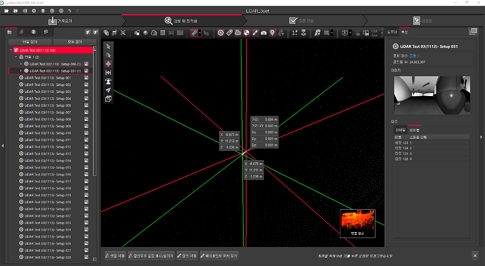
Cyclone REGISTER 360 PLUS 2 point comparison
3.6. Experiment Control
All scan configurations that were specified in the experimental design were successfully acquired and registered using the target-based workflow. No scans were excluded because of failure to register, excessive target residuals or target detection errors. Inspection of registration residuals showed stable alignment performance at all scan positions, distances, and heights and illustrated the fact that the entire data set met basic quality requirements for analysis.
To enable a focused investigation of cause–effect relationships between scanning geometry and registration consistency, a geometrically representative subset of scan positions was selected for detailed comparison. Of the six lateral scan positions established at each distance, four positions were retained at both 5m and 10m stand-off distances. These positions were located along the edge and near the center of the wall on which the targets were mounted, encompassing both symmetric and off-axis viewing conditions. The subset was defined a priori based on geometric representativeness and was not selected according to data quality considerations.
Scans not included in this subset were not excluded because of quality concerns but were excluded from the focused analyses because of the redundancy and difficulty in interpreting distance and position related effects. All results reported are therefore based on scans acquired to identical acquisition and registration criteria and the observed differences are therefore possible due to controlled geometric variation and not selective filtering.
4. Results
4.1. Overview of Data and Registration Consistency
The dataset is a set of repeated scans taken under three experimental repetitions (T1–T3) that combine two distances (5 m and 10 m from the scanner), four scanning heights, and six lateral scan positions defined along the target-mounted wall. Registration behavior was analyzed by comparing target-based displacement values between scans within each repetition, using the defined displacement metric.
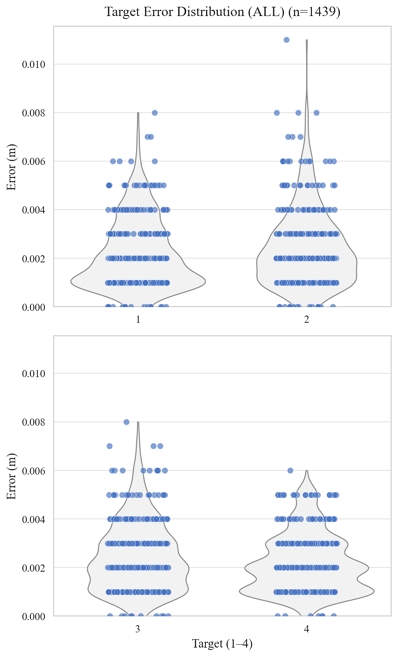
Distribution of registration error by target
For focused analysis of the geometric effects, a geometrically representative subset of scan positions was used with the definition found in the 6 lateral positions that could be had at different distances, 4 positions (P1, P3, P4 and P6) were chosen at each of the 5 meters and 10 meters standoff distance. Such positions capture edge and near center viewing geometries without redundant intermediate configurations.
All pairwise target displacement observations determined from this subset were preserved. For the three repetitions, this led to a total of 1,439 pairwise target-based displacement observations, in which each observation corresponds with the displacement of a target between a specific scan combination. No scan or repetition was excluded based on the quality of registration, and all the scans included in the analysis meet the same acquisition and registration conditions.
Registration quality was first checked to ensure that later patterns of error did not result from registration artefacts such as misalignment. No repetition (T1–T3) exhibited systematically larger residuals compared to others, indicating comparable registration conditions across experimental runs.
Cloud-to-cloud residual inspection revealed greater dispersion than target residuals did but did not reveal any spatially localized misregistration patterns associated with the position or height of individual scans. No spatially concentrated error patterns or systematic alignment offsets were observed across scan locations. These results demonstrate that the observed displacement patterns reflect acquisition geometry and relative scan configuration, rather than indicating registration failure.
For all the scan configurations and repetitions, target-based measurements of displacement magnitudes were right skewed, with displacement values defined as non-negative magnitudes, and most observations being less than 4mm. This skewness indicates that small displacement values dominate the dataset while a limited number of larger deviations form the upper tail of the distribution, rather than indicating directional bias in registration. Inspection of the violin plots confirms that although median displacement values are consistent across targets, the upper tails vary slightly, reflecting occasional higher values rather than systematic target-dependent bias.
Importantly, no target exhibits a clearly dual-peaked or irregular distribution pattern, indicating the absence of competing alignment states or unstable registration outcomes, which supports the use of pooled target data for subsequent geometric factor analysis.
Although minor differences in dispersion were observed among targets, the median values and interquartile ranges largely overlapped. This suggests that target identity does not constitute a dominant source of variability. Therefore, differences in target response levels are considered secondary compared with scan geometry parameters (distance, lateral position, etc.).
4.2. Impact of Scanning Distance
When aggregated across all heights and scan positions, the 10m scanning condition exhibits higher median and mean target-based displacement values than the 5m condition, indicating greater centroid variation at longer scanner-to-target distances.
Box-and-strip plot analysis shows that this difference is primarily driven by increases in the upper-range values rather than by a uniform shift of the entire distribution. At 5m, the displacement distribution is more compact, with a narrower interquartile range and fewer extreme values. At 10m, dispersion increases, reflecting reduced centroid stability under longer-range acquisition.
Distance effects are not uniform across all scan positions. At central scan positions, the contrast between 5m and 10m is pronounced, whereas at edge positions the displacement distributions at both distances become more similar. This observation suggests that the scanner-to-target distance interacts with positional configuration, reducing the distinct separation between the two nominal distance settings.
Furthermore, the influence of scanning distance on registration consistency cannot be interpreted independently of scan position, as scan position strongly affects the effective distance between corresponding target observations. The results therefore indicate that distance remains the dominant factor in short lateral scan configurations, with distance-related effects manifested through systematic centroid displacement patterns.
4.3. Impact of Scanning Distance
Error distributions among the four scanner heights are large in the median values and dispersion. No monotonic increase or decrease of target-based displacement with increasing the height of the scanner is observed.
Stability rankings further show that both relatively and less stable base scans are predicted at multiple height levels, which leaves the scanner height into question as a reliable predictor of relative registration in isolation.
Across the four levels of the scanner heights, no systematic trend of target-based displacement magnitude is determined. Distributions of values of displacement overlap significantly between height configurations, and both the lower and higher dispersion cases occur at different height levels. This pattern suggests that the influence of scanner height is neither consistent nor directional in terms of centroid displacement patterns under the configuration tested in this study.
In relation to the effects of scanning distance and scan position, the variability in height remains secondary and does not become a major factor in target centroid variation. These results indicate that, within a normal indoor survey range, there is not a significant change in viewing geometry due to scanner height which produces a measurable and systematic effect on target-based relative registration.
4.4. Effects of Scan Position and Viewing Angle
Target-based displacement distributions vary across the six horizontal scan positions. The central scans exhibit higher median displacement values, and greater dispersion amongst each scan. In contrast, the scans conducted in the edge consistently exhibited lower median values and tighter distributions. However, This pattern should not be interpreted as evidence that non-central scans are more stable, but rather because the positioning of the scanner and the target align with each other.
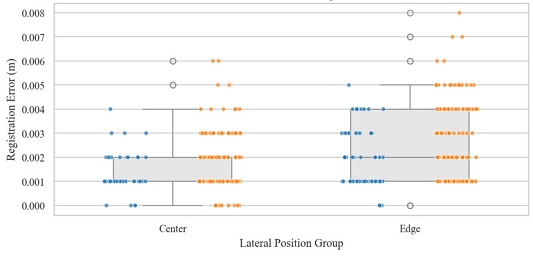
Effect of lateral scan position on registration residual
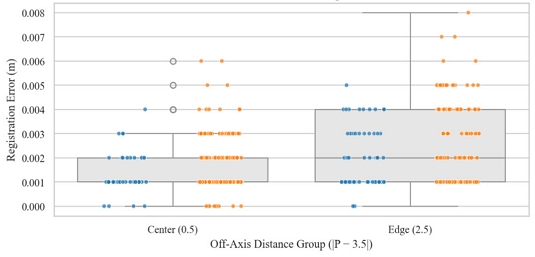
Effect of off-axis distance from scan center on registration residual
When scan positions are stratified into discrete positional categories, a monotonic decrease in displacement magnitude for individual targets is observed as the scanner moves toward the periphery. This pattern does not indicate the existence of a critical viewing angle or an optimal horizontal configuration. Rather, the gradual reduction in displacement arises from continuous changes in the distribution of scanner-to-target distances and associated incidence conditions resulting from lateral scanner movement, rather than from any inherent geometric advantage of non-central viewing configurations.
To further evaluate the relative performance of individual scan configurations, each scan was treated as a reference scan and compared with all other scans. Fig. 10. ranks scan configurations according to the mean target-based displacement across all comparisons. The results indicate that scans acquired at moderate horizontal positions away from the center consistently exhibit lower pooled displacement values, whereas centrally positioned configurations, particularly at longer distances, tend to act as less stable references. These differences can be attributed to the fact that horizontally shifted configurations reduce the effective scanner-to-target distance for a subset of targets, thereby improving centroid consistency, rather than reflecting any inherent geometric advantage of non-central positioning.
Overall, the results allow concluding that the scan positions have strong impact on target centroid displacement behavior. However, this effect is indirect and mainly mediated by distance whereby the scan position acts as a proxy that distorts the distribution of effective scanner-target ranges instead of being an independent geometric stabilizing factor.
4.5. Effects of Scan Position and Off-Axis Geometry
Interaction is weak between distance and height of the scanner. Height does not have an effect of systematically amplifying or beneath down distance (related error). This confirms that distance effects remain relatively independent from the elevation of the scanner within a range that was tested.
A regular trend which indicates interaction between the distance and the position of the scan is found. At 10m, mean error and variance are greater at central scan positions and reduced by much at edge positions. At 5m this positional contrast still exists but not as great.
This implies that distance-dependent degradation is more pronounced at center scan positions, while displacement magnitudes are reduced at edge positions due to changes in the scanner–target distance distribution.
Base scan stability rankings show that different scans do not perform equally well when used as the reference against which other scans are aligned. Some scan configurations consistently produce lower pairwise discrepancies across all comparisons, whereas others result in comparatively larger alignment differences.
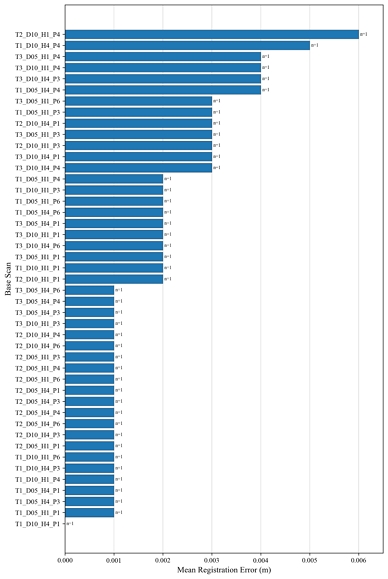
Base scan stability ranked by mean registration residual
The mean error heatmap also shows that scan comparability is a relative - not an absolute - measure: a scan very well correlated with one scan may not be so correlated with another. This type of structured, non-uniform pattern points out the importance of assessing the quality of a scan by pairwise diagnostics even with global averages.
The results show that scan position and distance are the main forces affecting target-based relative registration whereas the height of the scanner has a negligible role. Therefore scan positions conditions how distance effects are shown, primarily through differences in effective scanner-to-target distance, rather than representing an inherent off-axis stability advantage.
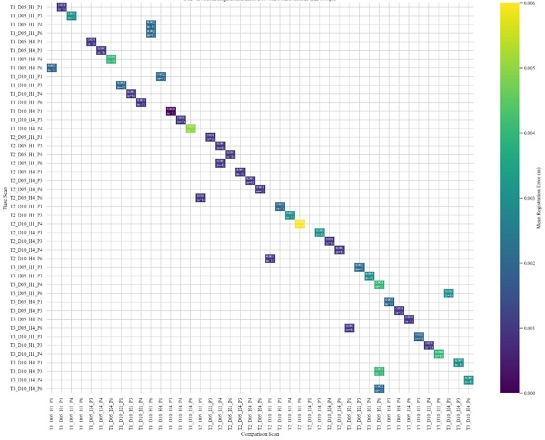
Heatmap of pairwise mean registration residual between scan positions
5. Discussion
5.1. Interpretation with Respect to Previous Research
The results are in line with previous work in the TLS literature, which shows that scanning distance and viewing configuration are primary determinants of centroid displacement behavior and ranging stability. Increased scanning distance enlarges the laser footprint and limits the effective sampling density in a manner that has been demonstrated to increase residual variability. In this study, target-based displacements were consistently larger at 10m than at 5m, with the difference being more pronounced at centrally positioned scan configurations, which aligns with the distance-related trends reported in prior studies.
The monotonic decrease in displacement magnitude with increasing horizontal shift from the central position is consistent with previous studies reporting geometry-driven behavior rather than discrete angular threshold effects. However, the results show that this trend can be interpreted as a distance-related effect rather than an axis-dependent effect. In the current experimental setup, this monotonic pattern can largely be interpreted as a distance-mediated effect, because horizontal scan position changes the effective distribution of scanner–target distances to the mounted targets, rather than reflecting an inherent benefit of non-central viewing configurations. Configurations positioned moderately away from the center are also likely to produce less symmetric ranging uncertainty and may yield reduced displacement when effective scanner–target distances are shorter, thereby improving target centroid consistency in relative measurements.
Differences from some previous studies can be explained by the controlled indoor environment and the use of the uniform planar wall. The lack of material variability and environmental disturbances makes the geometric effects come out clearly, which most likely is one of the reasons for the small displacement ranges observed and the negligible impact of scanner height. Overall, these geometry-based results indicate that acquisition configuration directly affects the stability of the data.
5.2. Implications for Plan of Architectural Scan
For registration of planar surface documentation workflows based on target-based registration, scanning distances should be as short as possible because increasing distances increase target centroid displacement and reduce relative registration consistency, especially for near normal incidence. Nevertheless, the results suggest that distance-related degradation can be taken care of by ensuring reduced effective scanner–to-target distance, of which lateral scan positioning may be one contributing factor in planar, limited indoor environments.
Scanner height in the range tested does not reveal any systematic effect on the variation of target centroid displacement, suggesting that height may be selected for practical reasons, e.g. accessibility and safety, without losing stability. These findings emphasize the value of incorporating lateral and angular diversity in the planning of scan within feature poor environments from the inside.
For Physical AI applications, the implications indicate that scan planning strategies should account for geometry based registration and stability in order to maintain reliable spatial data as an input source for perception and automation pipelines.
5.3. Limitation and Sources of Uncertainty
This study is confined to one interior wall with uniform reflectance, limiting the generalization to other materials and textured surfaces. Instrument-specific characteristics and operator-dependent placement may affect the absolute magnitude of the displacement, although the relative trends remain comparable. The limited number of repetitions also constrains statistical inference, and the magnitude of the observed effects should therefore be interpreted with caution.
Future work should expand this framework to varied surface materials and outdoor environments to determine how robust the observed geometric effects are in more heterogeneous environments.

Summary of geometric effects on data registration
6. Conclusion and Key Findings
6.1. Key Findings
This experiment systematically investigated the relationship between scanning range, scanner elevation, and scanner location with respect to the variation of target centroid displacement in target-based registration in a controlled indoor terrestrial laser scanning (TLS) setup. Across a succession of repeated acquisitions, scanning distance and lateral scan position emerged as the dominant determinants of target displacement, whereas differences in scanner height did not display any systematic impact within the parameter range examined.
Specifically, as scanning distances increased, both the magnitude of displacement and its dispersion increased, as expected from distance-related degradation in the stability of target centroid estimation. On the other hand, introducing a scan configuration that reduces the effective scanner–to-target distance for a subset of targets resulted in a monotonic reduction in displacement, suggesting that the observed reduction is primarily driven by shorter effective range under highly controlled indoor conditions.
These findings highlight that target centroid displacement variability is primarily governed by structured acquisition geometry, rather than by random alignment artefacts associated with target registration. In addition, they demonstrate that lateral scan configuration, which has been relatively underexplored in architectural-scale TLS literature, plays a centroid-stabilizing role and is of practical importance.
From the perspective of Physical AI, the results highlight why sensor working conditions are not limited to technical acquisition parameters, but primary control variables that are responsible for the reliability of embodied spatial perception and data-driven environmental intelligence. The sensitivity of the scanning distance position can show directional affect towards the spatial consistency of both training and data collection used by Physical AI systems, which influences long-term stability and cumulative learning performance.
6.2. Practice and Viewpoint Recommendations
In indoor architectural TLS surveys based on target-based registration, shorter scanning distances should be prioritized whenever possible. This approach reduces target centroid variability and, in turn, improves relative registration consistency.
For Physical AI applications, these findings further indicate that standardized sensor implementation guidelines and geometry-aware scan planning strategies should be incorporated into the data acquisition method to provide stable spatial input quality for AI-driven perception and automation systems.
Scanner height should primarily be selected based on practical constraints such as line-of-sight clearance and obstacle avoidance, as empirical results indicate that variations in scanner height exert a negligible influence on target centroid displacement behavior under controlled indoor conditions.
Although the experimental conditions of this research were controlled and thus enable clear isolation of geometric effects, further studies are required to determine the applicability of these findings to more complex indoor geometries, heterogeneous material conditions, and alternative registration strategies. Nevertheless, the geometry-driven trends identified in this study provide practical implications for scan planning and for improving centroid stability and displacement control in indoor target-based TLS applications. These results further suggest that geometry-aware sensor operation should be supported by a data foundation suitable for Physical AI system use and integration in built environments.
References
-
A. Aryan, F. Bosché, P. Tang, Planning for terrestrial laser scanning in construction: A review, Automation in Construction, 125, 2021, 103551.
[https://doi.org/10.1016/j.autcon.2021.103551]

-
P. Bauer, H. Woschitz, Laboratory investigations of the Leica RTC360 laser scanner—Distance measuring performance, Sensors, 24, 2024, 3742.
[https://doi.org/10.3390/s24123742]
-
B. Becerik-Gerber et al., Assessment of target types and layouts in 3D laser scanning for registration accuracy, Automation in Construction, 20, 2011, pp.649-658.
[https://doi.org/10.1016/j.autcon.2010.12.008]
- T. Chan et al., Optimization of the use of spherical targets for point cloud registration using Monte Carlo simulation, Journal of Geodesy and Geoinformation Science, 7(2), 2024, pp.18-36.
-
L. Fan et al., Error in target-based georeferencing and registration in terrestrial laser scanning, Computers & Geosciences, 83, 2015, pp.54-64.
[https://doi.org/10.1016/j.cageo.2015.06.021]
-
J. Janßen, H. Kuhlmann, C. Holst, Target-based terrestrial laser scan registration extended by target orientation, Journal of Applied Geodesy, 16(2), 2022, pp.91-106.
[https://doi.org/10.1515/jag-2020-0030]
-
Z. Ji et al., Accurate and robust registration of high-speed railway viaduct point clouds using closing conditions and external geometric constraints, ISPRS Journal of Photogrammetry and Remote Sensing, 106, 2015, pp.55-67.
[https://doi.org/10.1016/j.isprsjprs.2015.04.016]
-
S. Kaasalainen et al., Analysis of incidence angle and distance effects on terrestrial laser scanner intensity: Search for correction methods, Remote Sensing, 3, 2011, pp.2207-2221.
[https://doi.org/10.3390/rs3102207]
-
T.P. Kersten, M. Lindstaedt, Geometric accuracy investigations of terrestrial laser scanner systems in the laboratory and in the field, Applied Geomatics, 14, 2022, pp.421-434.
[https://doi.org/10.1007/s12518-022-00442-2]
-
K. Kregar, D. Grigillo, D. Kogoj, High precision target center determination from a point cloud, ISPRS Annals of the Photogrammetry, Remote Sensing and Spatial Information Sciences, II-5/W2, 2013, pp.139-144.
[https://doi.org/10.5194/isprsannals-II-5-W2-139-2013]
-
G. Lenda et al., Accuracy of laser scanners for measuring surfaces made of synthetic materials, Photogrammetrie, Fernerkundung, Geoinformation, 5, 2015, pp.357-372.
[https://doi.org/10.1127/pfg/2015/0273]
-
J. Markiewicz et al., The reliability assessment of the TLS registration methods: The case study of the Royal Castle in Warsaw, The International Archives of the Photogrammetry, Remote Sensing and Spatial Information Sciences, XLIII-B2-2021, 2021, pp.855-861.
[https://doi.org/10.5194/isprs-archives-XLIII-B2-2021-855-2021]
-
T. Medić et al., Empirical stochastic model of detected target centroids: Influence on registration and calibration of terrestrial laser scanners, Journal of Applied Geodesy, 13(3), 2019, pp.179-197.
[https://doi.org/10.1515/jag-2018-0032]
-
J. Pandzic et al., Error model of direct georeferencing procedure of terrestrial laser scanning, Automation in Construction, 78, 2017, pp.13-23.
[https://doi.org/10.1016/j.autcon.2017.01.003]
-
P. Rachakonda, B. Muralikrishnan, D. Sawyer, Metrological evaluation of contrast target center algorithm for terrestrial laser scanners, Measurement, 134, 2019, pp.15-24.
[https://doi.org/10.1016/j.measurement.2018.08.039]
- S. Soudarissanane et al., Error budget of terrestrial laser scanning: Influence of the incidence angle on the scan quality, The International Archives of the Photogrammetry, Remote Sensing and Spatial Information Sciences, 2009.
-
S. Soudarissanane et al., Scanning geometry: Influencing factor on the quality of terrestrial laser scanning points, ISPRS Journal of Photogrammetry and Remote Sensing, 66(4), 2011, pp.389-399.
[https://doi.org/10.1016/j.isprsjprs.2011.01.005]
-
D. Wujanz et al., A comparative study among three registration algorithms: Performance, quality assurance and accuracy, The International Archives of the Photogrammetry, Remote Sensing and Spatial Information Sciences, XLII-2/W9, 2019, pp.779-786.
[https://doi.org/10.5194/isprs-archives-XLII-2-W9-779-2019]
-
D. Wujanz, D. Krueger, F. Neitzel, Identification of stable areas in unreferenced laser scans for deformation measurement, The Photogrammetric Record, 31(155), 2016, pp.261-280.
[https://doi.org/10.1111/phor.12152]
-
C. Wu et al., Application of terrestrial laser scanning (TLS) in the architecture, engineering and construction (AEC) industry, Sensors, 22(1), 2022, 265.
[https://doi.org/10.3390/s22010265]
-
A. Yaman, H.M. Yılmaz, The effect of object surface colors on terrestrial laser scanners, International Journal of Engineering and Geosciences, 2(2), 2017, pp.68-74.
[https://doi.org/10.26833/ijeg.296835]
- M. Zamecnikkova et al., Investigation on the influence of the incidence angle on the reflectorless distance measurement of a terrestrial laser scanner, Journal of Geodesy, Cartography and Cadastre, 2015, pp.37-44.
-
M. Zamecnikkova et al., Influence of surface reflectivity on reflectorless electronic distance measurement and terrestrial laser scanning, Journal of Applied Geodesy, 8(4), 2014, pp.311-325.
[https://doi.org/10.1515/jag-2014-0016]
-
J. Qiao et al., Automatic extrinsic calibration of terrestrial laser scanner and digital camera by MoG image correlation, International Journal of Applied Earth Observation and Geoinformation, 119, 2023, 103315.
[https://doi.org/10.1016/j.jag.2023.103315]
-
J. Janssen et al., Decreasing the uncertainty of the target center estimation at terrestrial laser scanning by choosing the best algorithm and by improving the target design, Remote Sensing, 11, 2019, 845.
[https://doi.org/10.3390/rs11070845]
- D.D. Lichti et al., Calibration and testing of a terrestrial laser scanner, International Archives of Photogrammetry and Remote Sensing, XXXIII(B5), 2000, p.485-492.
- S. Soudarissanane, R. Lindenbergh, B. Gorte, Reducing the error in terrestrial laser scanning by optimizing the measurement set-up, The International Archives of the Photogrammetry, Remote Sensing and Spatial Information Sciences, XXXVII(B5), 2008, p.615-620.
- M. Yakar, H.M. Yılmaz, O. Mutluoǧlu, Comparative evaluation of excavation volume by TLS and total topographic station based methods, Lasers in Engineering, 19, 2010, pp.331-345.