
A Comparative Analysis of Constrained Adaptive Model Predictive Control by Use of Four Different Component Groups
ⓒ 2026. KIEAE all rights reserved.
Abstract
Improving building energy efficiency while maintaining occupant thermal comfort is an important challenge in building thermal control. Conventional control methods generally respond to current indoor conditions and may result in repeated corrective operation without considering future building states.
A one-year simulation was conducted using a 15-min time step under the same building and environmental conditions for both models. The proposed model predicts building conditions over a four-step horizon and selects the minimum-energy feasible control trajectory subject to indoor environmental constraints. Four groups of control variables were considered: supply-air mass flow and temperature, indoor temperature and humidity setpoints, motorized blind opening, and ventilation flow rate. Energy consumption and thermal comfort were evaluated using Energy Use Intensity and thermal comfort performance indicators.
The results show that annual Energy Use Intensity decreased from 108.24 to 70.80kWh/m2·yr, corresponding to approximately 34.6% energy reduction compared with the baseline model. During working hours, the energy use decreased by approximately 33.1%, and the yearly comfort index also decreased from 0.83 to 0.67, indicating improved control consistency. These results demonstrate that the predictive and coordinated control characteristics of the proposed model can reduce building energy consumption while maintaining control performance under thermal-comfort constraints.
Keywords:
Energy Use, Thermal Comfort, MPC, Group Control, Adaptive Model1. Introduction
1.1. Background
The building sector is increasingly recognized as a critical domain for reducing energy consumption and greenhouse gas emissions while simultaneously maintaining healthy and thermally comfortable indoor environments. Buildings require energy for a wide range of functions, including heating, cooling, ventilation, lighting, domestic hot water, and auxiliary services. Among these end uses, Heating, Ventilation, and Air-Conditioning (HVAC) systems are particularly important because their operation is strongly coupled with outdoor weather conditions, building envelope characteristics, occupancy behavior, and indoor environmental requirements. Reviews of building energy and HVAC research consistently identify HVAC operation and control as important opportunities for improving building energy performance. The challenge, however, is not simply to reduce HVAC energy consumption [1~3]. A reduction in energy use obtained by allowing excessive indoor temperature or humidity deviations would not necessarily represent an improved building operation. Instead, energy efficiency should be considered together with the thermal conditions experienced by occupants. This creates an inherently multi-objective control problem in which energy consumption and thermal comfort can be competing objectives [4,5].
Traditional HVAC control strategies generally rely on predefined rules, thermostatic control, proportional-integral-derivative (PID) control, or sequences of operation developed for specific equipment configurations. Such approaches remain highly relevant because of their simplicity, robustness, and ease of implementation. Contemporary building automation systems also increasingly employ standardized high-performance sequences. For example, ASHRAE Guideline 36 was developed to provide optimized control sequences intended to reduce energy use while maintaining comfort and indoor air quality [6,7]. Nevertheless, rule-based control has an inherent limitation: the controller generally responds to the current state of the building rather than explicitly optimizing future system behavior. A building is a dynamic system with significant thermal inertia. Consequently, a control action taken at the current time step may affect indoor temperature, humidity, HVAC load, and energy consumption several hours later. A controller that considers only the instantaneous error may therefore fail to exploit the thermal storage capacity of the building.
Model Predictive Control (MPC) provides an alternative approach. MPC uses a dynamic model of the controlled system to predict future states and determines control actions by solving an optimization problem over a future prediction horizon. The control action at the current timestep is then implemented, after which the prediction and optimization can be iterated by updating the system states update. This receding-horizon principle allows MPC to explicitly address future disturbances, operational constraints, and multiple competing objectives [8,9]. Recent research indicates that MPC has become increasingly relevant to building HVAC applications because modern building automation systems have greater computational capability and access to larger quantities of monitoring and weather data. A recent systematic review of 245 studies on predictive HVAC control identified continued development of both model-based MPC and model-free predictive control, with particular attention to model simplification, computational efficiency, nonlinear control, and real-time implementation [10,11].
1.2. Research Objectives
The study focuses on four groups of controllable building components: supply-air mass flow rate and supply-air temperature; indoor thermostat and hygrostat setpoints; motorized blind opening; mechanical ventilation flow rate. The principal objective is not to demonstrate a universally optimal controller, but to establish a transparent and reproducible simulation framework for determining whether predictive, constraint-aware control can reduce energy consumption without compromising thermal comfort. The objectives of the study are therefore defined as follows.
- 1) Develop a baseline building thermal control model that predicts indoor temperature, relative humidity, PMV, PPD, HVAC energy consumption, and actuator behavior at a 15-min resolution.
- 2) Develop a CA-MPC controller using the same building model and the same external and internal boundary conditions.
- 3) Incorporate thermal comfort constraints into the optimization process such that energy reduction cannot be obtained by violating predefined comfort limits.
- 4) Evaluate the effect of coordinated control of HVAC supply conditions, thermostat/hygrostat setpoints, solar shading, and ventilation.
- 5) Compare the baseline and CA-MPC models using annual energy consumption, indoor temperature, relative humidity, PMV, PPD, and actuator operating patterns.
The central hypothesis is that coordinated predictive control can achieve lower HVAC-related energy consumption than the baseline strategy while maintaining indoor temperature, relative humidity, and thermal comfort within predefined acceptable ranges.
2. Literature Review
2.1. Thermal Control in Buildings
The development of building HVAC control can broadly be interpreted as a progression from manually operated systems to thermostatic control, feedback-based automatic control, digital building automation, and predictive or optimization-based control [12,13]. Early HVAC systems were largely controlled through manual intervention or simple mechanical thermostats. The fundamental control principle was feedback: when indoor temperature deviated from a predetermined setpoint, heating or cooling capacity was adjusted. With the development of digital control, proportional, integral, and derivative control methods became increasingly common. These approaches improved responsiveness and reduced steady-state errors [14,15]. Modern Building Automation Systems (BAS) and Building Management Systems (BMS) have substantially expanded the number of variables that can be monitored and controlled. Current systems can coordinate air-handling units, variable-air-volume terminals, pumps, fans, dampers, valves, thermostats, lighting, shading, and ventilation systems. Demand-controlled ventilation (DCV) is one example of this development. Rather than maintaining a constant ventilation rate, ventilation can be adjusted according to occupancy or indoor air-quality requirements. ASHRAE research on CO2-based DCV has demonstrated the potential for substantial HVAC energy savings compared with conventional ventilation baselines while maintaining ventilation requirements [16,17]. These developments demonstrate that building control has progressively moved from controlling a single variable, typically indoor temperature, to coordinating multiple building systems.
Despite improvements in conventional feedback control, most conventional approaches remain fundamentally reactive. The controller observes the current state and responds to deviations. A building, however, exhibits dynamic behavior. Heat stored in walls, floors, furniture, and internal mass can influence indoor temperature long after the original disturbance has occurred. Solar radiation varies continuously, occupancy changes throughout the day, and outdoor temperature and humidity influence both sensible and latent loads [18~20]. In a typical MPC architecture, a dynamic model is used to predict the future state of the building. Weather, occupancy, and other disturbances may be incorporated into the prediction model. An optimization algorithm then identifies a future sequence of control actions. Only the first control action is implemented, and the optimization is repeated at the next control interval. ASHRAE describes MPC as a multivariable control strategy that combines a dynamic model [21~23], previous control actions, future disturbance information, and optimization over a receding horizon. This architecture is particularly attractive for buildings because it can simultaneously handle:
- 1) Multiple control variables
- 2) Operational constraints
- 3) Thermal comfort constraints
- 4) Future disturbances
- 5) Energy objectives
- 6) Thermal inertia
A major review of building MPC research similarly emphasizes that MPC can formulate energy consumption and thermal comfort as competing objectives while explicitly considering system constraints and disturbances.
2.2. Building Energy Modeling
The predictive capability of MPC depends strongly on the quality and computational efficiency of its internal model. Building models are commonly categorized as white-box, grey-box, and black-box models. White-box models attempt to represent the physical behavior of buildings using detailed physical descriptions of envelope construction, heat transfer, HVAC equipment, internal gains, solar radiation, and other phenomena. They can provide high physical fidelity but may require substantial computational effort. Grey-box models simplify the physical system using a limited number of physically meaningful parameters [24~26]. Resistance-capacitance (RC) network models are common examples. Black-box models instead derive system behavior primarily from measured data using statistical or machine-learning approaches. Artificial neural networks, support vector machines, Gaussian processes, and other data-driven approaches have been investigated for building prediction [24~26].
Recent reviews emphasize that the choice among white-box, grey-box, and black-box models is a fundamental design decision in MPC because prediction accuracy must be balanced against computational requirements. The present study adopts a simplified physics-based control-oriented model. This approach is appropriate for the current comparative simulation because the objective is to investigate the effect of the control strategy while maintaining transparency of the underlying engineering relationships.
2.3. Thermal Comfort as a Control Constraint
Energy minimization without explicit comfort constraints can produce undesirable control behavior. Consequently, thermal comfort has become an important component of building HVAC optimization. The index of the Predicted Mean Vote (PMV) provides a widely used analytical framework for evaluating thermal comfort. ISO 7730 specifies analytical methods for determining PMV and Predicted Percentage of Dissatisfied (PPD), and provides criteria for evaluating acceptable thermal environments [27,28]. The current ISO 7730:2025 edition explicitly addresses general thermal comfort and local discomfort. PMV depends on environmental and personal variables including air temperature, mean radiant temperature, air velocity, relative humidity, metabolic rate, and clothing insulation. PPD is subsequently derived from PMV and represents the predicted proportion of thermally dissatisfied occupants.
In optimization-based building control, thermal comfort can be incorporated in two principal ways. The first is a soft constraint, in which comfort violations are converted into penalties, and the second is a hard constraint, in which a candidate control solution is rejected whenever the predicted comfort state exceeds the permitted range. The latter approach is adopted in the present CA-MPC model because the primary research question is whether energy can be minimized without trading away thermal comfort.
3. Research Methodology
3.1. Overall Framework
The study employs a simulation-based comparative methodology consisting of two models developed using MATLAB/Simulink. The first model is the baseline model, which represents the conventional control strategy. The second model is the CA-MPC model, in which the controller is replaced while the principal building, weather, occupancy, comfort, and simulation conditions remain unchanged. The basic experimental structure is illustrated in Fig. 1.
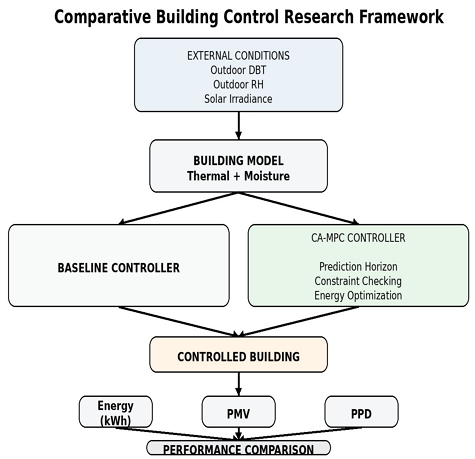
Overall framework for thermal controls
The model is implemented in MATLAB/Simulink using a MATLAB Function block for the building and control calculations. The simulation period is one full year (8,760 hours and 35,040 intervals, Δt=0.25h=15min). The use of a 15-min interval provides sufficient temporal resolution for evaluating HVAC operation, solar response, occupancy changes, ventilation control, and thermal comfort while keeping the annual simulation computationally manageable. The same timestep is used for both the models to ensure that the comparison is not influenced by differences in numerical resolution.
3.2. Model Inputs
The model contains 13 input variables in Table 1., which are maintained identically for both control strategies.

Model input variables
The building geometry is defined by width, length, and height. These variables determine the floor area, envelope area, window area, and indoor air volume. The outdoor dry-bulb temperature and relative humidity are supplied as time-varying signals. Solar irradiance is similarly provided as a time-varying external disturbance based on the JFK climate dataset. Occupancy is represented as an occupancy rate between 0 and 1. The model also incorporates metabolic rate and clothing insulation because thermal comfort depends not only on environmental conditions but also on occupant characteristics.
3.3. Building Thermal Geometry
The floor area is calculated as:
| (Eq. 1) |
The simplified external wall area is:
| (Eq. 2) |
A window-to-wall ratio is then applied:
| (Eq. 3) |
The conditioned indoor volume is:
| (Eq. 4) |
The conductive heat-transfer coefficient of the building envelope is represented by an aggregate thermal transmittance [29,30]:
| (Eq. 5) |
The corresponding envelope heat gain/loss is:
| (Eq. 6) |
A positive value represents heat transfer toward the indoor environment, whereas a negative value represents heat loss. This simplified formulation allows the building response to outdoor temperature to be represented without requiring a detailed multi-layer envelope model. Solar radiation is treated as an external disturbance that interacts with the window area and motorized blind position.
The solar heat gain is represented as [29,30]:
| (Eq. 7) |
where, Isol is solar irradiance, SHGC is the solar heat gain coefficient, B is the effective blind opening factor.
The blind therefore represents an active building-envelope control variable. In the CA-MPC model, the controller can reduce cooling demand by modifying the blind opening when solar radiation becomes significant. This is important because the blind is not treated merely as a visual-comfort device; it becomes an active component of the building thermal-energy control system.
Occupancy is defined as:
| (Eq. 8) |
where, O is the occupancy rate.
The sensible internal heat gain is approximated by:
| (Eq. 9) |
The model also considers occupant-generated moisture:
| (Eq. 10) |
Thus, occupancy affects both sensible heat and indoor humidity. This formulation is important for the present research because the controller is exposed to simultaneous thermal and moisture disturbances caused by changing occupancy. The indoor thermal state is represented using a simplified effective thermal capacitance [29,30]:
| (Eq. 11) |
The dynamic temperature equation can be expressed as:
| (Eq. 12) |
For discrete simulation:
| (Eq. 13) |
The thermal mass state is represented separately to capture delayed thermal response. This feature is particularly important for MPC because it provides the controller with a representation of the building’s thermal inertia. Ventilation affects both sensible heat transfer and moisture exchange. The sensible ventilation load is approximated by:
| (Eq. 14) |
where, V is the ventilation airflow rate.
| (Eq. 15) |
Outdoor humidity is represented using the humidity ratio. The indoor moisture balance is represented by:
| (Eq. 16) |
The corresponding indoor relative humidity is then calculated from indoor temperature and humidity ratio. This allows ventilation to become an active control variable rather than simply a fixed operating condition. The performance of the the HVAC control action is represented primarily through supply-air mass flow and supply-air temperature. The sensible HVAC heat transfer is [29,30]:
| (Eq. 17) |
where, is supply-air mass flow, Ts is supply-air temperature, cp is the specific heat of air.
The corresponding HVAC energy is estimated using an effective coefficient of performance:
| (Eq. 18) |
Fan power is represented as a nonlinear function of airflow:
| (Eq. 19) |
The ventilation fan power is similarly represented by:
| (Eq. 20) |
The total instantaneous power is therefore:
| (Eq. 21) |
For a 15-min timestep:
| (Eq. 22) |
Thermal comfort is evaluated using PMV (and PPD), and the PMV is calculated from: indoor air temperature, mean radiant temperature, relative humidity, air velocity, metabolic rate, clothing insulation. The PPD is obtained from PMV according to the standard PMV/PPD relationship:
| (Eq. 23) |
These limits are consistent with the conventional interpretation of acceptable thermal comfort associated with PMV/PPD-based evaluation. The methodology is formally specified by ISO 7730.
3.4. Thermal Control Algorithm
The baseline model represents a conventional adaptive control architecture. Its primary function is to maintain indoor environmental conditions within predetermined operating ranges while adjusting HVAC and associated building components. The baseline controller considers the current indoor and outdoor state and selects control actions accordingly. The model does not perform a multi-step optimization of future building states. The baseline controller therefore represents a reactive control paradigm [31~33]:
| (Eq. 24) |
where, xk is the current building state, dk is the current disturbance, uk is the control action.
The major advantage of this approach is computational simplicity. However, it does not explicitly evaluate the future consequences of a control decision. The proposed CA-MPC controller extends the baseline control structure by introducing a prediction horizon and constrained optimization. The control vector is [31~33]:
| (Eq. 25) |
These variables represent four control groups:
Group 1: Supply-air conditions
| (Eq. 26) |
Group 2: Indoor environmental setpoints
| (Eq. 27) |
Group 3: Solar shading
| (Eq. 28) |
Group 4: Ventilation
| (Eq. 29) |
This formulation allows multiple building subsystems to participate in the same optimization process. The CA-MPC objective is to minimize predicted energy consumption [31~33]:
| (Eq. 30) |
where, J represents a small actuator movement penalty.
The movement penalty is introduced only to prevent unnecessary control oscillation:
| (Eq. 31) |
Energy remains the dominant optimization objective. The controller is subject to the following constraints:
| (Eq. 32) |
The actuator constraints are also explicitly defined:
| (Eq. 33) |
The major setting values on the formulas are summarized in Table 2.
Major control setting values
An important distinction between the proposed CA-MPC and a conventional weighted-objective controller is that comfort is treated as a hard constraint. This means that a candidate producing lower energy consumption is not accepted if it causes a predicted comfort violation. Consequently, the optimization problem can be interpreted as: Minimize energy subject to thermal comfort feasibility. This structure directly reflects the principal research objective of reducing energy consumption without compromising occupant comfort.
Because the building control problem includes multiple variables, an exhaustive search over all possible combinations can become computationally expensive. The present CA-MPC therefore uses an adaptive local candidate strategy. Candidate values are concentrated around the previous control state, together with lower and upper operational boundaries. For example, supply-air mass flow candidates are generated around the previous value: . Equivalent adaptive candidate generation is applied to supply-air temperature, blind position, and ventilation flow. This strategy provides two advantages. First, it reduces computational burden compared with a full combinatorial search. Second, it promotes temporal smoothness because the optimal solution is searched preferentially near the previously applied control state. Although the controller predicts four future 15-min intervals, only the first control action is implemented. The overall operating process can be described in Fig. 2. This is the defining characteristic of MPC. The controller does not commit the building to the complete predicted control sequence. Instead, it continuously updates the optimal decision as new building states become available. Finally, the adaptive control loop and the ANN algorithm were integrated into a unified simulation framework using MATLAB and Simulink.
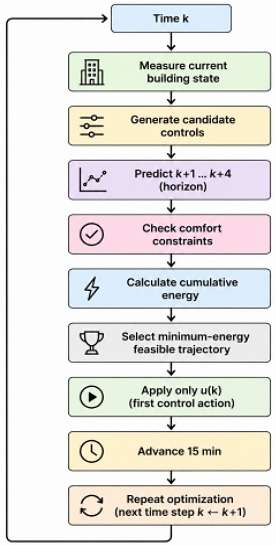
Operating principle of the proposed CA-MPC
4. Results
4.1. Characteristics of Controls
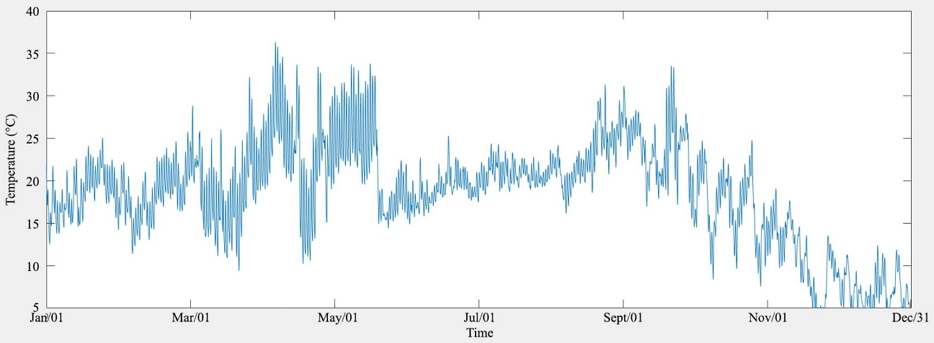
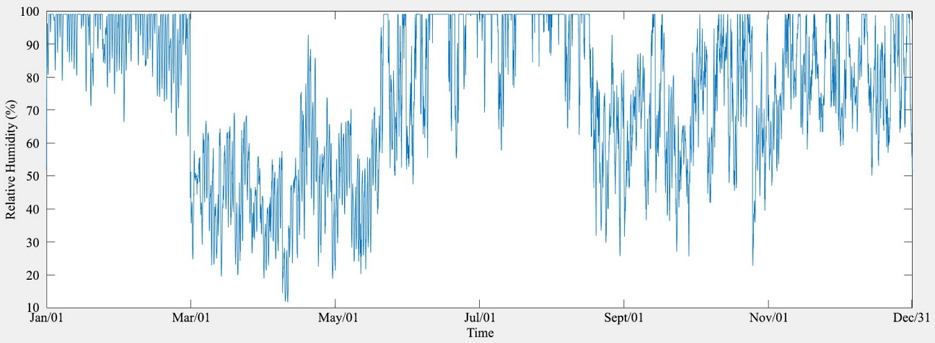
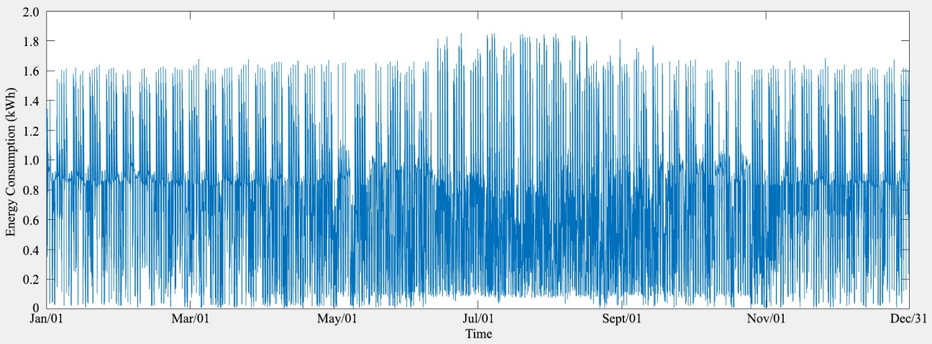
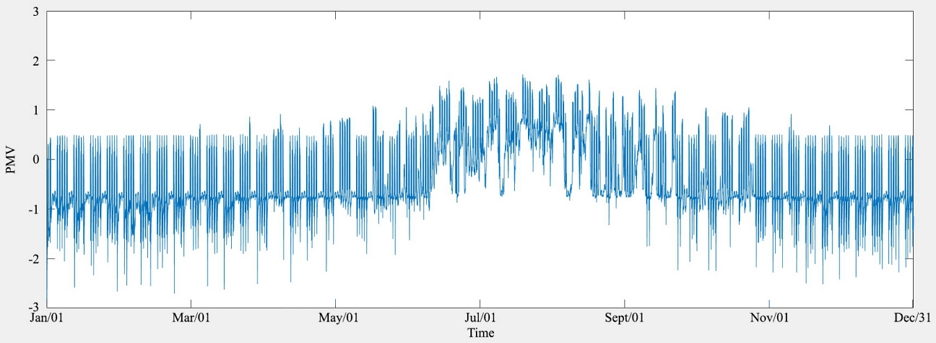
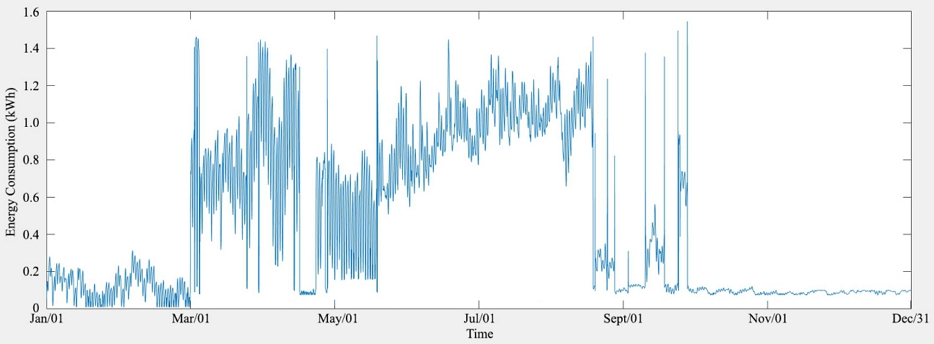
Both control models were simulated under the same building and environmental conditions. The main difference between the two models is therefore the control strategy. As indicated in Fig. 3., Fig. 4., Fig. 5., Fig. 6., the baseline model responds to the current building condition, whereas the CA-MPC model predicts the building response over the next four time steps and selects the lowest-energy feasible control trajectory. The baseline model shows frequent and repetitive fluctuations throughout the year, indicating continuous corrective HVAC operation. In contrast, the CA-MPC model shows a more variable but generally less intensive energy-use pattern, with periods of relatively low energy consumption when the predicted indoor conditions remain acceptable. Fig. 7. and Fig. 9. illustrate this difference. The CA-MPC model also coordinates four groups of control variables: supply-air conditions, indoor setpoints, blind opening, and ventilation flow rate.
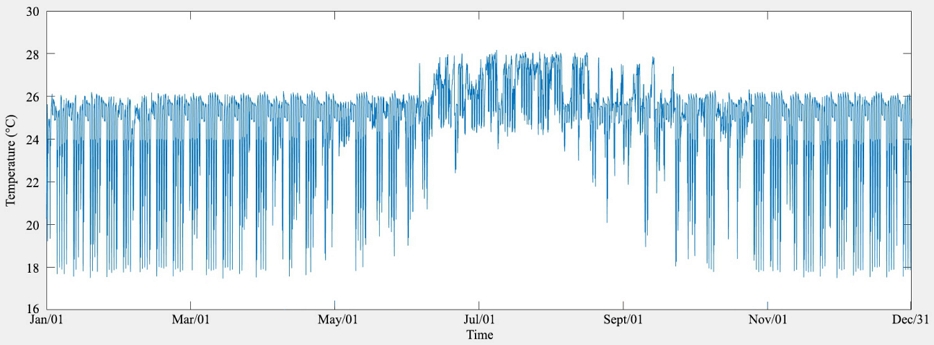
Temperature controlled by the baseline model
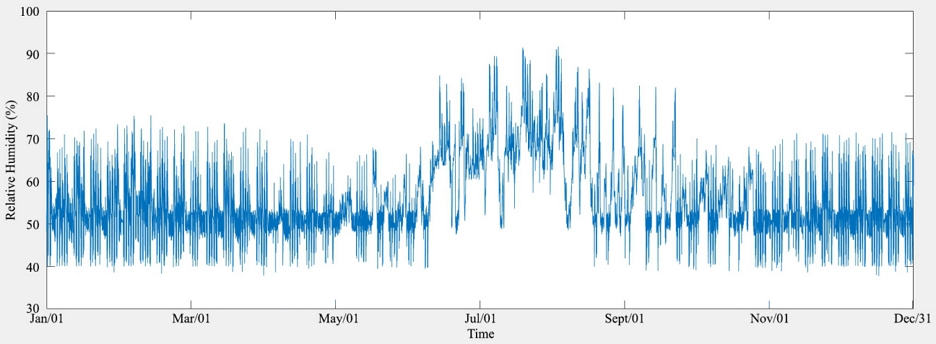
Relative humidity controlled by the baseline model
Temperature controlled by the CA-MPC model
Relative humidity controlled by the CA-MPC model
Energy consumption pattern from the baseline model
PMV pattern from the baseline model
Energy consumption pattern from the CA-MPC model
4.2. Performance of Controls
The numerical results in Table 3. demonstrate a substantial reduction in energy use with the CA-MPC model. During working hours, Energy Use Intensity decreased from 119.47 to 79.98kWh/m2·yr, corresponding to an approximately 33.1% reduction. For the full-year simulation, energy use decreased from 108.24 to 70.80kWh/m2·yr, corresponding to an approximately 34.6% reduction. The similar reduction observed for working-hour and annual operation indicates that the energy-saving effect was not limited to a specific operating period. Fig. 9. also shows that CA-MPC can maintain relatively low energy use during periods when the building does not require strong thermal conditioning. This result is consistent with the predictive structure of CA-MPC. Rather than reacting only to an existing indoor-condition deviation, the controller evaluates future conditions and avoids unnecessary energy use when the predicted state remains within the acceptable range. Comfort constraints are checked before a candidate trajectory is selected.
Comparison of the total energy use
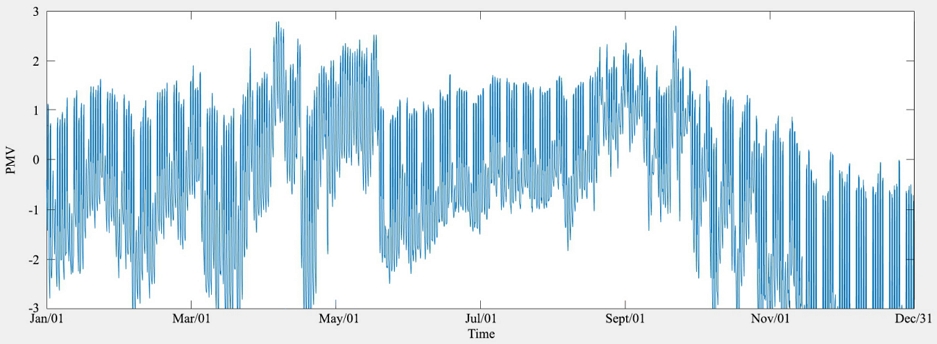
Fig. 8. and Fig. 10. show the PMV patterns of the baseline and CA-MPC models. Both models exhibit seasonal variation, but the CA-MPC model evaluates comfort as an explicit constraint during control optimization rather than treating it only as a result of temperature control. During the winter period extending from early November to late February, a significant reduction in space heating energy consumption was observed compared to other seasons. This energy saving is primarily attributed to higher indoor occupancy rates during the colder months, which substantially increases internal heat gains derived from human metabolic activity. In cold ambient conditions, these occupant-generated thermal loads effectively offset a major portion of the conductive heat loss through the building envelope. Capitalizing on these internal heat gains, the predictive control strategy curtails active mechanical heating inputs by optimizing supply-air mass flow and temperature, thereby achieving a highly positive energy-reduction effect. However, this aggressive reduction in auxiliary heating introduces a minor trade-off in thermal comfort. As the heating supply is minimized, indoor air and mean radiant temperatures tend to hover near the lower bound of the acceptable thermal setpoints, leading to a temporary decline in the PMV index toward the cooler spectrum during winter. This operational trade-off between reduced energy input and lowered PMV values is clearly demonstrated in the simulation profiles shown in Fig. 10. Table 4. provides an additional comparison using CvRMSE. The working-hour CvRMSE decreased from 0.65 to 0.54, representing an approximately 16.9% reduction. The yearly CvRMSE decreased from 0.83 to 0.67, corresponding to an approximately 19.3% reduction. These results indicate that the CA-MPC model not only reduces energy consumption but also produces a more consistent control response. The improvement in both energy performance and control error is particularly important because energy savings obtained by simply allowing larger indoor-condition deviations would not represent an effective building control strategy.
PMV pattern from the CA-MPC model
Comparison of the thermal comfort
Overall, the baseline model can be characterized as a reactive control strategy, with frequent corrective actions in response to changes in the building condition. The CA-MPC model provides a predictive and coordinated control strategy, considering future conditions and multiple building components simultaneously. The results indicate that CA-MPC reduced annual energy-use intensity by approximately 34.6%, while the yearly CvRMSE was reduced by approximately 19.3% compared with the baseline model. Therefore, the proposed approach demonstrates an improvement in both energy performance and control consistency. The main advantage of CA-MPC is consequently not simply lower HVAC operation. It is the ability to determine when energy use is necessary and when it can be reduced while maintaining acceptable indoor conditions.
5. Conclusion
This study compared a conventional baseline control model with a Constrained Adaptive Model Predictive Control (CA-MPC) model using a one-year building simulation with a 15-min time step. The baseline model showed a reactive control pattern with frequent corrective changes in response to indoor and outdoor conditions. In contrast, CA-MPC predicted future building conditions and optimized the operation of supply-air conditions, indoor setpoints, blinds, and ventilation while applying comfort constraints. The numerical results showed that annual Energy Use Intensity decreased from 108.24 to 70.80kWh/m2·yr, representing approximately 34.6% energy reduction. During working hours, the reduction was approximately 33.1%. The yearly CvRMSE also decreased from 0.83 to 0.67, indicating an approximately 19.3% improvement in control consistency. These results suggest that the predictive and coordinated control structure of CA-MPC can provide a significant improvement over the reactive baseline model. In particular, the ability to consider future conditions and coordinate several building components provides a practical mechanism for reducing unnecessary energy consumption while maintaining indoor environmental requirements.
Further studies should validate the proposed model using detailed building simulation or measured building data and investigate the influence of prediction horizon, weather uncertainty, and occupancy prediction on CA-MPC performance.
References
-
Y. Balali et al., Energy modelling and control of building heating and cooling systems with data-driven and hybrid models - A review, Renewable and Sustainable Energy Reviews, 183, 2023, 113496.
[https://doi.org/10.1016/j.rser.2023.113496]

-
Y. Peng et al., Energy consumption optimization for heating, ventilation and air conditioning systems based on deep reinforcement learning, IEEE Access, 11, 2023, pp.88265-88277.
[https://doi.org/10.1109/access.2023.3305683]
-
J. Ahn, S. Cho, D. Chung, Analysis of energy and control efficiencies of fuzzy logic and artificial neural network technologies in the heating energy supply system responding to the changes of user demands, Applied Energy, 190, 2017, pp.222-231.
[https://doi.org/10.1016/j.apenergy.2016.12.155]
-
Z. Liu et al., Advanced controls on energy reliability, flexibility and occupant-centric control for smart and energy-efficient buildings, Energy and Buildings, 297, 2023, 113436.
[https://doi.org/10.1016/j.enbuild.2023.113436]
-
J. Ahn, S. Cho, Anti-logic or common sense that can hinder machine’s energy performance: Energy and comfort control models based on artificial intelligence responding to abnormal indoor environments, Applied Energy, 204, 2017, pp.117-130.
[https://doi.org/10.1016/j.apenergy.2017.06.079]
- ASHRAE, High-performance sequences of operation for HVAC systems, ASHRAE Guideline 36-2024, Atlanta, GA: ASHRAE, 2024.
-
N. Milesi-Ferretti et al., Commissioning ASHRAE high-performance sequences of operation for multiple-zone variable air volume air handling units, Technical Note 2024, 2019.
[https://doi.org/10.6028/NIST.TN.2024]
-
S. Taheri, P. Hosseini, A. Razban, Model predictive control of heating, ventilation, and air conditioning (HVAC) systems: A state-of-the-art review, Journal of Building Engineering, 60, 2022, 105067.
[https://doi.org/10.1016/j.jobe.2022.105067]
-
J. Moon, J. Ahn, Improving sustainability of ever-changing building spaces affected by users’ fickle taste: A focus on human comfort and energy use, Energy and Buildings, 208, 2020, 109662.
[https://doi.org/10.1016/j.enbuild.2019.109662]
-
E. Saloux et al., From theory to practice: A critical review of model predictive control field implementations in the built environment, Applied Energy, 393, 2025, 126091.
[https://doi.org/10.1016/j.apenergy.2025.126091]
-
A. Mirakhorli, B. Dong, Occupancy behavior based model predictive control for building indoor climate - A critical review, Energy and Buildings, 129, 2016, pp.499-513.
[https://doi.org/10.1016/j.enbuild.2016.07.036]
-
S. Yang et al., A state-space thermal model incorporating humidity and thermal comfort for model predictive control in buildings, Energy and Buildings, 170, 2018, pp.25-39.
[https://doi.org/10.1016/j.enbuild.2018.03.082]
-
J. Ahn, An occupancy-weighted energy consumption and thermal comfort control model by communication and reallocation algorithms, KIEAE Journal, 26(4), 2026, pp.25-32.
[https://doi.org/10.12813/kieae.2026.26.4.025]
-
J. Ahn, S. Cho, Dead-band vs. machine-learning control systems: Analysis of control benefits and energy efficiency, Journal of Building Engineering, 12, 2017, pp.17-25.
[https://doi.org/10.1016/j.jobe.2017.04.014]
-
X. Liu, Z. Gou, Occupant-centric HVAC and window control: A reinforcement learning model for enhancing indoor thermal comfort and energy efficiency, Building and Environment, 250, 2024, 111197.
[https://doi.org/10.1016/j.buildenv.2024.111197]
-
J. Ahn, D. Chung, S. Cho, Performance analysis of space heating smart control models for energy and control effectiveness in five different climate zones, Building and Environment, 115, 2017, pp.316-331.
[https://doi.org/10.1016/j.buildenv.2017.01.028]
-
A. Borodinecs et al., Assessment of HVAC performance and savings in office buildings using data-driven method, Clean Technology, 6(2), 2024, pp.802-813.
[https://doi.org/10.3390/cleantechnol6020041]
-
M. Killian, M. Kozek, Ten questions concerning model predictive control for energy efficient buildings, Building and Environment, 105, 2016, pp.403-412.
[https://doi.org/10.1016/j.buildenv.2016.05.034]
-
H. Dong et al., Multi-step solar radiation prediction using transformer: A case study from solar radiation data in Tokyo, Journal of Building Physics, 47(4), 2024, pp.421-438.
[https://doi.org/10.1177/17442591231218831]
-
A. Jarraya et al., On-site temperature and irradiance forecast tuning for improved load prediction in buildings, Energy and Buildings, 337, 2025, 115642.
[https://doi.org/10.1016/j.enbuild.2025.115642]
-
Y. Ye et al., Energy-saving potential evaluation for primary schools with occupant-centric controls, Applied Energy, 293, 2021, 116854.
[https://doi.org/10.1016/j.apenergy.2021.116854]
-
F. Oldewurtel et al., Use of model predictive control and weather forecasts for energy efficient building climate control, Energy and Buildings, 45, 2012, pp.15-27.
[https://doi.org/10.1016/j.enbuild.2011.09.022]
-
S. Privara et al., Model predictive control of a building heating system - The first experience, Energy and Buildings, 43(2-3), 2011, pp.564-572.
[https://doi.org/10.1016/j.enbuild.2010.10.022]
-
S. Zhou et al., A comprehensive review of the applications of machine learning for HVAC, Decarbon, 2, 2023, 100023.
[https://doi.org/10.1016/j.decarb.2023.100023]
- J. Ahn, Development of energy performance metrics for airport terminal buildings using multivariate regression modeling (Doctoral dissertation), Raleigh, NC: North Carolina State University, 2016.
-
J. Ahn, S. Cho, D. Chung, Development of a statistical analysis model to benchmark the energy use intensity of subway stations, Applied Energy, 179, 2016, pp.488-496.
[https://doi.org/10.1016/j.apenergy.2016.06.065]
-
T. Cheung et al., Analysis of the accuracy on PMV - PPD model using the ASHRAE Global Thermal Comfort Database II, Building and Environment, 153, 2019, pp.205-217.
[https://doi.org/10.1016/j.buildenv.2019.01.055]
-
S. Park, S. Cho, J. Ahn, Improving the quality of building spaces that are planned mainly on loads rather than residents: Human comfort and energy savings for warehouses, Energy and Buildings, 178, 2018, pp.38-48.
[https://doi.org/10.1016/j.enbuild.2018.08.007]
- T. Bergman et al., Fundamentals of heat and mass transfer, New York: Wiley, 2018.
- ASHRAE, The 2023 ASHRAE handbook – HVAC applications, Atlanta: ASHRAE, 2023.
-
J. Drgona et al., All you need to know about model predictive control for buildings, Annual Reviews in Control, 50, 2020, pp.190-232.
[https://doi.org/10.1016/j.arcontrol.2020.09.001]
-
A. Afram, F. Janabi-Sharifi, Theory and applications of HVAC control systems - A review of model predictive control (MPC), Building and Environment, 72, 2014, pp.343-355.
[https://doi.org/10.1016/j.buildenv.2013.11.016]
-
W. Zheng, D. Wang, Z. Wang, Economic model predictive control for building HVAC system: A comparative analysis of model-based and data-driven approaches using the BOPTEST Framework, Applied Energy, 374, 2024, 123969.
[https://doi.org/10.1016/j.apenergy.2024.123969]