
Development for Improving Eco-Friendly and Energy Efficient Indoor Environment Control Algorithms Based on Building Users
ⓒ 2026. KIEAE all rights reserved.
Abstract
This study examines the effectiveness of an optimized, occupant-centric supply air thermal control strategy engineered to enhance the operational performance of a management office. The research focuses on establishing a control paradigm capable of resolving the classic trade-off between minimizing building energy consumption and maintaining desired indoor thermal comfort levels.
A straightforward thermal energy balance of the facility was formulated to quantify dynamic temperature variations over time. The thermal comfort index was implemented as the core ergonomic metric to track indoor comfort deviations. An adaptive control loop featuring step-by-step air supply adjustment logic was developed and utilized to train an artificial neural network structured. The combined the adaptive control loop and the network algorithm were subsequently integrated into a unified simulation block framework.
The adaptive control model demonstrated high statistical accuracy for both mass flow rate and supply air temperature. Multi-seasonal simulation results revealed that the adaptive model successfully mitigates the severe temperature fluctuations and overshooting typical of traditional dead-band thermostats. During peak summer demands, the proposed model achieved about 20% increase in energy efficiency alongside a massive 46% improvement in thermal comfort tracking precision. Annually, the framework sustained about 6% reduction in overall energy footprint and about 38% increase in comfort homeostasis, respectively.
Keywords:
Energy Use, Thermal Comfort, Occupancy Rate, Adaptive Control, Artificial Neural Network1. Introduction
This study examines the effectiveness of a thermal control system to optimize supply air conditions in mitigating the environmental requirements for a management office. Beyond the primary mandate of energy conservation, the core objective encompasses the integration of control rules designed to improve indoor thermal comfort levels. Adopting a methodological scenario, this study focuses on the formulation of control paradigms engineered to achieve concurrent optimization between energy efficiency and thermal comfort. Specifically, the empirical evaluation analyzes the performance of the proposed control model under dynamic operational systems, assessing its robust functionality across diverse physical conditions characterized by fluctuating thermal and cooling loads. Furthermore, particular emphasis is directed toward scenarios that enhance building flexibility such as the spatial optimization of management buildings thereby increasing resource saving and operational agility.
2. Literature Review
2.1. Indoor Thermal Control
Several studies develops a data-driven energy optimization framework for Heating, Ventilating, and Air Conditioning (HVAC) systems utilizing deep reinforcement learning paired. The proposed enhanced deep deterministic policy gradient method yields rapid real-time control strategies, effectively lowering energy consumption while outperforming baseline models [1,2]. The methods used incorporates physical principles into deep learning architectures to improve predictive accuracy while minimizing the need for extensive training datasets [1~3]. The studies assess how effectively each technology responds to shifting user demands while balancing control efficiency against energy expenditure. The climate condition is an useful variable to execute a comparative performance analysis of an intelligent, network-based adaptive control model operating during transitional seasonal periods [4]. The findings reveal that while precise, automated adjustments slightly increase energy consumption, they drastically improve the consistency and quality of occupant thermal comfort compared to conventional thermostat controls. In order to investigate the model’s effectiveness, an adaptive and predictive control technique are constructed specifically for intermittently occupied interior spaces. The strategy focuses on regulating climate systems to concurrently minimize energy consumption and maintain stable indoor thermal comfort during variable occupancy periods [5,6]. Several studies establishe a theoretical and analytical framework for neural networks applied to building thermal behavior. The study confirms that embedding energy conservation laws into neural networks ensures physically sound predictions and superior robustness compared to purely data-driven models [5,6]. Another results deliver a tutorial framework focused on adaptive control mechanisms, detailing fuzzy system identification methods. The text demonstrates how adaptive logic can be structured to seamlessly manage systems with highly nonlinear or uncertain operational parameters [7,8]. They examines the environmental sustainability of highly versatile building zones subject to frequent layout adjustments and shifting occupant preferences. The study focuses on balancing energy conservation and user satisfaction through agile climate management in dynamic spaces [7,8]. In addition, several recent studies present a data-driven measurement and verification methodology engineered to enhance the transparency and accuracy of energy efficiency evaluations in commercial buildings. The framework establishes more reliable tracking protocols for assessing real-world savings following HVAC retrofits or control upgrades [9~11]. The various comprehensive studies serve as a roadmap for deploying data-driven methodologies to accelerate building decarbonization and optimize thermal supply conditions.
2.2. Occupant-Centric Control
Several studies formulate a state-space thermal model that actively integrates humidity levels and composite thermal comfort indices into Model Predictive Control (MPC) algorithms. This multi-variable approach guarantees more precise comfort delivery alongside enhanced energy conservation in HVAC operations [12~14]. An optimal thermal control strategy is designed to utilize online, real-time tracking of occupant thermal sensations. This dynamic monitoring loop allows the system to achieve immediate energy savings while actively satisfying localized thermal comfort requirements. An artificial intelligence-based, occupant-centric HVAC control framework is designed for multi-zone commercial structures [12~14]. An occupant-centric reinforcement learning models evaluate the performance, energy usage, and control precision of smart space heating models across distinct climate zones. The study highlights how climate characteristics impact the comparative efficiency of deterministic versus advanced network-based control strategies. In addition they present a data-driven approach combined with building performance simulations to analyze constant air volume HVAC scheduling in commercial buildings [15~18]. The research proposes enhanced learning frameworks to prevent these cognitive errors and sustain optimal energy and comfort management. Another work utilizes Deep Neural Networks to forecast window-opening behavior in residential dormitories and quantify its subsequent impact on HVAC consumption. The findings underscore the importance of integrating behavioral data into building management systems to mitigate energy waste. The study proves that machine learning architectures offer much greater precision in thermal regulation, though their deployment requires careful structural tuning to prevent added energy penalties [19,20]. Another study assesses the quantitative energy-saving potential of deploying occupant-centric controls within primary school facilities. The simulation results show substantial energy reductions by dynamically synchronizing climate and lighting systems with actual classroom occupancy patterns [21,22]. They propose a network-based supply air thermal control strategy engineered to optimize the operational sustainability of school annex structures [21,22].
3. Research Method
3.1. Facility Model
The report of the Commercial Buildings Energy Consumption Survey (CBECS) by the U.S. Energy Information Administration, serves as a primary data source for researchers studying energy use across the public, commercial, and residential sectors. This comprehensive dataset quantifies the Energy Use Intensity (EUI) for fourteen major building classifications. Despite being classified as many building uses as possible, some building uses that are difficult to standardize are included in service or other. Therefore, it may be necessary to study the energy use intensity of buildings whose purpose is not clearly specified or open-plan buildings that can be used for various purposes in the future. In this study, an architectural model is constructed using EUI and simulation templates for building types of service and other [23,24]. The information of building geometry and component specifications is indicated in Fig. 1. and Table 1.
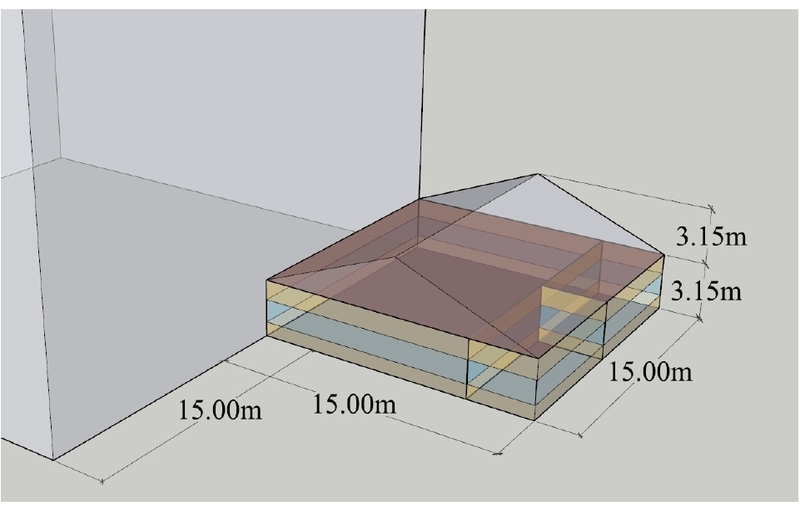
Schematic building model

Building geometry and component specification
The management office is mainly used as a shelter for residents, visitors, and workers in the summer, while it is mainly used as an event product storage, parcel storage, and a warehouse for landscaping maintenance in winter. Therefore, the occupancy rate scenario is set as follow:
- 1) Winter: 0.2 for the 08:00~19:00, 0 for the other time zones.
- 2) Summer: 0.2 for the 06:00~08:00, 0.8 for the 08:00~19:00 time zone, 0.2 for the 19:00~21:00 time zone, and 0 for the other time zones.
3.2. Thermal Control
The performance of the thermal model is calculated by establishing a straightforward thermal energy balance. This process involves summing the heat input delivered by the heating air supply system and subtracting the heat transfer occurring through the building envelopes including windows and doors. This energy exchange, which drives the temperature variations within the indoor space over time, can be mathematically defined by the following equation [25,26].
| (Eq. 1) |
where, hin and hout are the heat transfer coefficients (W/m·K), A is the area (m2), k is the transmission coefficient (W/m·K), D is the depth of envelope (m).
The Predicted Mean Vote (PMV) index, standardized under EN ISO 7730 and established by P. O. Fanger, is utilized as a performance evaluation index for evaluating indoor thermal comfort for occupants [27]. The simulation framework calculates the PMV index by utilizing six input parameters: dry-bulb temperature, relative humidity, mean radiant temperature, indoor air velocity, clothing insulation, and metabolic rate. In order to improve computation efficiency and reduce simulation time, several baseline assumptions were applied to lower the mathematical complexity of the model. Specifically, the indoor air velocity is fixed at 0.1m/s, and the mean radiant temperature is assumed to equal the dry-bulb temperature. Additionally, the metabolic rate is kept constant at 1.2 MET to represent standard working activity, while the clothing insulation is set at 1.2 clo to represent typical winter attire [27,28].
| (Eq. 2) |
| (Eq. 3) |
where, L is the thermal load and M is the metabolic rate.
The basic process is to calculate the energy consumption for creating an air supply condition to maintain the indoor temperature at the setpoint temperature according to the occupancy rate. Based on this result value, an adaptive model controls the amount of energy consumption as the changes in indoor thermal comfort within the initial setting value. The adaptive model includes a switch that can control air supply conditions step by step (by 5% point) according to the setting value range. The schematic flow diagram of this process is shown in Fig. 2.
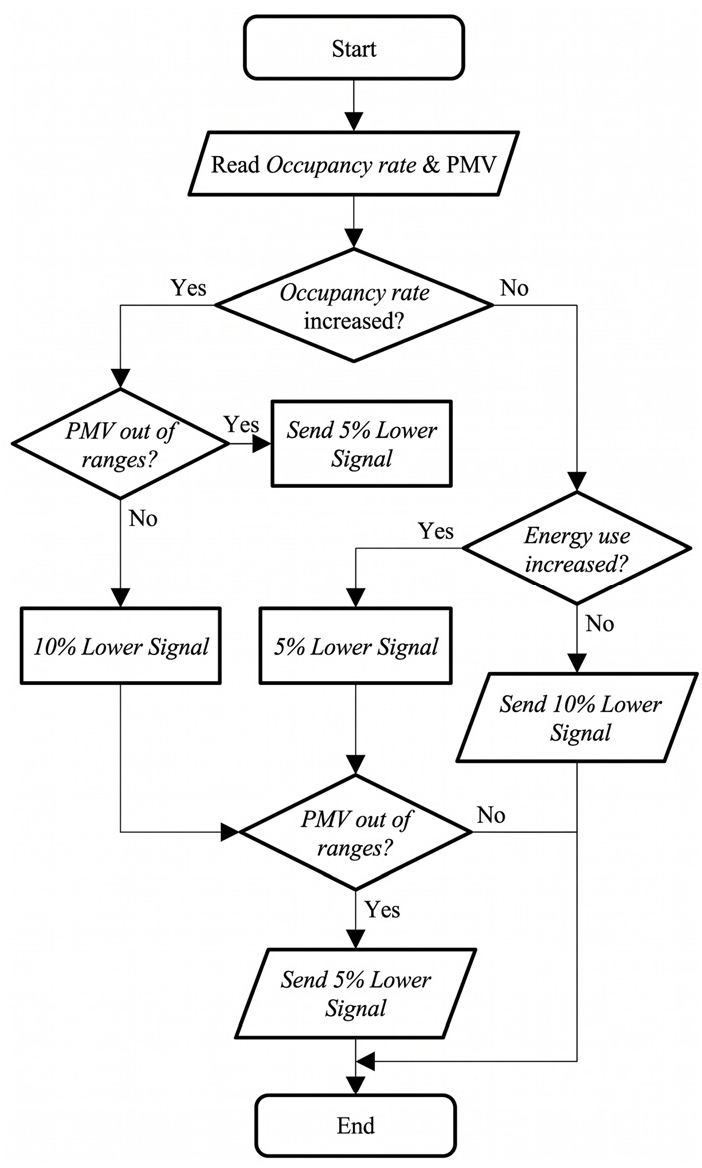
Schematic flow diagram for an adaptive process
Next, the outputs from the adaptive algorithm are utilized to train the artificial neural network (ANN). This model is structured as a multilayer perceptron (MLP), a fully connected network architecture widely used to resolve complex, non-linear mapping relationships [29,30]. The standard MLP configuration employs a three-layer design consisting of three different layers (an input layer, a hidden layer, and an output layer) to process data. Within this structure, each neuron calculates an intermediate summation value, (nc), by multiplying its inputs (x1,⋯,xk) by their respective weights (wai) and adding a bias value (θb). This summation is then processed via a non-linear activation function (gd) to generate the final layer output [29,30]. Network training was performed using the scaled conjugate gradient backpropagation algorithm for 1,000 iterations, configured at one epoch per iteration. The resulting model demonstrated high statistical accuracy, achieving coefficient of determination R2 values of 0.99004 for the mass flow rate and 0.98953 for the supply air temperature. Finally, the adaptive control loop and the ANN algorithm were integrated into a unified simulation framework using MATLAB and Simulink, as illustrated in Fig. 3.
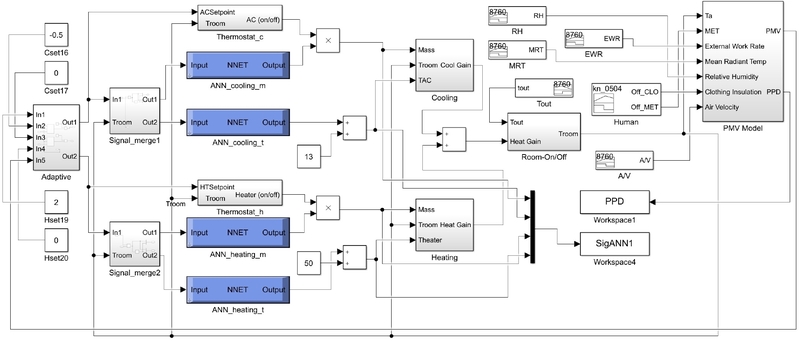
Simulation block model
4. Results
Fig. 4., displays the yearly outside temperature of Kangneung City in Korea as a simulation input variable. The climate exhibits distinct four-season variations characteristic of a temperate zone. Winter temperatures (January to February and December) regularly drop below 0℃, reaching minimums near -10℃. Conversely, summer temperatures peak significantly between July and August, reaching maximums between 30℃ and 37℃. The spring (March to May) and autumn (September to November) segments display rapid, transitional thermal shifts. Spring exhibits a steady upward trajectory in baseline temperature, while autumn shows a corresponding gradual decline. The high density and sharp vertical oscillations of the data line throughout the year indicate substantial daily (diurnal) temperature swings. These daily variations are particularly pronounced during the spring and summer months, signaling highly dynamic external thermal loads that an thermal control system must continuously accommodate.
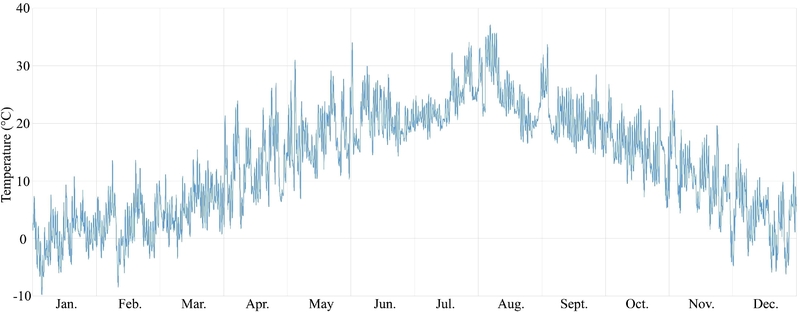
Outdoor air temperature of Kangneung City in Korea
The indoor temperature exhibits massive, unbroken vertical bands spanning roughly 20℃ to 25℃ across the entire year. This pattern indicates a traditional on/off or aggressive dead-band thermostat in Fig. 5. It continuously overshoots and undershoots the comfort target because it reacts purely to instantaneous threshold breaches without predicting thermal inertia or outdoor influence. As indicated in Fig. 6., the network dynamically alters its control strategy based on the time of year. During the hottest months, the massive daily temperature swings are heavily mitigated. The temperature is tightly bound and stabilized within a narrow, comfortable band between 15℃ and 30℃. By flattening the extreme peaks and valleys between June and September, the ANN model prevents the indoor space from overheating. This ensures stable, predictable human thermal comfort when the cooling load is highest. Rather than maintaining a rigid, highly active control cycle year-round like the baseline model, the ANN model relaxes its tight bounding during colder months. Permitting wider, controlled swings when acceptable suggests the model optimizes system runtimes (minimizing short-cycling and saving substantial heating energy). The baseline model treats January and July with the same erratic logic. In contrast, the ANN model successfully learns the non-linear relationship between the outdoor dry-bulb temperature (which peaks in July/August) and indoor thermal dynamics, shifting its control paradigms to match shifting environmental demands. Fig. 7. and Fig. 8. show the energy consumption patterns used to control these indoor temperatures, and Fig. 9. and Fig. 10. show the damper opening pattern and the heating and cooling supply air temperature controlled. As can be inferred from the indoor temperature control result value, it can be seen that the control patterns of the two models are clearly different in winter and summer depending on the occupancy rate scenario. It can be inferred that dense real-time control is performed to maintain the thermal comfort homeostasis of users in summer when the occupancy rate is high, whereas in winter when the occupancy rate is low, the amount of energy consumed unnecessarily can be reduced by lowering the frequency of control.
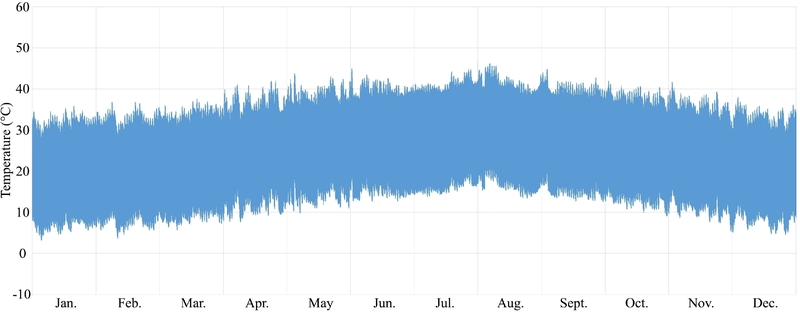
Indoor air temperature by the baseline model
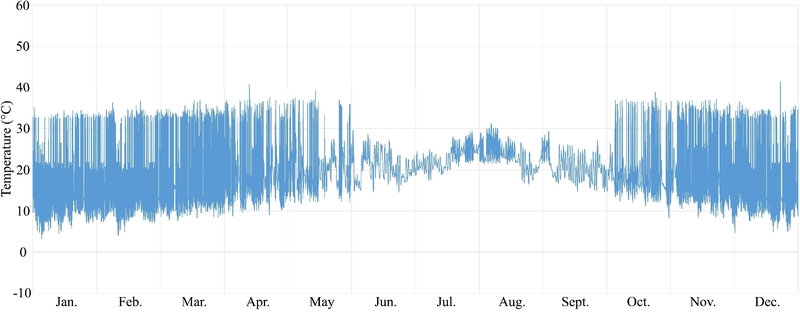
Indoor air temperature by the adaptive model
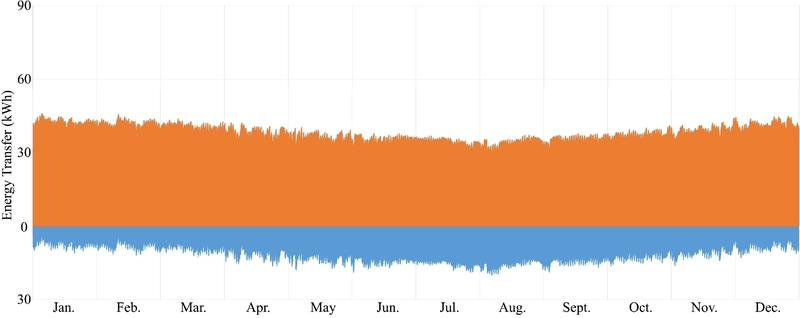
Energy transfer by the baseline model
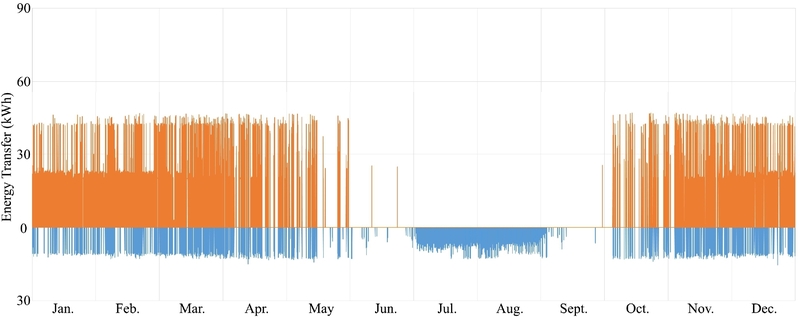
Energy transfer by the adaptive model
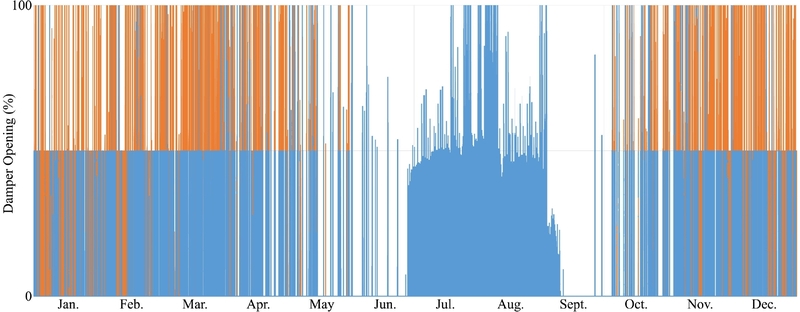
Control pattern of the damper opening by the adaptive model
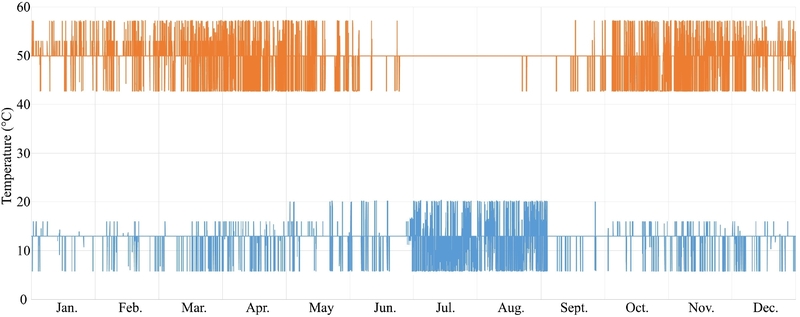
Control pattern of the heating and cooling supply air temperature by the adaptive model
Table 2. and Table 3. show the numerical results for the energy use intensity and the thermal comfort homeostasis. During the core summer months, the adaptive model reduces energy consumption from 30.33 to 24.47, yielding a substantial 20.08% increase in energy efficiency. This directly validates the previous Fig. 6., showing that the ANN’s tight bounding of indoor temperatures during peak summer heat avoids the aggressive over-cooling and continuous short-cycling typical of standard thermostats. Over the entire annual cycle, the adaptive model maintains a lower energy footprint (176.05 vs. 187.56), reflecting a 6.14% efficiency improvement. The lower percentage compared to summer suggests the system intelligently relaxes or modifies its operational intensity during heating or transitional seasons to conserve energy when maximum cooling loads are absent. During the critical two-month summer period, the CvRMSE drops sharply from 0.28 (Baseline) to 0.15 (Adaptive), representing a massive 46.43% enhancement in control precision. The ANN excels at handling non-linear outdoor peak temperatures, successfully keeping indoor conditions exceptionally close to the desired comfort envelope. On a yearly basis, the adaptive model sustains this superior performance, improving control precision by 37.93%. As a result, the data proves the adaptive ANN model successfully breaks the typical engineering trade-off where increasing occupant comfort usually demands more power. Instead, it achieves concurrent optimization - drastically stabilizing indoor comfort (up to 46.43% improvement) while simultaneously driving down energy consumption (up to 20.08% savings). The model’s efficiency gains are most aggressive exactly when the building is under maximum environmental stress (the summer months), proving its superior resource administration and responsiveness to dynamic spatiotemporal loads.
Comparison of the total energy use
Comparison of the thermal comfort
5. Conclusion
This study investigated the development and performance of an adaptive artificial neural network (ANN) control algorithm designed to optimize supply air thermal management systems within management buildings. By integrating step-by-step adaptive rule logic with a multilayer perceptron (MLP) network framework, the proposed control loop successfully established a balance between occupant thermal comfort and building energy consumption. The performance was evaluated using MATLAB and Simulink system simulations against a baseline dead-band thermostat model.
The empirical findings demonstrate that the adaptive ANN framework effectively addresses the typical engineering trade-off where improved human comfort incurs an energy penalty. This concurrent optimization is most prominent during peak environmental stress periods. In the core summer months (June 15 to August 15), the adaptive model achieved a 20.08% reduction in Energy Use Intensity (EUI), decreasing consumption from 30.33 to 24.47 kWh/m2·yr. Concurrently, indoor thermal comfort precision was substantially stabilized, yielding a 46.43% improvement as the comfort index dropped from 0.28 to 0.15. On an annual viewpoint, the adaptive system sustained its benefits, delivering a 6.14% increase in energy efficiency alongside a 37.93% improvement in thermal comfort control precision. The results indicate that the adaptive control logic lowers its operational frequency during low-occupancy winter periods to mitigate energy waste while executing dense, real-time control adjustments under high-occupancy summer cooling demands.
As a future study, the proposed model can be improved to maximize the utility and operational sustainability of existing auxiliary infrastructures through intelligent frameworks. The new model can be expected to offer a highly scalable pathway to enhance resource conservation and operational agility while mitigating the financial and environmental burdens associated with new facility construction.
Acknowledgments
This work was supported by a research grant from Hankyong National University for an academic exchange program in 2025 (본 연구는 2025년도 한경국립대학교 연구년 경비의 지원에 의한 것임).
References
-
Y. Peng et al., Energy consumption optimization for heating, ventilation and air conditioning systems based on deep reinforcement learning, IEEE Access, 11, 2023, pp.88265-88277.
[https://doi.org/10.1109/access.2023.3305683]

- G. Gokhale, B. Claessens, C. Develder, Physics informed neural networks for control oriented thermal modeling of buildings, Applied Energy, 314, 2022, 118852.
-
J. Ahn, S. Cho, D. Chung, Analysis of energy and control efficiencies of fuzzy logic and artificial neural network technologies in the heating energy supply system responding to the changes of user demands, Applied Energy, 190, 2017, pp.222-231.
[https://doi.org/10.1016/j.apenergy.2016.12.155]
-
S. Yoon, J. Ahn, Comparative analysis of energy use and human comfort by an intelligent control model at the change of season, Energies, 13, 2023, 6023.
[https://doi.org/10.3390/en13226023]
-
J. Ahn, Adaptive and predictive control method to improve energy efficiency and indoor thermal comfort for intermittently occupied spaces, KIEAE Journal, 25(5), 2025, pp.21-29.
[https://doi.org/10.12813/kieae.2025.25.5.021]
- L. Di Natale et al., Physically consistent neural networks for building thermal modeling: Theory and analysis, Applied Energy, 325, 2022, 119806.
-
R. Qi et al., Adaptive control: A tutorial, Fuzzy System Identification and Adaptive Control, 1, 2019, pp.55-74.
[https://doi.org/10.1007/978-3-030-19882-4_3]
-
J. Moon, J. Ahn, Improving sustainability of ever-changing building spaces affected by users' fickle taste: A focus on human comfort and energy use, Energy and Buildings, 208, 2020.
[https://doi.org/10.1016/j.enbuild.2019.109662]
-
S. Rastegarpour et al., Energy management in buildings: Lessons learnt for modeling and advanced control design, Frontiers in Energy Research, 10, 2022, 899866.
[https://doi.org/10.3389/fenrg.2022.899866]
-
B. Grillone et al., A data-driven methodology for enhanced measurement and verification of energy efficiency savings in commercial buildings, Applied Energy, 301, 2021, 117502.
[https://doi.org/10.1016/j.apenergy.2021.117502]
-
S. Zhou et al., A comprehensive review of the applications of machine learning for HVAC, Decarbon, 2, 2023, 100023.
[https://doi.org/10.1016/j.decarb.2023.100023]
-
S. Yang et al., A state-space thermal model incorporating humidity and thermal comfort for model predictive control in buildings, Energy and Buildings, 170, 2018, pp.25-39.
[https://doi.org/10.1016/j.enbuild.2018.03.082]
-
W. Li, J. Zhang, T. Zhao, Indoor thermal environment optimal control for thermal comfort and energy saving based on online monitoring of thermal sensation, Energy and Buildings, 197, 2019, pp.57-67.
[https://doi.org/10.1016/j.enbuild.2019.05.050]
-
A. Yayla et al., Artificial intelligence (AI)-Based occupant-centric Heating Ventilation and Air Conditioning (HVAC) control system for multi-zone commercial buildings, Sustainability, 14, 2022, 16107.
[https://doi.org/10.3390/su142316107]
-
X. Liu, Z. Gou, Occupant-centric HVAC and window control: A reinforcement learning model for enhancing indoor thermal comfort and energy efficiency, Building and Environment, 250, 2024, 111197.
[https://doi.org/10.1016/j.buildenv.2024.111197]
-
J. Ahn, D. Chung, S. Cho, Performance analysis of space heating smart control models for energy and control effectiveness in five different climate zones. Building and Environment, 115, 2017, pp.316-331.
[https://doi.org/10.1016/j.buildenv.2017.01.028]
-
A. Borodinecs et al., Assessment of HVAC performance and savings in office buildings using data-driven method, Clean Technology, 6(2), 2024, pp.802-813.
[https://doi.org/10.3390/cleantechnol6020041]
-
J. Ahn, S. Cho, Anti-logic or common sense that can hinder machine's energy performance: Energy and comfort control models based on artificial intelligence responding to abnormal indoor environments, Applied Energy, 204, 2017, pp.117-130.
[https://doi.org/10.1016/j.apenergy.2017.06.079]
-
P. Pandey, B. Dong, Prediction of window opening behavior and its impact on HVAC energy consumption at a residential dormitory using deep neural network, Energy and Buildings, 296, 2023, 113355.
[https://doi.org/10.1016/j.enbuild.2023.113355]
-
J. Ahn, S. Cho, Dead-band vs. machine-learning control systems: Analysis of control benefits and energy efficiency, Journal of Building Engineering, 12, 2017, pp.17-25.
[https://doi.org/10.1016/j.jobe.2017.04.014]
- Y. Ye et al., Energy-saving potential evaluation for primary schools with occupant-centric controls, Applied Energy, 293, 2021, 116854.
-
J. Ahn, S. Lee, A network-based thermal control strategy for improving the operational sustainability of school annex buildings, KIEAE Journal, 25(6), 2025, pp.15-23.
[https://doi.org/10.12813/kieae.2025.25.6.015]
- J. Ahn, Development of energy performance metrics for airport terminal buildings using multivariate regression modeling (Doctoral dissertation), Raleigh, NC: North Carolina State University, 2016.
-
J. Ahn, S. Cho, D. Chung, Development of a statistical analysis model to benchmark the energy use intensity of subway stations, Applied Energy, 179, 2016, pp.488-496
[https://doi.org/10.1016/j.apenergy.2016.06.065]
- T. Bergman et al., Fundamentals of Heat and Mass Transfer, New York: Wiley, 2018.
- C. Borgnakke, Fundamentals of thermodynamics, New York: Wiley, 2025.
-
T. Cheung et al., Analysis of the accuracy on PMV - PPD model using the ASHRAE global thermal comfort database II. Building and Environment, 153, 2019, pp.205-217.
[https://doi.org/10.1016/j.buildenv.2019.01.055]
-
J. Grabe, Potential of artificial neural networks to predict thermal sensation votes, Applied Energy, 161, 2016, pp.412-424.
[https://doi.org/10.1016/j.apenergy.2015.10.061]
- K. Priddy, P. Keller, Artificial neural networks: An introduction, Bellingham, WA: SPIE Press, 2005.
- The University of Wisconsin-Madison, A basic introduction to neural networks, http://pages.cs.wisc.edu, , (n.d.).