
Urban Development and Land Surface Temperature : Spatiotemporal Analysis in Java’s Coastal Cities, Indonesia, 2000 to 2023
ⓒ 2025. KIEAE all rights reserved.
Abstract
This study analyzes the impacts of urban development on Land Surface Temperature (LST) across 68 coastal cities in Java Island, Indonesia (2000~2023). Understanding how urbanization affects LST is crucial for climate-responsive planning in these vulnerable areas.
Land cover was extracted using Landsat, while LST and climatic variables were derived from MODIS and CHIRPS datasets. These spatial data were integrated with socioeconomic indicators to construct a panel dataset, which was then tested using panel regression. Nine independent variables were tested, including total population, population density, GDP, GDP/capita, economic growth, built-up area, vegetation proportion, rainfall, and albedo. Through diagnostic tests, the Fixed Effects was selected as the best fit.
Land cover experienced an average 15% loss of vegetation, due to the conversion of cropland and sparse vegetation, especially in mid-sized cities such as Tangerang and Sleman. LST along the northern industrial corridor showed a higher trend, while southern cities remained cooler due to vegetation and topography. Population density and economic growth have a positive influence on LST, with a 0.17℃ temperature increase for every 1,000 people/km2, and each 1% increase in economy growth corresponds to a 0.10℃ increase in LST. Vegetation, albedo, and rainfall had adverse effects on LST, with a 10% increase in vegetation lowering LST by 0.11℃, a 0.1 rise in average albedo by 1.24℃, and 100 mm rise in rainfall by 0.019℃. These patterns highlight the importance of integrating spatial and ecological considerations into climate-responsive urban planning.
Keywords:
Urbanization, Urban Heat Island, Land Cover, Land Surface Temperature, GIS1. Introduction
Urbanization has taken off rapidly in the 21st century, where more than half of the population is living in cities. This trend is likely to continue, as it is predicted that by 2050, urban populations will be 70% of the world’s population [1]. Particularly, a significant amount of urbanization is occuring in developing countries, where population is moving from rural to urban areas in such a short period. Urbanization not only creates economic growth, but also urban sprawl, environmental degradation, and public health issues [2]. From the issue of sprawl, the intensification of urban heat has become more pressing over the last several decades. A dominant factor of the heat problem comes from natural land conversion into impervious surfaces that change the local climate and increase surface temperature [3].
The Urban Heat Island (UHI) is defined as the temperature increase of the urban area, compared to rural areas; it has gained significant research attention, especially amongst urban researchers [4]. UHI is ultimately caused by the change in vegetation, as the amount of impervious surfaces and concentrated human activity increases Land Surface Temperature (LST) [5]. Some of the consequences of UHI include an increased demand for energy, reduced air quality, and potential health impacts with decreased thermal comfort (especially during extreme heat events) [6]. Research has noted that cities with dense built-up areas and fragmented forest loss have stronger heat impacts [7].
Coastal cities can be described as unique urban areas that have acute and particular vulnerabilities. Coastal cities have concentrated populations, critical infrastructure, and vital ecosystems, but they may be one of the locations with the greatest exposure to climate stressors such as increasing temperatures and sea level rise [8]. The pressure from economic activity, align with pressure from climate change has made coastal areas as the most vulnerable locations [9]. Furthermore, land use changes are acknowledged to increase UHI intensity but have not been studied as thoroughly in urban coastal settings [10]. Many of the prior research has emphasized developed countries with a variety of planning and governance contexts. Additionally, few studies examined LST change relative to urbanization indicators using a spatiotemporal or multi-city perspective, particularly in coastal urban areas such as Java in Indonesia.
Indonesia is the largest archipelagic country with more than 17000 islands. Among those islands, Java Island is the most populated island of Indonesia, and more than half of the nation population resides on Java Island. Java Island is important for Indonesia’s urban development due to its important coastal cities such as Jakarta, Surabaya, Semarang, and Yogyakarta. Java Island coastal regions are facing serious environmental conditions associated with urbanization including land subsidence, erosion, and pollution [11]. Along Java’s coastline, 68 cities and regencies exhibit varying land use patterns and are becoming increasingly exposed to urban heat. To date, very few large-scale studies have examined how LST patterns react over the timescale of multiple coastal urban settings. Additionally, few studies of urban heat are conducted over a long duration for more than two decades, or longer periods, making this study essential.
Although UHI impacts have been well understood, incorporating socioeconomic and climatic factors in the analysis of LST in multi-coastal cities is still scarce, especially in rapidly urbanizing countries, such as Indonesia. Many studies on urbanization looking at single city/ region, covering short periods, or considering how demographic and economic factors interact inadequately. This research addresses these gaps by analyzing multi-cities during long term period with diverse variables. Particularly, this study investigates 68 coastal cities across Java, Indonesia, from 2000~2023, using land cover. socio-economic, and climate data. The objectives of this research are to 1) investigate urbanization patterns in terms of land cover change, and 2) analyze how urban development features (land cover change, socio-economics, and climate conditions) explain LST, and how their relationships have changed since 2000. Utilizing a combination of multi-temporal geospatial analysis and statistical modelling approaches allows this study to share new perspectives on the relationships between urban dynamics and LST in one of Indonesia’s most densely populated and ecologically vulnerable areas. The results can guide future urban planning looking to enhance thermal resilience in coastal cities.
2. Literature Review
Urbanization is rapidly increasing worldwide, especially in developing countries, leading to significant changes in land cover. When green and permeable areas become built, the surface energy processes are altered, producing even greater localized warming [12]. One result of this change is the UHI effect, defined as increased temperature within urban areas compared to surrounding rural settings [13]. LST obtained from satellite data is the most applied measure for estimating UHI intensity and has emerged as one of the most utilized variables in research on urban climate to measure heat exposure, assess landscape effects, or develop mitigation plans [14].
Numerous studies have examined how urban development shapes LST, primarily using remote sensing-derived spatial indicators. Common methodologies include the Normalized Difference Vegetation Index (NDVI) and Normalized Difference Built-up Index (NDBI), and are often used with land cover classifications to map vegetation and impervious surfaces [15~16]. The use of more complex spatial measures, such as patch shape, complex edge, and spatial configuration, can provide better context for how urban form induces thermal effects. Examples of complex metrics are: the Percentage of Landscape (PLAND), Largest Patch Index (LPI), and Edge Density (ED), which have been employed in cities like Beijing and Guiyang [5,17]. These studies stress the significance of landscape structure, primarily density and cohesion, in LST. Morphological studies rely on specific land-use maps, making the contextual analysis limited, especially for large or heterogeneous areas. However, recent studies argue that broader measures like land-use percentages or percentage of vegetation cover are, in fact, accurate at explaining differences in LST [18~19]. This is especially true for large-scale or multi-city studies.
Although land cover is a key element in LST research, integrating socioeconomic and climatic factors is also valuable. A few studies have incorporated demographic factors, like population density, and identified them as significant [20]. Many studies often overlook crucial climatic factors such as rainfall, humidity, and albedo, or present them as merely supporting information. For instance [21], examined temperature and rainfall patterns but did not accommodate them directly into the model. Albedo is frequently applied in studies of urban heat but is still rare in tropical, multi-city analyses [22]. Investigated the impact of albedo on LST reduction in seven US cities, yet concentrated on temperate, developed areas with a distinct context. This study extends previous works by combining land cover, socioeconomic, and climatic factors to provide a scalable method for understanding LST trends in the coastal cities of Java Island.
Numerous studies have examined how urban form and land cover influence LST, often focusing on cities in developed countries. For example [20], analyzing European cities, found that built-up volume and population density were stronger predictors of LST than climate factors, especially in low-vegetation contexts. A research [23] reported that compact morphology in Malaga, Spain contributed to elevated LST, while [19] highlighted that in coastal cities such as Tokyo, San Francisco, and Hong Kong, LST increases were most pronounced in areas of recent impervious surface expansion, while nearby forest and water zones remained significantly cooler. In Jeju, South Korea [21], found that UHI intensity rose from 2.47℃ in 2002 to 3.10℃ in 2021, as urban land area expanded from 8.69% to 20.81%. In Singapore [18], reported that redevelopment scenarios incorporating green space reduced high-temperature zones by up to 8.77%. Though most studies focus on single cities, short timeframes, and mainly in more developed or urban contexts. Development studies in emerging regions, such as in studies on Surakarta and Bogor, Indonesia [24~25] or in Iran and Pakistan [26~27], are also dominated by single-city case studies, or short timespan studies of often < 10 years. Overall, the literature tends to be geographically limited and temporally short, with few examples of multi-city, long-term patterns, particularly for tropical coastal regions of the global south.
From a methodological standpoint, most LST studies rest on spatial analysis using Geographic Information System (GIS) techniques and satellite imagery provided by Landsat and MODIS platforms [28] while some apply CHIRPS and ERA5 to build upon additional climatic data [29]. These tools are effective for mapping thermal variation, but many studies stop at descriptive or spatial overlay analysis. Some researchers have applied basic statistical models like Ordinary Least Squares (OLS) or spatial regression, but these are usually cross-sectional and limited to single-city cases [30]. Machine learning techniques, including random forest, have been valuable to improve prediction accuracy [23], but, again, the majority of studies are climatologically related investigations in the context of specific cities. While access to long-term satellite and socio-economic data is increasing, relatively few studies have attempted to model LST over time due to urbanization. Importantly, standard statistical testing methods such as the Chow test, Hausman test, or Breusch-Pagan test have not been utilized, thus inhibiting clear conceptualization regarding urbanization towards the LST process across space and time.
This study adresses those limitations, including the limited consideration of both climatic factors and socioeconomic influences, the tendency to conduct short term and single-city assessments, and the lack of temporal modeling and associated diagnostic validation. This study analyzed 68 coastal cities across Java at three separate time periods (2000, 2010, and 2023). By integrating land cover, socio-economic, and climate variables in a multi-city, longitudinal context, this research employs panel regression to assess how urban characteristics influence LST over time. By using this approach, the research advances understanding of how urban characteristics influence LST in one of the nation’s most densely populated and urbanizing coastal regions.
Based on the identified literature, this study proposes the following hypotheses:
H1: The extent of built-up land cover has altered greatly in the coastal cities of Java Island between 2000 and 2023.
H2: The spatial and temporal patterns of LST across Java’s coastal cities are unique and are influenced by the conditions and characteristics of each city.
H3: Each urbanization indicator has a significant influence on LST, either intensifying or mitigating surface heat patterns.
H4: The strength and direction of the relationship between urban development indicators and LST vary over time.
3. Methods
3.1. Study Area
The study focused on the 68 coastal cities/regencies of Java Island, Indonesia (Fig. 1.). Java Island is the most densely populated island in the world, with a population of over 150 million people [31]. With 7% of the total land but serving as home for 57% of the population, Java Island contributes at least 59% to the country’s economy [32]. Java Island consists of six provinces and includes major metropolitan areas such as Jakarta, Surabaya, Semarang, and Yogyakarta, which are important due to the significant impact of human activities on the ecosystem. This region is confronted with significant environmental issues, highlighting its importance for examining the link between rapid development and the urban heat effect.
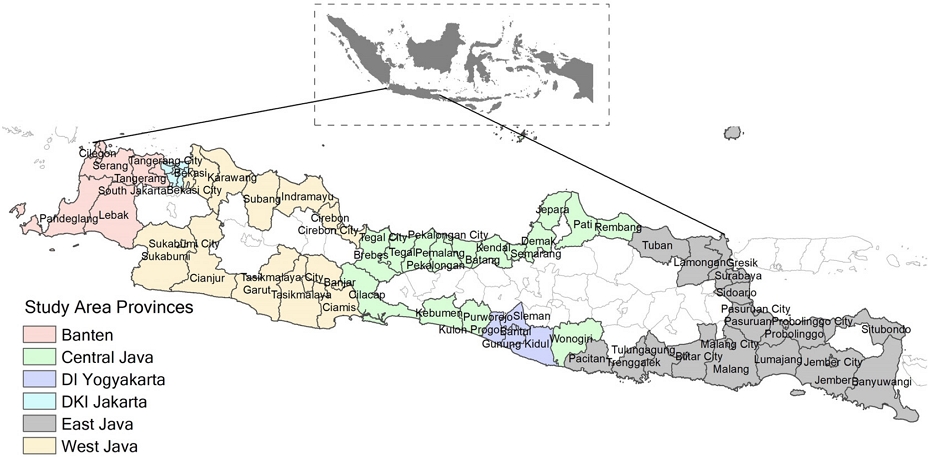
Study area
This study aims to examine long-term urban and climatic trends in the 21st century. Although an initially include a decadal approach (2000, 2010, 2020), the data for 2020 were significantly impacted by anomalies due to COVID-19 pandemic, especially concerning economic indicators. To maintain consistency and relevance in a post-pandemic context, the final year was adjusted to 2023.
3.2. Data Source and Variables
This study employs a balanced panel dataset of 204 observations across 68 coastal cities and regencies in Java Island for the years 2000, 2010, and 2023. Table 1. outlines the sources of the dataset and includes one dependent variable with nine independent variables that represent the spatial, socioeconomic, and climatic dimensions of the urban region.

Data sources
Unlike air temperature, this study uses LST as dependent variable to represent the thermal state of the land. LST often appears higher than average air temperature as it captures direct heating, which absorbs solar energy intensely, affected by factors such as solar radiation, land cover, and human activities, and is widely used to assess more dynamic urban heat conditions [23]. LST data were obtained from NASA’s MODIS Terra which provides 1km resolution with 8-day composites. Annual mean LST for each city was calculated for 2000, 2010, and 2023.
While land cover indicators are commonly used to examine urban heat, studies that incorporate more comprehensive variables, including socioeconomic and climatic factors, remain rare. To address this gap, this study includes nine independent variables representing land cover, socioeconomic, and climatic conditions.
Land cover indicators in this study reflect the physical transformation of urban areas that influence surface heat patterns. PUBUA represents impervious surfaces such as roads and buildings, which tend to trap heat and reduce natural cooling. Vegetation cover captures the extent of green areas, including sparse and dense vegetation classes, which typically lower LST through shading and evapotranspiration. Both variables were derived from Landsat 7 ETM and Landsat 8-9 OLI/TIRS data using NDVI and supervised classification analysis.
Socioeconomic factors capture how human activity shapes urban development and, indirectly, temperature conditions. Total population and population density reflect the size and spatial concentration of residents, both of which contribute to land conversion and increased urban heat. Economic indicators, including GDP, GDP per capita, and economic growth, describe each city’s development stage. These factors often correlate with infrastructure expansion and land cover change, influencing thermal conditions. All socioeconomic data were obtained from Indonesia’s Province in Figures reports published by BPS.
Climatic factors are included to account for environmental conditions that influence LST but are often overlooked in urban heat studies. Total annual precipitation reflects moisture availability, which can moderate LST through soil moisture and evapotranspiration. Surface albedo measures the reflectivity of the land surface, with higher albedo generally reducing heat absorption, although the relationship can vary depending on geographical location land cover type. Precipitation data were sourced from CHIRPS imagery, while surface albedo values were extracted from NASA’s MODIS MCD43A3.
3.3. Data Analysis
Land cover and climatic variables were extracted using a combination of Google Earth Engine (GEE) and ArcGIS 10.8. Landsat imagery was processed through mosaicking, cloud masking, and NDVI computation, followed by supervised classification to verify land cover types, including water bodies, cropland, dense vegetation, sparse vegetation, and built-up areas (see Table 2.). PUBUA and vegetation cover were calculated for each city using zonal statistics based on administrative city boundaries. In addition, total annual precipitation from CHIRPS and surface albedo from MODIS MCD43A3 were extracted in GEE by overlaying city boundaries and calculating annual mean values for each city.
Land cover detail
As seen in Fig. 2., the dependent variable, LST, was obtained from MODIS Terra through cloud-contaminated pixels were filtered using Quality Assurance (QA) bands, and annual mean LST was calculated for 2000, 2010, and 2023. All geospatial processing was conducted to align variable boundaries, ensuring comparability across cities and time periods.
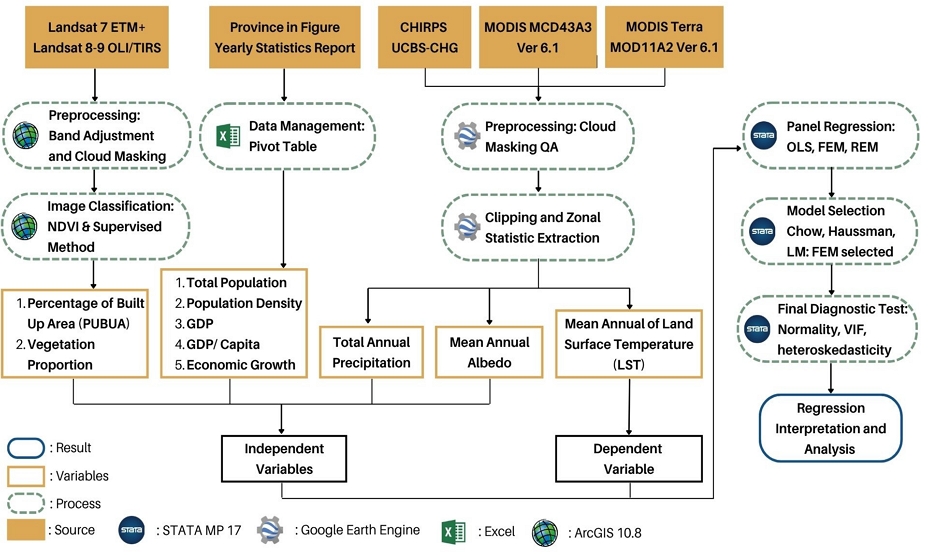
Research framework
Panel regression analysis was conducted in STATA MP 17 to quantify the relationship between urban features and LST across space and time. Three models were tested: Common Effect (CEM), Fixed Effect (FEM), and Random Effect (REM). The process of selecting models adhered to the typical sequential approach for model selection as described by [33].
Based on the results of these tests, the Fixed Effect Model (FEM) was chosen as the most suitable specification for this case. Additional diagnostics were carried out to validate the regression, which included checking for multicollinearity using the Variance Inflation Factor (VIF), conducting heteroskedasticity tests, and assessing the normality of the residuals.
The ultimate model evaluates how land cover, socioeconomic factors, and climate variables affect LST, while also accounting for variations at the city level and addressing both spatial and temporal trends in the coastal cities of Java.
4. Result
4.1. Spatiotemporal Trend of Land Cover
Based on Fig. 3., secondary centers exhibited significant outward expansion and growth (Tangerang, Bekasi, Sidoarjo, and Sleman), while major cities suggested rapid development through urban expansion in-town (e.g., Jakarta, Semarang, Yogyakarta, and Surabaya), and urban development had spread vertically into surrounding regencies (e.g., in DI Yogyakarta province, urban areas expanded into either Sleman or Bantul regency). Overall lost vegetation cover in the entire study range was approximately 15%, with mid-sized and satellite cities (e.g., Tangerang, Garut, Batang, Sleman, and Sidoarjo) having the most lost vegetation cover (shown to be at upwards of 20%). The findings confirm H1, as there has been a regionally-consistent, while spatially-varied increase in built-up land use and loss of vegetation cover for Java’s coastal cities.
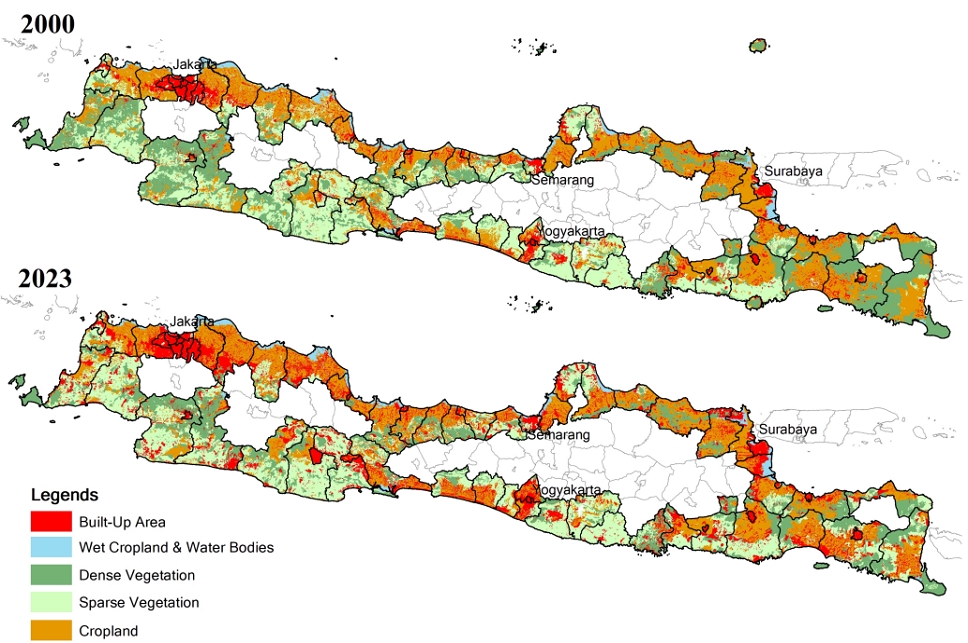
Land cover change of Java’s coastal cities 2000~2023
Fig. 4. illustrates the key land cover changes driving urban expansion over two time periods across the entire study area, which includes all 68 coastal cities of Java. The total observed area covers approximately 86,537km2, depicting the joint administrative borders of municipalities. This broad coverage enables a thorough evaluation of urban growth and land cover changes in the Java coastal regions.
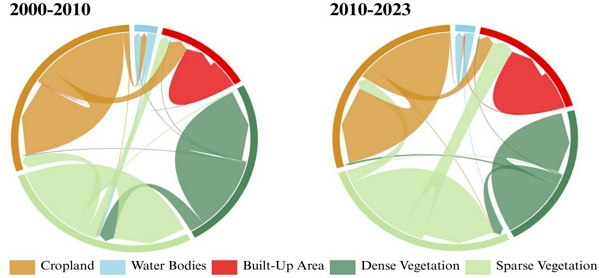
Chord diagram of land cover change 2000~2010 and 2010~2023
From the years 2000 to 2010, the primary contributor of built-up area was 5.4% of the total cropland (4,698km2). Sparse vegetation and dense vegetation areas were also converted during this time by 2.91% (2,533km2) and 0.21% (187km2) respectively. Cropland was the dominant land cover converted to urban use during this period, but increased rates of vegetation loss, especially sparse vegetation, were increasingly influential over urban growth.
By 2010 to 2023, the largest converting land cover of built-up area was sparse vegetation (6.5% or 5,669km2). The total amount of cropland converted to built-up area remained significant around 4.25% (3,681km2), while dense vegetation was still noticeably converted at 0.35% (305km2). These observations emphasize a greater vegetation decline turnover due to urban expansion in the last decade.
The graphics clearly illustrate a trajectory of vegetation loss: dense vegetation converts to sparse vegetation, and sparse vegetation converts to cropland. From 2010 to 2023, 2.92% (2,528km2) went from dense vegetation to sparse vegetation, and 3.69% (3,195km2) was converted from sparse vegetation to cropland. The pattern indicates that vegetation and vegetation degradation often include pre-designation of urban development in Java’s coastal cities.
4.2. Spatiotemporal Trend of LST
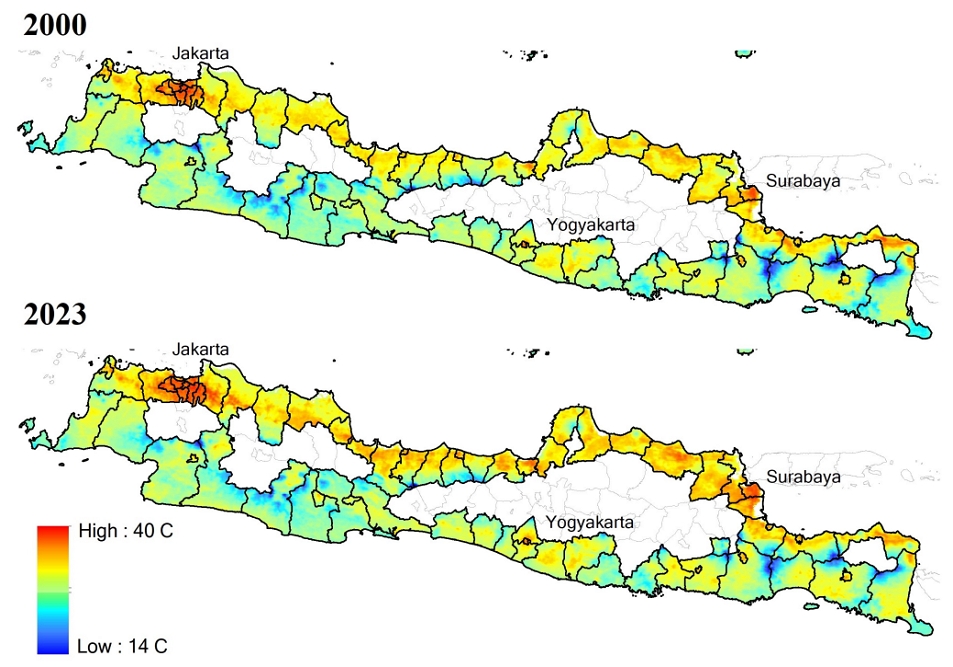
Fig. 5. shows a spatial gradient in LST across Java’s coastal cities, with a clear trend of higher temperature concentrated along the northern coasts. In 2023, the urban areas of Jakarta, Bekasi, Semarang, and Surabaya recorded average LST of 35℃, with some of the hotspot areas reaching 38℃. Urban residential areas along the north coastline of Java are typically characterized by the extended built-up area, the presence of a large deep port, and the industrial area corresponding to elevated LST. The spatial clustering of the urban space matches spatially with part of the high LST areas that exist in Java’s coastal cities. It is important to note that LST values could be slightly higher than the air temperature values from climate stations, given that this study used remotely sensed derived LST measurement.
LST of Java’s coastal cities 2000~2023
In contrast, southern coastal cities like Yogyakarta, Malang, Banyuwangi, and Pandeglang generally have lower average LST values, with values between 28℃ and 35℃. These cities afford a higher amount of vegetation cover and are situated on more hilly land and their land use arrangements focus on natural conservation, tourism, and cultural heritage. For instance, a number of those southern municipal cities are home to national parks and protected forests that provide localized cooling effects.
As indicated in Fig. 5., there was an overall trend of increasing LST across the northern cities of Java from 2000 to 2023. DKI Jakarta had an approximately 1℃ increase in average LST over the 23 years, while Semarang and Surabaya had lower increase in average LST. The increases in LST are quite visible in the densely populated regions adjacent to port zones. LST trends for the southern coastal cities, meanwhile, were relatively flat, and average changes were generally around 0.5℃, demonstrating cooling effects from green space and mountainous terrain. As an example, average LST increased by about 0.4℃ in Yogyakarta and about 0.5℃ in Malang.
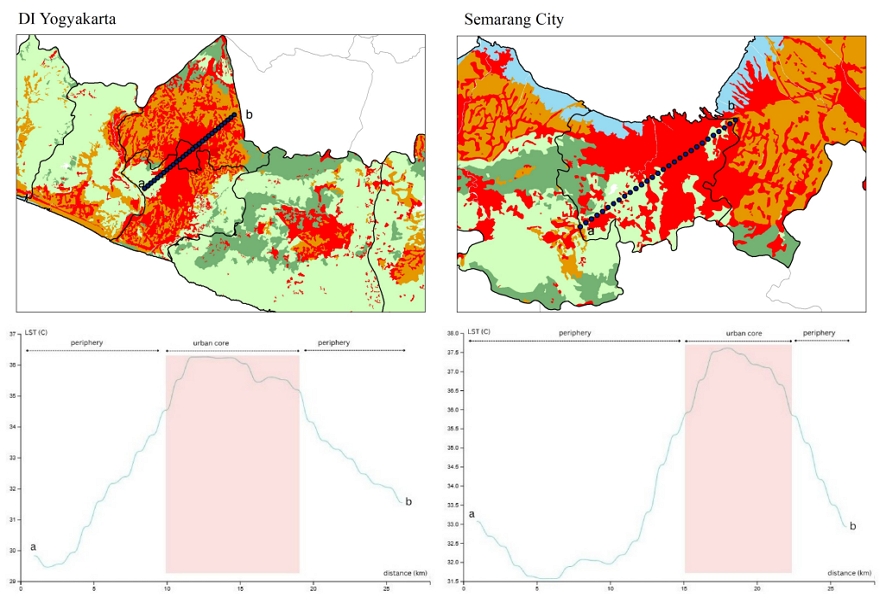
To further illustrate the LST variation between urban cores and peripheries, Semarang (northern coastal city) and Yogyakarta (southern coastal city) were analyzed as study cases (Fig. 6.). The LST of Yogyakarta’s peripheries value between 30 and 33℃, while the city center peaks at around 36℃, indicating a difference of at least 3~6℃. The urban core of Semarang reaches almost 38℃, while the surrounding areas range between 32 and 34℃, indicating a 4~6℃ difference. This indicates that Semarang not only has a slightly higher overall LST but also a narrower vegetation-related cooling effect compared to Yogyakarta. The hinterland of Yogyakarta is more densely vegetated, especially in the nearby areas of Kulon Progo and Gunungkidul. The temperature difference between urban cores and surrounding areas is evident from these transect lines.
LST trend in different types of land cover (2023)
These patterns support H2 and demonstrate that geographic location, urban density, and vegetation cover characteristics contribute to the spatial distribution of LST in Java’s coastal cities.
4.3. Model Selection and Diagnostic
The results of the diagnostic tests are presented in Table 3. to verify the regression model’s assumptions. The normality test for the residuals produced an adjusted chi-square value of 2.58 (p=0.2755), indicating that the residuals are normal at a 5% significance level. To assess multicollinearity, a Variance Inflation Factor (VIF) statistic was calculated. The overall mean VIF was 4.24, and all VIF values were below 10, suggesting low-moderate multicollinearity which does not bias the coefficient estimates.
Statistical test summary and modelling test
The Breusch-Pagan test for heteroskedasticity gave a chi-square value of 9.44 and a p-value of 0.2011, suggesting that residuals follow a stationary distribution across observations. On the other hand, the Wooldridge test for autocorrelation suggested that there was serial correlation present, with an F-stat of 9.23 and a p-value of 0.0031. Therefore, robust standard errors were used in the model estimation.
In terms of model selection, the Chow test confirmed the appropriateness of using the FEM over pooled OLS, with an F-statistic of 7.02 and a p-value of 0.0000. The Breusch-Pagan Lagrange Multiplier (LM) test also supported the use of the REM over pooled OLS, as shown by a chi-square value of 48.37 and a p-value of 0.0031. Lastly, the Hausman test indicated that FEM is preferred over REM, with a chi-square value of 34.04 and a p-value of 0.0001. Based on these results, the FEM was selected as the most suitable model for this study.
4.4. The Effect on LST
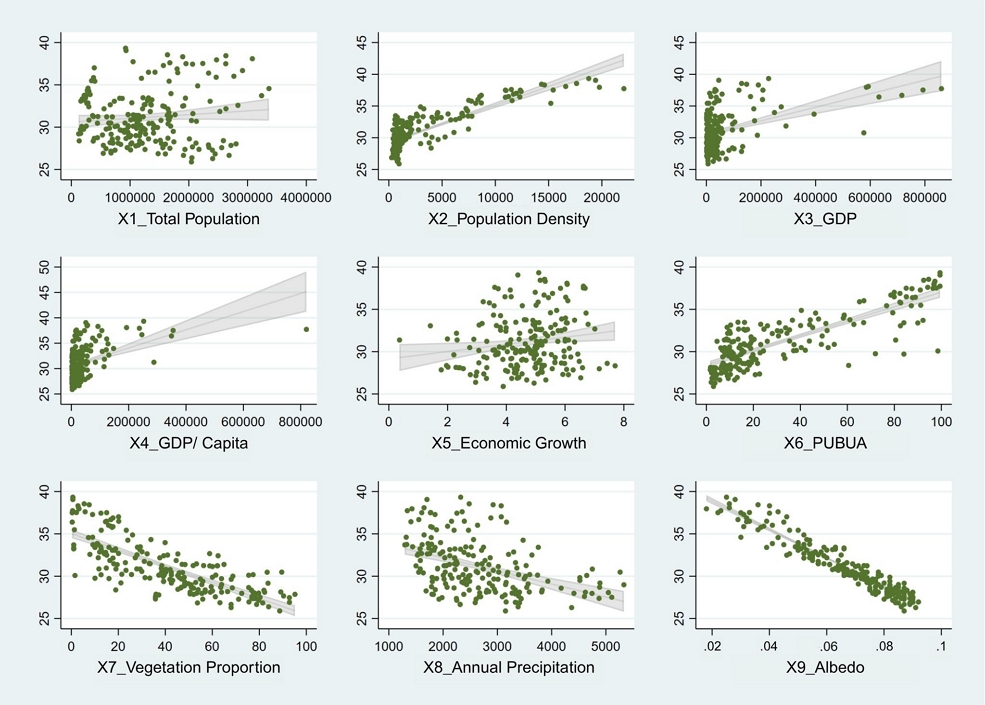
To provide an initial understanding of the relationships between explanatory variables and LST, scatter plots were generated for each predictor (Fig. 7.). Despite some variability in strength across variables, notably with the economic-related variables displaying more variable distributions, all plots show a positive relationship for total population, population density, GDP, GDP/capita, and PUBUA variables, while LST is negatively correlated with the proportion of vegetation and annual precipitation. The average albedo showed the strongest negative correlation, indicating that as LST decreases, the surface reflectivity increases. These bivariate relationships provide initial insight into potential relationships and establish the basis for further regression analysis of each of these variables’ influence on LST, which can be analyzed with panel regression.
Data distribution
Based on the Table 4., panel regression model demonstrates strong explanatory power, with an R-squared within value of 0.6136, meaning that over 61% of the variation in LST across time within cities is explained by the included variables. The overall R-squared reaches 0.9323, indicating high reliability in capturing spatial and temporal factors influencing surface temperature across Java’s coastal cities.
Panel regression result
Of the urban characteristics, population density shows a positive association with LST (β=0.00017). This indicates that for every additional 1,000 people/km2, there is an estimated 0.17℃ increase in LST. The distribution in Fig. 7. shows that areas with population density below 5,000 people/km2 could maintain LST under 35℃. A 5,000 increase in population density could add 0.85℃ or more, pushing beyond this threshold. Economic growth also has a significant positive relationship with LST (β=0.0988), indicating that a 1% increase in economic activity leads to increased LST, likely by adding physical infrastructure and industrial growth or energy use. To mitigate this effect, future development strategies could incorporate a shift toward a green economy, emphasizing efficient and renewable energy.
Moreover, land cover variables have a significant influence on LST. Specifically, a negative correlation was explored for the vegetation proportion and LST (β=-0.01056), which indicated that as the proportion of vegetative cover increases by 10%, LST would decrease by 0.1℃. The data distribution further shows that maintaining 30~40% vegetation cover generally keep LST below 33℃. This highlights the importance of integrating minimum vegetation in dense area where heat pressure is already high.The non-significant PUBUA results may relate to interactive effects occurring across the other spatial variables.
Total annual precipitation showed a negative relationship with LST (β=–0.0001887), meaning that as annual precipitation increases by an additional 100mm, LST will decrease by approximately 0.019℃. Similar to precipitation, average albedo also has a negative influence (β=–12.401), where a 0.1 increase in urban reflectance would result in an estimated 1.24℃ decrease in LST. This suggests that strategies such as reflective roofing, bright pavements, or cool materials could mitigate heat, potentially lowering LST by over 1℃. These results support Hypothesis 3 in showing that multiple urbanization indicators, as well as environmental factors, have an important role in influencing LST, whether it has increased heat or mitigated the heat trends.
The year-by-year OLS regression results reveal how these relationships have evolved over time (Table 5.). In 2000, only climatic factors, including rainfall and albedo, were significantly associated with LST, suggesting that environmental conditions dominated during the early stages of urban growth. By 2010, human-driven factors such as PUBUA also became significant. In 2023, the model reflects an even more complex dynamic, with urbanization factors including population density, economic growth, and vegetation proportion showing significant effects alongside climatic variables. This progression supports H4, which posits that the strength and direction of the relationship between urban development and LST vary over time.
OLS Regression of each observed year
5. Discussion
This study demonstrates that urban development has reshaped land cover and intensified LST across Java’s coastal cities, particularly along the northern industrial corridor. The average amount of vegetation loss was 15% and in some mid-sized cities, this amount exceeded 20%, which further highlights that development pressures are increasing outside metropolitan areas. Greater LST which is around 35~38℃ in large cities such as Jakarta, Semarang, and Surabaya, is associated with these changes. Collectively, these trends highlight as urbanization increases, so does the exposure to heat, pointing to the need for climate-responsive planning and for integrating land-use management.
By applying several socioeconomic and climatic factors using a temporal panel regression framework, this study confirms global findings that link urbanization to LST. This study finds that population density is one of the strong driver of LST in tropical coastal contexts (β=0.00017), whereas [20] included population density among urban form indicators in European cities and found a slightly low influence. Economic growth and LST have a positive but less investigated, relationship (β=0.0988), which further suggests that expansion driven by development may increase thermal exposure if adequate environmental protections are not in place.
In accordance with findings from Jeju [21] and [34], where NDVI and LST correlations reached r=-0.74 and r=-0.591, respectively, vegetation exhibits a significant cooling effect (β=-0.01056). In addition, this study supports the idea that higher annual rainfall lowers surface temperatures (β=–0.00018), which is consistent with [35], who observed rainfall events increased evapotranspiration in vegetated areas, lowering daily maximum air temperatures by more than 1℃. In line with research [22], a 0.1 increase in average albedo decreased LST across different urban types by 0.24℃. Surface albedo has shown a strong cooling effect (β=–12.4008). This study discovered that built-up expansion across Java’s coastal cities was resulted from the conversion of cropland and sparse vegetation land use classes, particularly in satellite and medium-sized cities. These sites experienced vegetation loss higher than the major metropolitan cores, visible from development pressure and selective targeting of land in surrounding regencies. The analysis indicates that land conversion is based on expansion not only from residential uses but also on large-scale infrastructure and industry development under Indonesia’s National Strategic Projects (PSN). One of those national projects is the construction of Industrial zones in Kendal, the Rebana Metropolitan area, and the Java Integrated Industrial Port Estate (JIIPE) in Gresik, all which replaced vast areas of vegetative cover. These events contribute to a further rise in housing and services for workers, resulting in additional growth, as well as displacement, aside from land clearing from the construction of power plants at Batang, Cirebon, Indramayu, and Pacitan on both coastlines. This is consistent with recent studies, which stated that more than 50% of urban expansion in Java by 2045 will occur in non-metropolitan locations [36]. Furthermore, the rise of urbanization in non-metropolitan space occurs under conditions where cropland and sparse vegetation dominate the areas, given their availability and affordability.
LST is generally higher over Java’s northern coastline than its southern coastline. These differences can be reflective of differences in development priorities, land use, topography, and climate. The northern part serves as Java’s industrial and logistics corridor with flat terrain, significant urban areas, and extensive transportation infrastructure, all of which are conducive to higher LST. Meanwhile, the southern part is more rugged and largely used for agriculture, national parks, and tourism, all of which help moderate temperatures. Cities such as Pacitan and Kebumen, which are higher and more vegetated, maintain cooler profiles. The observed drops of LST in 2010 may be related to the slower rate of urbanization followed by extensive infrastructure investment of PSN, which start in 2014. While this study have not examined this effect in this study, climatic variations such as La Niña may also influence this trend. These results suggest that regional thermal dynamics oscillate in response to policy-driven developments, and geographic features on man-made features influence thermal variations.
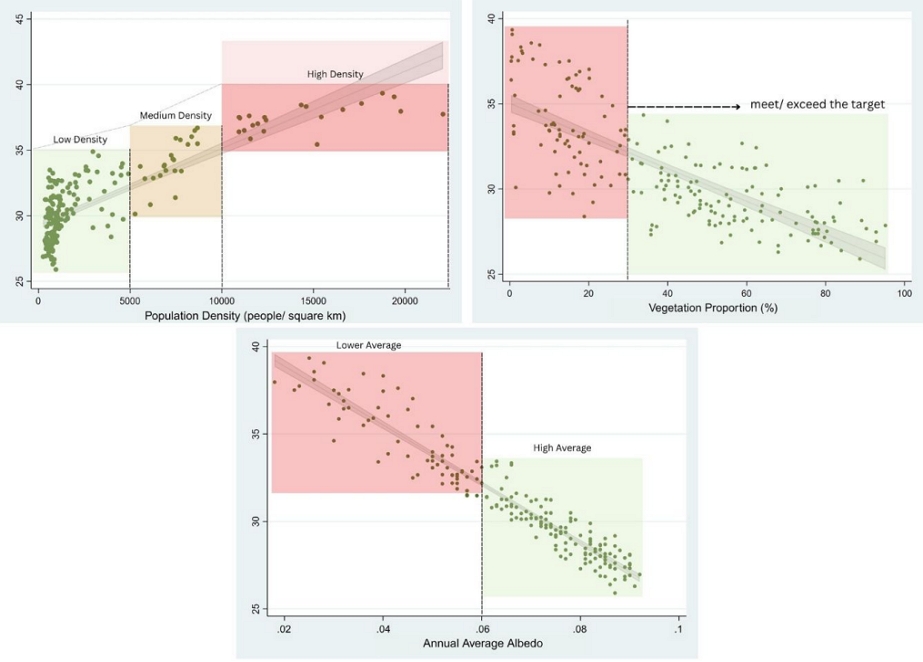
Using the research results, this study suggests strategic policies based on population density thresholds to more effectively mitigate urban heat risks. Fig. 8. indicates that cities with population density below 5,000 people/km2 tend to maintain lower and more controllable LST, suggesting the importance of keeping urban density within this threshold where feasible. However, controlling population density directly is challenging, different adaptation strategies are needed. Urban areas with population density greater than 10,000 people/km2, like DKI Jakarta, Tangerang, Bekasi, and Yogyakarta, all show a spread LST pattern and therefore, their meaning is associated with the complexity of driving factors creates challenges for managing urban heat. Adaptations such as vertical greening, reflective calm roofing materials, green roofing, and light pavement surfacing must be put in place. Moreover, managing vegetation connectivity and cooling by restructuring urban forest patches at a small scale and applying structure-forming ecological corridors could be one option [2]. Nationally, a long-term scheme to relocate the capital city, Jakarta, to Nusantara has also been developed as one of the attempts to respond densification, as well as environmental issues in Jakarta [37]. Meanwhile, medium population density cities from 5,000 to 10,000 people/km2, like Cirebon, Pekalongan, Semarang, Blitar, Malang, and Surabaya, are expected to control density before it reaches a critical level. Those cities need to continue to invest in their green space budgets, developing the vegetation network and links to help manage urban heat. Finally, also for cities with a lower density of below 5,000 people/km2, including Cilegon, Lebak, Ciamis, Jepara, Demak, and Sidoarjo, it remains essential to maintain the existing green spaces, including national parks such as Ujung Kulon and Baluran, to retain ecological stability and reduce urban heat, without compromising diversity and tourism.
Population density, vegetation proportion, and average albedo threshold
At present, Law No. 26 of 2007 on Spatial Planning is the most prevalent regulation for green space in Indonesia and determines a proportional obligation of 30% of land to be allocated to green space. However, reaching a percentage without effective quality guidelines, green configuration, and connectivity is inadequate to effectively mitigate urban heat. Furthermore, national green space management is still redundantly overlapped amongst some public agencies, which causes occasional inconsistencies that complicate its planning, management, and maintenance. As indicated in Fig. 8., in cities with coverage above the 30 percent threshold, especially around medium and low-density coastal areas, the priority should be to conserve existing green space and improve connectivity through green corridors especially in association with adjacent and nearby national parks. In cities below the 30 percent target, the priority should be on improving quantity and quality of vegetation through the creation of parks, planting street trees, and using native and drought-tolerant plants [2]. Moreover, the “compensation” principle should be strictly applied to ensure that any lost vegetation due to urban development is replaced by an equivalent or larger area of artificial or restored greenery, thereby mitigating urban heat issues [5]. Lastly, it is acknowledged that any policy implications, especially in developing settings like Indonesia, depend on the political will. It is highly recommended to secure a green investment budget for vegetation planning as part of larger urban development strategies.
To provide a consistent, city-level indicator of surface reflectivity across Java’s coastal urban areas, this study utilized annual average albedo values, which are computed from pixel averages throughout the city. Although this oversimplifies the variety of surface materials, it can capture the broad range of variations in urban surface properties that affect heat accumulation. As shown in Fig. 8., this study investigated a strong negative correlation between annual average albedo and LST. Higher albedo cities exhibit a denser and more stable distribution. In contrast, lower albedo cities display a dispersed and fluctuating LST pattern. The use of light-colored roofing, reflective coatings, light pavements, and watered contained elements with high reflectance qualities are all workable ways to improve urban albedo, especially for cities with low average albedo (Jakarta, Bekasi City, Surabaya, Semarang). However, for the high average albedo cities (Cilegon, Indramayu, Malang, Kulon Progo), adapting these strategies offer rapid and scalable options, but focusing to the more sustainable solution is important. Moreover, for materials adjustment, their lasting environmental benefits are limited when compared to urban green spaces, which provide ongoing cooling effects as well as several co-benefits, including improved air quality, reduced ecological stressors, increased physical activity, and enhanced social cohesion [22]. As the benefits of plant growth and shade improve over time, cities should consider reflective materials as part of a long-term investment in urban greening for heat mitigation.
This research suggested that both economic growth and rainfall drive LST. Economic growth drives heat from construction and energy use, which urge a climate or green economy that allows for development but also allows reflection to have a sustainable impact. Precipitation provides cooling through evapotranspiration, but it is not a controllable cooling, and extreme weather events, such as El Niño and La Niña, produce temperature anomalies to demonstrate the effects of climate variability on urban heat [25]. This research indicates that heat management/mitigation strategies should focus on controllable characteristics such as population density, green economic growth, complex vegetation cover, and the potential to create an improved surface albedo through highly reflective materials. Together, these vital characteristics could provide a more panoptic approach to thermal management in quickly evolving coastal urban environments
6. Conclusion
The conversion of cropland and sparse vegetation was the main driver of urban expansion in Java’s coastal cities between 2000 and 2023. The region saw an average 15% loss in vegetation, with highest losses for 20% in mid-sized cities like Tangerang and Sleman. About 29.2% of sparse vegetation (5,922km2), 17.4% of cropland (4,151km2), and 2.7% of dense vegetation (324km2) were converted to built-up areas during 23-year period of the observed region. LST trends show a distinct north-south gradient: in 2023, peak temperatures reached up to 38℃, while northern coastal cities like Jakarta, Semarang, and Surabaya saw average LST increases of 0.7~1℃. In contrast, southern cities like Yogyakarta and Malang saw smaller increases of 0.1 to 0.5℃, remaining below 35℃. In example cities such as Yogyakarta and Semarang, urban cores were 3~6℃ hotter than vegetated peripheries, highlighting the cooling role of green areas. Although 34 out of 68 cities met the national 30% vegetation requirement, many green spaces were fragmented which limited their cooling benefits.
The panel regression findings emphasize important elements influencing LST in coastal cities of Java. A rise of 1,000 people/km2 in population density correlates with an estimated 0.17℃ increase in LST, indicating the heat impact from more concentrated urban areas. In addition, a 1% increase in economic growth is associated with a corresponding increase in LST of approximately 0.1℃. On the other hand, a 10% increase in vegetation cover lowers LST by roughly 0.1℃. the cooling influence of precipitation is emphasized, suggesting that a 100 mm increase in rainfall corresponds with an associated decrease of 0.019℃ in LST that illustrates the significance of climatic factors. The significant effect of reflective surfaces was also illustrated with an estimated 0.1 increase of albedo lower LST by 1.24℃.
This study reinforces that addressing urban heat is dependent on integrated and site-specific approaches that exceed the fulfillment of vegetation threshold. Findings show that cities with high population density ( >10,000 people/km2) are facing a greater challenge in controlling LST as a result of disconnected green space and limited land available. The consideration of vertical greening, reflective roofing, cool pavements, and reorganizing urban forests to increase connectivity is paramount in those areas. Medium-density cities (5,000~10,000 people/km2) should focus on expanding parks and vegetation networks as a means of preventing existing thermal risks from worsening. Low-density cities should focus on natural landscapes and ecological assets remaining intact. While Indonesia’s Law No. 26/2007 requires a minimum of 30% green space, improving vegetation quality, spatial variability, and connectivity guideline is needed for more impactful implementation. The compensation balance principle must be applied to ensure that any green space lost to development has been compensated for with replacement green space of equal and/or higher ecological value. Benefiting quickly from multiple material types to increase urban albedo is acceptable in cities with low average albedo, but this needs follow-up investments in urban forestry, which provides both social and environmental value. This knowledge demonstrates the importance of contributing to urban heat reduction, while preparing for climate-resilient urban redevelopment and a transition to a green economy.
This study has several limitations. The use of 30-meter resolution Landsat to define land cover and 1km MODIS data to identify LST, also the analysis of global climatic data such as CHIRPS and MODIS Albedo does not allow to identify detail spatial differences within urban centres and peripheries. Furthermore, although vegetation cover and demographic data were incorporated in this study, the analysis did not account for qualitative aspects such as the continuity and configuration of green networks, cooling potential of riparian zone, pavement types, specific density patterns for buildings, or energy use, all of which are known to greatly impact urban heat. The analysis also did not consider extreme climatic conditions like El Niño and La Niña (ENSO), even though precipitation and albedo were employed as climatic factors. In addition, while basic demographic indicators were included, broader social vulnerability factors affecting heat exposure were not considered. Future research should: 1) use higher resolution spatial data to better analyze micro-spatial variations within cities; 2) consider various climate variability, such as ENSO, to understand the impacts of extreme weather; 3) expand spatial analytics to consider materials, energy consumption trends, urban configuration beyond land cover percentage; 4) integrate social vulnerability indicators such as age, income, and health conditions to better assess population-level heat risks. These improvements will support more reliable applied insights for useful, site-specific polices aimed at reducing urban heat and building a climate-resilient urban place.
Acknowledgments
The author gratefully acknowledges the support of the Korea University Urban Laboratory (KUUL) for providing academic guidance and resources throughout this study.
References
- United Nations, Make cities and human settlements inclusive, safe, resilient, and sustainable, United Nations, 2024.
-
Y. Guo et al., Dynamic evolution of PM2.5 removal by urban forests during rapid urbanization: From forest landscape pattern dominance to impervious surfaces, Journal of Cleaner Production, 493, 2025, 144930.
[https://doi.org/10.1016/j.jclepro.2025.144930]

-
H.T. Hang, M.J. Alshayeb, Technological innovations in urbanization and land surface temperature analysis: A remote sensing and machine learning case study of Delhi, Environmental Technology and Innovation, 38, 2025, 104164.
[https://doi.org/10.1016/j.eti.2025.104164]
-
X. Li et al., Revisiting urban heat island effects in China: Multi-satellite evidence from the ESA-CCI land surface temperature product, Sustainable Cities and Society, 123, 2025, 106281.
[https://doi.org/10.1016/j.scs.2025.106281]
-
S. Liu et al., Optimizing green space configuration for mitigating land surface temperature: A case study of karst mountainous cities, Sustainable Cities and Society, 125, 2025, 106345.
[https://doi.org/10.1016/j.scs.2025.106345]
-
B. Bekele et al., Urban expansion-induced land use land cover changes and the subsequent changes in ecosystem service and land surface temperature in the central highland of Ethiopia, Environmental and Sustainability Indicators, 26, 2025, 100626.
[https://doi.org/10.1016/j.indic.2025.100626]
-
J. Li et al., Contrasting temporal dynamics of land surface temperature responses to different types of forest loss, The Innovation, 6(6), 2025, 100875.
[https://doi.org/10.1016/j.xinn.2025.100875]
-
Y. Huang et al., Spatiotemporal patterns and influencing factors of urban ecological space availability in coastal cities of China during rapid urbanization, Ecological Indicators, 154, 2023, 110757.
[https://doi.org/10.1016/j.ecolind.2023.110757]
-
P.A. Sandifer, G.I. Scott, Coastlines, coastal cities, and climate change: A perspective on urgent research needs in the United States, Frontiers in Marine Science, 8, 2021. 631986.
[https://doi.org/10.3389/fmars.2021.631986]
-
G. Graells et al., A review on coastal urban ecology: Research gaps, challenges, and needs, Frontiers in Marine Science, 8, 2021, 617897.
[https://doi.org/10.3389/fmars.2021.617897]
-
L. Dsikowitzky et al., Java Island, Indonesia, in Sheppard C, editor, World Seas: An environmental evaluation. Volume II: The Indian Ocean to the Pacific, Amsterdam: Elsevier, 2018, pp. 459-490.
[https://doi.org/10.1016/B978-0-08-100853-9.00029-4]
-
W. Chen et al., Measuring heat transfer index (HTI): A new method to quantify the spatial influence of land surface temperature between adjacent urban spaces, Sustainable Cities and Society, 122, 2025, 106268.
[https://doi.org/10.1016/j.scs.2025.106268]
-
M. Nastran, M. Kobal, K. Eler, Urban heat islands in relation to green land use in European cities, Urban Forestry and Urban Greening, 37, 2019, pp. 33-41.
[https://doi.org/10.1016/j.ufug.2018.01.008]
-
Y. Song et al., Linking spatiotemporal variations in urban land surface temperature to land use and land cover: A case study in Hangzhou City, China, Ecological Indicators, 173, 2025, 113336.
[https://doi.org/10.1016/j.ecolind.2025.113336]
-
S. Zhang et al., A cross-scale indicator framework for the study of annual stability of land surface temperature in different land uses, Sustainable Cities and Society, 116, 2024, 105936.
[https://doi.org/10.1016/j.scs.2024.105936]
-
A. Roy et al., Land surface temperature anomalies as indicators of urban land cover change—A study of two Indian cities, Earth Science, Systems and Society, 4, 2024,10096.
[https://doi.org/10.3389/esss.2024.10096]
-
X. Sun et al., Impact of urban green space morphology and vegetation composition on seasonal land surface temperature: A case study of Beijing’s urban core, Urban Climate, 60, 2025, 102367.
[https://doi.org/10.1016/j.uclim.2025.102367]
-
J. Li, Y. Yan, R. Stouffs, Simulating land surface temperature impacts of proposed land use and land cover plans using an integrated deep neural network approach, Energy and Buildings, 332, 2025, 115437.
[https://doi.org/10.1016/j.enbuild.2025.115437]
-
Q. Zhang et al., Revealing the dynamic effects of land cover change on land surface temperature in global major bay areas, Building and Environment, 267, 2025, 112266.
[https://doi.org/10.1016/j.buildenv.2024.112266]
-
Y. Ren et al., Understanding the coupling effect of multiple urban features on land surface temperature in Europe, Urban Forestry and Urban Greening, 105, 2025, 128723.
[https://doi.org/10.1016/j.ufug.2025.128723]
-
M.F.U. Moazzam, Y.H. Doh, B.G. Lee, Impact of urbanization on land surface temperature and surface urban heat island using optical remote sensing data: A case study of Jeju Island, Republic of Korea, Building and Environment, 222, 2022, 109368.
[https://doi.org/10.1016/j.buildenv.2022.109368]
-
I.A. Smith, M.P. Fabian, L.R. Hutyra, Urban green space and albedo impacts on surface temperature across seven United States cities, Science of the Total Environment, 857, 2023, 159663.
[https://doi.org/10.1016/j.scitotenv.2022.159663]
-
F. Rodríguez-Gómez et al., URSUS_LST: URban SUStainability intelligent system for predicting the impact of urban green infrastructure on land surface temperatures, Environmental Modelling & Software, 186, 2025, 106364.
[https://doi.org/10.1016/j.envsoft.2025.106364]
-
F.F.K. Imroah, N. Setiawan, Integration of Landsat-8 OLI/TIRS and Sentinel-1A PolSAR for analyzing land surface temperature and its anomalies linked to ENSO in Surakarta, Indonesia, Geomatica, 76(2), 2024, 100038.
[https://doi.org/10.1016/j.geomat.2024.100038]
-
A. Nurwanda, T. Honjo, The prediction of city expansion and land surface temperature in Bogor City, Indonesia, Sustainable Cities and Society, 52, 2020, 101772.
[https://doi.org/10.1016/j.scs.2019.101772]
-
M. Mokarram, F. Taripanah, T.M. Pham, Investigating the effect of surface urban heat island on the trend of temperature changes, Advances in Space Research, 72(8), 2023, pp. 3150-3169.
[https://doi.org/10.1016/j.asr.2023.06.048]
-
N. Farid et al., Monitoring the impact of rapid urbanization on land surface temperature and assessment of surface urban heat island using Landsat in megacity (Lahore) of Pakistan, Frontiers in Remote Sensing, 3, 2022, 897397.
[https://doi.org/10.3389/frsen.2022.897397]
-
T. Sun, R. Sun, L. Chen, The trend inconsistency between land surface temperature and near surface air temperature in assessing urban heat island effects, Remote Sensing, 12(8), 2020.
[https://doi.org/10.3390/rs12081271]
-
Huang, S et al., Urbanization-induced spatial and temporal patterns of local drought revealed by high-resolution fused remotely sensed datasets, Remote Sensing of Environment, 313, 2024, 114378.
[https://doi.org/10.1016/j.rse.2024.114378]
-
M. Yong, K.H. Lim, Urban heat islands: Beating the heat with multi-modal spatial analysis, arXiv:2012.03049, , 2020.
[https://doi.org/10.1109/BigData50022.2020.9378391]
- Encyclopaedia Britannica, Java, island, Indonesia, Encyclopaedia Britannica, 2024.
-
A.S.N. Syaban, S. Appiah-Opoku, Building Indonesia’s new capital city: An in-depth analysis of prospects and challenges from current capital city of Jakarta to Kalimantan, Urban, Planning and Transport Research, 11(1), 2023.
[https://doi.org/10.1080/21650020.2023.2276415]
-
B.H. Baltagi, Econometrics, 6th ed., London: Springer Nature, 2021.
[https://doi.org/10.1007/978-3-030-80149-6]
-
M. Cetin et al., Determination of land surface temperature and urban heat island effects with remote sensing capabilities: The case of Kayseri, Türkiye, Natural Hazards, 120(6), 2024, pp. 5509-5536.
[https://doi.org/10.1007/s11069-024-06431-5]
-
J.A. Acero et al., Impact of rainfall on air temperature, humidity and thermal comfort in tropical urban parks, Urban Climate, 56, 2024, 102051.
[https://doi.org/10.1016/j.uclim.2024.102051]
-
A.E. Pravitasari et al., Dynamics and predictions of urban expansion in Java, Indonesia: Continuity and change in mega-urbanization, ISPRS International Journal of Geo-Information, 13(3), 2024, 102.
[https://doi.org/10.3390/ijgi13030102]
-
I. Zainal et al., Relocating or retaining the capital city of Jakarta—Evaluation of the feasibility, sustainability, and strategic planning of Indonesia in facing the challenges of relocating the national capital from a multidimensional perspective, Journal of Infrastructure, Policy and Development, 9(1), 2025.
[https://doi.org/10.24294/jipd10920]