Hybrid Modular Supply System : A Resilient Strategy for Post-Conflict Kharkiv
ⓒ 2025. KIEAE all rights reserved.
Abstract
This study aims to propose a hybrid modular supply system for the reconstruction of Kharkiv, a city severely damaged by war. The primary objective is to establish a resilient and resource-efficient urban recovery model that integrates rapid shelter provision with long-term adaptability. By addressing both immediate housing needs and sustainable urban regeneration, the system aspires to provide a scalable framework applicable to various post-conflict contexts.
The research employs a qualitative methodology combining literature review, precedent analysis, and comparative case study. Three urban recovery models—Kharkiv’s hybrid modular system, Aleppo’s post-war redevelopment, and Seoul’s incremental regeneration—were systematically examined to identify operational processes, strengths, and limitations. These insights were synthesized into a framework that grounds the proposed strategy. Building on this analytical foundation, the hybrid modular approach is articulated as a design-based proposal, integrating off-site supply (factory-based prefabrication of structural cores) with on-site supply for flexible assembly and progressive expansion. This dual system also considers partially functioning infrastructure and the adaptive reuse of construction yards.
The hybrid system demonstrates efficiency in both speed and scalability. Off-site manufactured cores allow for rapid deployment of safe shelters, while on-site assembly supports incremental growth that accommodates diverse household needs. Furthermore, by incorporating environmentally sustainable practices such as resource-efficient construction and adaptive reuse, the system enhances long-term resilience. This framework not only addresses Kharkiv’s urgent housing crisis but also provides a transferable model for resilient urban regeneration in post-conflict environments worldwide.
Keywords:
Hybrid Modular Supply System, Resilient Urban Recovery, Environmental Sustainability, Resource-Efficient Urban Regeneration1. Introduction
Kharkiv is a major city in eastern Ukraine that carries the dual legacy of Soviet-era high-density housing and industrial infrastructure. Following the Russian invasion in 2022, widespread destruction occurred, particularly in the northern residential areas. Many residential buildings were either partially collapsed or left with only skeletal structures and fragmented infrastructure. In this context, conventional post-war reconstruction methods—often reliant on complete demolition and resource-heavy redevelopment—are neither time-efficient nor adaptable to evolving community needs. For instance, post-war redevelopment in Aleppo, Syria, involved large-scale demolition and long reconstruction timelines with limited resident participation [4,5].
To address this multifaceted crisis, architecture must offer strategies that are both temporally agile and socially resilient. The hybrid modular supply system proposed in this study is positioned at the intersection of rapid deployment and spatial adaptability. It combines off-site prefabricated core units with on-site expandable modular components, enabling fast initial habitation and long-term flexibility.
Moreover, the strategy is not solely a technical solution. It is rooted in the belief that rebuilding cities must involve reconstructing lives — which means recognizing and responding to the needs of displaced populations, reactivating social infrastructure, and fostering community participation from the earliest stages of recovery. By leveraging modular architecture, this study explores how Kharkiv’s urban fabric can be restructured to support a return to daily life, while laying the groundwork for a sustainable and community-driven future.
This paper outlines the contextual challenges of Kharkiv, introduces a hybrid modular design strategy, and evaluates its application through construction phasing, community space integration, and comparative case analysis in 3 and 4. The ultimate aim is to contribute a replicable and adaptive model for post-conflict residential recovery.
2. Theoretical Framework
This section explores the theoretical framework that informs the proposed hybrid modular strategy, focusing on three key domains: modular construction methods, urban recovery after disasters, and the role of community participation in spatial design. To ground these concepts, the chapter concludes with a comparative analysis of precedent cases from Aleppo, Seoul, and Kharkiv—each demonstrating distinct approaches to urban reconstruction under different constraints.
2.1. Modular Architecture and Industrialized Construction
The concept of modular construction dates to early modernist visions such as Le Corbusier’s Domino system, which promoted structural rationalism and spatial repetition. In the 1960s and 70s, this idea evolved into urban-scale proposals [6] like Archigram’s Plug-in City and the Japanese Metabolist movement, which emphasized flexibility and metabolic growth. In recent decades, modular architecture has gained renewed relevance, especially in emergency housing and large-scale urban infill. Prefabrication allows for faster assembly, consistent quality [2], and reduced environmental impact—qualities well suited for post-conflict settings [3,4,7].
2.2. Post-Disaster Urban Recovery
Reconstruction is not merely about physical rebuilding but about restoring the functionality, memory, and identity of cities. Alexander (1977) emphasized the importance of reconnecting living systems, suggesting that recovery efforts must prioritize social infrastructure and daily life routines over formal or aesthetic goals [1]. Vale and Campanella (2005) argue that post-disaster urbanism must avoid “build back better” clichés and instead enable locally rooted, flexible, and participatory recovery processes [5,10]. Post-earthquake recovery in Kobe, Japan, and post-tsunami reconstruction in Tōhoku exemplify the need for flexible, community-centered approaches [1].
2.3. Community and Spatial Design
Recent architectural discourse highlights the significance of public space and shared infrastructure in healing social wounds after displacement [8]. Adaptive reuse of war-affected areas—such as converting former industrial grounds or temporary assembly yards into civic spaces—has become a strategic move in post-conflict design. This study integrates such ideas by proposing shared decks, communal shelters, and gradual transformation of production sites into community nodes as part of the design framework.
Together, these theoretical perspectives inform the hybrid modular system proposed for Kharkiv: a strategy that seeks not only to house people, but to rebuild spatial dignity, social coherence, and urban resilience [11].
2.4. Comparative Strategies in Practice
To reinforce the relevance of the proposed design framework, it is helpful to examine comparable urban reconstruction strategies from different global contexts. While theoretical discourse informs the core ideas of modularity and community-centered recovery, precedent cases provide concrete validation of their effectiveness or limitations.
Table 1. provides a comparative analysis of three urban recovery strategies. Aleppo’s post-war redevelopment is defined by large-scale, government-led reconstruction projects intended to modernize war-damaged districts. Its strength lies in the possibility of comprehensive urban redesign and infrastructure renewal. However, it is heavily dependent on centralized planning and capital, resulting in long delays and limited responsiveness to urgent shelter needs. The effect of this model is the production of formalized urban layouts but often at the expense of timeliness and local participation.

Comparative strategies for urban reconstruction
Seoul’s incremental regeneration model is characterized by gradual, small-scale improvements carried out with strong community involvement. Its strengths include cost efficiency, flexibility, and social cohesion, as residents actively shape their environments. Yet, its weaknesses are evident in its slow pace and limited capacity to handle the scale of destruction seen in post-war contexts. The effect of this approach is steady enhancement of livability and neighborhood identity, but it falls short in providing immediate large-scale housing relief.
In contrast, Kharkiv’s hybrid modular system integrates the rapidity of off-site prefabrication with the adaptability of on-site assembly, allowing both urgent shelter provision and scalable long-term growth. By combining the comprehensive ambition of redevelopment with the participatory adaptability of incremental regeneration, while avoiding their respective weaknesses, the hybrid modular strategy achieves superior outcomes in speed, scalability, sustainability, and resilient community integration.
3. Hybrid Modular Supply System Strategy
This section outlines a three-part design study that addresses the spatial and infrastructural challenges of post-conflict reconstruction. It is organized into three components: (1) the overall design approach, (2) a phased construction scenario encompassing Core → Unit → Expansion, and (3) a strategy for community participation and the transformation of shared spaces.
3.1. Design Approach
The proposed approach consists of Modular Infill, Structural Core Anchoring, and Progressive Growth, as described in detail below.
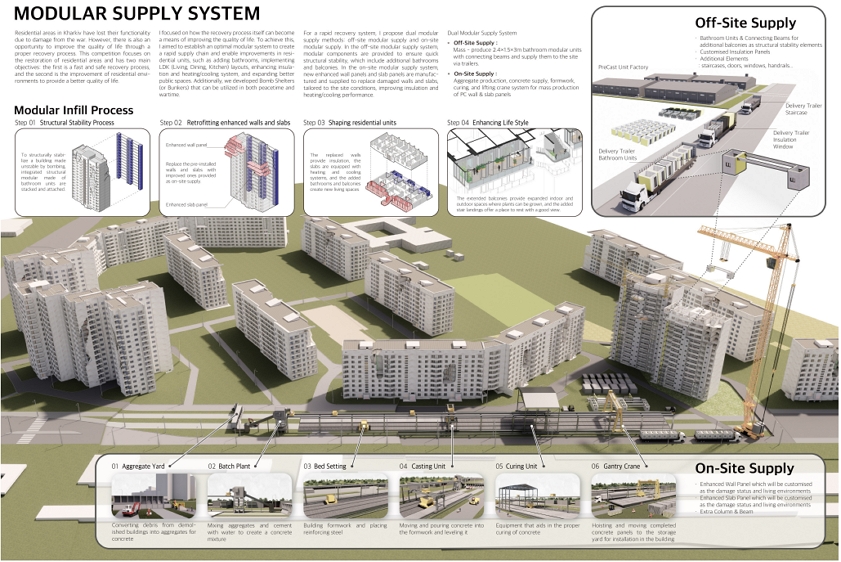
Modular infill refers to inserting factory-made modules into the remains of existing structures. The off-site cores are combined with on-site components to create complete residential units. This dual supply model ensures both rapid deployment and adaptability (Fig. 1.).
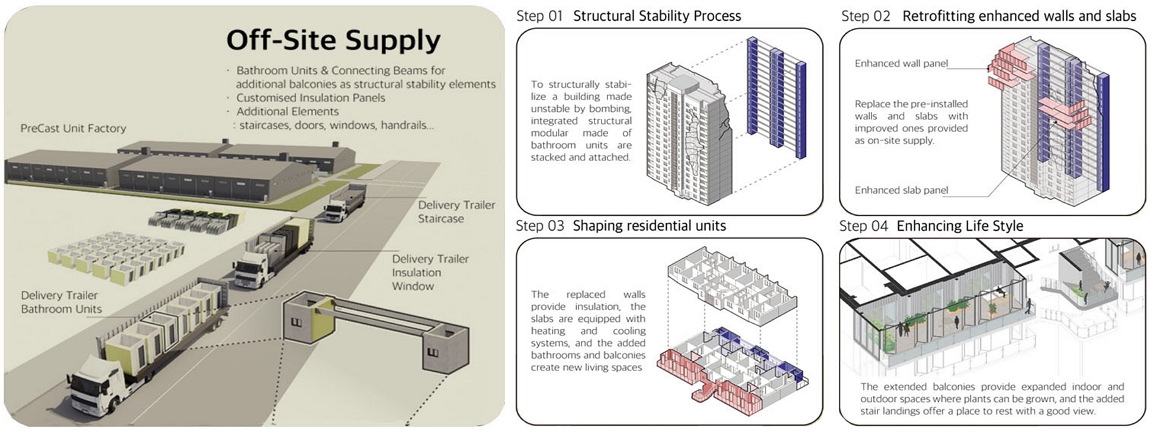
Modular assembly process overview
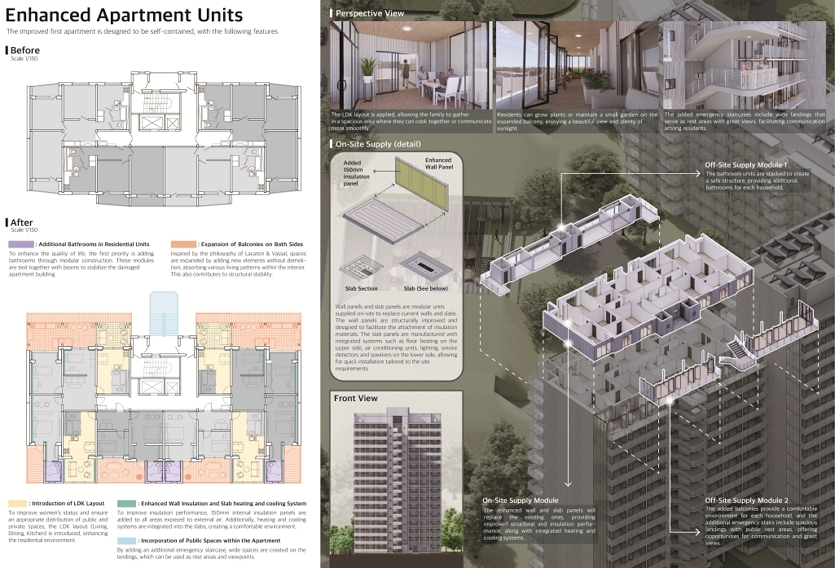
Most apartments in Kharkiv were built during the Soviet era and are characterized by a structural limitation: each household typically has only one bathroom. This constraint poses significant challenges for multi-generational families and affects overall residential convenience. The Structural Core Anchoring strategy proposed in this study aims to fundamentally improve this local housing condition.
In this approach, prefabricated structural cores are produced off-site and rapidly installed on-site. Each core includes essential utilities and bathroom facilities. To address the chronic shortage of bathrooms in existing housing, the strategy introduces additional bathroom units per module, thereby ensuring that each dwelling unit can contain at least two bathrooms—an essential upgrade for improving quality of life.
This approach is expected to deliver the following benefits:
- - Reduces domestic inconvenience and family tensions caused by the one-bathroom layout.
- - Enhances sanitary conditions and increases overall user comfort.
- - Increases the long-term market value and functional potential of each housing unit by offering multiple bathrooms.
The integration of bathroom units into the structural core represents a practical application of modular architecture, especially well-suited for post-conflict cities like Kharkiv, and may be extended to other urban areas facing similar limitations.
The hybrid modular system is designed to begin with the rapid installation of off-site prefabricated structural core units, which provide essential living functions from the outset. Over time, on-site modular expansionis planned to accommodate evolving residential needs. This expansion is not limited to changes in household size, but rather focuses on improving living quality through functional spatial enhancements.
Examples include the separation of bedrooms, the addition of auxiliary bathrooms, and increased storage capacity—all contributing to a more comfortable and adaptable living environment. Modules can be connected either horizontally or vertically, with the structural core ensuring overall stability.
By combining structural integrity with spatial flexibility, this system forms the foundation for transitioning from temporary emergency housing to sustainable, long-term dwellings that respond to both current and future needs.
3.2. Construction Scenario: Core → Unit → Expansion
Table 2. illustrates the phased construction process of the proposed hybrid modular system.
Summary of hybrid construction stages
Stage 1 involves the on-site installation of a prefabricated structural core unit produced off-site. This unit contains essential services such as bathrooms, plumbing, and electrical connections, enabling basic habitability to be established within a single day.
Stage 2 consists of the on-site assembly of wall, floor, and ceiling modules around the core. These modules are designed for rapid connection through standardized joints, allowing for fast and efficient construction of full dwelling units. The modular nature of the system significantly enhances the speed and consistency of assembly.
Stage 3 refers to the horizontal or vertical expansion of the units over time, based on the changing spatial needs of the residents. This allows the initially limited living space to grow progressively, ensuring long-term adaptability without requiring structural demolition or major renovation.
These three stages are not isolated phases but are part of a continuous and expandable process built upon a shared structural framework. In the context of post-conflict reconstruction, this approach enables not only rapid deployment but also sustainable housing solutions that evolve alongside community recovery.
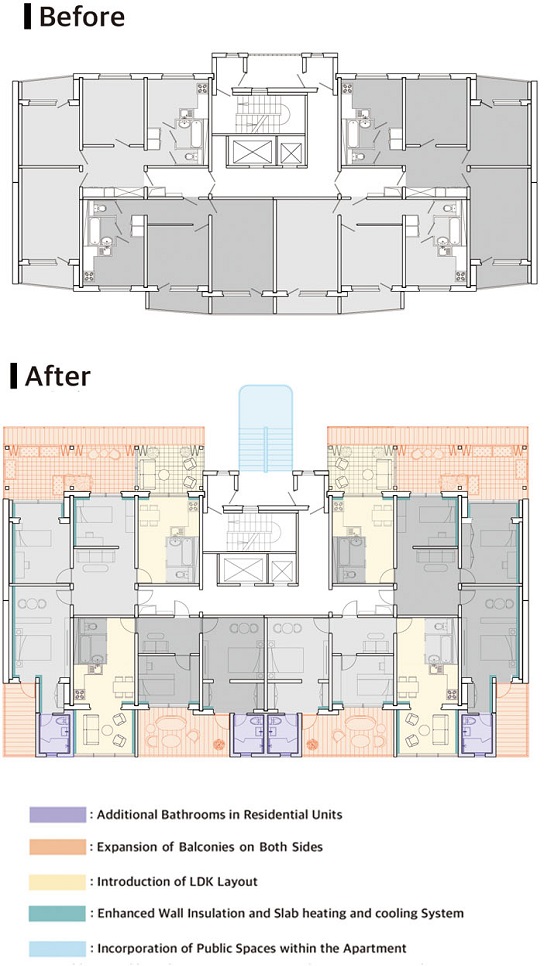
Model of modular growth and community formation
3.3. Community Participation and Shared Space Strategy
This section presents a strategy for transforming the initial modular assembly yard (used for off-site supply and on-site installation) into a community space through active resident participation. This approach extends beyond physical reconstruction by emphasizing the social and symbolic reuse of post-conflict urban space.
By converting the modular construction site into a shared civic area, the place of production is redefined as a site of community regeneration. The strategy unfolds through several phases:
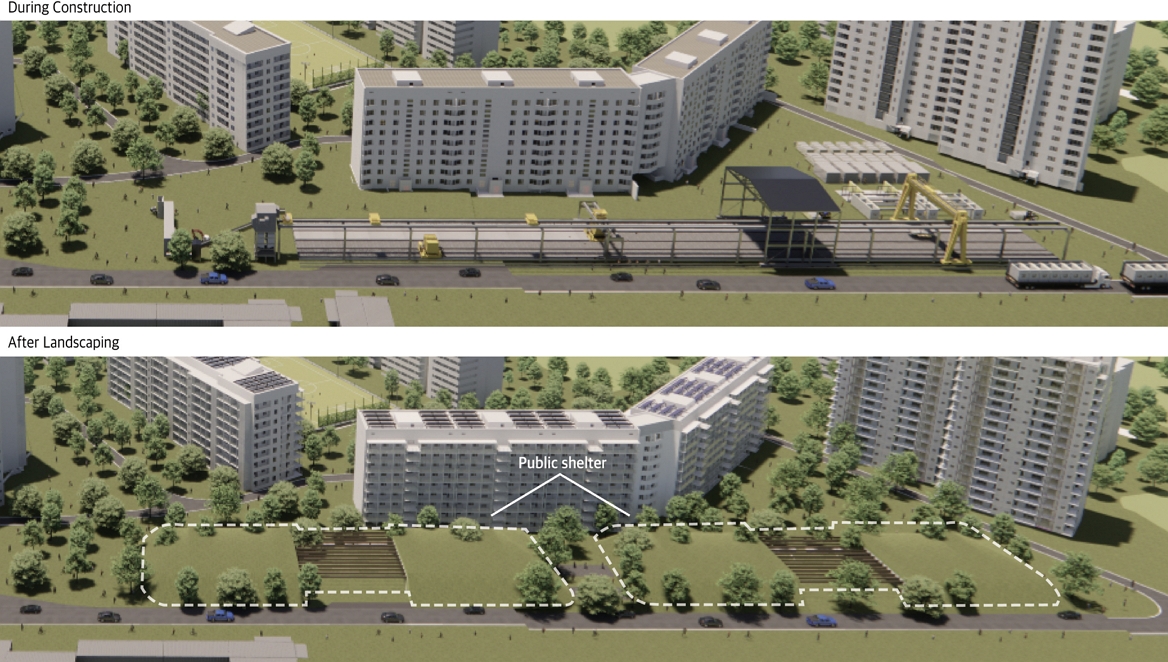
Scenario of transforming the assembly yard into a community space
- Introduction of Shared Shelter Units:
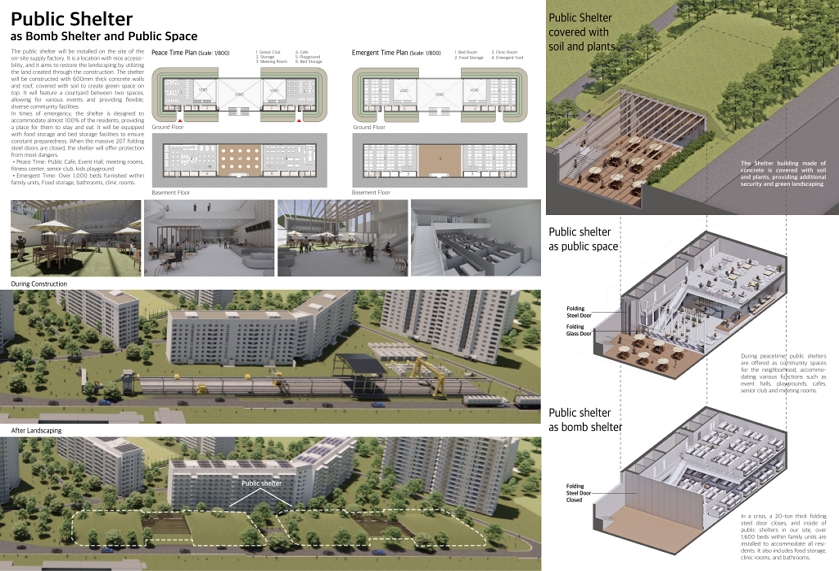
During the initial assembly phase, select modular units are used as communal emergency shelters. These are designed to share essential infrastructure such as sanitation, power, and water, offering basic services in early stages of reoccupation.
- Transformation of Assembly Grounds:
The space originally used for unloading and assembling factory-made modules is seamlessly transformed into a community square, common kitchen, or medical station after the housing installation is complete. This process reflects a design ethos where urban recovery includes the reinterpretation of residual space.
- Formation of Shared Facilities:
Communal amenities such as clean water points, laundry areas, and shared gardens are integrated into the spatial layout. Connecting decks between modules serve not only physical movement but also as symbolic bridges for psychological and social recovery.
The core shelter units serve a collective role in the early stages, allowing for temporary shared refuge. Later, the assembly site becomes a node of shared civic life, embodying resilience through spatial transformation. As one might argue, “Publicness in Kharkiv is not designed, but emerges through the reuse of spaces left behind.”
4. Conclusion
This study proposes a hybrid modular system for the reconstruction of Kharkiv, a city severely damaged by war. The strategy combines off-site supply — in which prefabricated structural cores are manufactured in factories—with on-site supply, allowing for flexible assembly and incremental expansion of residential units. By utilizing remaining structural frameworks and partially functioning infrastructure, this approach ensures both rapid deployment and scalable growth.
Given Kharkiv’s specific conditions — such as the one bathroom layout in most units, fragmented infrastructure, and the simultaneous need for both emergency shelter and long-term settlement — the integration of additional bathroom units into the structural core offers a substantial improvement in living quality, not merely physical restoration.
The system follows a coherent process of modular insertion, structural anchoring, progressive growth, and community-space transformation, enabling a smooth transition from temporary housing to long-term, self-sustaining residential environments.
The primary strengths of the Kharkiv strategy include:
- - Speed: Immediate deployment through off-site manufactured cores.
- - Flexibility: Spatial adaptability through modular expansion.
- - Quality of life enhancement: Addition of bathrooms and expansion of usable floor area.
- - Community regeneration: Conversion of assembly sites into shared public space.
However, several limitations must be acknowledged:
- - Logistical uncertainty: Difficulty securing transportation routes for off-site units in post-conflict conditions.
- - Lack of maintenance systems: Insufficient long-term support for upkeep and repairs.
To address these challenges, the following measures are recommended:
- – Establishment of low-impact logistics routes and temporary transport infrastructure to minimize environmental disruption during deployment.
- – Development of standardized, resource-efficient utility interfaces adaptable to varied on-site conditions, including integration with renewable or decentralized systems.
- – Implementation of local maintenance training programs for technicians and residents to promote long-term sustainability and reduce material waste through community-based upkeep.
Ultimately, this research demonstrates that post-conflict reconstruction is not merely about rebuilding forms, but about redesigning systems of life. The proposed hybrid modular approach provides a replicable, adaptable model for residential recovery—one that can be applied in various war-torn or disaster-affected urban contexts.
Still, practical challenges remain, particularly in transporting prefabricated units through damaged infrastructure and ensuring connections to disrupted utility networks [9]. These factors may affect the immediate feasibility of deployment in unstable environments.
Nevertheless, by minimizing demolition, reusing structural frames, and promoting modular construction with reduced material waste, the strategy aligns with broader goals of environmental sustainability and resource-efficient urban regeneration.
References
- C. Alexander, A pattern language: Towns, buildings, construction, New York: Oxford University Press, 1977.
- J. Carney, Advanced modular housing design: Developing the CORE+, Cityscape, 25(1), 2023, pp.45-60.
- R.E. Smith, Prefab architecture: A guide to modular design and construction, Hoboken: John Wiley & Sons, 2010.
- UN-Habitat, People’s Process in Post-disaster and Post-Conflict Recovery and Reconstruction, https://unhabitat.org/peoples-process-in-post-disaster-and-post-conflict-recovery-and-reconstruction, .
-
L.J. Vale, T.J. Campanella, The resilient city: How modern cities recover from disaster, New York: Oxford University Press, 2005.
[https://doi.org/10.1093/oso/9780195175844.001.0001]

- S.H. Cho, C.K. Kim, A study on the Dom-Ino system and proportion in Le Corbusier’s houses, Journal of the Korean Housing Association, 15(4), 2004, pp.23-32.
-
S. Ban, Paper tube emergency shelters, Oz Journal, 28, 2006, pp.22-25.
[https://doi.org/10.4148/2378-5853.1431]
-
P. Bris, F. Bendito, Impact of Japanese post-disaster temporary housing areas’ design on mental and social health, International Journal of Environmental Research and Public Health, 16(23), 2019, pp.4757-4775.
[https://doi.org/10.3390/ijerph16234757]
- D. Alexander, Critical infrastructure and post-disaster urban recovery, Disaster Prevention and Management, 15(5), 2006, pp.734-740.
-
P.R. Berke, T.J. Campanella, Planning for postdisaster resiliency, The ANNALS of the American Academy of Political and Social Science, 604(1), 2006, pp.192-207.
[https://doi.org/10.1177/0002716205285533]
-
K. Dovey, Becoming places: Urbanism/architecture/identity/power, London: Routledge, 2010.
[https://doi.org/10.4324/9780203875001]
Appendix
Appendix: Four Architectural Design Panels as the Basis for the Research
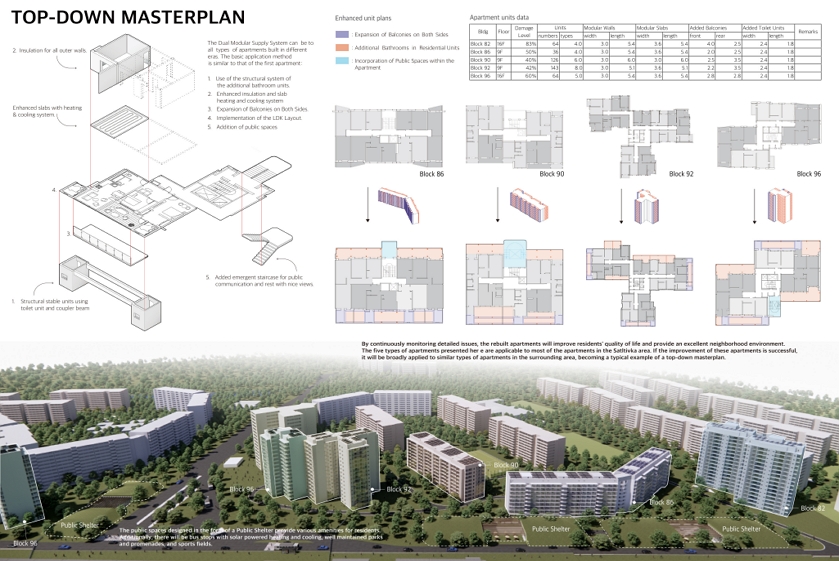
This appendix compiles four architectural design panels that form the foundation of the research, illustrating the proposed modular reconstruction strategy for damaged residential areas in Kharkiv. The designs integrate dual off-site and on-site modular supply systems to accelerate recovery, enhance living conditions, and strengthen community resilience.
Together, these four panels form a comprehensive visual and conceptual foundation for the research. They not only depict technical construction processes and architectural interventions but also reveal the social and environmental aspirations embedded in the design. By combining detailed construction methodologies, functional program layouts, and broader urban strategies, the panels bridge the gap between theoretical concepts and on-the-ground implementation. They also serve as an integrated communication tool—helping to convey the project’s vision to stakeholders, decision-makers, and residents—ensuring that the proposed recovery framework is both technically feasible and socially inclusive.