
Adaptive and Predictive Control Method to Improve Energy Efficiency and Indoor Thermal Comfort for Intermittently Occupied Spaces
ⓒ 2025. KIEAE all rights reserved.
Abstract
Beyond the essential concerns of economy and maintenance for intermittently occupied spaces, there’s a critical need to investigate high performance control methodologies. The goal is a dual imperative: significantly enhancing occupant thermal comfort while optimizing the energy performance profile of these often-fleeting architectural assets.
The core method integrates a conventional thermostat model with an adaptive control process. This adaptive layer continuously analyzes and incorporates real-time changes in human-centric factors (like occupancy and adaptive comfort expectations) as dynamic system inputs. These refined control patterns, which integrate both the building’s physics and occupants’ behavior, are used to train a machine learning-based predictive control model. The subsequent analysis rigorously assesses the model’s control validity and energy efficiency.
The performance assessment demonstrates significant efficiency for the developed learning predictive model when compared to the baseline conventional thermostat control. In thermal comfort consistency, a substantial improvement of approximately 84.8% is observed in meeting the thermal comfort index. In operational energy reduction, the model achieves an estimated 7.4% reduction.
Keywords:
Intermittently Occupied Space, Energy Use, Thermal Comfort, Adaptive Control, Predictive Control1. Introduction
1.1. Research Background
An effective supply-air control strategy is a crucial research objective for both current and planned spaces, primarily aiming to address several environmental concerns. This strategy goes beyond energy efficiency by exploring methods to ensure acceptable thermal comfort for occupants. Specifically, the proposed methodology focuses on balancing energy efficiency with indoor thermal comfort, maximizing the utility of existing extra spaces to lessen the need for new construction. The research particularly assesses control performance across diverse time periods and locations, testing how the system manages varying heating and cooling loads, especially in situations where a single space is occupied intermittently.
1.2. Research Objectives and Methods
As such, effective HVAC control models for commercial buildings require advanced control algorithms that respond to both of the designed and unpredicted conditions. In particular, it may be necessary to consider effective control strategies in intermittently occupied spaces where economic activities may be more important than the energy efficiency and the quality of the indoor environment. Therefore, it is time to study a sustainable control model that balances theoretical and practical situations where it helps to increase the thermal comfort without any excessive energy costs in use.
This research aims to develop an effective control model to increase energy performance in using intermittently occupied spaces. In addition to the energy efficiency, the model works to maintain thermal comfort according to the operational characteristics as workers and visitors. In this process, in order to improve its statistical validity, this proposed control model utilizes a designed adaptive process to increase the mathematical clearness of deterministic processes and an artificial neural network learning algorithm to improve the performance of predictive processes. The main objectives of this research are summarized like below:
- 1) By using a intermittently occupied space model and a conventional thermostat control, the performance of energy use and thermal comfort is calculated.
- 2) By adding an adaptive control process into the thermostat control model, the performance of energy use and thermal comfort values of this adaptive control model is calculated.
- 3) By artificial neural network learning of the adaptive control results, the performance of energy use and thermal comfort values of this learning predictive control model is calculated.
- 4) The performance of three control models is compared to define their strengths and weaknesses.
After analyzing the results from the process above, the conclusion section describes any advantages or disadvantages of the proposed model, and suggests the possibility of a follow-up research on improving the performance of models or algorithms for the sustainable use of spaces.
2. Literature Review
2.1. Thermal Control
The Heating, Ventilating, and Air Conditioning (HVAC) system is a fundamental element of the building’s environmental control system, critically enabling thermal comfort and acceptable indoor air quality for occupants engaging in diverse activities, ranging from sedentary work to active recreation [1~3]. Beyond mere comfort, its effective operation is instrumental in health and productivity, with poorly controlled environments often linked to “sick building syndrome” and reduced cognitive function. The pursuit of optimized HVAC performance has spurred significant advancements in both theoretical understanding and applied engineering. The foundational principle for understanding air distribution remains fluid mechanics, where analyses of airflow patterns often involving computational fluid dynamics simulations are employed to design efficient systems that minimize pressure losses, ensure uniform thermal distribution, and effectively manage contaminant dispersal [4~6]. This is crucial for systems like and displacement ventilation, which are designed to decouple ventilation rates from heating/cooling loads.
Concurrently, thermal sciences dictate strategies for minimizing building energy load. This involves the application of principles of heat transfer (conduction, convection, and radiation) to enhance the thermal resistance (R-value) of the building envelopes through the use of advanced insulating materials and high performance glazing. The goal is to minimize the sensible and latent heat gains/losses that the HVAC system must offset, thereby directly impacting equipment sizing and operational energy consumption [7~9]. Thermostats, the ubiquitous interface, translate occupant-desired setpoints into control signals, activating mechanical equipment to maintain the desired indoor temperature within an acceptable dead-band.
The Proportional-Integral-Derivative (PID) controller has historically served as the workhorse of HVAC control, particularly when computational resources were limited. Its appeal lies in its mathematically intuitive structure, where the control signal is a weighted sum of the error, the integral of the error, and the derivative of the error [10,11]. This clear deterministic signal processing is invaluable for controlling single-input, single-output loops, such as regulating the supply air temperature or the coil valve position. The PID framework provides an effective means to implement model-based control methods simpliand allows engineers to readily identify and tune parameters to correct for physical errors frequently encountered in real world installations [12~14].
However, modern, large-scale HVAC systems are highly non-linear, coupled, and subject to significant disturbances. This complexity has driven the adoption of Model Predictive Control (MPC). MPC represents an advancement by utilizing a dynamic model of the system to predict the system’s future behavior over a finite prediction horizon. At each time step, MPC optimizes a sequence of future control actions by minimizing an objective function typically involving a trade-off between energy consumption and setpoint tracking error while explicitly considering operational constraints [15,16]. This ability to look ahead and manage multiple coupled variables simultaneously makes MPC the preferred technique for achieving system-level energy efficiency in the operation and maintenance phases. It is frequently employed to control central plant components like chillers, boilers, and thermal energy storage systems, optimizing their operation based on predicted electrical utility tariffs and weather forecasts, often demonstrating energy savings of 10~30% over conventional PID methods [17~19].
2.2. Thermal Comfort
In order to save energy, it is common to perform the control in the direction of increasing the temperature of supply air in summer, lowering in winter, or reducing the amount of supply air. However, in such situations, the thermal comfort may deteriorate. In order to precisely measure the level of this deterioration, various indicators have been developed and utilized. Mapping diagrams by temperature and relative humidity or utilizing the psychrometric chart is an intuitive method commonly used without any mathematical or engineering calculation [20~22]. Identifying energy use patterns have been a major subject in this area where maintaining such a comfort level can produce specific conditions that interact with other minor factors. In addition to such mechanical and technical factors, unexpected changes in temperatures and relative humidity, as major input variables, which are not defined as a clear regression model under climatic conditions, have been considered as major target of improving indoor thermal comfort. Therefore, selecting a thermal indicator that can reflect these various conditions is a very important part in the early phase [23,24].
Recently, among the various indicators, the most commonly preferred one can be the Predicted Mean Vote (PMV). The major advantages of PMV is that it is possible to quantitatively calculate the sense of heat that feels different as users in the same environment. It simultaneously utilizes two different types of numerical factors constituting the indoor environment such as indoor air related factors and people related factors. This method can confirm the large change in the sense of heat even with a very small change in values of parameters, which means that the efficiency of improving the sense of heat can be increased with very precise control [25~27]. In the case of highly precise supply air controls, a simulation model utilizes 1-minute intervals, and it achieves the improvement of energy use by about 4%, at the same time, the improvement of thermal comfort consistency by about 95% [28~30]. However, many studies are being conducted to reveal the hidden correlation of thermal factors that cause the changes in values and to increase the engineering validity of the equation.
3. Research Method
3.1. Building Concept
Research on the energy consumption intensity of buildings has been ongoing. Furthermore, data directly surveying the energy consumption of actual buildings and analyzing their characteristics based on a vast amount of statistical data is available. In particular, the U.S. Energy Information Administration’s Commercial Building Energy Consumption Survey (CBECS) report is arguably the most useful resource for this research. It categorizes buildings across the United States into 14 categories and examines their energy consumption by each category [31]. However, even with the CBECS report and other sources, there are certain buildings for which energy consumption is difficult to assess. Among these, research has been conducted on large-scaled buildings with a strong public character, such as airports, subway stations, and multi-purpose terminals with mixed uses [32~34].
This study aims to test a model to improve the indoor environment and energy consumption of spaces with unclear uses and low usability, which are commonly found in the aforementioned complex buildings. Therefore, the modeling of the architectural space follows the characteristics of typical small and medium-sized commercial spaces, but simulation tests will be conducted using a time schedule scenario with irregular occupancy times. Table 1. summarizes the characteristics of the space geometry, and Table 2. presents scenarios regarding space occupancy times.

Geometry information of a designed spaces
Scenario in use
3.2. Control Rule
To quantify the model’s energy consumption, the total energy use per unit time is calculated using a foundational thermodynamic balance equation. This equation accounts for the heat energy supplied by the HVAC system and the net heat transfer across the building envelopes [35,36]. By reformulating this process as the rate of change in the controlled indoor temperature over time, an essential differential equation is derived, which serves as the core formula for constructing the building’s thermal simulation module.
| (Eq. 1) |
The PMV index, developed by Dr. P. O. Fanger and standardized by EN ISO 7730, serves as the primary metric for quantifying thermal comfort [35,36]. Its auxiliary indicator, the Predicted Percentage of Dissatisfied (PPD), is derived from the PMV equation, indicating the percentage of occupants expected to feel uncomfortable, ranging from 0% (near-satisfied) to 100% (fully dissatisfied). To calculate the PMV level within this simulation model, six core variables are input into a block module: dry bulb temperature (DBT), relative humidity (RH), indoor air speed (AS), mean radiant temperature (MRT), metabolic rate (MET), and clothing insulation (Clo) [37,38]. It is assumed that indoor the AS is 0.1m/s, the MRT is the same as the DBT with a 1 hour delay, the MET is a fixed value of 1.2 (light office work), and the Clo is 1.0 (ligh summer clothing).
| (Eq. 2) |
| (Eq. 3) |
where, M is the metabolic rate and L is the thermal load.
Then, the results of the three different control model are compared in terms of the level of energy use and the consistency of thermal comfort. In the case of energy use, the total sum of the amount of energy consumed for heating and cooling can be used because it is intuitive and uncontroversial. In the case of the PMV, since positive and negative values exist in the calculated result, it is difficult to evaluate the performance with a simple sums or average values, so the Root Mean Squared Error (RMSE) can be used as follows:
| (Eq. 4) |
Through this method, the most comfortable state in the PMV value is ±0, which is used as the best fit model, and the distribution of the results of each model is compared as the indicator of maintaining consistency of thermal comfort.
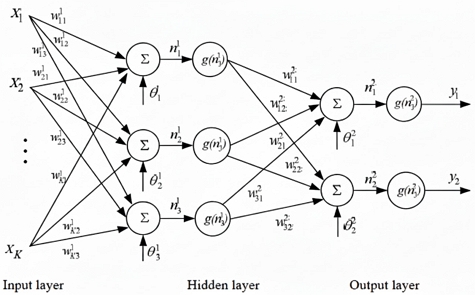
The result from the thermal model and the process in input into the ANN learning model. In general, the structure of the ANN consists of fully connected multi-layer neural network as a multilayer perceptron. This type of network includes more than one layer of artificial neurons or nodes, which is used to solve more complex classification and regression model. The most typical structure is the three layers fully connected backpropagation model. The first layer consists of input neurons that send data on to the second layer as hidden layers. Then it, in turn, sends the output neurons as the third layer to get results from this neural networks. As described in Fig. 1., each neuron takes weighted inputs x1, ... xk multiplied by a weight term wai. Then, each result adds a bias term θb, then uses the result nc as an input into an activation function gd [39~41]. In the simulation to get a learning predictive model, the scaled conjugate gradient algorithm is adopted with a configuration of 1,000 iterations at 1 epoch each. In the results for controlling mass flow rate and temperature of supply air, the tested statistical significance of R2 is 0.99175 and 0.98969, respectively.
Conceptual thermal model
The method of sending appropriate control signals into a system in certain situations has been studied very widely in the deterministic viewpoint. When the system operates over a certain period of time, the difference in two control signals before and after and the derivative of the difference have been preferred to determine the increase or decrease of the next control signal. And these approaches have been applied into in several algorithms to construct the initial deterministic structure.
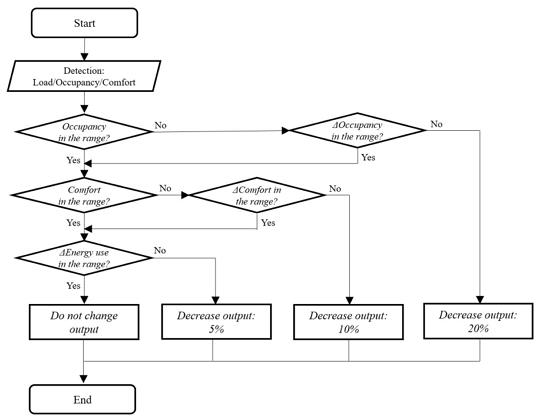
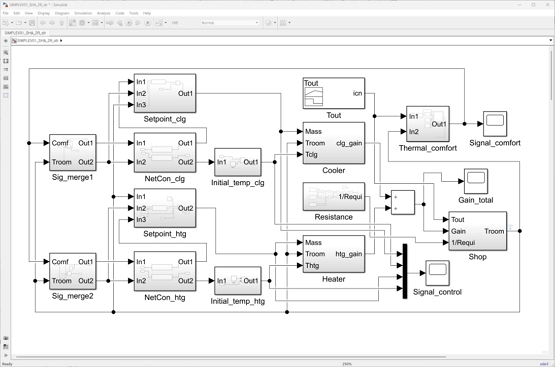
For maintaining indoor thermal comfort, a deterministic process utilize the results of five different variables related to thermal comfort and energy use as input variables: difference of occupant, derivative of the difference of occupant, difference of PMV value, derivative of the difference of the PMV, derivative of the energy use. Then, by adopting the fuzzy algorithm, the output values of heating and cooling supply air are adjusted by summing the weights specified in each range according to the designed configuration like fuzzy membership functions. At this time, the total output value is combined by use of two elements: mass flow rate, temperature. Then, the adaptive control process optimizes the output values whether they are within or outside in designed ranges for energy use. For example, if the number of workers and visitors does not met a required number, and this increase or decrease rate do not exceed a certain designed range, the output is decreased by 20% to reduce energy use regardless of other conditions. However, in the next simulation phase, if the conditions of the occupant related and the comfort related values are increased while the rate of change in energy use is within a certain designed range, the output is decreased by 5%. In addition, No adjustment is made if all the conditions are within the designed ranges. This adaptive control process is conceptually described in Fig. 2. In order to integrate each of the above programmed thermal and statistical models into one model, Simulink in Matlab r2024b is used as illustrated in Fig. 3. The entire simulation block model consists of 6 different parts: Signal (adaptive), Control (thermostat and ANN), Supply (cooler and heater), Condition (indoor, outdoor, and people), Room, PMV Calculator.
Adaptive control process
Simulation block model
4. Result and Discussion
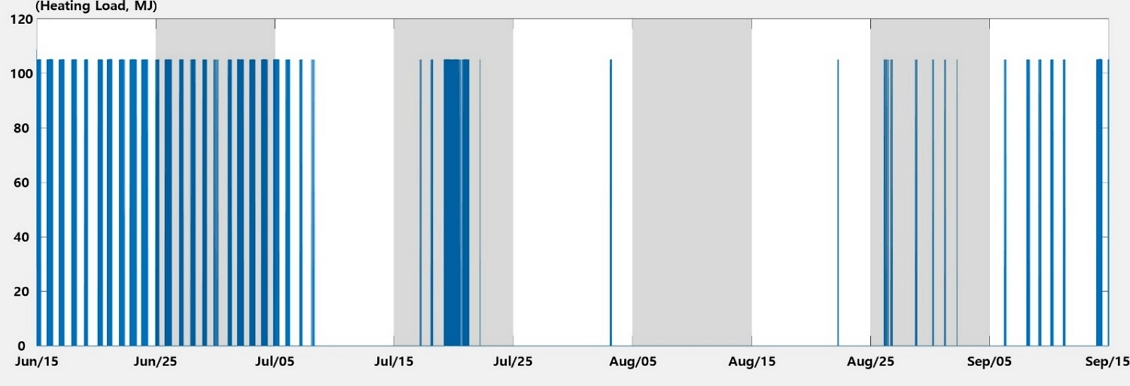
Table 3. shows the results of the thermal comfort consistency and the energy efficiency controlled by three different controls, and the performance of two models is improved as compared to the conventional thermostat model. As predicted in the indoor temperature control pattern, the numerical results confirm that the learning predictive model by the ANN algorithm is highly effective in maintaining the consistency of the PMV level. In the adaptive control model, through the adaptive control process of the thermal variables related to the PMV level, the high performance of its thermal comfort was achieved to be more than 50% as compared to the thermostat model, but the learning predictive model showed a very high performance exceeding the result. In particular, it shows a very high effectiveness of maintaining the consistency of thermal comfort in the intensive cooling period from July 25th to August 14th. In addition to this period, significant performance can be seen in the period from June 15th to June 24th and from September 5th to September 14th, which effectively suppresses parts of overshooting when the system turns on for cooling supply air.
Comparison of the thermal comfort by RMSE
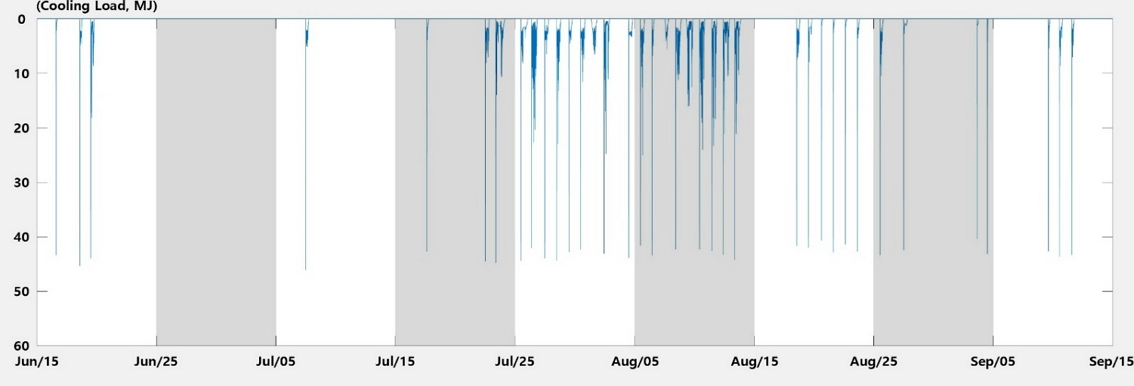
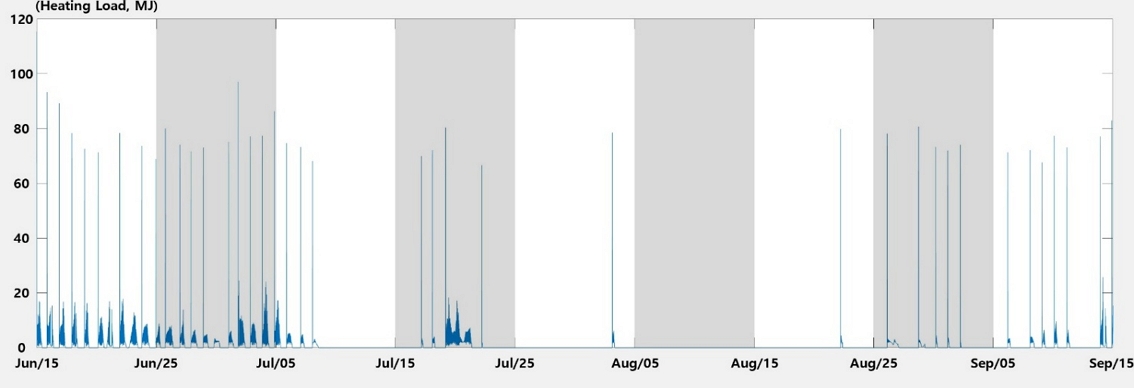
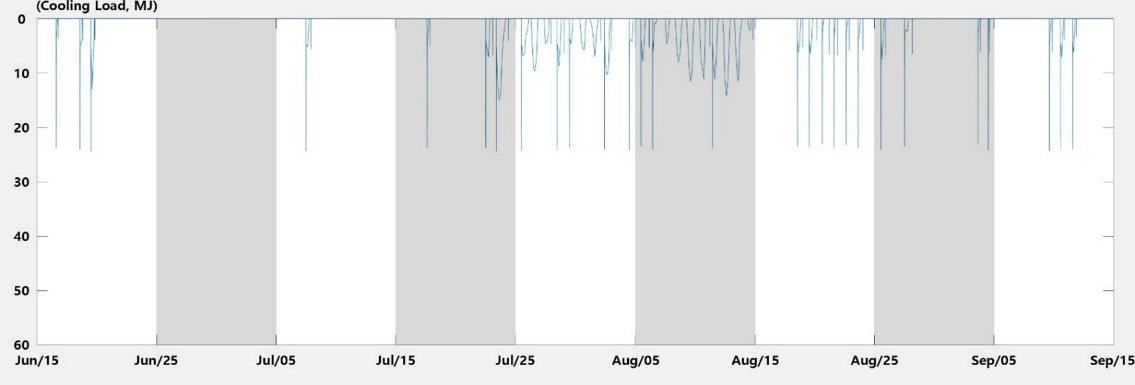
Table 4. displays the result of the cooling and heating load controlled by tree different controls. Although the short periods of early summer and early autumn are included on the designed period, it can be considerable for the heating by the configuration of heating set-point temperature. Therefore, this result needs be considered when early morning or late night working hours are included to increase its operational economy. As predicted by the RMSE results, the control characteristics from August 5th to Au-gust 24th are clearly different from other period. The energy use of the learning predictive model, which significantly reduced the overshooting and the fluctuation of the controlled pattern, is confirmed to be higher than that of other periods. In particular, from August 15th to September 14th, it is confirmed that high increases from 15% to 25% for both cooling and heating. It is confirmed that this pattern is effectively maintained from August 25th to September 4th. If this is inferred by the comparison of the graphs, the controlled pattern of the thermostat model clearly has a regular up and down based on the designed set-point temperature, whereas the learning predictive model works continuously supplying heating and cooling energy derived from adjusted values above the set-point temperature (22℃ for heating and 26℃ for cooling). It is predicted that the indoor temperature was controlled a bit higher than the heating set-point temperature and slightly lower than the cooling set-point temperature, according to the adaptive control process of analyzing the number of users and the changes in the PMV values. However, from August 5th to August 14th, it is confirmed that a significant amount of cooling energy use is reduced. This implies a fact that the adaptive control process optimizes the supply of cooling energy responding to the decrease of the number of users in extreme hot temperature in early August. Therefore, accordingly, it can be inferred that the energy efficiency has increased to a significant level in the period when the importance to maintain the thermal comfort is decreased due to changes in designed thermal situations. Overall, the energy use intensity by the adaptive control model slightly increases by about 0.91% as compared to the thermostat model. It can be a reasonable result of the mathematically deterministic model which increases the cooling energy in summer and heating energy in winter in order to maintain the thermal comfort level above the designed levels. On the other hand, it can be inferred that the ANN learning algorithm which made it possible to predict the next situations makes the learning predictive model reduces about 7.35% of energy use.
Comparison of the energy use by thermal loads
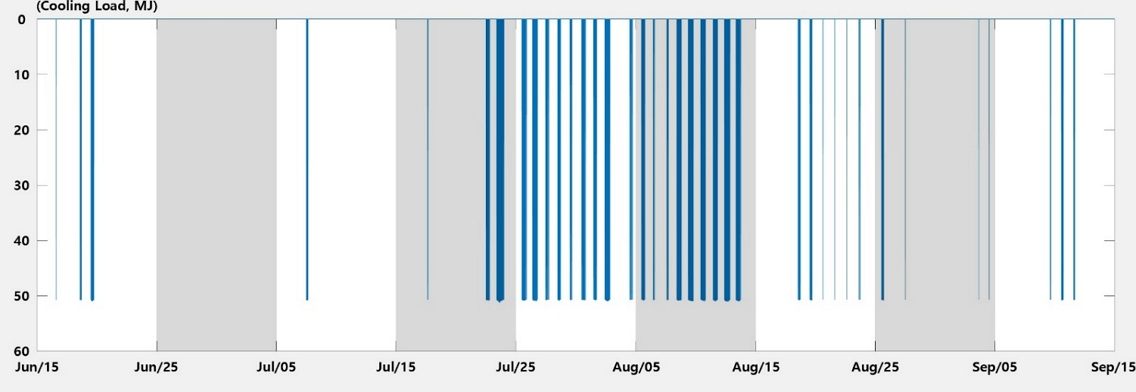
Fig. 4. and Fig. 5. display the result of the cooling and heating load controlled by the thermostat model. Depending on the set-point temperature and the dead-band range, highly regular energy supply patterns are confirmed. Fig. 6. and Fig. 7. show the improved performance of the model reflecting the adaptive control process. As predicted, in the thermostat model, the repetitive on/off controls occur in the maximum range of 50MJ for cooling and 100MJ for heating, but the adaptive control model controls to a maximum of 25MJ for cooling and a maximum of 23MJ for heating. In particular, it can be seen that the overshooting that occurs at the beginning of operation is also effectively suppressed to a maximum of 48MJ for cooling and a maximum of 95MJ for heating. Energy use increases in some periods and decreases in others, resulting in a slightly increased total sum of energy use. However, as seen in Fig. 8. and Fig. 9., the learning predictive model controls to a maximum of 16MJ for cooling and to a maximum of 12MJ for heating. In addition, it can be seen that it effectively suppresses the overshooting at the beginning of operation to a maximum of 25MJ for cooling and a maximum of 95MJ for heating. It is inferred that energy use could be effectively suppressed, unlike the thermostat model, by reducing maximum values of the control range and the overshooting in spite of the consistent and continuous control. In the viewpoint of improving the space types sustainability, this result can have an opportunity without consuming any additional resources.
Cooling load by the baseline (thermostat) control
Heating load by the baseline (thermostat) control
Cooling load by the adaptive control model
Heating load by the adaptive control model
Cooling load by the learning predictive control model
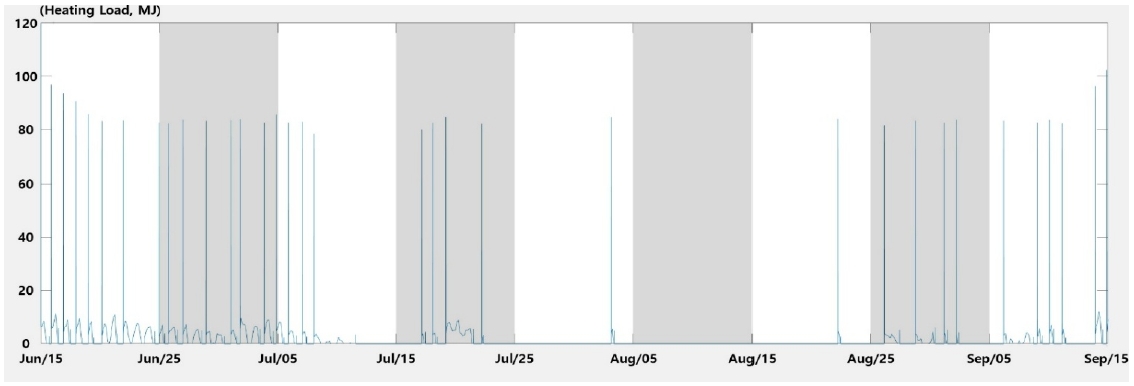
Heating load by the learning predictive control model
However, even though the model with increased statistical validation by learning the adaptive control process and improved control results was used, there are still some undefined overshoots and some periods in which the patterns of increase or decrease in energy use are not identified. This should be tested with more effective regression models using more weather conditions and space models reflecting various physical conditions. In addition, it is necessary to improve the statistical validation of input data for the ANN learning process and to increase the precision of deterministic algorithms by diversifying membership functions and variables.
5. Conclusion
This study investigated the performance of a proposed control model designed for an intermittently occupied space to enhance occupant thermal comfort without compromising operational energy efficiency. The methodology involved combining a conventional thermostat model with an adaptive control process that refined output signals by analyzing real-time data on occupant size and thermal comfort levels. The resulting control data were then fed into a learning algorithm to develop a predictive model.
The study concluded by comparing the performance of three different control models based on the consistency of maintaining thermal comfort and the reduction of energy use. The learning predictive model demonstrated significant improvements: it effectively maintained thermal comfort consistency by approximately 84.8% and achieved an energy use reduction of about 7.4%. These results confirm the model’s advantage: it allows for significant energy savings while simultaneously increasing the usability of building types where operational economy is important.
However, the analysis of performance improvement highlighted several areas for future research: the need to incorporate more detailed thermal dynamics, increase statistical validity through the use of more variables and extensive datasets, and analyze unforeseen practical issues by applying the model to actual, functioning buildings. The anticipated rise in the spaces necessitates improved operational methods focused on human-centric issues. The adaptive control process proves valuable in increasing the effectiveness of managing the deterministic trade-off between thermal comfort and energy use. The learning predictive model offers a distinct advantage in maintaining thermal comfort consistency while effectively reducing energy consumption.
A follow-up study will be initiated to reinforce these strengths and address the identified limitations, specifically including a regression model analysis of various control patterns and energy supply characteristics. If this human-centered control method is successfully integrated with broader research in urban planning, material science, and recycling, the methodological spectrum for improving the overall sustainability of various spaces is expected to expand considerably.
References
-
G. Huang et al., State of the art review on the HVAC occupant-centric control in different commercial buildings, Journal of Building Engineering, 96, 2024, 110445.
[https://doi.org/10.1016/j.jobe.2024.110445]

-
J. Ahn, D. Chung, S. Cho, Performance analysis of space heating smart control models for energy and control effectiveness in five different climate zones, Building and Environment, 115, 2017, pp.316-331.
[https://doi.org/10.1016/j.buildenv.2017.01.028]
-
M. Abuhussain et al., Adaptive HVAC system based on fuzzy controller approach, Applied Science, 13, 2023, 11354.
[https://doi.org/10.3390/app132011354]
-
J. Ahn, S. Cho, Dead-band vs. machine-learning control systems: Analysis of control benefits and energy efficiency, Journal of Building Engineering, 12, 2017, pp.17-25.
[https://doi.org/10.1016/j.jobe.2017.04.014]
-
J. Ahn, S. Cho, D. Chung, Analysis of energy and control efficiencies of fuzzy logic and artificial neural network technologies in the heating energy supply system responding to the changes of user demands, Applied Energy, 190, 2017, pp.222-231.
[https://doi.org/10.1016/j.apenergy.2016.12.155]
-
E. Barbadilla-Martun et al., Analysing the indoor temperature ranges for an efficient control of HVAC systems, Energy and Buildings, 301, 2023, 113681.
[https://doi.org/10.1016/j.enbuild.2023.113681]
-
X. Liu et al., Enhancing HVAC energy management through multi-zone occupant-centric approach: A multi-agent deep reinforcement learning solution, Energy and Buildings, 303, 2024, 113770.
[https://doi.org/10.1016/j.enbuild.2023.113770]
-
C. Thakre, R. Vijay, Impact of low-frequency noise on a residential zone due to commercial HVAC systems, Journal of Building Engineering, 91, 2024, 109616.
[https://doi.org/10.1016/j.jobe.2024.109616]
-
B. Grillone et al., A data-driven methodology for enhanced measurement and verification of energy efficiency savings in commercial buildings, Applied Energy, 301, 2021, 117502.
[https://doi.org/10.1016/j.apenergy.2021.117502]
-
G. Barone et al., A new thermal comfort model based on physiological parameters for the smart design and control of energy-efficient HVAC systems, Renewable and Sustainable Energy Reviews, 173, 2023, 113015.
[https://doi.org/10.1016/j.rser.2022.113015]
-
Z. Xu et al., Physics guided wavelet convolutional neural network for wind-induced vibration modeling with application to structural dynamic reliability analysis, Engineering Structures, 297, 2023, 117027.
[https://doi.org/10.1016/j.engstruct.2023.117027]
-
S. Zhou et al., A comprehensive review of the applications of machine learning for HVAC, Decarbon, 2, 2023, 1000023.
[https://doi.org/10.1016/j.decarb.2023.100023]
-
F. Ciampi et al., Energy consumption prediction of industrial HVAC systems using Bayesian Networks. Energy and Buildings, 309, 2024, 114039.
[https://doi.org/10.1016/j.enbuild.2024.114039]
-
S. Yoon, J. Ahn. Comparative analysis of energy use and human comfort by an intelligent control model at the change of season, Energies, 13, 2020, 6023.
[https://doi.org/10.3390/en13226023]
-
J. Ahn, S. Cho, Development of an intelligent building controller to mitigate indoor thermal dissatisfaction and peak energy demands in a district heating system, Building and Environment, 124, 2017, pp.57-68.
[https://doi.org/10.1016/j.buildenv.2017.07.040]
-
C. Turhan et al., An integrated decision-making framework for mitigating the impact of urban heat islands on energy consumption and thermal comfort of residential buildings, Sustainability, 15, 2023, 9674.
[https://doi.org/10.3390/su15129674]
-
A. Agouzoul et al., Advancing sustainable building practices: Intelligent methods for enhancing heating and cooling energy efficiency, Sustainability, 16, 2024, 2879.
[https://doi.org/10.3390/su16072879]
-
A. Skala et al., Implementation of building a thermal model to improve energy efficiency of the central heating system-A case study, Energies, 16, 2023, 6830.
[https://doi.org/10.3390/en16196830]
-
J. Ahn, S. Cho, Anti-logic or common sense that can hinder machine’s energy performance: Energy and comfort control models based on artificial intelligence responding to abnormal indoor environments, Applied Energy, 204, 2017, pp.117-130.
[https://doi.org/10.1016/j.apenergy.2017.06.079]
-
X. Liu, Z. Gou, Occupant-centric HVAC and window control: A reinforcement learning model for enhancing indoor thermal comfort and energy efficiency, Building and Environment, 250, 2024, 111197.
[https://doi.org/10.1016/j.buildenv.2024.111197]
-
J. Moon, J. Ahn, Improving sustainability of ever-changing building spaces affected by users’ fickle taste: A focus on human comfort and energy use, Energy and Buildings, 208, 2020, 109662.
[https://doi.org/10.1016/j.enbuild.2019.109662]
-
A. Youssef et al., Development and comparison of adaptive data-driven models for thermal comfort assessment and control, Total Environment Research Themes, 8, 2023, 100083.
[https://doi.org/10.1016/j.totert.2023.100083]
-
A. Laouadi, A new general formulation for the pmv thermal comfort index, Buildings, 12, 2022, 1572.
[https://doi.org/10.3390/buildings12101572]
- USEIA, Commercial buildings energy consumption survey final results, http://www.eia.gov/consumption/commercial/
-
B. Barbosa et al., Energy efficiency and thermal comfort analysis in a higher education building in Brazil, Sustainability, 16, 2024, 462.
[https://doi.org/10.3390/su16010462]
-
A. Baba et al., Indoor environmental quality for comfort learning environments: Case study of Palestinian school buildings, Buildings, 14, 2024, 1296.
[https://doi.org/10.3390/buildings14051296]
-
M. Rodiriguez et al., Thermal comfort in educational buildings: The classroom-comfort-data method applied to schools in Bogota, Colombia, Building and Environment, 194, 2021, 107682.
[https://doi.org/10.1016/j.buildenv.2021.107682]
-
K. Strelets et al., Analysis of microclimatic comfort conditions in university classrooms, Sustainability, 16, 2024, 3388.
[https://doi.org/10.3390/su16083388]
-
D. Custodio et al., Thermal comfort in university classrooms in humid subtropical climate: Field study during all seasons, Building and Environment, 258, 2024, 111644.
[https://doi.org/10.1016/j.buildenv.2024.111644]
-
G. Settimo et al., CO2 levels in classrooms: What actions to take to improve the quality of environments and spaces, Sustainability, 16, 2024, 8619.
[https://doi.org/10.3390/su16198619]
- J. Ahn, Development of energy performance metrics for airport terminal buildings using multivariate regression modeling, Raleigh, NC: North Carolina State University, 2016.
-
J. Ahn, S. Cho, D. Chung, Development of a statistical analysis model to benchmark the energy use intensity of subway stations, Applied Energy, 179, 2016, pp.488-496.
[https://doi.org/10.1016/j.apenergy.2016.06.065]
-
J. Ahn, A benchmark methodology to assess the energy performance of train station complexes, KIEAE Journal, 19, 2019, pp.5-12.
[https://doi.org/10.12813/kieae.2019.19.6.005]
-
S. Kim, H. Shin, J. Ahn, Energy performance analysis of airport terminal buildings by use of architectural, operational information and benchmark metrics, Journal of Air Transport Management, 83, 2020, 101762.
[https://doi.org/10.1016/j.jairtraman.2020.101762]
- The Engineering Toolbox, Building elements - heat loss vs. thermal resistivity, https://www.engineeringtoolbox.com/heat-loss-buildings-d_194.html, , 2003.
- F. Incropera et al., Fundamentals of heat and mass transfer, New York, NY: Wiley, 2018.
- The Engineering Toolbox, Predicted Mean Vote Index, https://www.engineeringtoolbox.com/predicted-mean-vote-index-PMV-d_1631.html, , 2010.
- National Institute of Building Science, Space types, Whole Building Design Guide, https://www.wbdg.org/space-types, , 2018.
- K. Ahamed, S. Akthar, A study on neural network architectures, Computer Engineering and Intelligent Systems, 7, 2016, pp.2222-1719.
- R. Vamsi, What’s a neural network?, https://medium.com
-
D. Palladio et al., Artificial neural network for the thermal comfort index prediction: Development of a new simplified algorithm, Energies, 13, 2020, 4500.
[https://doi.org/10.3390/en13174500]