
Predicting and Analyzing Urban Growth in a Developing Capital, Trends, Drivers, and Future Directions : Case of Antananarivo Agglomeration, Madagascar (1995~2045)
ⓒ 2025. KIEAE all rights reserved.
Abstract
Urbanization and city expansion in developing countries often lead to drastic spatial transformations, creating uneven growth patterns toward neighboring cities and climate-related challenges. Monitoring and predicting changes in land use within cities are essential to urban planners to understand growth dynamics and make decisions accordingly. This study aims to track urban expansion in Greater Antananarivo and examine growth pattern from 1995 to 2024, then predict the city’s potential growth pattern until 2045 using the MOLUSCE and finally examine possible urban sprawl inhibitors relevant to the case of Antananarivo based on previous research.
Land use changes were analyzed using satellite imagery and remote sensing data. MOLUSCE CA-ANN was applied to simulate future urban growth. UEII is used to assess buildup changes for each time interval while the Shannon Entropy model is used for showing sprawl changes.
The findings show that after rapid urbanization between 1995 and 2005, leading to saturation of the city center, sprawl started toward the neighboring municipalities the following years. Overall, Urban expansion in Greater Antananarivo has slowed for all studied years (1995~2024) and predicted trends (2025~2045) suggest that growth will continue to diminish in the center city, with peripheral expansion stabilizing after 2035. Entropy analysis shows past unplanned sprawl due to weak planning, while future projections suggest a slowdown, possibly from land saturation. Previous studies on urban growth of Antananarivo highlight fast population growth, internal migration from rural areas, and poor land management as key factors behind the city’s uncontrolled spatial expansion.
Keywords:
Urban Sprawl, Remote Sensing, Molusce, Urban Expansion Intensity Index, Shannon’s Entropy Model1. Introduction
Since the Industrialization era, the global trend of urbanization has displayed consistent growth. Since 1970, the share of people living in urban environments has steadily increased, rising from 37% to 57% by 2023 and future forecasts suggest that it could climb to 68% by the year 2050 [1~3]. Cities have long served as economic hubs, contributing more than three-quarters of the global GDP [2]. Although developed nations experienced faster urban growth before the 1950s, the current trend of urbanization shows it is most intense in developing regions, which are projected to account for nearly 93% of the world’s future population growth [4]. Africa’s urban population which was only 17% in the mid-20th century has risen to over 40% and is expected to reach 55% by 2050 [4,5]. This accelerated urbanization presents various sustainability challenges, including ecosystem degradation, housing shortages, and infrastructure stress [6].
Urbanization has played a significant role in reshaping land use trends worldwide, both in developed and developing nations [7]. According to [8], factors like population growth, higher household incomes, and rising transportation needs push cities to expand spatially to accommodate the growing population. As cities attempt to accommodate the growing populations, spatial expansion occurs, whether through formal urban planning or unregulated growth. However, rising urban housing costs tend to push people toward more affordable housing in the periphery and this contributes to urban sprawl by extending the city’s spatial boundaries [8]. In addition, sometimes policies designed to support urban growth, particularly those aiming to meet rising housing and infrastructure demands, can unintentionally accelerate urban sprawl [9]. The countries in Sub-Saharan African (SSA) especially deals with those challenges associated with rapid urbanization with a significant portion of growth occuring in informal settlements. The uncontrolled growth is typically accompanied by issues such as poverty, unemployment, environmental harm, deteriorating infrastructure, and the expansion of urban sprawl [5,10]. Antananarivo, the capital of Madagascar, reflects many typical urbanization trends seen throughout SSA. The National Institute of Statistics in Madagascar (INSTAT) reported that almost 5 million Malagasy people lived in urban areas in 2018, with fast urban growth becoming a significant problem due to the absence of proper planning [11]. Despite efforts to regulate urban sprawl, Antananarivo continues to struggle with providing sufficient infrastructure to satisfy the housing demand of its expanding population.
The use of remote sensing, Geographic Information Systems (GIS), modeling, and simulation have become essential tools for urban management, particularly in monitoring and predicting urban growth patterns. The combination of remote sensing and GIS has been widely applied to track urban land use changes, providing valuable historical data that allowed researchers and urban planners to make informed decisions [7]. Given Antananarivo’s strategic position as the city center, it plays a vital role in accommodating a substantial portion of the nation’s population. For decision-makers to be able to plan adequately to address the negative consequences of uncontrolled urbanization, monitoring and forecasting urban growth patterns in the area is crucial. A thorough analysis should focus on understanding the spatial and temporal patterns of sprawl in the city. The primary objectives of this study are to: (1) investigate the spatiotemporal dynamics of Antananarivo’s urban growth from 1995 to 2024 and analyze the city’s expansion patterns employing tools such as the Urban Expansion Intensity Index (UEII) and Shannon’s Entropy Model (SEM); (2) Forecast potential urban expansion patterns until 2045 if the current trend continues, using predictive modeling and (3) Identifying possible urban sprawl inhibitors relevant to the case of the Agglomeration of Antananarivo based on previous research. By incorporating remotely sensed big data from 1995 to 2024, along with various spatial attributes, this research will provide a comprehensive understanding of urban growth trends. After assessing the primary drivers of urban sprawl in Antananarivo, the discussion part will also take few lessons from urban policies implemented in Seoul since the 1960s. That will help formulate recommendations for effective policy strategies that could be adapted to the context of Antananarivo to better manage urban sprawl and promote sustainable urban growth. In fact, in contrast to Western society’s urbanization pattern, which developed through industrialization, Seoul’s urban expansion is revealed to be more similar to most developing countries [12]. Cities in developing countries like Antananarivo could gain a lot in terms of urban sprawl mitigation and sustainable urban growth by drawing inspiration from Seoul’s urban strategies.
2. Literature Review
2.1. Related Previous Research
Previous studies has demonstrated the effectiveness of remote sensing in detecting urban sprawl and analyzing land-use transformations across various geographic contexts. For instance, [7] employed Landsat imagery and change detection techniques to examine urban sprawl in Tshwane, South Africa, revealing a 109% increase in built-up areas over three decades. [13] used GIS and Shannon entropy to investigate the rapid urbanization of Kabul, highlighting a significant reduction in vegetation cover resulting from urban expansion. In African cities such as Bamako, Nairobi, and Cairo, [14] draw attention to the role of remote sensing in tracking green space loss associated with urbanization.
Over the years, various analytical tools and indices have been developed to enhance the understanding of urban sprawl’s characteristics and magnitude [15]. Two commonly used indices for evaluating urban sprawl include the Urban Expansion Intensity Index (UEII) and Shannon’s Entropy Model (SEM). The UEII measures the proportion of recently developed urban land proportionate to the total area, allowing to understand the speed and potential of urban sprawl, while SEM assesses the degree of sprawl by analyzing how urbanized areas are distributed and concentrated spatially, making it a worthwile tool for detecting patterns of urban spread [15~17]. [18] employed Shannon’s entropy alongside GIS to analyze urban sprawl in the Pearl River Delta, effectively capturing dispersed growth patterns. More recently, [19] utilized this approach to assess urban expansion in Semarang, Indonesia, emphasizing the influence of diverse land use on spatial growth. Furthermore, [20] combined Shannon’s entropy with UEII to study urban growth in Jalpaiguri, India, revealing significant shifts in spatial development over time. These studies reinforce the utility of entropy-based indices as reliable tools for quantifying and understanding the complexities of urban sprawl.
In addition to these indices, modeling techniques have proven essential for predicting future urban expansion. The Markov Cellular Automata (CA) approach is frequently utilized to simulate potential future land cover changes. Advancements in predictive modeling, particularly using tools such as the MOLUSCE plugin and Cellular Automata-Artificial Neural Network (CA-ANN), have significantly enhanced researchers’ ability to forecast urban sprawl. For example, [21] used the CA-ANN modeling within QGIS to predict urban expansion, finding continuous increases in impervious surfaces alongside declining green areas projected through 2050. In a similar effort, [22] applied machine learning models, including CA-ANN, to anticipate urban growth in Nasiriyah, Iraq, revealing considerable unplanned expansion by 2052. Additionally, [23] used CA-Markov and ANN models in India to forecast substantial urban growth and associated agricultural land loss by mid-century. Various techniques have been employed to estimate LULC, and one noteworthy approach is MOLUSCE (Modules for Land Use Change Evaluation), a QGIS plugin that combines Markov chain analysis and cellular automata (CA), to analyze land use dynamics. Its applications are diverse, including assessing temporal LULC changes, predicting future land use scenarios, modeling transitions in land and forest cover, and identifying areas at risk of deforestation [23]. These tools and methodologies will significantly enhance our knowledge of urban sprawl and will support urban planning strategies.
As urban sprawl emerges as a global issue, particularly in terms of its sustainability impacts, its underlying causes have also drawn significant attention from researchers. After analyzing urban sprawl in Ajmer city, India, [24] tried to determine the correlation between urban sprawl and its influencing factors. Their findings highlighted that population growth and density play a major role in driving sprawl. They predicted that, under existing trends, the urban sprawl rate could be twice as much the pace of population growth by the year 2051. Similarly, [25], through a global analysis of urban growth patterns, affirmed that sprawl tends to occur when land is developed at a speed greater than the rate at which the population expands. Another research by [26] on urban sprawl in Chile argued that while urban sprawl is often linked to inadequate planning and liberal real estate policies, the government itself has played a role in its expansion. By passing legislation that encourages land market freedom, especially in areas beyond formal urban boundaries, the state has indirectly supported the continued spread of urban sprawl. The causes of urban sprawl tend to change according to local context. For instance, in the United States, suburban growth supported by automobile usage is identified as a major contributor to sprawl [26] while in developing countries urban sprawl are more linked to congested urban centers and insufficient urban planning. Still, a literature review conducted by [27] on the driving forces behind urban sprawl found that two key factors are most frequently cited: firstly, the influence of spatial or land use policies, and secondly, population growth.
In Antananarivo, Madagascar, remote sensing has emerged as a valuable tool for analyzing land use land cover changes and addressing associated challenges. [11] employed spatiotemporal analysis using GIS to investigate the relationship between urban growth and flood risks, revealing that by 2017, nearly a quarter of the city’s buildings were situated in flood-prone areas. Similarly, [28] utilized remote sensing to explore urban agriculture, emphasizing its role in enhancing food security and reducing flood risks. Complementing these findings, [29] conducted a multi-temporal analysis to identify high-risk zones for landslides within the city. Despite the ongoing pressures of urban expansion, [30] underscored the persistence and importance of urban agriculture in the region. Collectively, these studies highlight the diverse applications of remote sensing in addressing Antananarivo’s urban development challenges.
2.2. Research Question and Hypothesis
Previous research demonstrated the effectiveness of remote sensing and statistical model analysis like Shannon’s entropy and UEII to monitor and evaluate urban sprawl. Predictive modeling like MOLUSCE has also proved its effectiveness in forecasting future urban growth.While several studies have applied remote sensing to various aspects of urban development in Madagascar’s capital, a comprehensive analysis focusing specifically on urban growth patterns and its possible causative factors remains unexplored. Given the critical need for effective urban planning, understanding the spatial and temporal growth patterns of Antananarivo is essential for informing decision-making processes. Despite being the most densely populated city in the country, a systematic assessment of current and future urban sprawl trends within the agglomeration has yet to be conducted. To address this gap in literature, our study aims to answer the following research questions:
1-How has urban expansion and urban sprawl evolved in Antananarivo in the last 20 years (from 1995 to 2024)?
2-What are the potential future growth patterns of the city in the next 20 years (2025 to 2045) if the current state of growth continues?
3-What area the possible urban sprawl inhibitors relevant to the case of the Agglomeration of Antananarivo based on previous research?
While our research questions 1 and 3 are addressed through hypothesis-driven analysis, question 2 is exploratory and aims to project potential future growth trends using geospatial modeling techniques. As such, it is not accompanied by a formal hypothesis. Our hypothesis on Question 1 and 2 are then as follows:
1-H1: Based on previous studies conducted in Sub-Saharan African Countries like Tswane in South Africa (3.52%), Bamako (5.57%), Nairobi (4.99%) and Cairo (2.79%), this study hypothesizes that Antananarivo also has experienced a comparable rapid increase of built up area per years of more than 3% as observed through the remote sensing data result.
1-H2: In line with the findings of [20] on urban expansion in medium-and small-sized cities, which showed that a rapid increase in built-up areas was accompanied by a compact inner center and more sprawled dispersed development on the outskirts, it is expected that Antananarivo has followed a similar pattern—characterized by compact infill growth in the city center and sprawling on the periphery, as demonstrated by the Urban Expansion Intensity Index (UEII) and Shannon’s Entropy values.
3-H1: A study analyzing urban sprawl in Ajmer city, India by [24] highlighted that population increase and density are significant factors contributing to the expansion of urban sprawl. [25], through a global examination of urban development trends, affirmed that sprawl tends to occur when land is developed at a speed greater than the rate at which the population expands. In Antananarivo Madagascar, the drivers of urban sprawl are expected to be directly related to population growth, similarly due to urbanization rate surpassing the population growth rate.
3-H2: A research by [26], on urban sprawl in Chile argued that the government played a role in urban sprawl by passing legislation that encourages land market freedom. Our hypothesis is that similarly, in Antananarivo, land use regulations passed by the Government contributed significantly to urban sprawl in the Agglomeration of Antananarivo.
3. Materials and Methods
3.1. Study Area
The Municipality of Antananarivo, located in Analamanga Region, capital of Madagascar, is the fastest developing area of the country. Antananarivo agglomeration or Greater Antananarivo (Grand Tàna) is composed of 38 municipalities including the Urban Municipality of Antananarivo (Commune Urbaine d’Antananarivo) in the center, part of the district Antananarivo Avaradrano in the North and Southeast, Antananarivo Atsimondrano in the West and Southwest, and Ambohidratrimo in the North part (Fig. 1.). According to [31], in 2024 the city’s population was counted at 4,048,670 in 2024 with a growth rate of 4,5 %, the city is one of those that notice the fastest urbanization growth.
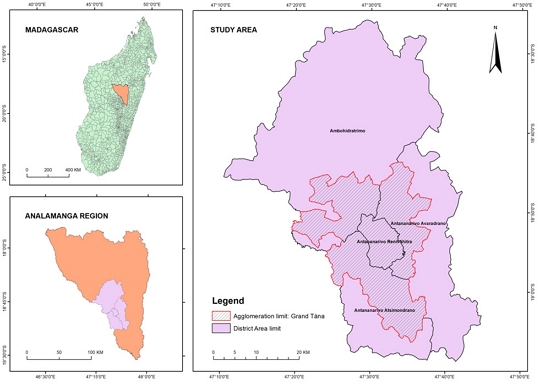
Study area map
3.2. Data Acquisition and Pre-Processing
To assess the extent of urban expansion in the study region, four satellite images were obtained from the United States Geological Survey (USGS) platform, covering path 159 and row 73. Only images with cloud cover below 5% were chosen to improve the precision of classification and reduce the likelihood of analytical errors. Two image correction were processed, Radiometric calibration and Quick Atmospheric Correction (QUAC). As the original satellite images covered a wider region than the specific area of interest, they were cropped to isolate only the intended study zone. This pre-processing step was conducted using ENVI 64-bit software, ensuring that only relevant portions of the images were included in the analysis. These processed and refined images were subsequently used to analyze shifts in Land Use and Land Cover (LULC) and to examine trends in urban sprawl across the selected time frames.
3.3. Image Classification and Accuracy Assessment
Prior to classification, all images were georeferenced to the WGS 84 UTM Zone 38S coordinate system. Once corrected, the images were classified into five land cover categories: built-up areas, plains, vegetation, bare land (including dry agricultural areas), and water bodies. This classification process was carried out using the support vector machine (SVM) supervised classification technique within the ENVI 5.3 software. An accuracy assessment was conducted as part of the study to evaluate the reliability of the classified maps and to determine the performance of the classification algorithm. According to [32], the values of Kappa that are defined between 0.81~1.0 is a nearly perfect connection. This study utilized the Kappa coefficient to measure the accuracy of the land use and land cover (LULC) classifications. The assessment was based on more than 400 reference points identified across the classified maps. The kappa values are 0.83, 0.81, 0.85, 0.89 for the years 1995, 2005, 2015 and 2024, respectively, which are measurably nearly perfect agreement indication of classification accuracy.
3.4. MOLUSCE
As more people around the world migrate to urban areas, managing this growth while ensuring both social stability and environmental balance remains a key area of research. To address this challenge, researchers have developed models to predict land use and land cover (LULC) changes over time. One approach involves using the MOLUSCE (Modules for Land-Use Change Simulation) plugin in QGIS, a tool that enables to model spatial transitions and predict future urban expansion scenarios [21]. The MOLUSCE plugin,developed by Asia Air Survey for QGIS version 2.0 and onward, is an open-source tool for analyzing and simulating land use and land cover (LULC) changes. It combines multiple modeling approaches, including artificial neural networks (ANNs), multi-criteria evaluation (MCE), weights of evidence (WoE), logistic regression (LR), and Monte Carlo-based cellular automata (CA). The CA-ANN model in the MOLUSCE plugin for QGIS 2.xx has been a trusted and reliable tool among researchers for predicting future LULC, making it highly useful for land use planning and management [33~36]. Originally developed for QGIS 2.xx, the MOLUSCE plugin became incompatible with QGIS 3.xx after it transitioned to Python 3 in 2018. As a result, researchers relied on QGIS 2.14 to access its features until the software developers updated the plugin. Compatibility was restored with the release of MOLUSCE 4.0.0 in August 2024, so this research utilizes the updated version of MOLUSCE 4.0.0 in QGIS 3.40.
3.5. Urban Expansion Intensity Index (UEII)
By highlighting areas of concentrated urban development and offering insights into likely directions and intensity of future growth, the Urban Expansion Intensity Index (UEII) delivers a quantitative measure of spatial urban growth, showing the proportion of urban area increase within spatial unit i relative to the total area of that unit [15,37]. UEII is calculated using the following equation (1):
| (Eq. 1) |
where UEIIi stand for UEII of spatial unit i and and are the urbanized area at times t2 and t1, respectively. TLAi is the total area of the spatial unit i, and Δt is the duration of the study period. For reference UEII value ranging from 0–0.28 is slow development, 0.28-0.59 low-speed development, 0.59-1.05 medium-speed development, 1.05-1.92 high-speed development, and ≥1.92 very high-speed development [38].
3.6. Shannon’s Entropy
In the context of urban studies, Shannon’s entropy model has become a widely applied technique for assessing the degree of urban sprawl and understanding patterns of spatial diffusion or compactness within urban areas. By utilizing Remote Sensing (RS) and Geographic Information Systems (GIS), researchers can effectively measure the distribution of urban growth across a region and evaluate whether the expansion is occurring in a more dispersed or compact manner [20,39]. The model’s structure can be calculated by applying equation (2) below:
| (Eq. 2) |
where, Hn is Shannon’s entropy calculated for each study period, Pi is the proportion of variable in the i-th zone relative to the entire area. m is the total number of zones. Values approaching 0 suggest compact urban development, whereas values nearing log m indicate more dispersed growth, characteristic of urban sprawl.
4. Results
4.1. Spatiotemporal Analysis
As the dominant land use within the municipality of Antananarivo, built-up areas have expanded rapidly over the past few decades, particularly within the central district of Antananarivo Renivohitra (AR). Monitoring built-up patterns plays a critical role in identifying urban sprawl, which is the focus of this study for the years 1995, 2005, 2015, and 2024 (Fig. 2.). In the first year, the built-up area covered approximately 82.44km2 of the study area across all districts and has steadily increased over the years (Table 1.). In Antananarivo Renivohitra (AR), urbanized areas went from 28% in 1995 to more than 56% of the total area within two decades. Meanwhile, surrounding areas like AAT that were once predominantly rural, with urbanization rates below 10%, have been gradually transitioning toward more urbanized landscapes. Table 1 presents data demonstrating consistent and gradual growth of built-up areas throughout the study period. As the center municipality became very saturated, urban sprawl intensified in surrounding cities especially since 2005, as we can see based on these built-up maps (Fig. 2.).
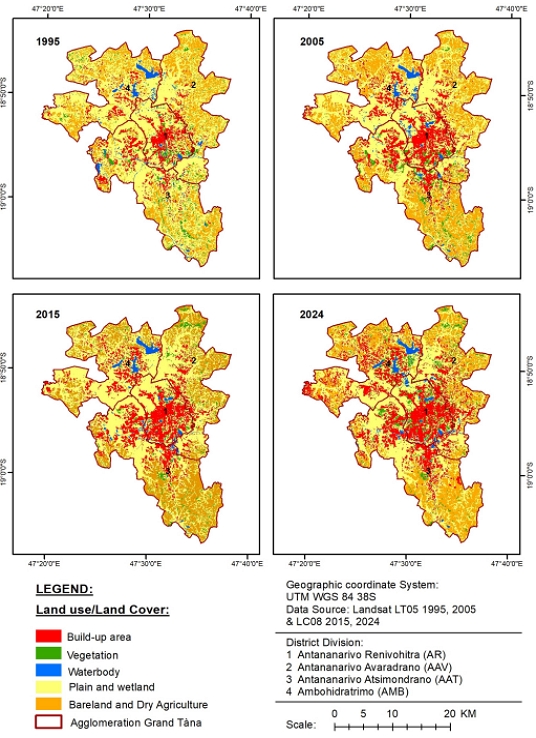
Land Use Land Cover Map (LULC) 1995~2024

Urbanized area extracted from LULC map
4.2. Urban Growth Forecasting with MOLUSCE
In predicting future changes using MOLUSCE, researchers prioritize physical and socioeconomic factors when selecting variables, as these have been shown to have a more significant influence on the dynamics of land use and land cover (LULC) changes [21]. For this study, to predict LULC for 2025, 2035, and 2045, we used the MOLUSCE CA-ANN method with remotely sensed data from 1995 to 2024 at 10 years intervals, incorporating spatial factors as digital elevation models (DEM), slope, aspect, proximity to rivers and roads, and population density. Initially, we utilized LULC data from 1995 to 2005, combined with spatial variables, to simulate the LULC distribution for the year 2015. The transition potential model generated a validation Kappa coefficient of 0.62. Following the projection, the simulated 2015 map was compared with the observed LULC map for the same year and obtained a percentage of correctness of 74.73% and an overall kappa value of 0.60 (Fig. 3.). In prediction modeling, a Kappa value exceeding 0.5 can be considered satisfactory [40]. Recent research on prediction modeling using MOLUSCE considered an overall kappa value greater than 0.60 as satisfactory [21,23,41]. Following successful model validation, we projected land use and land cover (LULC) for the years 2025, 2035, and 2045. This prediction used temporal LULC data from 1995 and 2005, along with spatial variables such as DEM, slope, aspect, distances to rivers and roads, population density, and the transition probability matrix. Fig. 4. shows the projected map for 2025, 2035 and 2045.
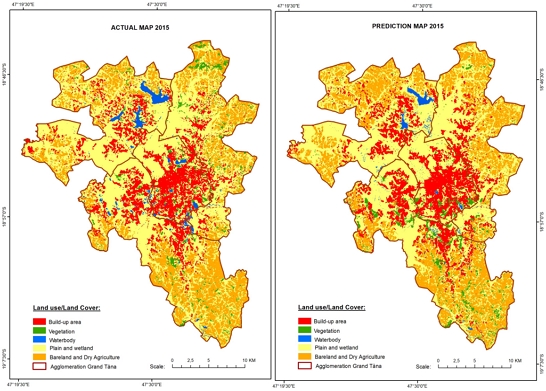
Actual vs predicted LULC map (2015)
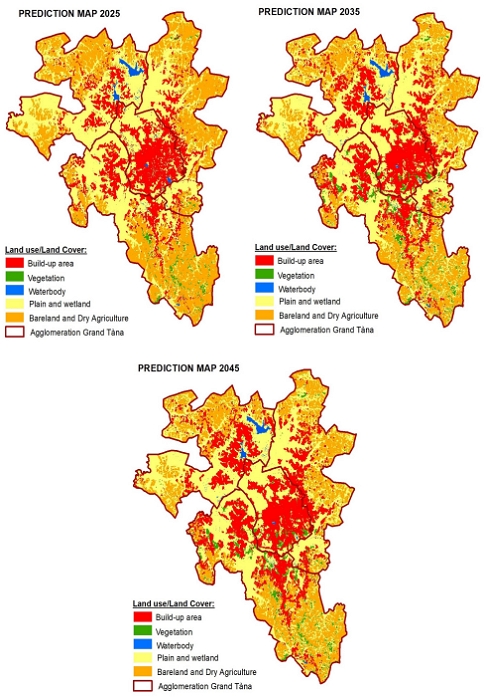
Predicted LULC map (2025, 2035, 2045)
4.3. Urban Expansion Intensity Index (UEII)
The analysis of the Urban Expansion Intensity Index (UEII) reveals significant trends in urban sprawl in each different district across different timelines. Initially, the AR district was rapidly expanding from 1995~2005 but then saw a significant decline in urban expansion in the following years. Predicted future values suggest continued decline, approaching very slow development. As for AAV district, it started with moderate medium-speed expansion, with a dip in 2005~2015 but a slight increase again in 2015~2025. Future projections indicate fluctuations but an overall slow-to-moderate expansion rate. AAT was Initially a slow-developing area, but as the city center began to get saturated, the area gradually noticed an increase in 2015 which suggests an urban expansion phase and slow sprawling. As for AMB, the area had relatively steady UEII values in the early periods. A slight negative value in predicted growth from 2015 to 2025 suggests a possible contraction in urban growth. However, the projections for 2025-2045 show a strong increase in UEII, indicating future rapid expansion. Overall, the observed data from 1995 to 2024 indicates that urban expansion in the Great Antananarivo has slowed down over time in the city center while neighboring district notice increasing expansion (Fig. 5.). The predicted 2025~2045 UEII trends suggest a continuation of the slowdown in the city center with lower expansion while in the other district, expansion will continue to increase until 2035 and begin to stabilize onward (Fig. 5.).
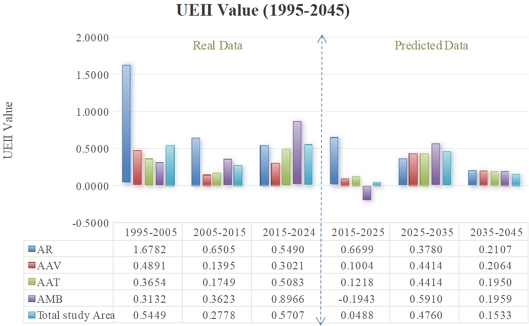
Comparison of UEII value from real (1995~2024) vs predicted (2025~2045) map
4.4. Shannon’s Entropy
Shannon’s Entropy was utilized to quantify urban sprawl both over time and across different zones within the agglomeration. Urban areas extracted from land use maps were analyzed temporally and divided into eight directional zones for zone-specific evaluation: North-Northeast (NNE), North-Northwest (NNW), East-Northeast (ENE), East-Southeast (ESE), South-Southeast (SSE), South-Southwest (SSW), West-Southwest (WSW), and West-Northwest (WNW). Two types of Entropy calculations were done, General Entropy for the whole study area and Entropy per direction. Urban growth doesn’t usually happen evenly in all directions. Some parts of a city tend to grow faster or more chaotically than others. By dividing the city into directional zones, we could better observe where land use is changing the most and where development is more disorganized. This approach helps highlight specific areas, or “hotspots,” where urban sprawl is more intense or unpredictable. Analyzing entropy in this way makes it easier to spot trends, anticipate where future expansion might occur, and identify zones that may require more focused planning or regulation. As a result, urban forecasting and planning efforts can be more precise and effective. For reference, entropy values near 0 indicate compact urban development, whereas values approaching log (n) signify urban sprawl. A value at half of log (n) is used as the threshold between these two growth patterns. Results of the Entropy value calculations revealed that, first for the study area in general, urban sprawl in the study area has been steadily increasing over time, as reflected in the rising entropy values from 1995 to 2024 (Fig. 6.). The sharpest rise was noticed during 1995 and 2005 period. After 2005, the growth rate of entropy slowed down, but sprawl continued, suggesting that urban development is spreading more randomly than being compact. The entropy obtained from projected data from 2025 onwards indicates a slowdown in sprawl growth (Fig. 6.). If we look at sprawl across directions, certain areas experience more rapid expansion than others. The ENE, ESE, and WSW directions exhibit the highest entropy values, indicating that urban expansion is most prominent in these directions (Fig. 7.). Those areas experience more dispersed development compared to other directions. If we compare Entropy from the existent data (1995~2024) and the predicted data (2025~2045), the entropy from existent data consistently shows increasing entropy, reflecting the continuous and unchecked urban sprawl caused by rapid urbanization. However, the predicted data (2025~2045) suggests a slowdown in entropy growth, and in some cases, even a decline in entropy values (Fig. 7.). This could indicate a natural limitation to sprawl, as urban areas become congested or land becomes less available for expansion. Additionally, some areas that have already seen high entropy values (such as WSW and ESE) may continue sprawling even in the predicted period.
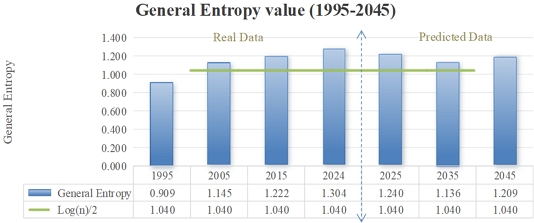
General entropy value from real (1995~2024) and predicted (2025~2045) map data
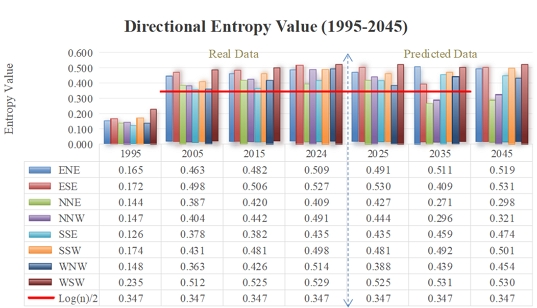
Directional entropy value from 1995 to 2045
4.5. Urban Sprawl Drivers
A review of literature on urban sprawl drivers identifies land use policies and population growth as the most influencing factors [27]. Researches conducted in Antananarivo, Madagascar echoed that result, urban sprawl has also been attributed to same drivers. From 1993 to 2018, Antananarivo’s annual population growth was approximately 3.8%, with the metropolitan area reaching nearly 3 million residents in 2018 [11]. This growth was driven by both natural increase and rural-to-urban migration, particularly among individuals seeking improved economic opportunities, education, and services. Due to limited availability and high costs of land within the urban core, many migrants have settled in peripheral zones, where land is more affordable and less regulated. These peri-urban areas have experienced growth rates exceeding 5% annually, far outpacing those of the central urban commune [11]. Since 2018, the annual growth rate of population has been decreasing although it still stays above 3% yearly and the population in the agglomeration is now a bit more than 4 million [31]. However, this rapid demographic expansion has not been matched by infrastructural development. The resulting housing shortages and insufficient urban planning have contributed to the proliferation of informal settlements, especially in flood-prone lowlands where land remains inexpensive and unregulated. From 1968 to 2004, the city lacked an updated urban master plan, which led to a near-total absence of formal land use regulation [11]. Although a new plan was adopted in 2004, its implementation has been partial and inconsistently enforced. As a result, land conversion and illegal settlements have proliferated. Moreover, land speculation and real estate development have intensified pressure on peri-urban and agricultural areas. Developers have increasingly targeted lowland flood zones, traditionally used for rice cultivation and urban agriculture, for residential and commercial development [11]. These agricultural lands are often viewed as land reserves rather than spaces for food production, further accelerating their conversion into urban land uses [42].
To evaluate if population growth could be counted as sprawl drivers, we did a comparison between population growth and urban growth. Urban Growth was calculated based on the data from the LULC while population growth was calculated following the equation (3):
| (Eq. 3) |
Where P1 is the population at a time t1 and P0 the population at a time t0 while n is the period interval between t0 and t1, here 9 intervals between 10 years period. Comparison between urban growth rate (Built-up area growth) and population growth rate in our study area shows that urban development did not keep pace with the population increase for the past 20 years especially since 2005. In the second period 2005 to 2015, population growth rate surpassed the 5% while urban growth rate was only about 1.84%. And finally, for the past 10 years (2015 to 2024), we can notice a bit of a balance between population growth which was 3.16% and urban growth of 2.78% yearly (Fig. 8.). The imbalance between rapid population growth and slower urbanization is a key condition for urban sprawl. When formal urban planning and infrastructure cannot accommodate growing populations, new residents often settle in informal or peripheral areas where regulation and services are limited. What makes this observation particularly noteworthy is that in contrast with findings from [25], who reported that urban sprawl typically happens when land development outpaces population growth.. Our case suggests a different dynamic starting from the year 2005, especially in developing countries, where land development struggles to keep up with fast-rising populations. This perspective adds nuance to how we understand the causes of urban sprawl in contexts with limited planning capacity and resource constraints.
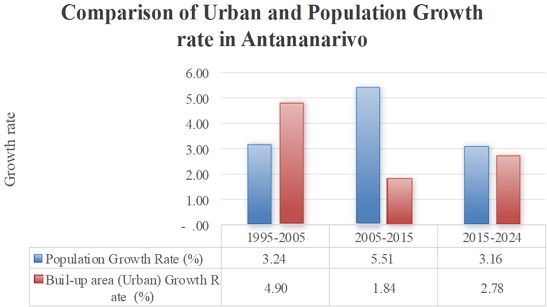
Average yearly growth rate in the study area, comparison between population and urban growth
4.6. Hypothesis Validation
Our first and second hypothesis aimed to answer the question of how urban expansion and urban sprawl have evolved in Antananarivo over the last 20 years (from 1995 to 2024). The first hypothesis was that similar to other Sub-Saharian African countries, urban expansion in Antananarivo has occurred at a fast rate, with annual growth exceeding 3%. Based on the analysis results, this hypothesis was confirmed, as the average urban growth rate in Antananarivo from 1995 to 2024 was calculated at 3.17% per year. The second hypothesis was that in line with past findings on urban growth in medium-and small-sized cities, a rapid increase in built-up area would be accompanied by compact development in the city center and more dispersed, sprawling growth in the outskirts. The hypothesis was also confirmed the UEII and Shannon’s Entropy values trend in Antananarivo shows a saturation of the city center AR and dispersed urban growth toward the neighboring districts.
As for our second and third hypotheses, they aimed to address the third research question regarding the possible cause of urban sprawl relevant to the case of the Agglomeration of Antananarivo, based on previous research. The third hypothesis was based on a study analyzing urban growth pattern by [25] affirming that urban sprawl tends to occur when land development outpaces population growth. However, in Antananarivo Madagascar, the hypothesis was proven to be false. In our case the results showed that from 1995 to 2024, the average annual urbanization rate was 3.17%, while the population growth rate was 3.97%, meaning that urban expansion did not exceed population growth. Lastly, the final hypothesis proposed that government land use policies have been a key factor affecting uncontrolled development in the Antananarivo agglomeration. This hypothesis is partially verified because from 1968 to 2004, the absence of formal land use regulation may have caused the proliferation of uncontrolled urban growth of the city [11]. However from 2004, even if a new urban plan was adopted, the detail, implementation and enforcement remain inconsistent limiting its effectiveness in managing urban growth.
Hypothesis validation
5. Discussion and Recommendation
This study quantifies and analyzes urban sprawl in the Great Antananarivo agglomeration, the capital city of Madagascar. Landsat satellite imagery for the years 1995, 2005, 2015 and 2024 were used to generate land use maps enabling an evaluation of past urban growth and predicting future urban expansion pattern. Sprawl analysis using the Urban Expansion Intensity Index (UEII) and Shannon’s Entropy model (SEM) was applied to extracted remote sensing data for a better understanding of the urban growth pattern in the city. The purpose of this study was to (1) Explore the spatiotemporal dynamics of Antananarivo’s urban growth from 1995 to 2024 through remote sensing and (2) forecast possible future urban growth patterns until 2045 based on that, then analyze the city’s expansion patterns employing tools such as the UEII and SEM and finally (3) identifying possible drivers of sprawl relevant to the case of the Agglomeration of Antananarivo based on past research.
For the past 20 years, spatiotemporal analysis of the study area revealed an increase in built-up area from 28% in 1995 to more than 55% in 2024. Formerly rural neighboring areas with less than 10% urbanization are progressively transitioning into more urbanized landscapes. Analysis of the UEII across different districts revealed that urban expansion in Greater Antananarivo has decelerated over time. The central district AR initially experienced rapid growth from 1995~2005 before slowing down, while surrounding districts (AAV, AAT, AMB) began to witness increased built-up areas. The stagnation in AR may be attributed to land unavailability and urban saturation. The predicted 2025~2045 trends suggest continued slow expansion in the city center while peripheral districts (AAV, AAT, AMB) may experience increasing urbanization until 2035, followed by stabilization. Notably, the predicted values for future urban expansion are lower than the observed historical trends, implying that spatial saturation, urban planning interventions, or natural constraints may contribute to slower expansion in the future. As for the result from sprawl analysis with SEM, general entropy values indicate that urban sprawl has progressively increased over time, with the most significant growth occurring between 1995 and 2005. Although the growth rate has since slowed, sprawl continues, reflecting a shift toward dispersed rather than compact urban development. Projections suggest a decline in entropy growth after 2025, but given the lack of urban planning and enforcement, the predicted slowdown may not necessarily indicate better land management but could result from congestion, land saturation, or external constraints. Directional entropy values highlights that urban expansion is most pronounced in the East-Northeast (ENE), East-Southeast (ESE), and West-Southwest zones (WSW), indicating highly dispersed and unregulated peri-urban development. These areas likely experience unplanned urbanization driven by city center saturation. A comparison between past (1995~2024) and predicted (2025~2045) entropy values reinforces the notion of continuous, unintended urban sprawl due to rapid urbanization and weak enforcement of urban planning regulations. Additionally, regions such as WSE and ESE are likely to experience continued sprawl in the future if proper decisions are not made on time.
The comparative growth trends between population and urbanization in Antananarivo underscore a structural imbalance that has likely accelerated urban sprawl. The 2005~2015 period experienced a sharp rise in population growth, while urban growth couldn’t follow. The findings contrast with our third hypothesis based on [25] ’s research affirming that urban sprawl tends to occur when land development outpaces population growth. In fact, in Antananarivo formal urban development was unable to absorb demographic pressures, leading to the proliferation of informal and peripheral settlements. However the finding aligns with existing literature, which identifies rapid population increase, rural-to-urban migration, and weak land governance as primary drivers of Antananarivo’s spatial expansion. Although the 2015~2024 period shows a slight recovery in urban growth rates, the continued gap with population dynamics suggests that current land use policies and planning mechanisms remain insufficient to guide sustainable urban growth.
Historically, the central areas of Antananarivo were primarily agricultural, providing food security for vulnerable populations [30]. Past research has proven the importance of those agricultural areas in the city’s resilience, by suggesting that the presence of these agricultural zones could mitigate climate-related disaster challenges [28,30]. Since 2015, the capital and its population have suffered from climate hazards, mainly floods and landslides. In 2022, about 6,800 houses were underwater and over 35,000 people have been forced to move into displacement sites established by the authorities [43]. Through the Land use land change analysis conducted in this study, we noticed that only two decades ago, the neighboring cities (AAV, AAT, AMB) remained predominantly rural, with a majority of land probably still utilized for agriculture by residents to meet their subsistence needs. However, after the central city got saturated, these areas are now experiencing gradually increased uncontrolled urbanization. And forecasting results show a possible steady increase in urbanization in the next decade in those areas. If appropriate policies and urban planning strategies are not implemented, uncontrolled sprawl is expected to further disrupt the spatial and socioeconomic balance of those regions in the next two decades. Now more than ever, enforcing more specific policies regarding land use planning and construction regulations is essential for Antananarivo in guiding future urban growth.
In contrast to Western society’s urbanization pattern, which developed through industrialization, Seoul’s urban expansion is revealed to be more similar to most developing countries. In the early stages of rapid urbanization, migrants typically moved into the city center without adequate infrastructure to support their arrival [12], mirroring what is happening in Antananarivo now. A historical investigation on Seoul’s fringe areas from 1950 to 2015 highlights how informal settlements served as a key mechanism for managing rapid urban population growth. These settlements began on flat, plain lands and gradually extended into steeper zones in the 1970s, driven by government slum clearance campaigns in the city center. Generally, urban governments have opted for eradication strategies, resulting in the relocation and displacement of their inhabitants [44]. Like in Antananarivo, land use regulations by the Government contributed to more unchecked urban growth in past Seoul even though the case of Antananarivo concerns more the content of land regulations and its ineffective implementation. However, through proactive, government-led initiatives, Seoul effectively managed the challenges associated with unplanned urban growth and transformed its urban landscape over time [45]. Seoul’s experience during the 1960s is particularly relevant when considering the current situation in Antananarivo. During that period, the city experienced a massive influx of population that exceeded the existing infrastructure’s capacity to accommodate new residents. To address these challenges, the government implemented strategies aimed at limiting sprawl and decentralizing growth by focusing on compact development, introducing green belts, and developing functional sub-centers as new towns. This approach contributed to a more balanced distribution of economic activities and population density across the metropolitan area [46]. Cities in developing countries like Antananarivo could gain a lot in terms of urban sprawl mitigation and sustainable urban growth by drawing inspiration from Seoul’s urban strategies which effectively managed those challenges through government-led initiatives and compact and decentralized development.
6. Conclusion
To conclude, this research contributes to the broader study of urban expansion in rapidly expanding cities within developing countries. Previous studies in the agglomeration of Antananarivo have limited research which employed remote sensing to examine the city’s expansion and sprawl dynamics. Through this study, we could discover that over the past two decades, urban sprawl in Antananarivo has transformed the city’s landscape, with built-up areas increasing from 28% in 1995 to over 55% in 2024 in the center city. Once fully rural districts were now progressively urbanizing, and urban expansion has remained constant, even though slowing over time. The analysis of the UEII revealed that while the center district initially experienced rapid growth, it has since stagnated due to land saturation, shifting urbanization toward surrounding districts. Predicted trends for 2025~2045 indicate that urban expansion will likely continue in the periphery until around 2035 before stabilizing. Shannon’s Entropy analysis highlights that sprawl has been increasing over time, with the most dispersed expansion occurring in East-NorthEast, East-SouthEast, and West-SouthWest. Existing literature reviews in Antananarivo identifies rapid population increase, rural-to-urban migration, weak land governance and weak law enforcement as primary drivers of unregulated spatial expansion. Given the challenges of data scarcity in developing contexts, this study adds more to the knowledge and literature about the region’s urbanization trends. However, this research presents a few key limitations. First, for sprawl detection, we relied on the use of satellite imagery (30m×30m resolution) which due to pixel-oriented classification may not have captured every built-up area perfectly, future studies could benefit from using higher-resolution images for a more detailed assessment. Secondly, in terms of the future growth prediction, we used the most recent version of MOLUSCE (4.0.0) in QGIS, which is a recently updated version that was not yet been used widely. Even though we could get a satisfying result during the prediction process, further research using the plugin in other study areas could be beneficial. And finally, for sprawl driver assessment and recommendation, we conducted a brief literature analysis to be able to get a general look on what could have caused the city’s sprawl and what can be the solution. Based on the trends identified in this study further research could explore deeper urban planning frameworks and legal measures, drawing from other cities experience, to ensure sustainable and controlled urban development in fast urbanizing cities in developing world like Antananarivo.
Acknowledgments
The author wishes to express heartfelt thanks to the Korea University Urban Laboratory (KUUL) for their valuable guidance and generous provision of resources during the course of this research.
References
- H. Ritchie, V. Samborska, M. Roser, Urbanization, Our World in Data, 2024.
-
A. Biłozor, I. Cieślak, Review of experience in recent studies on the dynamics of land urbanisation, Land, 10(11), 1117, 2021.
[https://doi.org/10.3390/land10111117]

- The World Bank Group, Urban population Data, 2023.
-
X.Q. Zhang, The trends, promises and challenges of urbanisation in the world, Habitat International, 54, 2016, pp.241-252.
[https://doi.org/10.1016/j.habitatint.2015.11.018]
- United Nations, World urbanization prospects: The 2014 revision, UN Library, 2014.
-
H. Hou, R.C. Estoque, Y. Murayama, Spatiotemporal analysis of urban growth in three African capital cities: A grid-cell-based analysis using remote sensing data, Journal of African Earth Sciences, 123, 2016, pp.381-391.
[https://doi.org/10.1016/j.jafrearsci.2016.08.014]
-
J. Magidi, F. Ahmed, Assessing urban sprawl using remote sensing and landscape metrics: A case study of city of Tshwane, South Africa (1984–2015), The Egyptian Journal of Remote Sensing and Space Science, 22(3), 2019, pp.335-346.
[https://doi.org/10.1016/j.ejrs.2018.07.003]
-
J.K. Brueckner, Urban sprawl: Diagnosis and remedies, International Regional Science Review, 23(2), 2000, pp.160-171.
[https://doi.org/10.1177/016001700761012710]
-
D. Dadi et al., Urban sprawl and its impacts on land use change in Central Ethiopia, Urban Forestry & Urban Greening, 16, 2016, pp.132-141.
[https://doi.org/10.1016/j.ufug.2016.02.005]
- UN-Habitat, World cities report 2016: Urbanization and development - Emerging futures, United Nations Human Settlements Program, 2016.
-
F.N. Ramiaramanana, J. Teller, Urbanization and floods in Sub-Saharan Africa: Spatiotemporal study and analysis of vulnerability factors—Case of Antananarivo agglomeration (Madagascar), Water, 13(2), 149, 2021.
[https://doi.org/10.3390/w13020149]
- Seoul Metropolitan Government, Policy sharing making cities around the world happier, Seoul Metropolitan Government, Publication number: 51-6110000-000879-01, 2014.
-
K. Ahmadi, A.S. Sahak, A.T. Sahak, Evaluation of urban sprawl and land use cover variation patterns through Remote sensing data: A case study in Kabul City, Afghanistan, European Journal of Environment and Earth Sciences, 4(6), 2023, pp.10-20.
[https://doi.org/10.24018/ejgeo.2023.4.6.434]
-
H. Hou, R.C. Estoque, Y. Murayama, Spatiotemporal analysis of urban growth in three African capital cities: A grid-cell-based analysis using remote sensing data, Journal of African Earth Sciences, 123, 2016, pp.381-391.
[https://doi.org/10.1016/j.jafrearsci.2016.08.014]
-
A. Adhikari, B.K. Ghosh, N. RAhman, Urban sprawl in Rangpur City Corporation from 2003 to 2023: A spatiotemporal exploration using geospatial techniques, Geographical Journal, 191(1), e12615, 2024.
[https://doi.org/10.1111/geoj.12615]
-
W. Yu et al., Analyzing and modeling land use land cover change (LUCC) in the Daqing City, China, Applied Geography, 31(2), 2011, pp.600-608.
[https://doi.org/10.1016/j.apgeog.2010.11.019]
-
N. Abdeljawad, V. Adedokun, I. Nagy, Managing, assessing and monitoring urban sprawl using remote sensing; change detection, urban expansion intensity index (UEII), and shannon entropy: A case study of Amman city, Jordan (1990–2022), Journal of Southwest Jiaotong University, 57(6), 2022, pp.413-429.
[https://doi.org/10.35741/issn.0258-2724.57.6.39]
- A.G.O. Yeh, X. Li, Measurement and monitoring of urban sprawl in a rapidly growing region using entropy, Photogrammetric Engineering & Remote Sensing, 67(1), 2001, pp.83-90.
-
D.D Dewa, I. Buchroi, A.W. Sejati, Assessing land use/land cover change diversity and its relation with urban dispersion using Shannon Entropy in the Semarang Metropolitan Region, Indonesia, Geocarto International, 37(26), 2022, pp.11151-11172.
[https://doi.org/10.1080/10106049.2022.2046871]
-
S. Barman et al., Assessment of urban growth in relation to urban sprawl using landscape metrics and Shannon’s entropy model in Jalpaiguri urban agglomeration, West Bengal, India, Geocarto International, 39(1), 2306258, 2024.
[https://doi.org/10.1080/10106049.2024.2306258]
-
R. Muhammad et al., Spatiotemporal change analysis and prediction of future land use and land cover changes using QGIS MOLUSCE Plugin and Remote Sensing big data: A Case Study of Linyi, China, Land, 11(3), 419, 2022.
[https://doi.org/10.3390/land11030419]
-
S.K. Hanoon et al., Urban growth forecast using machine learning algorithms and GIS-based novel techniques: A case study focusing on Nasiriyah City, Southern Iraq, ISPRS International Journal of Geo-Information, 12(2), 76, 2023.
[https://doi.org/10.3390/ijgi12020076]
-
B. Aneesha Satya, M. Shashi, P. Deva, Future land use land cover scenario simulation using open source GIS for the city of Warangal, Telangana, India, Applied Geomatics, 12(3), 2020, pp.281-290.
[https://doi.org/10.1007/s12518-020-00298-4]
-
M.K. Jat, P.K. Garg, D. Khare, Monitoring and modelling of urban sprawl using remote sensing and GIS techniques, International Journal of Applied Earth Observation and Geoinformation, 10(1), 2008, pp.26-43.
[https://doi.org/10.1016/j.jag.2007.04.002]
-
L. Liu, L. Meng, Patterns of urban sprawl from a global perspective, Journal of Urban Planning and Development, 146(2), 04020004, 2020.
[https://doi.org/10.1061/(ASCE)UP.1943-5444.0000558]
-
J.R. Barton, M.I. Ramírez, The role of planning policies in promoting urban sprawl in intermediate cities: Evidence from chile, Sustainability, 11(24), 7165, 2019.
[https://doi.org/10.3390/su11247165]
-
M.Y. Yasin et al., Urban sprawl literature review: Definition and driving force, Malaysian Journal of Society and Space, 17(2), pp.116-128, 2021.
[https://doi.org/10.17576/geo-2021-1702-10]
-
S. Dupuy et al., Analyzing urban agriculture’s contribution to a Southern City’s resilience through Land cover mapping: The case of Antananarivo, capital of Madagascar, Remote Sensing, 12(12), 1962, 2020.
[https://doi.org/10.3390/rs12121962]
-
W. Frodella et al., Integrated approach for landslide hazard assessment in the high city of Antananarivo, Madagascar (UNESCO tentative site), Landslides, 19(11), 2022, pp.2685-2709.
[https://doi.org/10.1007/s10346-022-01933-4]
-
L. Defrise et al., Disparition et permanence de l’agriculture urbaine à Antananarivo, L’Espace Géographique, Tome 48(3), pp.263–281.
[https://doi.org/10.3917/eg.483.0263]
- Antananarivo, Madagascar population, World Population Review, 2024.
-
M. Farhan et al., Monitoring and prediction of the LULC change dynamics using time series remote sensing data with Google Earth Engine, Physics and Chemistry of the Earth, 136, 103689, 2024.
[https://doi.org/10.1016/j.pce.2024.103689]
- P. Thammaboribal, N.K. Tripathi, Predicting land use and land cover changes in Pathumthani, Thailand: A comprehensive analysis from 2013 to 2023 using landsat satellite imagery and CA-ANN algorithm, with projections for 2028, International Journal of Geoinformatics, 20(5), 2024.
-
S. Baghel et al., Spatiotemporal LULC change detection and future prediction for the mand catchment using MOLUSCE tool, Environmental Earth Sciences, 83(2), 66, 2024.
[https://doi.org/10.1007/s12665-023-11381-5]
-
H. Ahmad et al., Evaluation and mapping of predicted future land use changes using hybrid models in a coastal area, Ecological Informatics, 78, 102324, 2023.
[https://doi.org/10.1016/j.ecoinf.2023.102324]
-
E.A. Alshari, B.W. Gawali, Modeling land use change in Sana’a City of Yemen with MOLUSCE, Journal of Sensors, 2022, pp.1-15.
[https://doi.org/10.1155/2022/7419031]
-
S. Kang et al., Changes in the extent and distribution of urban land cover in the democratic people’s Republic of Korea (North Korea) between 1987 and 2010, Land Degradation & Development, 30(16), 2019, pp.2009-2017.
[https://doi.org/10.1002/ldr.3396]
-
A.A.A. Al-sharif, B. Pradhan, S. Abdullahi, Urban Sprawl Assessment, In: Pradhan B, editor, Spatial modeling and assessment of urban form, Berlin: Springer, 2017, pp.61-92.
[https://doi.org/10.1007/978-3-319-54217-1_4]
-
D.K., D.P. Angadi, Urban expansion quantification from remote sensing data for sustainable land-use planning in Mangaluru, India, Remote Sensing Applications: Society and Environment, 23, 100602, 2021.
[https://doi.org/10.1016/j.rsase.2021.100602]
- J.P. Lesschen, P.H. Verburg, S.J. Staal, Statistical methods for analyzing the spatial dimension of changes in land use and farming systems, LUCC Report series, No 7, Wageningen University, 2005.
-
M. Kamaraj, S. Rangarajan, Predicting the future land use and land cover changes for Bhavani Basin, Tamil Nadu, India using QGIS MOLUSCE plugin, Research Square, 2021.
[https://doi.org/10.21203/rs.3.rs-616393/v1]
- A. Attoumani et al., La croissance de la ville d’Antananarivo et ses conséquences, Madarevues Recherches.
- United Nations, Madagascar: Deadly tropical storms cause flooding, landslides, United Nation News, 2022.
-
Y. Han et al., Spatiotemporal analysis of the formation of Informal settlements in a metropolitan fringe: Seoul (1950–2015), Sustainability, 9(7), 1190, 2017.
[https://doi.org/10.3390/su9071190]
- World Bank, A story of balanced territorial development and sustainable urban regeneration, World Bank, 2024.
- Seoul Metropolitan Government Urban Planning Bureau, Seoul urban planning, Seoul Solution, 2016.