
BIM-Based Visualization of Greenhouse Gas Emissions Using Generative Artificial Intelligence and Life Cycle Assessment
ⓒ 2025. KIEAE all rights reserved.
Abstract
The construction industry is a major contributor to global greenhouse gas emissions; thus, quantitatively analyzing the environmental impact of design alternatives during the early design stage is crucial. This study presents a method that leverages generative artificial intelligence (AI) to automatically produce multiple spatial layout options. The environmental impact of each alternative is evaluated by performing life cycle assessment (LCA), and corresponding building information modeling (BIM) models are generated based on the results.
Generative AI is used to create initial spatial configuration ideas, which are then visualized as layout alternatives. Each layout undergoes LCA to assess its environmental impact. Using Dynamo, the spatial layouts are automatically converted into BIM models, which are subsequently visualized with respect to their environmental performance.
Among the nine spatial layout alternatives generated, Case #9—comprising eight individual spaces—achieved the highest adjacency accuracy (93.33%) and the lowest greenhouse gas emissions (1.56×10⁴kg-CO2eq.) because of the utilization of a combination of wood panels, concrete blocks, and glass wool insulation. The environmental impact of wall materials was integrated into the BIM model, allowing non-experts to intuitively grasp LCA data. Because generative AI, LCA, and BIM are integrated, the proposed method enables stakeholders to incorporate sustainability considerations from the earliest stages of building design.
Keywords:
Generative AI, BIM, Life Cycle Assessment, Spatial Layout, Design Automation1. Introduction
The construction industry is a major contributor to global greenhouse gas (GHG) emissions. In response, the Ministry of Land, Infrastructure and Transport established the “2050 Carbon Neutral Strategy of the Republic of Korea,” aiming to reduce carbon emissions from buildings by 88.1% compared to 2018 levels by the year 2050 [1~2]. Against this backdrop, the importance of life cycle assessment (LCA) has been increasingly emphasized [3]. LCA is a methodology used to quantify the environmental burdens generated throughout a building’s life cycle—from design and construction to operation and disposal—and to systematically evaluate their environmental impacts.
In the construction industry, numerous researchers have applied LCA during the early design stage to identify and minimize environmental impacts. For instance, Jeong et al. (2015) developed a model that predicts the environmental impacts of new educational facilities using LCA and statistical methods based on limited planning-stage information [4]. Hester et al. (2018) introduced the Building Attribute to Impact Algorithm (BAIA), which incorporates Monte Carlo simulation and sensitivity analysis to perform LCA while accounting for early-stage uncertainty [5]. Budig et al. (2021) proposed an LCA-based evaluation framework for comparing the global warming potential (GWP) of different structural systems and material selections [6].
Despite these advancements, LCA remains complex and data-intensive, making it difficult for non-experts to use. It requires detailed input data and an understanding of various environmental indicators. To improve LCA’s accessibility and applicability, there has been growing interest in integrating it with building information modeling (BIM), which contains structured building information.
Kamari et al. (2022) analyzed the environmental impacts of buildings by linking BIM with the building material database provided by the ÖKOBAUDAT platform, enabling LCA during the early design stage [7]. Parece et al. (2024) proposed a method for automatically assigning LCA data to BIM objects using the Sustainability Enhanced Construction Classification System (SECCLasS), thereby improving interoperability between BIM and LCA datasets [8]. Forth et al. (2023) developed the BIM4EarlyLCA system, which visualizes LCA results during early design to support decision-making by non-expert users [9]. These studies made LCA more accessible by enabling non-experts to analyze or visualize LCA data via BIM. However, most focused primarily on automating analysis and visualization. They offer limited simplification of the underlying complex processes or means for non-experts to explore multiple design alternatives.
Furthermore, LCA is typically applied to only one or a few pre-defined design alternatives, restricting the potential for comprehensive comparison or the identification of optimal solutions. To address these limitations, some researchers have explored rule-based approaches, parameter optimization, and constraint-based automatic generation. Although these methods can support the creation and selection of design alternatives based on specific criteria, they often struggle with model complexity and lack flexibility in real-world application. Notably, they fall short in generating creative spatial configurations that align with a designer’s intent.
Generative AI has recently emerged as a promising solution in this context. It is capable of producing various forms of content—such as text and images—based on large-scale training data. With only natural language prompts, it can generate diverse design ideas. In particular, Generative Pre-trained Transformers (GPT) show strong potential for automatically generating design alternatives that incorporate user-defined structures, constraints, and intentions [10].
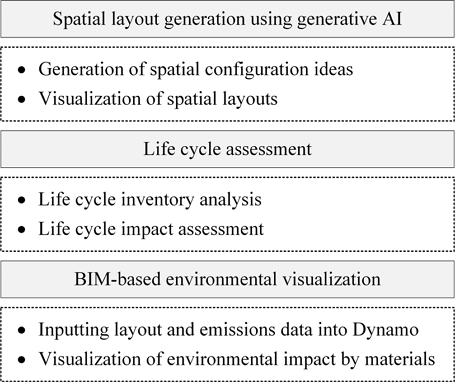
The aim of this study is the generation of spatial layout alternatives by utilizing GPT during the early design stage, evaluation of the environmental impact of each alternative using LCA, and automatic creation of BIM models. As illustrated in Fig. 1., the proposed method consists of three main steps. First, generative AI is used to derive spatial configuration ideas, which are then used to produce layout alternatives. Second, LCA is performed on these layouts to assess their environmental impacts. Finally, the layouts are automatically converted into BIM models using Dynamo, and their environmental performance is visualized.
Overview of proposed method
2. Research Method
2.1. Automatic Generation of Spatial Layout Alternatives Using Generative AI
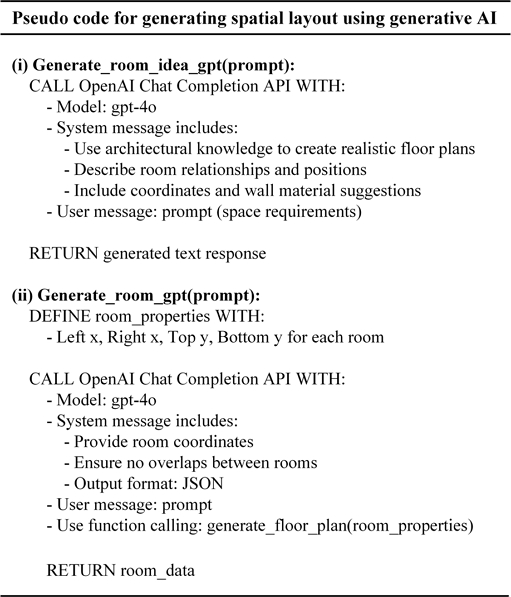
In this study, Python code and the OpenAI API were used to automatically generate spatial layout alternatives based on two GPT-4o models. The spatial layout generation process consists of (i) generating spatial configuration ideas and (ii) visualizing spatial layout alternatives based on those ideas (Fig. 2.).
Spatial layout generation process
First, spatial layout plans were developed by inputting the designer’s requirements using natural language prompts. These requirements could include the total building area, types and numbers of spaces, and occupant configuration. Accordingly, spatial configuration ideas were derived with consideration for the functional relationships between spaces. In this process, spatial layout constraints were necessary to reflect realistic design conditions, as generative AI tends to arrange spaces freely by inferring the designer’s intent. Table 1. presents the spatial configuration conditions predefined in this study, including space IDs, width and height ranges for each space, and required adjacencies. These conditions were derived by analyzing spatial configurations and layout patterns commonly found in five actual domestic apartment floor plans.

Defined condition for generating spatial layout
The spatial layout plans generated by the GPT-4o models, based on these constraints, included coordinate information for each space and reasoning behind the layout decisions. Proposals for wall materials—including finishing materials, structural components, and insulation—were also provided for each spatial layout alternative.
Next, the text-based layout plans were converted into coordinate-based geometric data (in JSON format). Specifically, coordinate information (Left x, Right x, Top y, Bottom y) was generated for each space, and spatial layouts were visualized accordingly. To assess how well the alternatives satisfied the design conditions, satisfied adjacencies (SA) in the final layout were evaluated against the total adjacency requirements (TAR) (Eq. 1)[11]. Additionally, the average distance (AD) from the living room (as the central hub) to key spaces (e.g., kitchen and bedrooms) was measured. Dividing the AD by the total area (TA) produced the distance per square meter (DPSM), used to evaluate spatial efficiency (Eq. 2)[12].
| (Eq. 1) |
| (Eq. 2) |
2.2. LCA-Based GHG Emission Analysis
LCA was performed for walls to analyze the environmental impacts of the spatial layout alternatives generated through generative AI. The analysis was based on the wall materials included in the spatial layouts, targeting 12 representative building materials corresponding to finishing materials, structural materials, and insulation. These included: external finishing (stone tiles and bricks); insulation (rigid polyurethane, fiberglass insulation, expanded polystyrene boards, and mineral fiber insulation boards); structural materials (concrete blocks, wood wall panels, and ready-mixed concrete); and internal finishing (paint, wood wall panels, and gypsum boards). In other words, GHG emissions for each spatial layout alternative were calculated based on the material combinations proposed by generative AI and then compared and analyzed.
The functional unit of the LCA was defined as a total floor area of 1m2 over the building’s life cycle. The system boundaries focused on embodied carbon and included the material manufacturing stage and the repair and replacement stage during the building operation period. The analysis period was set at 40 years, including the operation stage, in accordance with the service life standards for RC structures specified in the Enforcement Decree of the Corporate Tax Act. The environmental impact assessment used GWP as the main indicator. Common techniques for conducting LCA include process-based LCA and input-output LCA. Process-based LCA directly measures resource consumption and emissions generated during each stage of the production process or estimates them based on survey data. In contrast, input-output LCA evaluates the overall environmental load, including indirect impacts, using national-level input-output tables. In this study, a hybrid LCA approach was applied, combining the strengths of both methods.
First, the total amount of direct and indirect energy sources consumed during the material production stage was calculated using the input-output method. Direct energy refers to energy used in the actual manufacturing process, while indirect energy refers to the energy used throughout the material supply chain, including mining, processing, and transportation of raw materials. Direct energy consumption was calculated by multiplying the energy utilization coefficient (EUC), which represents energy use per cost unit, by the material cost (MC) (Eq. 3).
| (Eq. 3) |
Indirect energy was calculated as the product of EUC, the Leontief inverse matrix ((I–A)-1), and MC (Eq. 4). The Leontief inverse matrix quantifies the direct and indirect ripple effects of a KRW 1 increase in production in a specific industrial sector on the entire economy. In other words, it helps estimate total indirect energy consumption across sectors during material production.
| (Eq. 4) |
Second, environmental impact substances generated during the production and combustion of materials—resulting from both direct and indirect energy consumption—were calculated using the life cycle inventory database and the individual accumulation method. This approach enabled quantitative calculation of substances consumed and emitted during the production, repair, and replacement stages of each building material.
To evaluate the environmental impacts of the spatial layout alternatives, the environmental impact substances calculated through the individual accumulation method were converted into environmental impact indicators. This conversion typically involves four stages: classification, characterization, normalization, and weighting. In this study, the environmental impacts were assessed focusing on the classification and characterization stages, which are fundamental to LCA. The normalization and weighting stages—optional steps that can introduce regional or subjective variation—were omitted, as the study aimed to compare the relative environmental performance of layout alternatives.
The classification stage involves grouping substances from life cycle inventory analysis into environmental impact categories. The characterization stage quantifies the relative impact of each substance by multiplying its emissions (E) by a characterization factor (CF), resulting in the characterized environmental impact (EI) (Eq. 5).
| (Eq. 5) |
In this study, two evaluation values were calculated for each spatial layout alternative: adjacency accuracy, derived from the TAR, and environmental impacts, evaluated through LCA. To identify the optimal layout alternative considering both objectives, the Pareto optimal solution method was applied. As the two objectives use different units, each target value (Zx) was normalized to a value between 0 and 1 (Sx) using Eq. 6. The optimal alternative was then selected using a weighted Euclidean distance-based fitness function (Eq. 7). Because adjacency accuracy (SA) and environmental impact (SB) were considered equally important, both weights (W1 and W2) were set to 1. However, the weights can be adjusted to reflect stakeholders’ preferences or the specific decision-making context. According to this fitness function, the optimal solution is the one with a value closest to zero.
| (Eq. 6) |
| (Eq. 7) |
2.3. BIM Model Generation and GHG Emission Visualization
LCA for evaluating the environmental impacts of buildings can be difficult for non-experts to analyze and interpret. In this study, spatial layout alternatives were converted into BIM models using Dynamo, and a parametric algorithm was developed to visualize GHG emissions. Dynamo is a visual programming tool that integrates with Revit, enabling data manipulation, complex form creation, and automation of user-defined workflows. It features a drag-and-drop interface and allows the construction of parametric algorithms by connecting nodes.
To visualize GHG emissions effectively, their relative impact levels must be expressed using colors. For this, normalization of the GHG emission values is essential. In this study, normalization was conducted using a linear interpolation method based on a first-degree polynomial defined between two arbitrary values. Linear interpolation estimates a value proportionally between two points using a straight-line function. This approach is useful for converting a value’s position between the minimum and maximum into a ratio between 0 and 1, making it possible to quantify relative differences and apply consistent color ratings across visualizations.
Here, the maximum (MaxEI) and minimum (MinEI) values of all cases were fixed, and normalization was applied using these reference points to ensure that all cases were evaluated on the same basis. Equation 8 presents the formula used to convert GHG emissions into a normalized value between 0 and 1 via linear interpolation. For example, when comparing the environmental impacts (EI) of three building materials—material #1: 5.74×101 kg-CO2eq., material #2: 3.23×101kg-CO2eq., and material #3: 2.17×101kg-CO2eq.—the normalized values (NV) are calculated to be 1, 0.28, and 0, respectively, based on the given MaxEI and MinEI.
| (Eq. 8) |
3. Results and Analysis
3.1. Results of Generating Spatial Layout Alternatives Using Generative AI
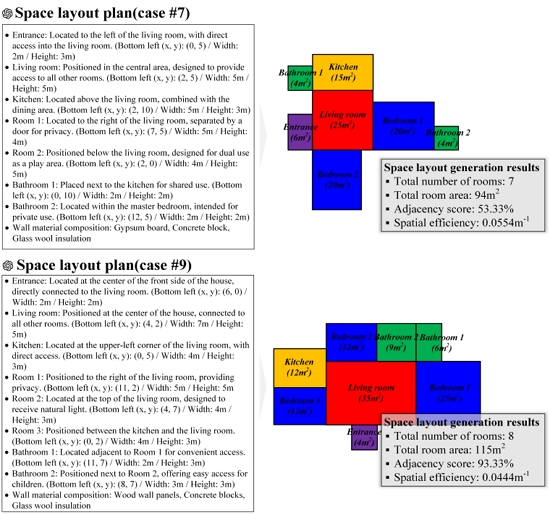
In this study, nine spatial layout alternatives were generated using generative AI. Fig. 3. presents the spatial configuration ideas proposed by the AI, along with visualization results for the alternatives with the lowest and highest adjacency accuracy—Case #7 and Case #9, respectively. The generative AI provided location data, coordinates, and wall material recommendations selected from 12 types of building materials for each space. Based on this information, the spatial layouts were visually implemented.
Spatial layout results using generative AI
Case #7 comprises seven spaces—living room, kitchen, entrance, two bedrooms, and two bathrooms—within a total area of 94m2. It satisfies the TAR with an adjacency accuracy of 53.33% and recommends a combination of gypsum boards, concrete blocks, and glass wool insulation for the walls. In contrast, Case #9 includes eight spaces—living room, kitchen, entrance, three bedrooms, and two bathrooms—over a total area of 115m2. It achieves a TAR adjacency accuracy of 93.33% and proposes a wall material combination of wood wall panels, concrete blocks, and glass wool insulation.
A comparison of the average distance per area from the living room revealed that Case #7 recorded 0.0554m-1 and Case #9 recorded 0.0444m-1. These results indicate that spatial layout efficiency improves as adjacency accuracy increases.
3.2. Comparison of GHG Emissions Based on Spatial Layout
Table 2. shows the results of calculating GHG emissions from finishing materials, structural materials, and insulation for the nine spatial layout alternatives (Case #1 to #9).
Results of environmental impact based on spatial layout
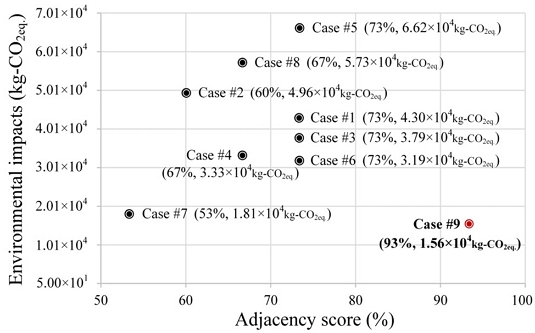
Among the nine spatial layout alternatives, Case #5 recorded the highest GHG emissions (6.62×10⁴kg-CO2eq.) with a combination of gypsum boards, ready-mixed concrete, and rigid polyurethane insulation. In contrast, Case #9 showed the lowest GHG emissions (1.56×10⁴kg-CO2eq.) using wood wall panels, concrete blocks, and glass wool insulation. Although GHG emissions can be directly compared across layout alternatives, evaluating performance based on a single indicator has limitations, as it does not fully capture functional aspects such as adjacency.
To address this, the optimal spatial layout alternative was identified by considering both adjacency and GHG emissions using the Pareto optimization technique (Fig. 4.). The analysis revealed that Case #9 is the optimal choice, achieving high adjacency accuracy (93%) and the lowest GHG emissions (1.56×10⁴kg-CO2eq.). This suggests that Case #9 offers a balanced solution, minimizing environmental impact while ensuring efficient spatial connectivity.
Analysis results of the optimal spatial layout
3.3. Results of BIM-based GHG Emission Visualization
In this study, the spatial layout alternatives generated through generative AI and their corresponding GHG emissions were visualized using a Dynamo-based parametric algorithm to make the results more accessible to non-experts. Fig. 5. shows the BIM model generated for Case #9—the selected optimal spatial layout alternative—and the visualization of the environmental impacts of each wall material. The materials—wood wall panels, concrete blocks, and glass wool insulation—were color-coded according to their roles as finishing, structural, and insulation materials, respectively, allowing users to intuitively grasp differences in environmental impact by material type.
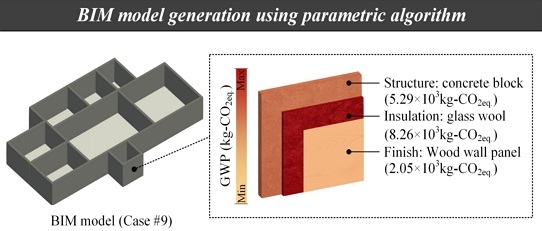
Visualization of spatial layout
This approach enables quantitative comparison of GHG emissions from each building material using an automated process, rather than relying on the manual comparisons shown in Table 2. In other words, the proposed method offers a practical tool for decision-making that supports the sustainability evaluation of spatial layout alternatives produced by generative AI.
4. Conclusions
The construction industry accounts for a significant portion of GHG emissions, and the environmental impact of buildings can vary considerably depending on design-stage decisions. Therefore, the environmental impacts of various design alternatives during the early design phase must be quantitatively analyzed. This study presented a method for automatically generating spatial layout alternatives using generative AI. The environmental impact of each alternative was evaluated through LCA, automatically creating corresponding BIM models.
To validate the proposed method, nine spatial layout alternatives were generated using GPT-4o models, and their environmental impacts were analyzed. The key findings are as follows:
First, among the nine alternatives, Case #9 comprised eight spaces over a total area of 115m2 and met the TAR with 93.33% accuracy. It also demonstrated the lowest GHG emissions (1.56×10⁴ kg-CO2eq.) through a wall material combination of wood wall panels, concrete blocks, and glass wool insulation. This result shows that the optimal spatial layout can be selected from generative AI–generated alternatives by considering environmental impact.
Second, a parametric algorithm was employed to automatically visualize each material’s environmental impact by coloring BIM objects based on LCA results. This approach enables users, including non-experts, to intuitively understand material-level environmental impacts and easily assess the sustainability of design alternatives.
However, this study has certain limitations. The design scope was limited to spatial layout (e.g., positioning and relationships between spaces) to examine the applicability of generative AI in early-stage design, thereby controlling complexity and focusing on AI’s spatial reasoning. Detailed design elements such as doors, windows, and furniture were excluded. Additionally, the LCA only covered material production, repair, and replacement stages, omitting the full building life cycle.
In future research, LCA should be incorporated across the entire life cycle and more comprehensive design elements are required. Overall, the purpose of the proposed method is to establish a framework for quantitatively evaluating the environmental impacts of spatial layout alternatives in the early design stage by integrating generative AI, LCA, and BIM. The method is expected to support carbon-conscious design decisions by providing early-stage environmental impact information—an aspect previously difficult to assess.
Acknowledgments
This work was supported by the National Research Foundation of Korea funded by the Ministry of Education (RS-2024-00409452) and the Ministry of Science and ICT (RS-2025-00516305).
References
- UNEP, Building materials and the climate: Constructing a new future, 2023, https://www.unep.org/resources/report/building-materials-and-climate-constructing-new-future, .
- Ministry of Land, Infrastructure and Transport, 2050 Carbon Neutral Strategy of the Republic of Korea, 2021.
-
C.K. Anand, B. Amor, Recent developments, future challenges and new research directions in LCA of buildings: A critical review. Renewable and Sustainable Energy Reviews, 67, 2017, pp.408-416.
[https://doi.org/10.1016/j.rser.2016.09.058]

-
K. Jeong et al., A model for predicting the environmental impacts of educational facilities in the project planning phase, Journal of Cleaner Production, 107, 2015, pp.538-549.
[https://doi.org/10.1016/j.jclepro.2014.01.027]
-
J. Hester et al., Actionable insights with less data: guiding early building design decisions with streamlined probabilistic life cycle assessment, The International Journal of Life Cycle Assessment, 23, 2018, pp.1903-1915.
[https://doi.org/10.1007/s11367-017-1431-7]
-
M. Budig et al., Computational screening-LCA tools for early design stages, International Journal of Architectural Computing, 19(1), 2021, pp.6-22.
[https://doi.org/10.1177/1478077120947996]
-
A. Kamari, B.M. Kotula, C.P.L. Schultz, A BIM-based LCA tool for sustainable building design during the early design stage, Smart and Sustainable Built Environment, 11(2), 2022, pp.217-244.
[https://doi.org/10.1108/SASBE-09-2021-0157]
-
S. Parece, R. Resende, V. Rato, A BIM-based tool for embodied carbon assessment using a construction classification system, Developments in the Built Environment, 19, 2024, 100467.
[https://doi.org/10.1016/j.dibe.2024.100467]
-
K. Forth, A. Hollberg, A. Borrmann, BIM4EarlyLCA: An interactive visualization approach for early design support based on uncertain LCA results using open BIM, Developments in the Built Environment, 16, 2023, 100263.
[https://doi.org/10.1016/j.dibe.2023.100263]
- J. Achiam et al., Gpt-4 technical report, arXiv preprint arXiv:2303.08774, , 2023.
-
K. Shekhawat et al., Gplan: Computer-generated dimensioned floorplans for given adjacencies, arXiv preprint arXiv:2008.01803, , 2020.
[https://doi.org/10.1016/j.autcon.2021.103718]
-
P. Merrell, E. Schkufza, V. Koltun, Computer-generated residential building layouts, ACM SIGGRApH Asia 2010, 2010, pp.1-12.
[https://doi.org/10.1145/1882261.1866203]