Local Space Branding-Based Adaptive Reuse Strategies : A Comparative Analysis of Office Projects in New York
ⓒ 2025. KIEAE all rights reserved.
Abstract
This study aims to investigate how adaptive reuse in post-industrial buildings can contribute to local branding, spatial identity, and urban revitalization. By focusing on three cases in New York City—Gaseteria Building, 95 Evergreen, and the Google Hudson Square Campus—it explores the architectural strategies that bridge heritage preservation with contemporary function.
The research adopts a qualitative case study approach, incorporating comparative analysis, architectural theory, and spatial typology frameworks. Each project was examined through design document analysis, field observation, and literature review. Key strategies such as façade retention, material reinterpretation, spatial reconfiguration, and boundary activation were analyzed to understand their role in place-making.
The study finds that adaptive reuse projects enhance cultural continuity and public engagement when architectural memory is preserved and integrated with new programs. Elements such as historic signage, industrial materiality, and civic-scale entry points help reinforce local identity and community relevance. The research concludes by suggesting future methodologies involving typological indexing and AI-assisted reuse tools to support context-specific, narrative-driven architectural regeneration.
Keywords:
Local Space Branding, Adaptive Reuse, Urban Regeneration, Community Engagement, Place Identity1. Introduction
1.1. Research Background
In recent years, adaptive reuse has become a critical strategy in global urban regeneration efforts, especially within post-industrial cities confronting the dual challenge of preserving cultural heritage while accommodating new economic and social functions. Scholars such as Bullen and Love (2011) argue that adaptive reuse not only reduces environmental impact by minimizing demolition waste but also reinforces urban continuity through the retention of material memory and historical context [1].
This convergence of sustainability and identity has gained renewed urgency in the context of shifting economic paradigms, remote work trends, and increasing demands for place-based authenticity. In cities such as New York, Detroit, and Seoul’s Seongsu-dong, the reuse of aging industrial infrastructure has emerged as a response to the scarcity of buildable land, rising construction costs, and public demand for culturally resonant spaces. In particular, adaptive reuse projects are now recognized as tools not only for architectural transformation, but also for spatial branding—strategies that reposition aging structures as branded destinations tied to local narratives and community values.
1.2. Research Objectives
The objective of this research is to explore how local branding emerges through adaptive reuse in Metropolitan’s post-industrial office buildings. Focusing on the Gaseteria Building, 95 Evergreen, and Google Hudson Square Campus, the study examines how architectural elements—such as structural preservation, material contrast, and spatial restructuring—are employed to strengthen spatial identity and collective memory. In doing so, it also evaluates how these interventions enhance public accessibility, user experience, and community relevance.
In parallel, the research examines how these interventions impact public engagement, user experience, and cultural continuity, especially within the broader context of urban policy goals and community development. To frame these insights, the study draws on adaptive reuse typologies [2] and spatial relationship frameworks [3] to propose a methodology that bridges design intent with strategic planning. Ultimately, the research aims to contribute to scalable, data-supported design approaches that leverage generative AI and spatial analysis for future adaptive reuse projects—across global contexts where identity-led regeneration is increasingly valued.
1.3. Scope and Methodology
This study adopts a qualitative case study methodology that integrates literature review, professional design experience, spatial observation, and conceptual analysis. The research begins with a comprehensive review of academic discourse on adaptive reuse, place identity, and local space branding within urban regeneration. It then focuses on three completed adaptive reuse projects in New York City: the Gaseteria Building in Long Island City, 95 Evergreen in Bushwick, and the Google Hudson Square Campus in Manhattan.
The author served as project architect at Fogarty Finger for both the Gaseteria Building and 95 Evergreen, offering direct involvement in spatial planning, material reuse, and branding strategies. This hands-on experience provides a grounded understanding of how design decisions—such as the retention of structural elements, modification of circulation paths, or incorporation of historical signage—were implemented to support identity formation and narrative continuity.
To enhance analytical rigor and objectivity, the study establishes a comparative evaluation framework consisting of the following key spatial branding indicators in Table1.

Comparative evaluation framework
These indicators are applied to each case through site observations, architectural documentation, planning records, and spatial diagrams. Findings are interpreted through established conceptual frameworks, including Liliane Wong’s adaptive reuse typologies—Insert, Wrap, Weave—and Fisher-Gewirtzman’s visual connectivity mapping methods [2~3].
Additionally, this study proposes a future research trajectory using AI-assisted design tools that analyze typological patterns and contextual datasets. Such tools can facilitate site-specific reuse strategies that are both culturally rooted and programmatically viable—thus extending the applicability of local space branding in diverse urban settings.
2. Literature & Conceptual Framework
2.1. Local Space Branding in Adaptive Reuse
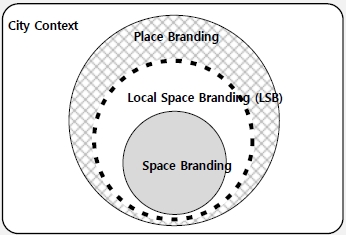
This study introduces Local Space Branding (LSB) as a distinct spatial strategy that links the cultural identity and architectural uniqueness of a locale to its design expression and branding potential. Unlike broader frameworks such as national place branding or city-level promotional strategies, LSB operates at the neighborhood or district scale. It captures both tangible and intangible local characteristics—historical narratives, industrial legacies, environmental cues—and translates them into architectural and programmatic elements that drive not only physical transformation but also symbolic, emotional, and economic revitalization.
While prior scholarship has addressed related terms such as “place branding” (Kavaratzis & Ashworth, 2005), “spatial identity” (Tiesdell et al., 1996), and “local branding” in the context of urban regeneration (Kim et al., 2018), LSB specifically emphasizes architecture’s role in articulating local narratives through spatial form. It frames adaptive reuse not only as a conservation technique, but as a strategic design method that fosters both community attachment and market differentiation [4~6].
In 2023, Sang-Hyun Park offered the first formal definition of LSB in Daejeon Ilbo, stating: “Local Space Branding is a process of designing user experiences and embedding brand value into space by utilizing the resources and content of a specific region [7].” This definition highlights LSB as a user-centered, context-sensitive approach that extends beyond form to engage with the symbolic, experiential, and communicative aspects of architecture.
This principle is often illustrated in adaptive reuse projects where the reuse of historic signage and industrial murals functions not only as aesthetic reference but as branding anchors rooted in local memory—an approach consistent with Maschaykh’s (2016) notion of cultural anchoring through industrial heritage [8]. Similarly, projects that integrate original industrial elements such as masonry walls, structural grids, or brewing infrastructure into spatial configurations and public-facing programs reflect Lee’s (2006) view that architectural continuity can simultaneously honor historical legacy and support contemporary use [9].
A complementary perspective is offered in Kim’s Space Branding: The principle of space that creates impressions, which defines ‘Space Branding’ as a tool for creating symbolic meaning and business value within spatial experiences [10]. While Kim’s approach often centers on brand identity from the owner’s or investor’s perspective—emphasizing novelty and visual distinctiveness—LSB prioritizes cultural rootedness and community relevance over commercial spectacle.
In contrast to more commercially driven space branding, LSB aims to cultivate collective emotional geographies. It embeds memory and place-specific identity into design decisions that resonate across entire districts. This makes LSB especially pertinent for post-industrial, underused, or shrinking regions seeking to re-establish identity and vibrancy through built form. It is not limited to reuse; the same logic applies to new construction that draws from natural landscapes, vernacular materials, or local culture to create meaningful, story-driven architecture.
Ultimately, Local Space Branding is both a conceptual framework and a practical tool, shaping adaptive reuse and new projects into places that embody narrative depth, community identity, and symbolic resonance.
Conceptual positioning of Local Space Branding (LSB)
2.2. Adaptive Reuse as Urban Strategy
Adaptive reuse is widely recognized as a key strategy for sustainable urban regeneration. Rather than discarding old buildings, cities increasingly view them as catalysts for revitalization. In Korea, Kim & Lee (2011) emphasize how urban regeneration policy shifted reuse from isolated renovations to strategic tools for broader renewal goals—stimulating local economies and reactivating communities [11]. National initiatives like Korea’s Urban Regeneration New Deal reflect this trend, promoting the reuse of idle industrial and vacant spaces in aging downtowns to address both blight and preservation.
Research supports this approach. Savoie et al. (2025) showed how Canadian cities successfully converted underused heritage buildings into vibrant community assets—such as artist lofts or public centers—when supported by grants or flexible regulations [12]. Landmark projects like the High Line in New York or the Tate Modern in London illustrate how adaptive reuse can transform infrastructure into urban icons, elevating not only physical space but also local identity and economic potential.
The strategy also advances sustainability. It minimizes demolition waste, retains embodied carbon, and fosters compact urban growth. Culturally, it safeguards local memory. Economically, reuse can offer faster approvals and cost savings, especially with policy support. As Bullen & Love (2007) argue, retained material value and faster permitting often make reuse financially viable [1]. Furthermore, many governments provide incentives—such as tax credits or zoning flexibility—encouraging developers to prioritize renovation. This convergence of heritage, sustainability, and development makes adaptive reuse a strategic bridge between past and future urban needs [13].
2.3. Spatial Identity Through Community and Storytelling
A recurring theme in the literature is that adaptive reuse enhances spatial identity by embedding collective memory and community narratives into the built environment. Instead of erasing history, successful reuse projects embrace the palimpsest of place—retaining signage, facades, and artifacts that serve as canvases of memory. Adin & Sirel (2024), in their comparative study of Vienna’s Gasometers and Istanbul’s Hasanpaşa Gasworks, emphasize that industrial heritage sites “which hold a place in the collective memory and identity of their cities” should preserve traces of their era to keep the “soul” of the site alive. This reinforces the argument that adaptive reuse is most impactful when it respects local history—whether an old factory or a culturally significant church—and when physical remnants are maintained to strengthen place identity [14].
Community engagement and storytelling play critical roles in this process. Involving residents during the reuse planning phases helps generate spaces that reflect local experiences and values. The National Trust for Historic Preservation promotes memory-based design, a view shared by architect Ethan Marchant, who describes adaptive reuse as “evolving and extending the narrative of a place.” Marchant (2024) highlights how buildings hold stories, and design interventions should interpret and extend those narratives. This can take the form of oral history workshops, interpretive signage, or the reuse of historical elements such as old machinery or site-specific names. These strategies build emotional resonance for longtime residents and create layered identities that also engage newcomers [15].
Empirical evidence supports this approach. Savoie et al. (2025) note that community participation in adaptive reuse is a key success factor, fostering a sense of ownership and long-term stewardship. This resonates with environmental psychology's concept of place attachment—spaces that reflect local stories tend to deepen community identity [12]. However, scholars like Zukin (2010) caution that when storytelling is exploited solely for branding, it can commodify culture and drive gentrification. This risk underscores the need for inclusive design that delivers tangible community benefits alongside aesthetic and economic gains [16].
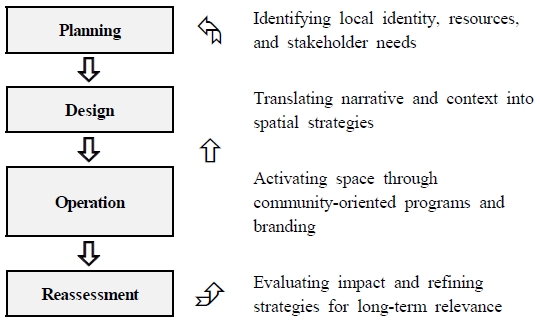
Application phases of local space branding
In sum, spatial identity in adaptive reuse is cultivated through memory, participation, and narrative continuity. By honoring community history and involving local voices, adaptive reuse projects become dynamic and rooted cultural infrastructures. These buildings not only serve new functions but also stand as living stories of their cities—proof that architecture can be both transformative and respectful of its past.
3. Case Analyses in Metropolitan Area
3.1. 95 Evergreen Building (Bushwick, Brooklyn)
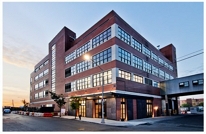
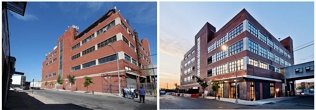
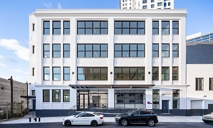
Formerly serving as a brewery facility in the early 20th century, the 95 Evergreen Building stands in Bushwick, a neighborhood with a rich industrial and cultural heritage. Over time, the property underwent periods of vacancy and partial commercial use, reflecting the broader shifts from manufacturing to creative industries in Brooklyn. Under a recent renovation led by Fogarty Finger Architecture (with the user serving as Project Architect), 95 Evergreen has been adaptively reused for a mix of programs, including a community-oriented healthcare department among other commercial tenants. This transition exemplifies how historic industrial assets in Bushwick find new life as vital local-service structures.
95 Evergreen building profile
Retaining Brewery Identity: The renovation preserves sections of the original brewery facade and structural elements. Exposed brick walls, steel beams, and large archways recall the building’s manufacturing roots. The design capitalizes on industrial aesthetics while integrating contemporary lighting and HVAC systems.
Mixed-Use Flexibility: The interior spaces are partitioned to accommodate office suites, public-facing healthcare facilities, and communal areas. Emphasis on open corridors and atrium-like zones fosters interaction, appealing both to tenants and the broader community.
Local Branding & Signage: Signage references the building’s brewery history, blending heritage-themed graphics with the new occupant’s identity—particularly the healthcare department. This dual branding underscores how a single building can symbolize past and present collectively.
The renovation of 95 Evergreen enhances public access through a reconfigured ground floor with large entryways, transparent glazing, and an inviting lobby that encourages neighborhood engagement. Central to the program is a health department—likely municipal or nonprofit—that provides essential medical and wellness services to local residents, reinforcing the social function of adaptive reuse within an evolving industrial corridor.
95 Evergreen adaptive reuse design strategy analysis
Complementary uses such as pop-up events, workshops, or nonprofit collaborations activate the space further, fostering community connection. These functions, housed within a historically rich structure, create meaningful overlap between heritage and service.
The branding impact is equally notable: the building’s brewery legacy is integrated with its current civic role, shaping a narrative that resonates with residents and affirms Bushwick’s transformation. Architectural interventions—restored masonry, industrial glazing, and daylight-enhancing interiors—shift spatial quality from cluttered factory to flexible loft, supporting co-working, wellness, and cultural programming.
Overall, 95 Evergreen exemplifies how industrial heritage can be preserved while delivering urgent community functions—positioning the building as a civic anchor and branding symbol in a rapidly changing neighborhood.
3.2. Gaseteria Building (Long Island City, Queens) Project Background
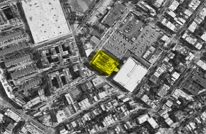
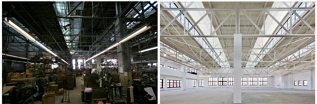
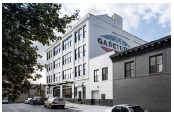
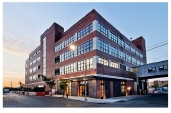
Originally a mid-20th-century industrial structure, the Gaseteria Building derives its name and initial identity from its former gas-related operations. Located in Long Island City—a district known for its shift from heavy manufacturing to creative and commercial endeavors—the building was recently repurposed to host co-working offices and an on-site food court. This contemporary program mix addresses local demand for flexible workspace solutions while boosting neighborhood-level dining options.
Gaseteria building profile
Preserving Industrial Character: Much like other adaptive reuse projects in the area, the Gaseteria Building retains its soaring ceilings, robust steel skeleton, and expansive floor plates. These industrial attributes not only honor the structure’s historic character but also provide appealing, lofty interior volumes ideal for co-working layouts.
Gaseteria building adaptive reuse design strategy analysis
Co-working Emphasis & Brand Identity: Multiple subdivided yet interconnected office suites cater to start-ups, small businesses, and creative professionals. Throughout common corridors and communal areas, the design incorporates industrial-themed graphics, signage, and material palettes under the “Gaseteria” name, lending a unique corporate address that celebrates the building’s past.
Food Court Integration & Building Connections: Recognizing that modern workers value diverse, on-site dining, a dedicated food court is strategically placed at ground level or an adjacent wing. This cohesive arrangement links seamlessly to nearby properties, creating a mini food and office cluster that elevates both occupant convenience and street-level activity.
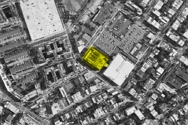
The Gaseteria Building exemplifies how an industrial-era structure in Long Island City can be skillfully adapted into a vibrant commercial hub while preserving and reactivating its local identity. By embracing urban memory as a branding tool, the project reintegrates defunct Gaseteria signage and murals, tapping into collective nostalgia to transform a once-anonymous warehouse into a recognizable neighborhood landmark. The use of a white-on-white material palette, paired with a rationalized window system, enhances interior brightness and reinforces spatial simplicity—creating a flexible environment well-suited for co-working and mixed commercial use. Rather than erasing its past, the design narrative folds the building’s former identity into a new story, bridging its industrial legacy with contemporary functionality. Meanwhile, the reconfigured public interface—through a clearly defined entry, plaza ramp, and visibility along the Sunnyside rail corridor—anchors the building as a civic marker within a rapidly transitioning urban fabric. Altogether, Gaseteria’s adaptive reuse demonstrates how architectural transformation, nostalgic branding, and strategic spatial planning can converge to create a commercially viable yet culturally resonant space.
3.3. Google Hudson Square Campus (NY, NY)
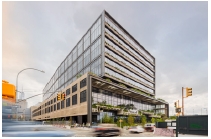
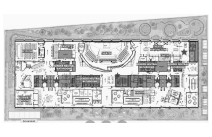
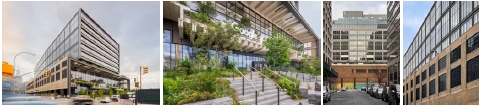
The Google Hudson Square Campus—formerly St. John’s Terminal—is a landmark adaptive reuse and vertical expansion project in Manhattan’s Hudson Square district. Originally built in the 1930s as a freight hub for the West Side Line and High Line, the terminal was central to New York’s industrial logistics. After years of inactivity, the site was transformed by COOKFOX and Gensler into a modern headquarters for Google, completed in 2023.
Google hudson square campus building profile
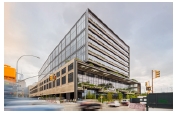
The redevelopment preserves the original three-story base, characterized by precast concrete and industrial detailing, while adding an eight-story glass-and-steel volume above. This vertical layering respects the site’s historical identity while introducing a bold new presence on the skyline. At street level, the project incorporates a public plaza, biophilic design elements, and generous entryways, anchoring the campus as both a corporate hub and an accessible civic space within the Hudson River Park corridor.
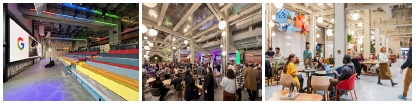
The architectural strategy at Google Hudson Square Campus skillfully blends preservation and innovation by retaining the original three-story base of the St. John’s Terminal and adding a sleek, eight-story glass volume above. This vertical expansion does not erase the past but highlights the layered history of the building, contrasting the raw, industrial concrete base with a refined curtain wall system. The transition between old and new becomes a key branding device, visually narrating the building’s evolution from a freight terminal to a modern tech campus. The grand, double-height glass entry lobby—framed by overhanging concrete beams—establishes a civic-scale threshold, reinforcing Google’s identity as an open and accessible brand. Inside, colorful wall graphics, bespoke furniture, and playful spatial moments animate the raw concrete structure, creating a strong interior brand presence aligned with Google’s creative culture. Biophilic design elements such as green terraces and landscaped edges further soften the building’s mass and connect the architecture to the surrounding neighborhood, reinforcing a brand image that is both forward-looking and grounded in place.
Beyond architectural expression, the transformation of Google Hudson Square Campus redefines how a corporate campus can serve its urban context. The building’s previously closed-off freight facade is reimagined as a publicly engaging front, featuring landscaped plazas, widened sidewalks, and transparent ground-floor spaces that foster pedestrian interaction. Public-facing cafés, lounges, and event zones support informal cultural programming and extend the utility of the building beyond Google’s employees. As a result, the building operates not only as a workplace but as a cultural node within the Hudson Square district. Located adjacent to the High Line’s southern end and along the West Side Highway, the site strengthens the area’s role as a tech and creative corridor. The project acknowledges its industrial legacy through its preserved structural elements and urban footprint, yet reframes it with new social meaning—offering permeability, visibility, and symbolic continuity. Through this multi-layered intervention, Google Hudson Square Campus becomes a model for adaptive reuse that merges innovation, memory, and public value.
Google hudson square campus adaptive reuse design strategy analysis
4. Comparative Synthesis
A comparative analysis of three adaptive reuse projects in New York; Gaseteria Building, 95 Evergreen, and Google Hudson Square Campus reveals consistent architectural strategies that successfully bridge historical memory with contemporary functionality. Despite their differences in scale and urban context, these projects demonstrate four common themes that contribute to their success.
Adpative reuse design strategy comparison chart
4.1. Architectural Memory as Identity Anchor
Each project strategically preserves and reinterprets architectural elements from its former use to construct a compelling narrative of place. The reuse of original signage and murals at the Gaseteria Building evokes local nostalgia, aligning with Maschaykh’s (2016) argument that symbolic artifacts in adaptive reuse reinforce place memory and branding [8]. At 95 Evergreen, exposed brewery brickwork, restored masonry, and retained structural grids lend continuity and authenticity to the site’s transformation—illustrating Kim et al.’s (2018) view that maintaining site-specific elements supports local identity and emotional resonance [6]. In the case of Google Hudson Square Campus, the preserved freight terminal base and contrasting modern tower demonstrate Shin’s (2021) idea that adaptive reuse can reflect both heritage continuity and forward-looking transformation [17]. These architectural decisions allow each project to function not only as a space of use, but also as a vessel of narrative and identity.
4.2. Space Transformation and Boundary Activation
The transformation of building boundaries enhances public access and integration with the city. For example, 95 Evergreen introduces new entryways, glazed portals, and curated public-facing lobbies that invite visibility and accessibility. This supports Savoie et al.’s (2025) view that redefining spatial boundaries improves inclusivity and urban connectivity [12]. At the Gaseteria Building, the former loading berth is converted into a welcoming food hall and public entrance, enhancing user circulation and fostering community interaction. At Google Hudson Square Campus, the removal of a street-facing wall allows for a landscaped public plaza and a transparent civic-scale lobby—further reinforcing the role of adaptive reuse in blending private architecture with public life. These boundary shifts not only improve spatial flow and user comfort but also blur the line between private use and public engagement—positioning the building as part of the social fabric.
4.3. Multi-Program Synergy and Cultural Layering
These projects blend commercial functions with community-focused programs, reflecting Bullen and Love’s argument that adaptive reuse can promote social inclusivity and economic diversity [1]. At Gaseteria, co-working spaces are integrated with food vendors and small retail units, creating a vibrant and interactive setting. 95 Evergreen incorporates a community health agency alongside flexible co-working and event spaces, ensuring both social value and operational viability. Google Hudson Square Campus includes collaborative lounges, community event spaces, and green terraces—demonstrating that even large-scale corporate reuse can retain cultural and social permeability. This multi-layered programming enhances spatial value while reinforcing narrative branding.
4.4. Narrative Design and Brand Storytelling
All three cases use architectural form and material to tell a story. Gaseteria revives its past identity through preserved signage and murals. 95 Evergreen conveys its brewing legacy via structural and spatial choices. Google Hudson Square Camp** Fisher-Gewirtzman’s visual connectivity mapping methodsus’s architectural contrast symbolizes Google’s future-oriented ethos, resonating with Shin’s and Marchant’s assertions that architectural storytelling deepens brand authenticity and cultural relevance [15,18].
Together, these findings underscore adaptive reuse not merely as a technique of conservation, but as a design framework for spatial identity-making and branded urban experience. Each project demonstrates that maintaining architectural continuity—while introducing new public thresholds, programmatic diversity, and branding layers—can transform former industrial sites into dynamic civic and commercial anchors. These outcomes suggest a pathway toward more structured typological study and AI-assisted reuse planning, where historic elements become inputs not just for form-making, but for storytelling and cultural relevance.
5. Conclusions & Recommendations
5.1. Key Findings
This study analyzed three adaptive reuse office projects in New York—Gaseteria Building, 95 Evergreen, and Google Hudson Square Campus—to investigate how architectural memory and local branding contribute to urban transformation. Despite differences in scale and use, all three projects demonstrated that adaptive reuse can foster continuity, authenticity, and cultural resonance in the urban fabric.
Adpative reuse design strategy comparison chart
One of the central findings is that local branding significantly amplifies the impact of adaptive reuse. Through the careful retention and reinterpretation of industrial structures, original signage, and material textures, these projects promote a sense of place rooted in memory and identity. This observation echoes Park’s (2021) argument that repurposed industrial buildings can become cultural anchors that project narrative and emotional meaning [19]. However, this study extends that notion by demonstrating how branding emerges not just through preservation but also through intentional design strategies that embed spatial storytelling into the reused architecture.
Additionally, the integration of layered programs—such as public cafés, health centers, and coworking hubs—proved crucial in generating everyday vibrancy and public relevance. Rather than treating community-serving programs as secondary, successful reuse projects place them at the heart of their spatial identity, ensuring inclusivity and long-term vitality. This aligns with Evan’s (2015) emphasis on participatory redevelopment, where community engagement is seen not as an afterthought but as a driver of cultural relevance and user-centered design [20].
Another key insight involves the transformation of spatial thresholds. By introducing transparent facades, open lobbies, and public plazas, these buildings blur the distinction between private interiors and public streetscapes. These interventions reframe reused buildings as part of the civic experience and reflect current urban needs for permeability and accessibility.
Yet, while these design and branding strategies increase appeal and economic opportunity, they also carry the potential to accelerate gentrification. As Kavaratzis and Ashworth (2005) caution, place branding must be implemented with care to avoid turning identity into a marketable façade that risks excluding original residents [4]. Therefore, balancing economic uplift with cultural continuity and affordability remains a pressing concern for adaptive reuse strategies.
5.2. Practical Implications
This study offers several takeaways that may be useful for architects, planners, and local governments involved in adaptive reuse. At the heart of these lessons is the idea that branding strategies should emerge organically from the character of a place. Instead of applying generic or externally imposed themes, the most resonant designs seem to grow from local memories—things like industrial remnants, street-level histories, or long-standing signage. The Gaseteria Building’s revived façade lettering, for instance, reflects how a modest design gesture can reconnect a site with its past. Likewise, the subtle references to brewing culture at 95 Evergreen speak to how buildings can hold and communicate identity through material and form [21].
Another important point concerns how space is used over time. Rather than planning all functions at once, it can be helpful to let programming develop gradually, in collaboration with local actors. Community-based organizations, artists, and residents often bring valuable insight into what the area needs—and how people might use the space differently as it evolves. At 95 Evergreen, for example, flexible spaces and mixed programming have allowed the building to remain relevant to both commercial tenants and local groups [22].
The architectural boundaries must be reimagined as interfaces, not barriers. Design elements such as open entries, transparent materials, and street-level plazas support walkability and redefine reused structures as shared civic assets.
Public policy, of course, plays a major role in shaping what’s possible. Planning tools like zoning overlays, historic preservation incentives, and adaptive reuse tax credits can give developers a reason to retain original structures while still investing in innovation. But more importantly, policies can be structured to encourage community input from the earliest stages. Co-programming initiatives, or requirements for public consultation in reuse projects, can help ensure that the design benefits local residents and not just private interests.
These ideas have clear relevance beyond New York. In South Korea, neighborhoods like Seongsu-dong, Mullae Art Village, or the Incheon Open Port area are already exploring ways to blend industrial memory with new cultural and commercial uses. Here, too, LSB (Local Space Branding) could serve as a useful framework—helping cities craft more meaningful, inclusive, and locally grounded regeneration strategies. Ultimately, adaptive reuse becomes more than an act of preservation; it becomes a tool for telling stories and building stronger relationships between people and place.
5.3. Future Research
Looking ahead, future research should more systematically examine adaptive reuse typologies. Frameworks such as Liliane Wong’s Adaptive-Reuse typologies and Fisher-Gewirtzman’s spatial cognition diagrams offer productive foundations. Refining these with empirical data could support clearer design protocols aligned with urban branding objectives—whether reinforcing historical continuity, fostering community engagement, or enhancing symbolic identity in the urban fabric.
The integration of generative AI tools into reuse workflows also holds promise. Techniques such as image-based similarity matching can identify precedent cases that align with specific site conditions, while pattern recognition algorithms may detect common reuse strategies to inform prototype designs. These tools can enhance early-stage ideation and feasibility analysis without replacing architectural intuition.
Finally, future research would benefit from mixed-method strategies that go beyond design logic. Methods like post-occupancy surveys, spatial network analysis, and ethnographic user studies can help evaluate how reuse projects function socially and symbolically over time. Mid-sized Korean cities like Suwon, Incheon, or Daejeon—with their unique blends of industrial memory and development pressure—offer valuable testbeds for applying LSB-informed adaptive reuse strategies in diverse urban contexts.
References
-
P.A. Bullen, P.E.D. Love, adaptive reuse of heritage buildings, Structural Survey, 29(5), 2011, pp.411-421.
[https://doi.org/10.1108/02630801111182439]

-
L. Wong, Adaptive reuse: Extending the lives of buildings, Basel, Swiss: Birkhäuser, 2016.
[https://doi.org/10.1515/9783038213130]
- D. Fisher-Gewirtzman, Space syntax and spatial cognition: The role of visual connectivity in shaping spatial experience, Frontiers of Architectural Research, 5(4), 2016, pp.449-456.
- M. Kavaratzis, G.J. Ashworth, Place branding: Where do we stand?, Marketing Theory, 5(4), 2005, pp.383-398.
-
B. Plevoets, K. Van Cleempoel, Adaptive reuse as a strategy towards conservation of cultural heritage, WIT Transactions on the Built Environment, 2011.
[https://doi.org/10.2495/STR110131]
-
B.M. Kim, Y.J. Kwon, J.Y. Kim, Place branding as a strategic method of revitalizing idle space - Based on European examples, Korean Institute of Spatial Design, 13(5), 2018, pp.331-344.
[https://doi.org/10.35216/kisd.2018.13.5.331]
- Daejeon Ilbo, S.H. Park, What is local space branding, https://www.daejonilbo.com/news/articleView.html?idxno=2078831, , 2023.08.09.
- U. Maschaykh, Reviving prosperity – Adaptive reuse and urban branding in the revitalization of Hamilton’s downtown neighbourhoods, International Journal Canada’s Journal of Global Policy Analysis, 2016.
- M.Y. Lee, A study on the cultural concept and methodology of the place marketing strategy, Journal of the Korean Geographical Society, 41(1), 2006, pp.39-57.
- J.Y. Kim, Space branding, Book Journalism, 2020, ISBN 9791196970000.
- H.J. Kim, S.H. Lee, The effect of urban regeneration concept revealed in renovation plans of under-used spaces - Focused on cases in prior research, Journal of Architectural Institute of Korea, 27(6), 2011, pp.103-112.
-
É. Savoie, J.P. Sapinski, A.M. Laroche, Key factors for revitalising heritage buildings through adaptive reuse, Buildings & Cities, 6(1), 2025, pp.103-120.
[https://doi.org/10.5334/bc.495]
- M. Robiglio, Re-cycle: Strategies for adaptive reuse in the built environment, Jovis Verlag, 2017.
-
M.S. Adın, A. Sirel, Heritage, memory and adaptive reuse: Vienna Gasometer and Istanbul hasanpaşa gasworks as palimpsest spaces, AIS: Architecture Image Studies, 5(1), 2024, pp.68-85.
[https://doi.org/10.62754/ais.v5i1.84]
- E. Marchant, The art of storytelling in adaptive reuse, Quinn Evans Architects – Insights, 2024.
-
S. Zukin, Naked city: The death and life of authentic urban places, UK: Oxford University Press, 2010.
[https://doi.org/10.1093/oso/9780195382853.001.0001]
- Y.H Shin, S.H. Kim, A study on adaptive reuse of idle industrial facilities and the utilizationof the elements of place identity - Focused on Seongsu-dong -, Journal of the Korean institute of Culture Architecture, 72, 2021, pp.83-94.
- Y.J. Cho, K.J. Shin, Reframing industrial space: AR strategies in the tate modern, Korean Institute of Spatial Design, 12(1), 2024, pp. 85-102.
- G.C. Park, L.H. Kim, A study on the formation of cultural space through spatial regeneration of modern industrial heritage buildings - Focusing on space utilization to revitalize place value -, Korean Institute of Interior Design Proceedings, 2023.11, pp.73-78.
-
G. Evans, Rethinking place branding and place making through creative and cultural quarters, In: Kavaratzis M, Warnaby G, Ashworth GJ, editors, Rethinking Place Branding: Comprehensive Brand Development for Cities and Regions, Germany: Springer, 2015, pp.135-158.
[https://doi.org/10.1007/978-3-319-12424-7_10]
- J.B. Park, Redevelopment of Brooklyn’s industrial waterfronts: Navy Yard, Greenpoint, Red Hook, Korean Journal of Urban History, 25(1), 2023.11, pp.45-60.
-
S.S. Lee, J.S. Lee, Investigating the impact of cultural regeneration on social capital and residents’ satisfaction of unused area : Y-Park project in Yeongwol-gun, Korea, Journal of Korea Planning Association, 57(2), 2022, pp.18-36.
[https://doi.org/10.17208/jkpa.2022.04.57.2.18]