
Institutional Framework and Operational Status of Business Improvement Districts in the U.K.
ⓒ 2025. KIEAE all rights reserved.
Abstract
This study was conducted to examine the introduction process and institutional characteristics of business improvement districts (BIDs) in the U.K. and analyze the operational practices of BIDs in London. Through this analysis, the study seeks to derive policy implications for establishing a public-private partnership-based local management system to revitalize central urban areas.
Previous studies were reviewed to investigate the background and introduction process of BIDs in the U.K. Relevant legislation and government publications were analyzed to understand the institutional framework of BIDs, focusing on the establishment procedures and support systems. Additionally, the operational practices of BIDs in London were analyzed by reviewing publicly available reports, thereby examining the activities, relationships with local communities, and the current status of public-private partnerships.
BIDs in the U.K. function as a form of partnership in which local governments and business communities collaborate to provide additional services aimed at improving and revitalizing specific districts. By securing stable funding sources, BIDs have emerged as a viable financial alternative. Furthermore, they pursue collaborative governance with the public sector to address local issues more effectively.
Keywords:
Business Improvement District (BID), Public Private Partnership, Town Management, Urban Regeneration1. Introduction
1.1. Background and Purpose
Urban regeneration initiatives, which are being promoted in response to urban decline, aspire to a holistic approach that not only improves the physical environment but also encompasses economic, social, and cultural aspects. The complexity of these projects, stemming from their multifaceted nature, requires the engagement of a diverse set of stakeholders. Consequently, the establishment of collaborative public-private partnerships has emerged as a pivotal concern for the effective implementation, ongoing management, and operation of projects. In this regard, the business improvement district (BID) model has garnered significant attention [1].
The inception of BIDs in Toronto, Canada, dates back to 1970, with the objective of counteracting the decline of the city’s downtown commercial core.1) Property owners within this area contributed a predetermined amount of money, proportional to the magnitude of their business, to address local concerns such as graffiti, litter, and substandard public safety conditions [2]. Following a period of accelerated proliferation, BIDs disseminated throughout Europe by the 2000s, a development concomitant with their institutionalization in prominent financial centers such as the U.K. and Germany [3].
In the U.K., BIDs are particularly noteworthy in that they exemplify the evolution of town center managements (TCMs), i.e., town management partnerships led by the private sector, into BIDs. The financial sustainability of TCMs has been contingent upon the receipt of donations from private companies and subsidies from local governments. This financial structure, however, poses significant challenges to the establishment of a stable income source, thereby jeopardizing the long-term viability of these projects. To address this issue, TCMs are being converted to BIDs, which have a legal basis and can secure stable funding through tax collection—this is considered a key factor in enabling the long-term sustainability of the projects [4].
In Korea, town center management was promoted as a pilot project led by the government in Seoul in 2016, but it has failed to establish itself as a sustainable local management system because of lacking institutional foundation and financial independence [5]. This study aims to discuss the introduction process and institutional features of BIDs in the U.K., where public-private partnerships for town management have evolved into BIDs, and to draw policy implications for the establishment of a town management system to revitalize urban centers by analyzing the current state of BID operations in London.
1.2. Methods and Scope of the Study
This study examined the background and institutional status of BIDs in the U.K., reviewed the data of previous studies to analyze their operation, and examined the institutional characteristics and support system of BIDs through relevant laws and government publications.
In order to identify the current state of BID establishment and operation in the U.K., an analysis was conducted using reports and statistics from BIDs and BID-related organizations in the U.K. to compile trends in the number of BIDs, their financial scale, and the types of BIDs since the implementation of the system. Furthermore, to examine the detailed operation of BIDs in large cities, 76 BIDs established in London as of September 2024 were analyzed, including their activities, relationships with local communities, and the status of public-private partnerships, using data from websites of individual BIDs and BID-related publications.
2. Concept and Theory of BIDs
2.1. Concept and Organizational Structure of BIDs
BIDs are voluntary organizations established by local businesses to promote commercial activity within a specific urban area and which pay additional taxes or dues for services such as environmental improvements, marketing, security, and cleaning. These organizational units are being used as an effective means of urban regeneration and local economic revitalization, thus attracting attention as a new model for public-private partnerships [6].
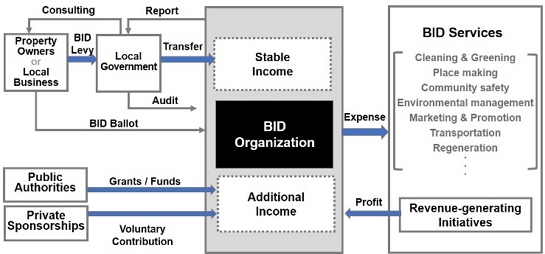
Fig. 1. illustrates the operational structure of BIDs. The designation of a BID is determined by an application and affirmative vote of property owners or businesses in the area, based on the relevant laws. If the local government approves the designation, the district is authorized to collect BID levies. BIDs are operated by designating an operating organization in the form of a non-profit corporation, a public institution under the local government, or a public-private partnership, with a board of directors comprising property owners, participating businesses, and others in charge of project planning and major decision-making. BIDs may seek additional revenue sources outside of the BID levy as needed. While the local government is involved in collecting levies, redesignating BIDs when their designation is due, and overseeing expenditures and decisions about BID operations are primarily made by the board of directors [7].
Organizational structure of BIDs
After designation of a BID, the local government collects levies in the form of taxes from property owners or businesses within the district, which are then redistributed to the BID organization. These funds are used to maintain streets, sidewalks, parks, or public spaces, increased policing, marketing, facility improvements, and various other activities to revitalize the district. These activities are supplementary to the fundamental care administered by the administration, and the activities of the BID are focused on quality improvement [8].
The operation of a BID has been demonstrated to improve the socio-economic conditions of the area and attract private investment. Consequently, this contributes to enhancing regional competitiveness and creating a stable city image. This, in turn, fosters a sense of community and pride among local residents and merchants. From the perspective of businesses within a BID, BID activities can help drive spending and increase sales through increased foot traffic and strengthen the competitiveness of local stores through joint advertising and place branding. Furthermore, it has the potential to attract new customers by facilitating networking and collaborative opportunities among businesses. Local governments can compensate for the limitations of public services through town management led by the private sector, and the revitalization of the local economy increases tax revenues and strengthens the financial base of the BID itself, thus creating a virtuous cycle of sustainable investment. Furthermore, property owners can benefit from enhanced environmental quality and economic revitalization, which can precipitate an increase in property values, higher rents, and heightened rental demand because of the increased attractiveness of the area, resulting in stable rental revenue [9].
2.2. Literature Review
The academic examination of BIDs commenced in the 1990s, and research concentrated on their legal formation process, financial structure, oversight models, and service delivery arrangements, with a particular emphasis on their success in cities of the United States (U.S.) [10].
BIDs are considered a viable alternative to the financially constrained public sector, playing a pivotal role in the revitalization of declining urban centers and the creation of walkable environments. Levy (2001) argued that BIDs contributed to addressing the problems of urban decline, such as rising unemployment, rising crime rates, and declining tax revenues [11]. Davies (1997) observed that BIDs promoted “New Urbanism” and provided a flexible governance structure for city center revitalization [12].
Meanwhile, BIDs have been criticized for the harmful effects of running urban spaces at private expense. There are also concerns that BIDs function as a mechanism for the management of urban space according to a corporate-driven logic, rather than as a public good, privatizing public space to create controlled spaces and excluding certain groups, such as the homeless and street performers [13]. A counterargument is that BIDs are overseen by the government from the outset and have a transparent operating structure with governance procedures, annual report submissions, and oversight by public officials, which allows them to remain public [14]. Therefore, the governance characteristics of BIDs are gaining attention as BIDs are not merely a coalition of companies but public-private partnerships composed of a complex network organization of various social stakeholders [15].
The dissemination of the BID model to the U.K. in the early 2000s prompted deliberations concerning the legal and tax distinctions associated with the implementation of BIDs in the U.K. [16]. As BIDs have become more entrenched in the U.K., research on BID performance evaluation and policy shifts has ensued.
In Korea, BID-related research has been conducted mainly on best practices in the U.S. Lee (2010) proposed the domestic introduction of the BID system as a way to finance urban regeneration projects and to manage and operate the area after completion through the case of the RiverWalk regeneration project in Milwaukee [17]. Yoon (2020) analyzed 76 BIDs in New York City by operating status and budget size to understand their operational structure and characteristics of public-private partnerships [18]. Park (2021) examined the case of the 42nd Street BID in the heart of Manhattan, New York City, to explore the use of a BID as a public-private partnership governance for urban revitalization in the city center [19]. Thus, domestic BID-related studies have focused on analyzing the success of BIDs in the U.S. and exploring ways to apply them to urban regeneration projects in Korea.
As discussed above, early BID studies were centered on analyzing the structure and legal legitimacy of BIDs based on successful examples from the U.S. The academic debate has intensified with the emergence of studies that examine the social functions of BIDs and their association with urban policy. As the BID model has since spread to other countries, including the U.K., BID research has evolved to attempt more sophisticated analyses from the perspectives of policy movement and governance networks. Therefore, this study seeks to explore the possibility of introducing a similar system in Korea by focusing on the BID system in the U.K., which has undergone a policy shift, and examining the operation of BIDs with a focus on London.
3. Characteristics of BIDs in the U.K.
3.1. Introduction and Development of BIDs in the U.K.
In the U.K., TCMs have emerged as town management organizations since the late 1980s in a policy environment that promotes decentralization and emphasizes public-private partnerships in line with the central government’s small government orientation. Since the 1980s, as large-scale shopping centers have been emerging in suburban areas, the phenomenon of urban hollowing-out has become a serious social problem, and TCM has been used to apply the successful operation model of suburban shopping centers to urban centers.2)
In the TCM approach, stakeholders such as local governments, businesses, property owners, and urban communities form a TCM organization led by the private sector. This organization is responsible for collectively managing and operating urban centers, as in shopping centers, with key activities including maintaining safety and cleanliness, promoting traffic and mobility, and organizing events and commercial promotions. As TCMs are based on partnerships between local governments and private companies, public-private partnerships, which are essential to BIDs, have already been established in the U.K., and TCMs are operating in similar areas to BIDs [20].
Although TCM activities have been funded through grants from local and national governments, the European Union, and membership fees from private companies, the problem of “free riders” who profit without paying membership fees and the need to secure sustainable funding remain major challenges. Therefore, the BID system in the U.S. has been recognized as a way to secure stable funding, which is vital for effective business operations.3)
As BIDs have their own stable source of funding through taxation, long-term plans can be made with a continuous stream of funds to carry out planned businesses in a defined area for a specific period of time, addressing the issue of inequality between businesses that contribute and those that do not while receiving the same benefits. Additionally, the initiative is organized by the private sector, and the use of funds is entirely at the discretion of local businesses without complicated administrative procedures. In this context, with the first BID legislation4) enacted in England in 2004, followed by BID legislation in Wales (2005), Scotland (2007), and Northern Ireland (2013), TCMs across the U.K. are on track to develop into BIDs, thus providing a financial solution to complement the conventional TCM model that relies on voluntary business contributions [21].
3.2. Establishment and Maintenance of BIDs
While the specific provisions of the laws governing BIDs vary somewhat by region, the overall process of establishing a BID is generally similar. The formation of a BID can be proposed by local governments responsible for taxation, property owners, private businesses, and others. The proponent of a BID must develop a business plan that includes the area to be addressed, who will pay taxes and how much, and what services the BID organization will provide. For a BID to be authorized by the local government, a BID ballot is required, which must be approved by “a majority of the tax obligors” and “a majority of the total assessed value of the real property subject to taxation.” The ballot is cast by mail, with the costs covered by the tax authorities [22].
Once the ballot approves the BID, the BID will remain in place for up to 5 years, during which time no levy payer in the district may refuse to pay the BID levy. After this period, another ballot is cast to renew or revoke it. The details of the BID can be modified, such as changing the rate of the levy or the area covered. The local government collects a BID special tax from businesses in the district, which is returned to the BID governing body to fund its activities. While BIDs in the U.S. typically charge the tax to the property owner, in the U.K. the tax is charged to the business occupying the property. For this reason, BIDs tend to focus on services that promote commercial activity and create neighborhood vitality rather than on cleaning and environmental maintenance, which increase property values. They are also becoming increasingly creative in their efforts to attract additional cooperation and investment from the community by focusing on high-impact activities, such as crime prevention, vacant store closures, and street improvements [23].
3.3. Status of BID Establishment
There are 341 BIDs in the U.K. (as of September 1, 2024), with 134,098 taxable business properties (hereditaments) and £154,620,538 (approximately KRW 2.8 trillion) in BID levy income. The number of participating businesses per BID varies from a minimum of 35 to a maximum of 2,500, with an average of 426 (Table 1.).

Statistics of BIDs in U.K.
The average levy income ranged from a maximum of £463,862 (KRW 890 million) to a minimum of £14,639 (KRW 28 million), with the largest single BID surcharge being £4,100,000 (KRW 7.8 billion). The first BID ballot was taken in November 2004 in the Kingston First neighborhood of London. Since then, there have been 1,041 BID ballots, including those to extend the term, over the past 20 years, and of those, only 105 (about 10.1%) have ended in a disapproval, suggesting stable operations.
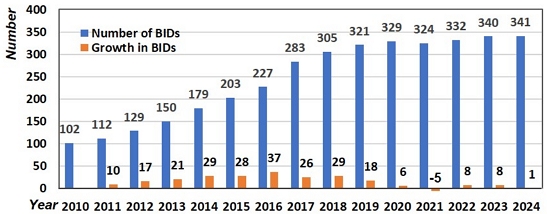
The number of BIDs in the U.K. has grown steadily since 2010. In 2021, immediately after the pandemic, the number of BIDs dropped by five but has since steadily increased, with 17 more BIDs by 2024 (Fig. 2.) [24]. These statistics demonstrate the success of BIDs and suggest that once a BID is established in an area, it is likely to become a permanent part of the civic infrastructure in that area.
Growth of BIDs in U.K. from 2010 to 2024(Source: C. Turner (2024), The 18th annual BID survey and report)
3.4. Funding and Operations of BIDs
BID levy rates are most frequently around 1% of the assessed valuation but can range from a minimum of 0.28% to a maximum of 6.0%, with an average levy rate of 1.5% and little variation based on the number of BID term renewals (Table 2.). BID levy revenues provide funds that organizers can use for an annual program of services agreed upon with members and are used for activities such as marketing the area, hosting events, improving and cleaning public spaces, and providing security services [25].
Levy % rates of current BIDs, by term
While BIDs primarily fund their activities reliably through levies, they also have the flexibility to leverage donations from property owners and sponsors, government grants, and other sources to fund additional operations [26]. This funding structure facilitates autonomous financial operations within the region, thus creating an effective system for allocating funds based on need. As local businesses determine how funds are spent within a BID, the process is streamlined and free of complex administrative procedures.
The planning and operation of the BID is bottom-up, led by the private sector. From the planning stages of the revitalization to its operation, residents and local businesses are actively involved, generating local interest and strengthening a sense of community. Furthermore, targeting and budgeting can be tailored to local economic conditions, allowing commercial districts to focus funds on projects that are directly linked to customer acquisition and revenue growth. These characteristics play a pivotal role in enhancing the economic sustainability of the district and empowering businesses to contribute to the revitalization of the area through a self-sustaining model.
3.5. Support for BIDs
In March 2015, the U.K. government published “Business Improvement Districts: guidance and best practice” as a guide for communities and businesses considering establishing a BID, and “Business Improvement Districts: Technical Guide for Local Authorities” to provide local governments, business groups, and other stakeholders looking to introduce a BID with clear guidance on the legal process and how to implement it, as well as sharing existing success stories and effective operational strategies to support the efficient operation of BIDs. To facilitate the formation of BIDs, the city launched the BID Loan Fund in 2013 to support development costs for new urban center BIDs through 2019.5) These funds provided initial funding for the feasibility study, consultation process, and formal BID ballot process to establish the BID, with a structure designed to repay the loan through BID levies collected once the BID is established and functional.
While BIDs are fundamentally partnerships led by the private sector, local governments assume a supportive role in the establishment process and wield significant authority in the issuance of business licenses. Consequently, BIDs have a close relationship with local councils and local governments, and the establishment of a BID is an opportunity for direct cooperation between local governments and local businesses. Local governments are closely involved in the establishment and management of BIDs. This involvement encompasses the preparation of assessment data used to calculate BID levies, the collection and distribution of BID levies to fund BID operations, and the organization and support for public organizations for BID ballots [27].
National support organizations for BIDs include the Association of Town & City Management (ATCM), British BIDs, and the BID Foundation, which are responsible for helping BIDs network and collaborate with one another.
Founded in 1991 to support TCMs, the membership of the ATCM6) now includes not only TCMs but also BIDs, Community Interest Companies, and other actors in the city management industry, providing guidance and resources for their development and operation through a range of research, policy proposals, and training consultancy to ensure their effective operation. In particular, the ATCM contributed to the creation of the BID system in collaboration with the U.K. government.
British BIDs7) is an organization that protects and supports the interests and values of the BIDs in the U.K. It works with BID members and a range of strategic partners to network, share knowledge, and develop best practices. For this purpose, it publishes the “Annual BID Survey and Report,” a survey report on major trends in the BID industry, and holds the National BIDs Conference to establish networking among related BIDs to promote cooperation. Meanwhile, British BIDs runs accreditation for BID organizations and training programs for BID workers. The accreditation assesses the items including governance, management and operations, finance, performance management, communications and reporting to provide advice on BID management needs to increase operational efficiency and secure the trust of levy payers, giving the BID operating team and board confidence and peace of mind. The British BID Academy is a platform for the training and development of BID practitioners and runs specialized courses for running and facilitating BIDs, including planning and management of BID ballots, understanding of BIDs, effective management of BIDs, duties and best practices for BID directors, and placemaking.
The BID Foundation8) is part of the Institute of Place Management (IPM),9) which has been established with the aim of strengthening the transparency, accountability and professionalism of a BID. With expertise in place management and leadership, it empowers BIDs to contribute effectively to their communities and facilitates collaboration with the government and a range of stakeholders. It provides strategic direction for growth and development of BIDs, develops relevant policies, and represents the interests of BIDs. It also helps BIDs sustain long-term impact, flexibly respond to changing environments, and innovatively achieve growth.
3.6. Summary
BIDs in the U.K. are distinguished by the following characteristics in terms of their legal framework, establishment process, and operation.
BIDs in the U.K. have an institutional basis in central government legislation, which provides formal guidance on the establishment, operation, and management of BIDs. BIDs are established by ballots of businesses and governed by a democratic process, with their continuation determined by a ballot every 5 years.
The levies that fund BIDs are typically charged to the businesses that occupy the property, and as a result, their primary focus is on services and marketing to revitalize the local business district, as well as environmental improvements, safety, business networking, and more. Local governments manage the ballot process for establishing and renewing BIDs; engage with BID organizations as partners by contributing cash, assets, and expertise to BID projects; facilitate their collaboration with other stakeholders; and provide hands-on support, such as updating business databases and mediating disputes.
4. The Reality of BIDs in London
4.1. Status of BIDs in London
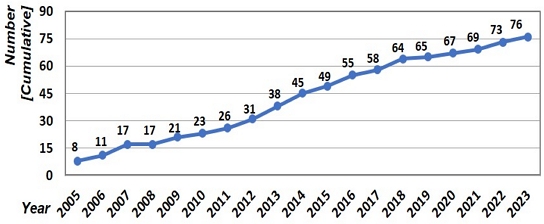
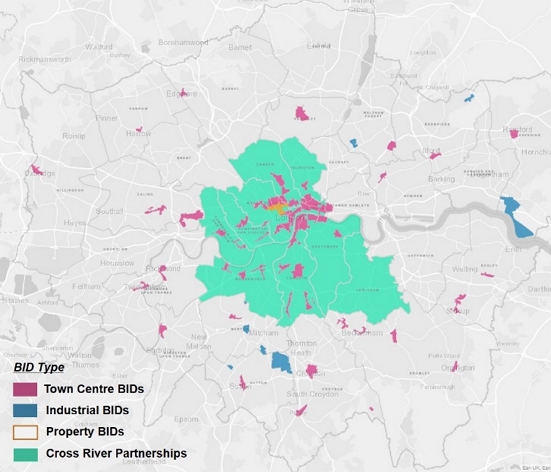
The number of BIDs in London has grown steadily since the establishment of the Kingston First BID in 2005, expanding to 76 as of September 2024 (Fig. 3.). BIDs are spread across London, with a particular concentration in key commercial areas in the urban center (Fig. 4.).
Number of BIDs in London by year
Location of BIDs by type in London(Source: https://apps.london.gov.uk/BIDs/)
By type of BID, town center BIDs constitute the majority of BIDs with 68 (89.5%), which are designated in business districts with a high concentration of shops and restaurants, tourism and cultural districts, transportation nodes, and areas where existing commercial districts are declining or in need of redevelopment. Of these, four (5.3%) BIDs in the City of Westminster area of the urban center are also designated as property BIDs, led by property owners.
While residents are more interested in BID services that address current neighborhood needs, property owners are more focused on the potential for BIDs to increase property values over the long term. The co-location of two BIDs in the same area fosters a symbiotic relationship, resulting in a mutually beneficial and win-win scenario. Industrial BIDs are a type of district that aims to revitalize the economy and improve the environment in areas with a high concentration of industry and manufacturers. There are eight (10.5%) designated areas to promote collaboration among businesses and connections with the local community. This diversity of BIDs requires a differentiated approach to collaboration among BIDs and local stakeholders.
The annual BID levy income of BIDs in London totaled approximately £61.63 million (KRW 11.56 billion), representing 39.8% of the total income of approximately £154.93 million (KRW 29.05 billion) in the U.K. (Table 3.). The funds are being reinvested in London to support projects across the region to introduce new services and drive urban regeneration and local planning initiatives.
Data on BIDs in Greater London and the U.K.
4.2. Key Activities and Roles of BIDs in London
BIDs in London function not only as service providers for levy payers in a specific area but also play various other roles that contribute to the vitality of their neighborhoods. Key activities include cleaning and greening, marketing the area to visitors, lobbying on behalf of the business community, improving community skills, promoting tourism and culture, improving wayfinding and public realm infrastructure, and enhancing security. In their nascent stages, BIDs prioritize the provision of fundamental services, including cleaning, environmental management, and neighborhood safety. However, as BIDs mature, they undergo a gradual expansion, encompassing placemaking and marketing services, undertaking more intricate projects, and generating additional revenue (Fig. 5.)[28].
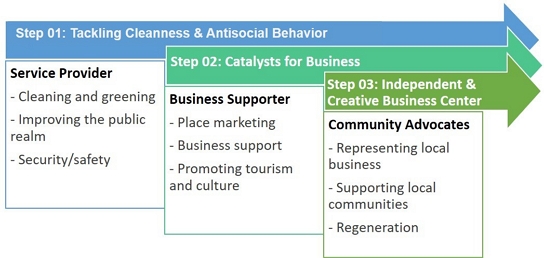
Roles and activity areas of BIDs in London
BIDs in London play an important role as mediators between local businesses and communities and as catalysts for policy and economic change. The flexible organizational characteristics enable them to allocate resources toward initiatives that promote long-term economic growth, thereby fostering positive change within local communities and contributing significantly to the advancement of the areas and London as a whole. Large BIDs in London fund research programs and use the data collected to inform BID policy and project evaluation. They pursue more efficient operations through research and data analytics and are constantly evolving the BID functions to keep pace with the changing urban landscape of London. The primary function of BIDs is to enhance the local commercial environment, thereby supporting business processes and driving visitor flows. BIDs serve as a platform for converging the interests of participating actors, with the collective aim of improving the district [29].
4.3. Collaboration and Partnerships Across BIDs in London
With their growing numbers, BIDs in London are collaborating in a variety of ways, networking to exchange ideas and collaborate on projects. Relationships between individual BIDs may include existing BIDs supporting the formation of new BIDs, sharing staff and services between neighboring BIDs, or expanding the scope of projects.
The Cross River Partnership (CRP)10) is a strategic partnership between the Greater London Authority (GLA), Transport for London (TfL), the eight inner London boroughs, and 14 BIDs. The formation of the CRP was intended to bring together a range of stakeholders to address local issues and work towards a common agenda for sustainable urban regeneration and economic development in central London. The CRP furnishes project management resources and expertise to support its member BIDs, which are undertaking projects to revitalize local economies, improve the environment, and advance transportation infrastructure.
BusinessLDN11) is a not-for-profit membership organization founded to make London a world-class business city and supports the city’s economic growth by working closely with BIDs in London. In particular, it has formed a council called the Central London BIDs Forum and hosts quarterly forums for BIDs in London to share insights and expertise on the work they do in their respective areas. The forum discusses key issues affecting the economic vitality of London, including policing and crime, improving public spaces, and keeping central business districts vibrant.
4.4. Relationships of BIDs in London with the Public and Community
The GLA actively supports BIDs and works with them in a number of ways. The GLA provides free guidelines12) on setting up and running a BID to local authorities and BIDs to use as a template. The GLA also supports the revitalization of the high streets of London by working with BIDs on campaigns (e.g., “Let’s Do London”) and providing high-quality data, analytical tools, and reports on consumer spending, footfall, and vacancy rates through its High Streets Data Service. The GLA also organizes regular network meetings to showcase BID activity, bringing together stakeholders including all BIDs in London, local authorities, TfL, and the Metropolitan Police.
BIDs in London are engaged with central government departments in the areas of city center management, economic development, electoral services, and business, and with the public sector, including boroughs and councils, in areas as diverse as the public realm, community safety, local promotion and events entities, waste management, and skills and employment. As a result, the composition of the board of directors of BIDs encompasses not solely businesses that are BID levy payers, but also local government officials, city council representatives, and local stakeholders, among others who possess a voice in the resolution of community problems and the implementation of improvements.
4.5. Summary
BIDs in London are pursuing the dual challenges of improving citywide competitiveness and tackling regional disparities, and are becoming more than mere business district management organizations but key partners in driving urban innovation and economic growth.
Beyond the provision of fundamental services such as cleaning and security, BIDs are engaged in a range of activities including urban regeneration, placemaking, environmental enhancement, employment and educational support, and local economic revitalization. They are progressively extending their purview to complement select public services.
This is evolving into a complex governance system led by a private-public partnership based on collaboration with various stakeholders, including businesses, property owners, local governments, and local communities. There are many different forms of BIDs, including property BIDs, and in urban centers, strategic partnerships between BIDs are forming to create a framework for addressing common agendas at the regional level, strengthening project management capacity, and providing specialized services.
5. Conclusion
Major cities overseas are introducing and operating town management systems through cooperation with the private sector to enhance the attractiveness of urban spaces and manage them as active spaces. The BIDs in the U.K. examined in this study are collaborative endeavors between local authorities and local businesses. These partnerships aim to enhance the environment and revitalize specific districts by offering supplementary services. Positioned as a financial alternative to the conventional TCM model, which relies on local government funding and donations, BIDs provide a reliable source of funding.
BIDs in the U.K. are distinguished from BIDs in the U.S. by the fact that BID levies are typically paid by local businesses rather than property owners. Consequently, the activities of BIDs are also oriented towards commercial revitalization and are funded and run by local businesses that directly benefit from them, based on the “beneficiary pays principle,” making them a community-driven means of revitalizing urban centers. The structure minimizes the involvement of local governments and allows local businesses to organize and run their own projects, which encourages self-financing, public-private partnerships, and local revitalization.
The central and local governments are promoting the establishment of BIDs through institutional support and subsidies, and national or regional organizations have been established to network among BIDs, share best practices, and make business connections to promote the interests and prosperity of BIDs.
The BIDs in London are operating at different scales across the city, reflecting local characteristics, and they are supporting the revitalization of the commercial district with a stable revenue structure and government support to improve the local environment, as well as placemaking, urban regeneration, and job creation. With a growing number of BIDs in London, they are building alliances with one another and seeking opportunities to achieve economies of scale through joint projects or expertise sharing, and to realize better value for money. Furthermore, they play a pivotal role in establishing robust partnerships with a diverse array of stakeholders across the GLA, boroughs, and communities for attracting new investment and ensuring that London maintains its status as a desirable location for both work and tourism.
BIDs in the U.K. are engaging with the public sector to solve local challenges. As BIDs grow and influence the wider community beyond their service to BID levy payers, the importance of engaging with local stakeholders and partners is becoming increasingly important, and they are exploring various ways to incorporate their input.
Although this study used publicly available data from government agencies and related organizations to identify general trends in the establishment and operation of BIDs in the U.K., it was limited in its ability to capture the detailed activities of BIDs. Future research is needed to identify various cases of BID activities outside of London and examine them in depth to identify success and failure factors in building a business model for urban management by the private sector, as well as empirical research on the economic and institutional effects of BIDs and the sustainability of urban management.
Acknowledgments
This research was supported by Seoul National University of Science and Technology.
Notes
References
- W.Y. Lee, M.K. Kim, J.H. Lee, A study on the urban renewal mechanism of BID (Business Improvement Districts) in the United States, Urban Design, 9(2), 2008.06, pp.41-48.
- M. Charenko, A historical assessment of the world’s first Business Improvement Area (BIA): The case of Toronto’s Bloor West Village, Canadian Journal of Urban Research, 24(2), 2015.02, pp.3-11.
- F. Friesecke, Revitalization of urban areas through Business Improvement Districts (BIDs): Trends and expectations for shrinking cities, Conference of the 5th FIG Regional Africa: Promoting Land Administration and Good Governance, 2006.03, pp.2-3.
-
S.T. Kim, T.C. Ryu, Business improvement districts as governance for urban regeneration, Journal of Housing Welfare, 16(4), 2018.12, pp.205-208.
[https://doi.org/10.22313/reik.2018.16.4.197]

- S.Y. Yoon, S.H. Jeong, S.Y. Lee, Diagnosis and improvement direction of the town management of Seoul, Seoul Institute, 2022, p.40-57.
-
P. Guimaraes, Business improvement districts: A systematic review of an urban governance model towards city center revitalization, Land, 10(9), 2021.09, pp.7-11.
[https://doi.org/10.3390/land10090922]
-
J. Mitchell, Business improvement districts and the “new” revitalization of downtown, Economic Development Quarterly, 15(2), 2001.05, pp.117-118.
[https://doi.org/10.1177/089124240101500201]
- T. Kobayashi, Current status and potential of Business Improvement Districts (BID), Land Institute of Japan, Comprehensive Land Research, 2014, Spring, pp.117-118.
-
S.A. Grossman., Reconceptualizing the public management and performance of business improvement districts, Public Performance & Management Review, 33(3), 2010.03, pp.361-394.
[https://doi.org/10.2753/PMR1530-9576330304]
-
D. Kudla, Fifty years of business improvement districts: A reappraisal of the dominant perspectives and debates, Urban Studies, 59(14), 2022.11, pp.2840-2842.
[https://doi.org/10.1177/00420980211066420]
-
P. Levy, Paying for the public life, Economic Development Quarterly, 15(2), 2001.05, pp.124-131.
[https://doi.org/10.1177/089124240101500202]
- M. Davies, Business improvement districts, Journal of Urban and Contemporary Law, 52, 1997, pp.187-223.
-
M. Symes et al., Lessons from America: The role of business improvement districts as an agent of urban regeneration, The Town Planning Review, 74(3), 2003.01, pp.301-313.
[https://doi.org/10.3828/tpr.74.3.3]
- B. Hochleutner, BIDs fare well: The democratic accountability of business improvement districts, New York University Law Review, 78(1), 2003.04, pp.374-404.
-
G. Morçöl et al., Understanding business improvement districts: A new governance framework, Public Administration Review, 70(6), 2010.12, pp.906-913.
[https://doi.org/10.1111/j.1540-6210.2010.02222.x]
-
M.G. Lloyd et al., Business improvement districts, planning and urban regeneration, International Planning Studies, 8(4), 2003.11, pp.295-321.
[https://doi.org/10.1080/1356347032000153133]
- S.S. Lee, J.S. Lee, A study on funding and management policies for urban regeneration projects utilizing tax increment financing and business improvement district, Journal of the Korean Urban Management Association, 26(1), 2013.03, pp.117-141.
- Z.S. Yoon, N.H. Byun, Characteristics and the conditions of business improvement districts in New York City, Journal of the Architectural Institute of Korea, 36(12), 2020.12, pp.171-178.
-
W.S. Park, How to use Business Improvement Districts (BID) as a public-private partnership governance for urban regeneration, Journal of Real Estate Analysis, 7(2), 2021.07, pp.89-116.
[https://doi.org/10.30902/jrea.2021.7.2.89]
- S.Y. Park, S.C. Lee, S.M. Song, A study on the area management system for urban revitalization, Journal of AIK, 25(8), 2009.08, pp.215-220.
- M. Sandford, Business improvement district, House of Commons Briefing Paper 04591, 2018.05, pp.4-6.
- Department for Communities and Local Government, Business Improvement Districts (BIDs): Technical guide for local authorities British BIDs, 2015.03, pp.4-18.
- Department for Communities and Local Government, Business improvement districts guidance and best practice, ATCM, 2015.03, pp.7-14.
- C. Turner, The 18th annual BID survey and report 2024, British BIDs, 2024, pp.15-23.
- C. Turner, Business improvement districts in the British isles, British BIDs, 2024, pp.8-10.
-
K. Ward et al., Territorial policy and governance: Alternative paths, UK: London Routledge, 2017, pp.127-146.
[https://doi.org/10.4324/9781315734644-10]
-
J. Grail et al., Business improvement districts in the UK: A review and synthesis, Journal of Place Management and Development, 13(1), 2020.02, pp.73-88.
[https://doi.org/10.1108/JPMD-11-2019-0097]
- Greater London authority, The evolution of London’s business improvement districts, Future of London, 2016.03, pp.13-17.
- Greater London authority, Business improvement districts: The role of BIDs in London’s regeneration, Regeneration Committee of London Assembly, 2016.02, pp.10-15.