
An Occupancy-Weighted Energy Consumption and Thermal Comfort Control Model by Communication and Reallocation Algorithms
ⓒ 2026. KIEAE all rights reserved.
Abstract
This study proposes a predictive, real-time thermal system control framework designed to resolve the operational trade-off between building energy efficiency and indoor thermal comfort. The study establishes a formal mathematical architecture for inter-building energy reallocation that is dynamically weighted by real-time human occupancy rates.
The central communication module calculates a weighted discomfort cost function utilizing occupancy counts, metabolic rates, and clothing insulation. An artificial neural network, structured as a multilayer perceptron, was trained over to dynamically optimize the supply air signals. This algorithm was integrated into a unified simulation application framework to test a low-occupancy retail space alongside a high-occupancy food service space.
The proposed model achieved high predictive accuracy, yielding the Coefficient of Determination values for the supply air temperature. The communication and reallocation alrorithm successfully mitigated high-frequency signal volatility and prevented sudden temperature overshoot. Quantitatively, the proposed model improved total weekly energy efficiency by 2.56%, reducing the total Energy Use Intensity from 77.31kWh/m2 to 75.33kWh/m2. Concurrently, the system achieved a 52.00% improvement in sustained thermal comfort homeostasis, reducing the average weekly Coefficient of Variation of the Root Mean Square Error from 0.25 to 0.12.
Keywords:
Energy Use, Thermal Comfort, Occupancy Rate, Reallocation Algorithm, Artificial Neural Network1. Introduction
Conventional Heating, Ventilation, and Air Conditioning (HVAC) control architectures operate independently on a per-building basis. However, they prequently fail to dynamically adapt to spatiotemporal variations in occupancy rate and transient thermal loads, leading to concurrent energy inefficiencies and suboptimal thermal comfort. Recent, several studies have investigated to establish a demand-side flexibility framework that optimizes building HVAC operations across multiple zones and structures through the indices of occupancy-weighted thermal comfort and energy efficiency. This study proposes a predictive, real-time control framework that continuously monitors and forecasts zone-level headcount and personal parameters such as metabolic rate and clothing insulation. The algorithm dynamically minimizes the discomfort across the system under peak power constraints. Beyond standard energy-saving protocols or single-building thermal comfort regulation, this work establishes a formal mathematical architecture for inter-building energy reallocation, weighted dynamically by human occupancy.
2. Literature Review
2.1. Indoor Thermal Control System
Several studies have provided an overview of HVAC systems and evaluates emerging technologies to meet modern sustainability and indoor environmental quality demands. They highlight future applications focused on smart control, electrification, and decarbonization strategies, and emphasizes integrated approaches to maximize energy performance and reduce carbon footprints in modern buildings [1,2]. In specific, recent three dacades, historical trends in thermal comfort, system modeling, and energy-saving building practices show the energy saving technologies: implementation of heat recovery ventilation to pre-condition incoming air, integration of thermal energy storage to shift peak cooling loads to off-peak hours, and utilization of indirect evaporative cooling in dry climates [3]. For using recent control technologies, several studies have adopted advanced algorithms such as fuzzy logic and artificial neural network (ANN) in response to fluctuating heating demands. They effectively demonstrate that intelligent, data-driven controllers significantly outperform conventional methods in both adaptability and energy savings [4~6]. In addition to improving the control methods, many studies focused on innovative HVAC technologies for net-zero energy houses to highlight practical solutions for solar-assisted heating and cooling, Low-GWP refrigerants, and operational best practices targeted at reducing the carbon intensity of built environments [7,8]. They adjust the control strategies for adaptive building spaces subject to changing spatial layouts and shifting user preferences. The studies focused on balances human thermal comfort with energy efficiency by dynamically adapting system setpoints to user activities [7,8]. This fast development for HVAC control systems mainly depends on a data handling and Model Predictive Control (MPC) framework. By applying advanced baseline regression models, the strategies enhance the transparency and accuracy of energy performance assessments, and the MPC can demonstrate how accounting for zone interactions and thermal dynamics yields superior comfort regulation and peak power reduction [9,10]. In other viewpoints, some studies provide the mathematical backbone for decentralized control and statistical learning applications in engineering systems. Moreover, they prove that predictive control utilizing weather uncertainty significantly lowers energy consumption while reliably maintaining indoor comfort [11,12].
2.2. Occupancy-Based Comfort Control
The paradigm shift toward occupant-centric HVAC control begins with foundational reviews and sensing methodologies that establish the necessity of moving away from static, schedule-based conditioning to dynamic occupant sensing, In order to operationalize this shift, advanced sensing techniques ranging from environmental CO2 sensors and motion detectors to vision-based camera feeds and wireless tracking are deployed to capture real-time occupancy counts, presence, and behavioral patterns [13,14]. Recognizing these behavioral patterns allows predictive and data-driven models to anticipate occupancy schedules and occupant thermal preferences, providing a structured foundation for smart climate regulation [14,15]. However, translating occupancy data into effective control actions across diverse commercial and residential building typologies requires robust control algorithms [15,16]. Conventional dead-band and rule-based thermostats often fail to balance thermal comfort with energy efficiency due to operational signal volatility and system overshoot. To overcome these limitations, machine learning algorithms and artificial intelligence models such as artificial neural networks, fuzzy logic, and deep reinforcement learning are implemented to dynamically adjust HVAC supply air and temperature setpoints. These intelligent control models demonstrate significant performance gains in both energy reduction and comfort homeostasis when tested across varying climate zones and severe outdoor thermal loads [17~19]. Furthermore, research shows that AI-driven predictive models can successfully navigate abnormal indoor environments and non-linear disturbances, preventing unperdicted energy waste while maintaining human comfort [17~19]. In residential settings, occupancy-aware controls validate these theoretical gains by yielding measurable energy savings without compromising resident satisfaction. Recent advancements further integrate process-driven physical thermal models with data-driven frameworks to ensure generalizability and rapid convergence in complex multi-zone buildings [20,21]. Ultimately, this holistic analytical trajectory, progressing from raw occupancy detection to pattern recognition, algorithm synthesis, multi-climate performance evaluation, and hybrid data-driven optimization, proves that occupant-centric HVAC control is a primary technical mechanism for achieving energy-efficient, low-carbon, and occupant-responsive built environments [20,21].
3. Research Method
3.1. Building Model
The U.S. Energy Information Administration's Commercial Buildings Energy Consumption Survey (CBECS) provides essential data for analyzing energy use across public, commercial, and residential sectors. This comprehensive resource establishes the Energy Use Intensity (EUI) benchmarks for fourteen major building classifications [22~24]. While CBECS categorizes standard building uses extensively, some unique or non-standard uses are grouped together, as seen in Table 1., which details building geometry and component specifications.

Building geometry and component specification
The foundation of this system is real-time sensing. The diagram begins by distinguishing between two rooms with highly disparate occupancy characteristics: Room A (Retail - Low Use/Occupancy) and Room B (Food Service - High Use/Occupancy). This distinction is a fundamental input, allowing the system to understand where users are concentrated. This difference dictates the initial priority for energy distribution. The the entire operation is the Central Communication and Optimization Module. This module connects directly to the principles of central optimization. The module uses its real-time understanding of occupancy and space purpose to establish a “load-based priority” for energy allocation. Fig. 1. visually confirms this by placing a literal neural network schematic inside the optimization loop. The ANN receives input data such as temperature setpoints and indoor temperature, and dynamically optimizes the supply signal to the local HVAC actuators. Occupancy-weighted discomfort modeling is where the core logic mentioned in my academic English revision is put into practice. The system uses a weighted discomfort cost function to generate optimal control signals that maximize social welfare. The central module senses that occupants in high-use food service are significantly larger than retail. The module recognizes that the priority for comfort is lower in this space. It sends a relaxed setpoint command, causing supply temperature to drift further from the local thermal neutral point. This intentionally allows a minor increase in perceived discomfort, but significantly decreases the energy burden in that zone. The optimization engine prioritizes the discomfort penalty in this highly-occupied space. It maintains an aggressive setpoint, causing the supply temperature signal to tightly track the neutral comfort temperature. This shift ensures high thermal comfort satisfaction for the larger number of users, consistent with the occupant-centric principles discussed in the literature. The diagram explicitly visualizes the novel inter-space energy transfer mechanism that I highlighted in my technical overview. The Dynamic Energy Reallocation labels with associated memory module architectures and arrow vectors confirm that the system goes beyond simply varying setpoints.
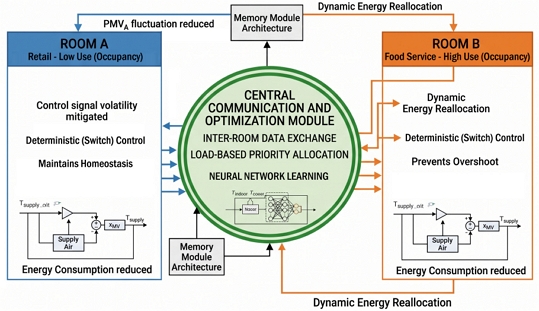
Schematic approach
A key feature is that the central module uses past experiences stored in the memory architectures to anticipate load shifts. The reduced energy consumption in the low-priority zone (Room A) is mathematically and physically “shifted” to satisfy the increased comfort prioritized in the high-priority zone (Room B). This dynamic reallocation proves that user-centric HVAC control can serve as a primary technical mechanism for demand-side flexibility in multi-building scenarios, exactly as specified in your research framework. Simply, this diagram is a holistic visual validation of the academic theories you are studying, explicitly demonstrating how occupancy detection, data-driven optimization, multi-zone control, and inter-building energy transfers converge into a unified, next-generation HVAC optimization system for sustainable built environments.
3.2. Occupancy-Based Control Model
In order to maintain real-time computational tractability, Fanger’s ISO 7730 PMV formulation is linearized around the thermal neutral point Tcomf, k [25,26]. For building k at time step t, the neutral indoor temperature Tcomf, k (t) is evaluated based on the average metabolic rate Mk (t) (met) and clothing insulation Icl, k (t) (clo):
| (Eq. 1) |
| (Eq. 2) |
where, “αk” denotes the thermal sensitivity factor of zone k.
| (Eq. 3) |
where, “ω” is priority weighting factor accounting for room-use criticalities.
The thermal response of each building is modeled using a 1st-order Lumped Resistance-Capacitance formulation [27,28].
| (Eq. 4) |
| (Eq. 5) |
where, “Ck” is lumped thermal capacitance (J/K), “Rk” is equivalent thermal resistance of the building envelope (K/kW), “Qint, k (t)” is internal heat gains from occupants and equipment, “Qhvac, k (t)” is thermal energy supplied or extracted by the HVAC unit (kW), “Phvac, k (t)” is determined via the Coefficient of Performance (COPk).
To suppress sensor noise and forecast headcount over the control horizon H, a discrete state-space smoothing model is applied:
| (Eq. 6) |
where, “Nmeasured, k (t)” is raw real-time occupancy data from computer vision or access-control sensors, “γ” is smoothing coefficient (0<γ<1), “δk(t)” is categorical time-of-day trend correction term.
| (Eq. 7) |
Thermal System State Equations: Compliance with 1R1C differential continuous state transitions. Global Peak Power Capacity Limit, Safety Operational Bounds, Allowable PMV Bounds are fomulated below:
| (Eq. 8) |
| (Eq. 9) |
| (Eq. 10) |
The flow diagram in Fig. 2. outlines a continuous loop designed to optimize multi-building HVAC controls, prioritizing human comfort based on real-time occupancy. The system gathers current environmental data (outdoor and indoor temperature/humidity for buildings A and B) and specific occupant profiles. Then, using statistically-derived trends, the system forecasts near-future occupancy (Nk). It then computes the baseline thermal comfort index (PMV) for each building. The third phase is the core logical step. It establishes two key functions:A “Discomfort Function” for each building, which is mathematically weighted based on the number of occupants (N). The more people in a space, the “heavier” the priority for comfort in that zone. A Total Power Constraint that ensures combined energy usage of both buildings stays under a set maximum cap. The primary goal is minimizing Total Social Discomfort across both structures. The algorithm calculates the optimal temperature setpoint vector needed to meet this goal. Crucially, as a sub-clause, if Building A is much less occupied than Building B (NA ≪ NB), it intentionally “relaxes” the Building A setpoint to save energy, which is then dynamically reallocated to prioritize thermal comfort in the more populated Building B. The newly calculated optimal setpoints are sent to each building's HVAC system. Building A enters an Energy Saving Mode based on its relaxed setpoint, while Building B enters a Thermal Comfort Priority Mode. After a specific control interval, the entire process loops back to Step 1.
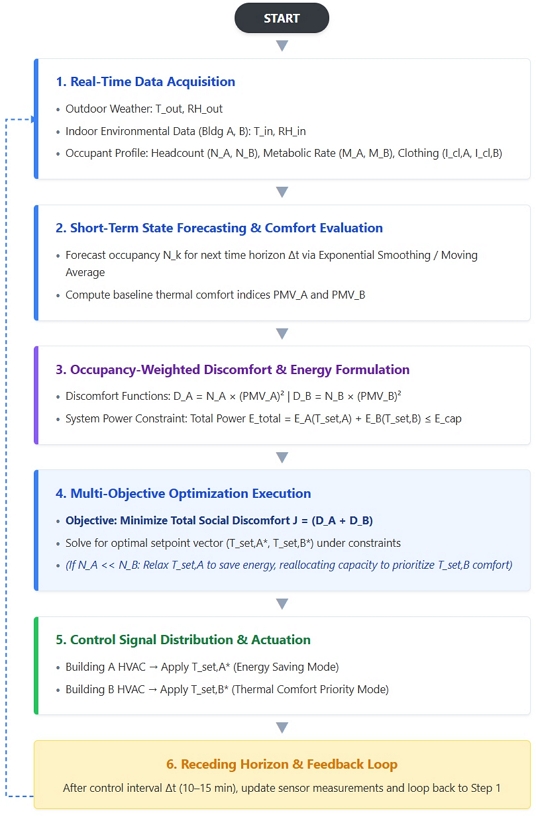
Flow diagram of the communication and reallocation
3.3. Artificial Neural Network Model
Data generated by the control algorithm served as the training set for an artificial neural network (ANN) modeled after a multilayer perceptron (MLP). This fully connected architecture was selected for its proven efficacy in mapping intricate, non-linear relationships [29~30]. Several studies utilized a standard MLP configuration comprising distinct input, hidden, and output l-ayers to process information. Within this framework, individual neurons first derive an intermediate summation, (nc), by calculating the dot product of their inputs (x1,…, xk) and respective weights (wai), followed by the addition of a bias term (θb). This value is subsequently transformed via a non-linear activation function (gd) to yield the neuron’s output [29~31]. Network optimization was executed over 1,000 iterations using the scaled conjugate gradient backpropagation algorithm, with a computation budget of one epoch per iteration. Statistical evaluation of the resulting model revealed strong predictive capability, yielding coefficient of determination R2 values of 0.99147 for mass flow rate and 0.98911 for supply air temperature. Final system validation was conducted within a MATLAB and Simulink environment, integrating the control algorithm loop with the ANN algorithm into a single simulation framework.
4. Results and Discussion
The simulation framework like Fig. 3. evaluated the proposed central communication and energy reallocation engine using real-world outdoor air temperature data as the primary environmental input. As shown in Fig. 4., the outdoor temperature profile from May 1st to May 7th exhibited significant diurnal fluctuations, ranging from near 2℃ to peaks approaching 24℃. Before analyzing the thermal control responses to this weather data, the predictive capability of the ANN was validated. The Multilayer Perceptron (MLP) model, trained over 1,000 iterations using a scaled conjugate gradient backpropagation algorithm, achieved high statistical accuracy. Specifically, the model yielded a coefficient of determination (R2) of 0.99147 for the mass flow rate and 0.98911 for the supply air temperature, confirming its robustness for integration into the unified simulation framework.
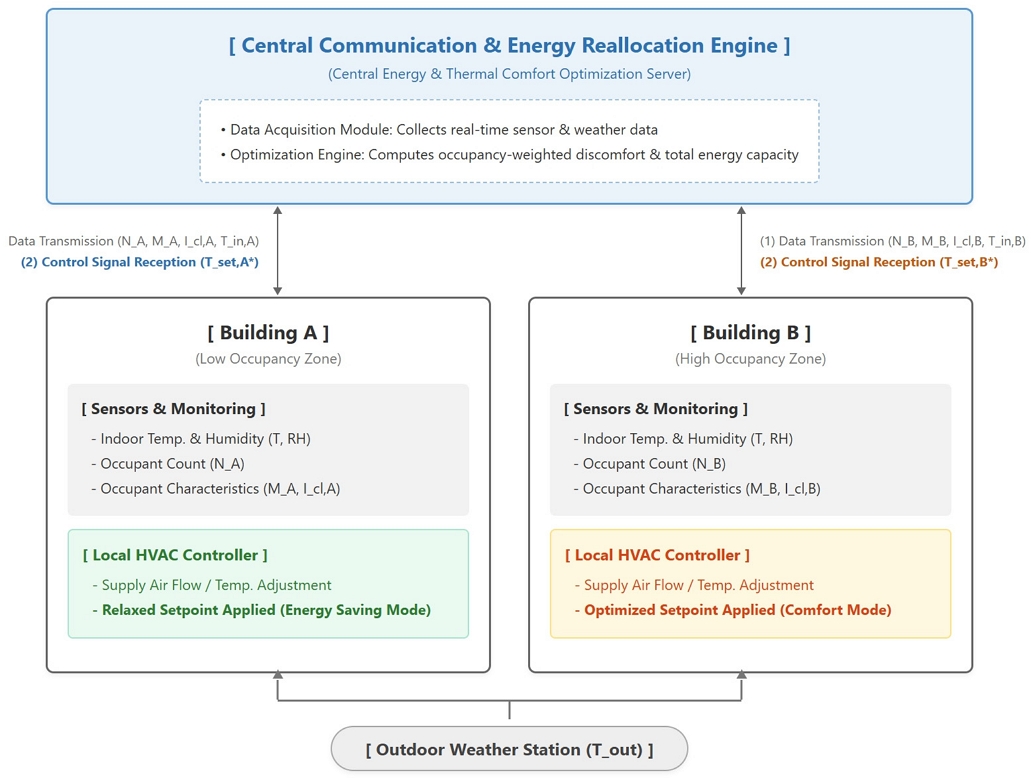
Simulation process of the communication and reallocation
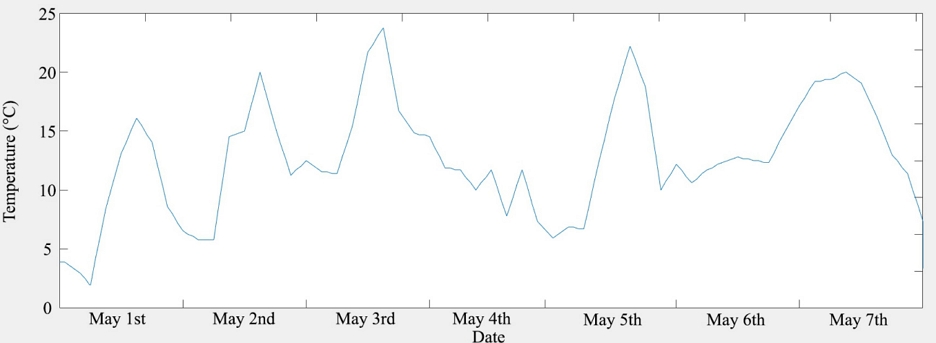
Outdoor air temperature of Incheon City in Korea
The operational differences between conventional HVAC control and the proposed occupant-centric model are clearly visualized through the indoor temperature graphs across the first week of May. Fig. 5. and Fig. 6. display the indoor air temperatures for Room A and Room B when controlled by the baseline model. The graphs illustrate that the conventional dead-band thermostat suffers from severe, high-frequency signal volatility, causing the temperature to oscillate constantly and erratically between 21.5℃ and 21.8℃. Furthermore, the baseline system fails to prevent sudden system overshoot during peak outdoor thermal loads. For example, around May 3rd and May 7th, both rooms experienced sharp indoor temperature spikes exceeding 22.5℃ and 23.0℃, directly mirroring the outdoor temperature peaks seen in Fig. 4.
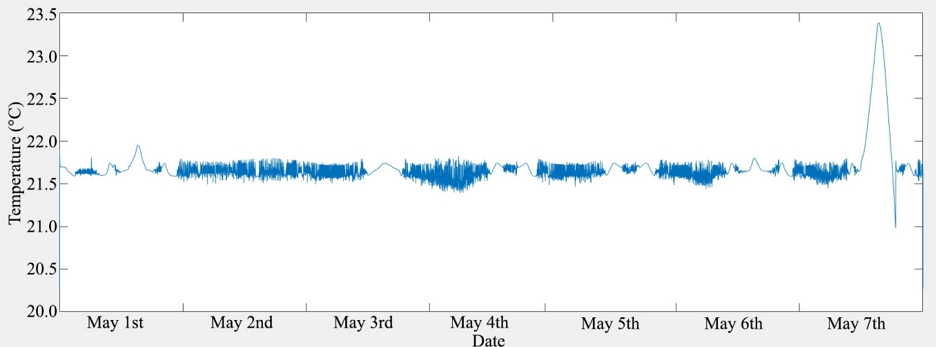
Room A Indoor air temperature controlled by the baseline model
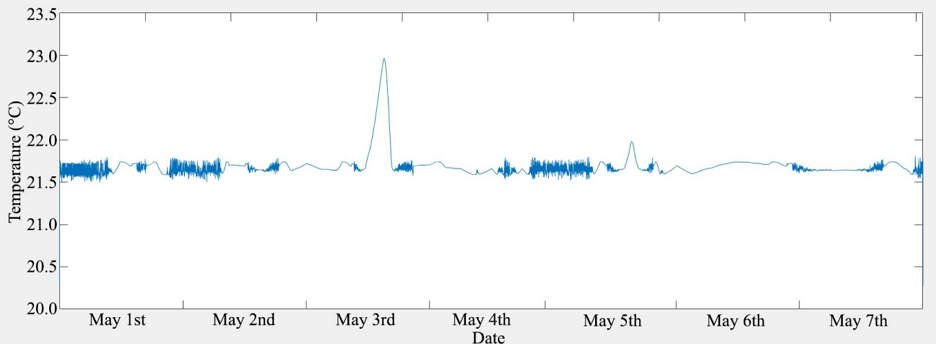
Room B Indoor air temperature controlled by the baseline model
Conversely, Fig. 7. (Room A) and Fig. 8. (Room B) demonstrate the indoor temperatures governed by the communication and reallocation model. The most immediate observation is the successful mitigation of the high-frequency control signal volatility; the temperature curves are smooth and maintain homeostasis without the erratic switching seen in the baseline.
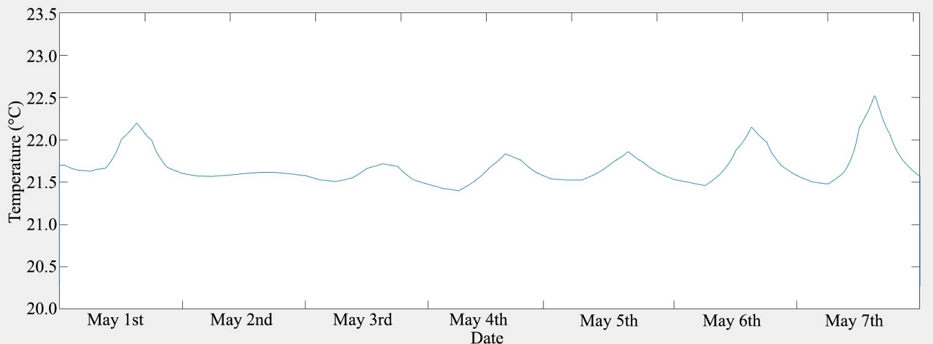
Room A Indoor air temperature controlled by the communication and reallocation model
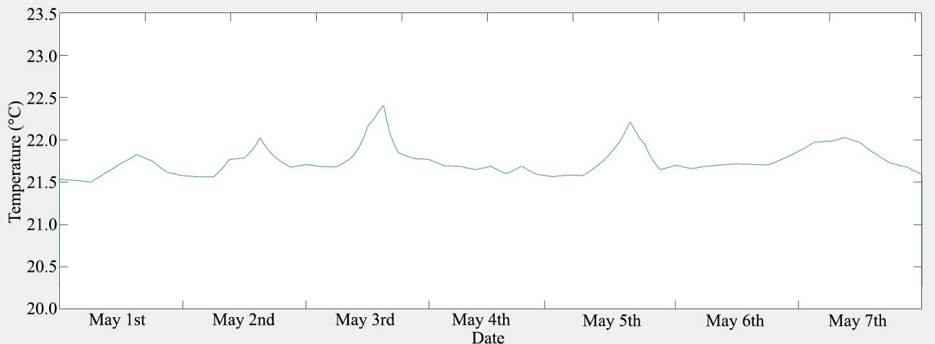
Room B Indoor air temperature controlled by the communication and reallocation model
The distinct curves in Fig. 7. and Fig. 8. validate the algorithm’s “load-based priority” logic. In Room A (the retail space with low occupancy), the system intentionally sends a relaxed setpoint command, allowing the temperature to drift smoothly upwards (peaking near 22.5℃ on May 7th) to decrease the energy burden in that zone. Meanwhile, in Room B (the high-occupancy food service space), the supply temperature tightly tracks the neutral comfort temperature, utilizing the energy saved from Room A to prevent overshoot and maximize thermal comfort satisfaction for the larger number of users.
The mathematical and physical shifting of energy consumption from the low-priority zone to the high-priority zone successfully resolved the trade-off between energy savings and thermal comfort. The quantitative improvements in energy use are detailed in Table 2. During the period, the baseline model's EUI was 39.87kWh/m2 for Room A and 37.44kWh/m2 for Room B, whereas the Communication and Reallocation (C+R) model reduced this to 38.52kWh/m2 and 36.81kWh/m2 representing a 3.39% and 1.68% increase in energy efficiency, respectively. On an annual scale, the proposed framework sustained an overall energy footprint reduction from 77.31kWh/m2 to 75.33kWh/m2, yielding a 2.56% efficiency improvement. Concurrently, the system massively improved ergonomic metrics. Table 3. details the thermal comfort tracking precision, measured via the Coefficient of Variation of the Root Mean Square Error (CvRMSE). The baseline CvRMSE of 0.27 was halved to 0.12 for Room A, and 0.22 to 0.11 for Room B by the C+R model, marking a substantial 55.56% and 50.00% improvement in thermal comfort, respectively. Totally, the C+R model improved the CvRMSE from 0.25 to 0.12, representing a 52.00% increase in sustained thermal comfort homeostasis.
Comparison of the total energy use
Comparison of the thermal comfort
4. Conclusion
This study investigated the effectiveness of an occupancy-weighted energy consumption and thermal comfort control model utilizing communication and reallocation algorithms. By dynamically shifting energy from low-priority, low-occupancy zones to high-priority, high-occupancy zones, the system successfully resolved the trade-off between energy savings and thermal comfort. Regarding the results, the key contributions can be summarized like below:
- 1) Occupancy Paradigm Shift: Moves away from static, floor-area-based energy distribution models by introducing a mathematically rigorous resource allocation scheme rooted in occupant-weighted social welfare.
- 2) Low Computational Overhead: Formulated as a quadratic programming problem, allowing real-time implementation on standard local building automation systems without complex deep-learning overhead.
- 3) Scalability via Distributed Architecture: Easily extends to large-scale multi-building complexes, where individual building controllers solve local sub-problems and the central server coordinates shared power capacity constraints.
However, this study has weaknesses. The system’s final validation was limited to simulation applications framework, relying on a simplified 1st-order Lumped Resistance-Capacitance formulation and a just one-week outdoor weather profile. Therefore, a follow-up study will be conducted focusing on the specific physical characteristics and operational mechanisms of the algorithm, as well as the expansion of the learning processes for handling huge control data.
References
-
D. Mckoy et al., Review of HVAC systems history and future applications, Energies, 16, 2023, 6109.
[https://doi.org/10.3390/en16176109]

-
S. Saadoon et al., Energy-efficient HVAC technologies and strategies: A comprehensive overview. NTU Hournal of Renewable Energy, 10(1), 2026, pp.21-30.
[https://doi.org/10.56286/1rpz0d67]
-
Y. Huang, J. Niu, A review of the advance of HVAC technologies as witnessed in ENB publications in the period from 1987 to 2014, Energy and Buildings, 130, 2016, pp.33-45.
[https://doi.org/10.1016/j.enbuild.2016.08.036]
-
J. Ahn, S. Cho, D. Chung, Analysis of energy and control efficiencies of fuzzy logic and artificial neural network technologies in the heating energy supply system responding to the changes of user demands, Applied Energy, 190, 2017, pp.222-231.
[https://doi.org/10.1016/j.apenergy.2016.12.155]
-
J. Ahn, Development for improving eco-friendly and energy efficient indoor environment control algorithms based on building users, KIEAE Journal, 26(3), 2026, pp.43-51.
[https://doi.org/10.12813/kieae.2026.26.3.043]
-
Z. Ma, H. Ren, W. Lin, A review of heating, ventilation and air conditioning technologies and innovations used in solar-powered net zero energy Solar Decathlon houses, Journal of Cleaner Production, 240, 2019, 118158.
[https://doi.org/10.1016/j.jclepro.2019.118158]
-
R. Kumar et al., Emerging HVAC technologies and best practices for energy-efficient, low-carbon buildings: A review, Energies, 19(5), 2026, 1296.
[https://doi.org/10.3390/en19051296]
-
J. Moon, J. Ahn, Improving sustainability of ever-changing building spaces affected by users’ fickle taste: A focus on human comfort and energy use, Energy and Buildings, 208, 2020, 109662.
[https://doi.org/10.1016/j.enbuild.2019.109662]
-
B. Grillone et al., A data-driven methodology for enhanced measurement and verification of energy efficiency savings in commercial buildings, Applied Energy, 301, 2021, 117502.
[https://doi.org/10.1016/j.apenergy.2021.117502]
- Y. Ma et al., Model predictive control for multi-zone building HVAC systems, IEEE Transactions on Control Systems Technology, 20(4), 2012, pp.1010-1019.
-
S. Boyd et al., Distributed optimization and statistical learning via the Alternating Direction Method of Multipliers (ADMM), Foundations and Trends in Machine Learning, 3(1), 2011, pp.1-122.
[https://doi.org/10.1561/2200000016]
-
F. Oldewurtel et al., Use of model predictive control and weather forecasts for energy efficient building climate control, Energy and Buildings, 45, 2012, pp.15-27.
[https://doi.org/10.1016/j.enbuild.2011.09.022]
-
A. Amiri et al., A review of occupancy detection techniques for HVAC control: Advances and practical challenges, Journal of Building Engineering, 113, 2025, 113962.
[https://doi.org/10.1016/j.jobe.2025.113962]
- B. Dong, B. Andrews, Sensor-based occupancy behavioral pattern recognition for energy and comfort management in intelligent buildings, Glasgow, Scotland: 11th International IBPSA Conference, 2009.07, pp.1444-1451.
-
G. Huang et al., State of the art review on the HVAC occupant-centric control in different commercial buildings, Journal of Building Engineering, 96, 2024, 110445.
[https://doi.org/10.1016/j.jobe.2024.110445]
-
C. Turley et al., Development and evaluation of occupancy-aware HVAC control for residential building energy efficiency and occupant comfort, Energies, 13(20), 2020, 5396.
[https://doi.org/10.3390/en13205396]
-
J. Ahn, D. Chung, S. Cho, Performance analysis of space heating smart control models for energy and control effectiveness in five different climate zones, Building and Environment, 115, 2017, pp.316-331.
[https://doi.org/10.1016/j.buildenv.2017.01.028]
-
M. Esrafilian-Najafabadi, F. Haghighat, Occupancy-based HVAC control systems in buildings: A state-of-the-art review, Building and Environment, 197, 2021, 107810.
[https://doi.org/10.1016/j.buildenv.2021.107810]
-
J. Ahn, S. Cho, Dead-band vs. machine-learning control systems: Analysis of control benefits and energy efficiency, Journal of Building Engineering, 12, 2017, pp.17-25.
[https://doi.org/10.1016/j.jobe.2017.04.014]
-
M. Bonyani, M. Soleymani, C. Wang, Occupancy-based HVAC control through process-driven models with data-driven approach using deep reinforcement learning, Phoenix, AZ: ASHRAE, 2025 Conference, 2025.06.
[https://doi.org/10.63044/w25bon122]
-
J. Ahn, S. Cho, Anti-logic or common sense that can hinder machine’s energy performance: Energy and comfort control models based on artificial intelligence responding to abnormal indoor environments, Applied Energy, 204, 2017, pp.117-130.
[https://doi.org/10.1016/j.apenergy.2017.06.079]
- J. Ahn, Development of energy performance metrics for airport terminal buildings using multivariate regression modeling (Doctoral dissertation), Raleigh, NC: North Carolina State University, 2016.
-
J. Ahn, S. Cho, D. Chung, Development of a statistical analysis model to benchmark the energy use intensity of subway stations, Applied Energy, 179, 2016, pp.488-496.
[https://doi.org/10.1016/j.apenergy.2016.06.065]
-
S. Kim, H. Shin, J. Ahn, Energy performance analysis of airport terminal buildings by use of architectural, operational information and benchmark metrics, Journal of Air Transport Management, 83, 2020, 101762.
[https://doi.org/10.1016/j.jairtraman.2020.101762]
-
T. Cheung et al., Analysis of the accuracy on PMV - PPD model using the ASHRAE Global Thermal Comfort Database II, Building and Environment, 153, 2019, pp.205-217.
[https://doi.org/10.1016/j.buildenv.2019.01.055]
-
F. Tartarni, S. Schiavon, Comparative analysis of PMV Models accuracy implemented in the ISO 7730:2005 and ASHRAE 55:2023, Building and Environment, 275, 2025, 112766.
[https://doi.org/10.1016/j.buildenv.2025.112766]
- C. Borgnakke, Fundamentals of thermodynamics, New York: Wiley, 2025.
-
E. Camacho, Model predictive control, Berlin: Springer, 2007.
[https://doi.org/10.1007/978-0-85729-398-5]
-
P. Braspenning, F. Thuijsman, A. Weijters, Artificial neural networks, Berlin: Springer, 1995.
[https://doi.org/10.1007/BFb0027019]
- The University of Wisconsin Madison, A basic introduction to neural networks, http://pages.cs.wisc.edu, , 2026.05.02.
-
S. Kalogirou, Artificial neural networks in renewable energy systems applications: A review, Renewable and Sustainable Energy Reviews, 5(4), 2001, pp.373-401.
[https://doi.org/10.1016/S1364-0321(01)00006-5]