
The Role of Walls in Facilitating Communication in Design, Educational, and Office Spaces : A Design Decision-Making Study Based on Plan Analysis and FGI Cross-Validation
ⓒ 2026. KIEAE all rights reserved.
Abstract
This study investigates how the physical conditions of walls influence communication patterns and environmental sustainability in design, educational, and office spaces. Based on long-term practical and educational observations, the research challenges the assumption that spatial openness alone fosters communication, and instead hypothesizes that the continuity of wall surfaces and the availability of pin-up areas play a more decisive role.
A case-based research approach was employed, combining plan analysis with Focus Group Interviews (FGI). Case studies included design studios, architectural offices, and general office environments. From architectural drawings, quantitative indices were derived, including the Wall Density Index (WDI), Pin-up Usable Area (PUA), and Pin-up Utilization Ratio (PUR). These spatial metrics were cross-validated with qualitative FGI data to examine the consistency between physical conditions and user communication experiences.
The results indicate that spaces with higher WDI and larger PUA tend to support frequent multi-participant discussions and open critiques, facilitated by shared visual references on continuous wall surfaces. In contrast, spaces with lower wall density and limited pin-up areas show a tendency toward small-scale (2–4 person) conversations and reduced collective interaction. These findings suggest that walls should be understood not merely as partitioning elements but as vertical media that enable visual information sharing. Moreover, wall-based physical communication environments can enhance social interaction without relying on additional digital devices or energy-intensive systems, thereby contributing to environmental sustainability.
Keywords:
Wall Density Index (WDI), Pin-Up Usable Area (PUA), Communication Space, Plan Analysis, Focus Group Interview (FGI)1. Introduction
Over the past several decades, the open-plan layout has been widely adopted in workplaces and educational settings as a spatial strategy intended to promote communication and collaboration [1,2]. However, this approach has never been universally accepted, and its actual performance in practice has repeatedly diverged from the intended outcomes [7].1)
Based on the author’s professional experience in a large architectural firm, a phased transition to fully open-plan offices was carried out around 2008, involving the progressive removal of partitions and bookshelves.2) Contrary to expectations, the frequency of direct face-to-face conversation declined after this transition, while reliance on indirect, digital communication via social media and messaging applications increased [3,5]. In environments lacking shared, fixed visual reference media, it became more difficult to follow colleagues’ work contexts. The psychological burden of speaking in front of a large group intensified, and communication tended to consolidate into small-scale, desk-proximate exchanges involving two to four people [7,11].
Similar concerns emerged more clearly from the spatial management experience of the architecture design studio at Jeonju University. Prior to 2020, the department operated a large open-plan studio in which noise and the lack of visually shareable information were recurring problems. After a phased transition to medium- and small-scale partitioned studios—and with pin-up displays made a regular practice—inter-student mutual feedback and information sharing became noticeably more active. While the open-plan arrangement had advantages for large model-building and movement, it was difficult for open critiques and group discussions to expand naturally. Once continuous wall surfaces became available, discussions involving many students simultaneously became a daily occurrence, organized around pin-up walls connected to major circulation paths.
This series of experiences in design offices and educational spaces suggests that whether communication flourishes depends not so much on spatial openness per se, as on how walls are arranged and utilized. This observation is also explicable from the perspectives of architectural history and environmental psychology. Western architecture has long employed walls as structural, decorative, and narrative media, developing sophisticated practices of accumulating and sharing visual information through frescoes and friezes [4,9]. East Asian timber-frame traditions, organized around post-and-beam structures and flexible screens, afforded walls a comparatively limited role as media for narrative or display.3) Environmental psychology and workplace research have further noted that walls are not simply elements of separation but can contribute to the focusing of attention, regulation of privacy, and facilitation of interaction through visual mediation [6,11,12].
The central question, then, is not whether walls exist, but where walls of what density and continuity are placed, and what they render visible and how. This study aims to systematically examine how the availability of continuous wall surfaces and pin-up-capable area influences the scale and quality of communication. To this end, using design, educational, and office spaces as case studies, quantitative indices including WDI, PUA, and PUR are derived from plan analysis and cross-validated against FGI findings based on actual user experiences.
The significance of this study is threefold. First, without presupposing a value judgment on open-plan layouts, it positions the continuity of wall surfaces and their function as vertical media as core variables in design decision-making. Second, it integrates observations from two different environments—architectural offices and university design studios—within a common analytical framework. Third, it thereby provides a practical basis for spatial design that simultaneously addresses communication and environmental sustainability across diverse workplace and educational settings.
2. Theoretical Background
This chapter reviews theoretical foundations for understanding the role of walls in design and educational spaces. While prior discussions have largely remained at the level of contrasting open-plan versus partitioned layouts, this study selectively examines the theoretical grounding needed to reinterpret the wall as a spatial device mediating communication. Three themes are addressed: (1) the spatial-cognitive significance of walls and boundaries, (2) the relationship between communication scale and visual mediation, and (3) the role of pin-up in design and educational spaces.
2.1. Spatial-Cognitive Significance of Walls and Boundaries
The wall is the most fundamental element of spatial composition in architecture, and also the primary device organizing user cognition and behavior. Lynch observed that boundaries (edges) serve as crucial visual cues in perceiving urban and architectural space—not as barriers but as frames of perception that structure spatial understanding and guide action [6]. From this perspective, the wall can be interpreted not merely as a physical element dividing space, but as an active medium regulating sightlines, movement, and attention.
Environmental psychology has repeatedly noted that physical boundaries such as walls affect human behavior and modes of interaction. Sommer demonstrated that inter-personal interaction can be facilitated or suppressed by spatial conditions, and that complete openness does not always increase communication [11]. In environments where visual privacy is entirely absent, the psychological burden of speaking increases and conversation may actually diminish. This suggests that what matters is not the presence of walls per se, but the spatial conditions walls provide.
2.2. Relationship Between Communication Scale and Visual Mediation
Communication changes in character depending on the number of participants. Small-scale conversation (2–4 people) enables relatively intimate and immediate exchange, but medium- to large-scale communication (5 or more) is difficult to sustain without shared visual reference objects [8]. Research in communication studies and organizational behavior has also emphasized that simultaneous access to and sharing of the same information is a prerequisite for discussions involving multiple participants.
In this context, the wall surface functions as key infrastructure enabling multi-party communication. Plans or images posted on continuous wall surfaces allow participants to share the same field of vision, lower the entry threshold for speaking, and facilitate the expansion of discussion. Conversely, in open-plan spaces where visual references are dispersed, conversations naturally converge toward small-scale exchanges around desks. This provides a basis for explaining communication patterns in terms of physical spatial conditions rather than individual attitudes or organizational culture.
2.3. The Role of Pin-up in Design and Educational Spaces
Pin-up—posting drawings, images, and sketches on wall surfaces for multiple users to share visual information simultaneously—has long served a central function in architectural and design education. As Schön noted, the design process develops through ‘reflection-in-action,’ in which visual outputs function as media for externalizing and sharing thought [10].
The effect of pin-up extends beyond simple information transmission. Posted materials are exposed to passing users, creating opportunities for unintended participation and feedback—accidental communication that plays an important role in expanding the frequency and range of interaction. Accordingly, the area and continuity of pin-up-capable wall surfaces can be understood as key spatial conditions determining the communication potential of design and educational spaces.
However, existing research has primarily consisted of qualitative discussion of pin-up’s educational and cultural significance, with limited examples of quantitative analysis of physical wall conditions and their relationship to communication. This study extends the existing discussion by reconceptualizing the quantitative and spatial characteristics of wall surfaces in the language of design metrics.
3. Research Method
To examine how the physical conditions of wall surfaces influence communication in design, educational, and office spaces, this study employs a case-based research method combining quantitative index derivation through plan analysis with experiential validation via Focus Group Interviews (FGI) [10]. The aim is not statistical generalization but validation of the explanatory power of spatial indices applicable to design decision-making.
3.1. Case Selection Criteria
Cases were selected from domestic and international examples spanning educational spaces, design offices, and general office environments, based on three criteria.
First, diversity of space type: cases spanning design educational spaces (university studios), architectural offices, and general corporate offices were included to cover environments with differing communication characteristics.
Second, comparability of layout types: cases were prioritized in which open-plan and partitioned layouts could be compared under the same organizational or similar work conditions, in order to isolate the effect of spatial configuration itself rather than differences in organizational culture or work nature.
Third, availability of plans and measurability: only cases from which wall lengths and areas could be objectively derived from actual floor plans and site documentation were included.
Accordingly, the cases comprise: Jeonju University Architecture Studio (open/partitioned), Samoo Architects (CD department/competition department), Inter-Archi Architects, Samsung Fire & Marine Insurance (general office/TF office), and overseas offices (Beck Group, HOK). Table 1 and Figure 1 summarize the spatial configuration and layout types of the selected cases.

Selected cases
Case numbers and names
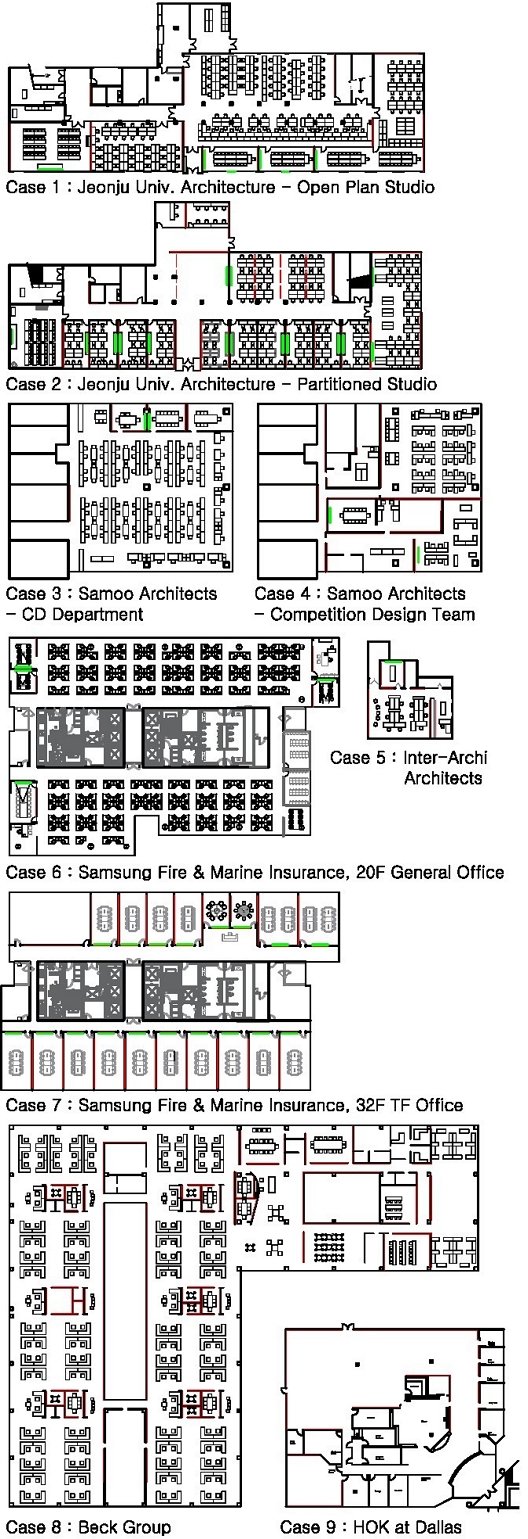
Case floor plansSource: design office archives and author’s redrawn diagrams
3.2. Plan Analysis and Quantitative Index Derivation
Floor plans were collected from the target spaces and, referencing prior research on the effects of physical distance and visibility on interaction frequency in collaborative settings [8], the following three indices were derived to compare spatial configurations:
- • WDI (Wall Density Index): The ratio of internal partition wall area to total floor area, indicating the degree of spatial subdivision.
- • PUA (Pin-up Usable Area): The area of continuous wall surfaces on which pin-up is possible, calculated from the net wall surface excluding openings and service areas.
- • PUR (Pin-up Utilization Ratio): The ratio of PUA to floor area, expressing the relative sufficiency of pin-up-capable area relative to space size.
Wall surfaces were measured by applying an effective height to actual wall lengths to convert to area, using a consistent height standard across all cases. Digital displays and electronic media were excluded from the primary analysis variables, with focus maintained on the physical wall conditions.
3.3. FGI Composition and Analysis
In this study, a total of five FGI sessions were conducted between September and November 2025. FGI was conducted with actual users of each space as a supplementary method for verifying correspondence between the quantitative indices derived from plan analysis and user perception. The aim was to confirm how the physical conditions of space are perceived and operated in actual communication experience.
To understand how informal communication and chance encounters occur within spaces, this study referenced the concept of spatial affordances proposed by Fayard and Weeks [3], who demonstrated that everyday spatial elements such as photocopiers and water coolers can function as conditions triggering unintended meetings and interactions. This study extends this concept to the physical conditions of wall surfaces and pin-up areas.
FGI was conducted in small groups with actual users of each case (design studio students and practitioners from architectural offices and general offices), on multiple occasions. Interviews followed a semi-structured format focusing on recurring communication patterns observed during space use. Key questions centered on:
- • The typical scale of daily communication interactions
- • Frequency of group discussions and open feedback events
- • Overall satisfaction with the communication environment
To better interpret the relationship between spatial conditions and actual pin-up use, several supplementary questions were included in the FGI interviews. These questions addressed whether the participants’ work was primarily team-based or individual, whether collaboration occurred mainly through physical pin-up surfaces or digital tools, and how comfortable participants felt expressing ideas in the presence of supervisors or evaluators.
Accidental communication frequency was assessed not by directly counting specific conversations but through participants’ relative perceptions of how often unplanned conversations or discussions occurred during ordinary space use. Collected statements were organized around recurring assertions per case, and results were normalized on a 5-point scale for cross-case comparison. FGI results were used strictly as a cross-validation tool to confirm whether spatial tendencies predicted through plan analysis appeared consistently in actual experience, not as an independent means of conclusion-drawing.4) FGI interviews were conducted only for the domestic cases due to research access limitations; therefore, overseas cases were analyzed primarily through spatial configuration indicators.
3.4. Analytical Procedure and Scope
Research was conducted in three steps: (1) collection of case floor plans and derivation of WDI, PUA, and PUR through dimensional analysis; (2) comparative analysis across cases based on quantitative indices; and (3) cross-comparison of FGI results with plan analysis results for the same cases. This study does not aim to derive statistical correlation coefficients or establish generalized causal relationships. Instead, its scope lies in interpreting the influence of physical wall conditions on communication from a design decision-making perspective and in presenting spatial indices that may be referenced in similar projects.
4. Results
This chapter presents results derived from plan analysis and FGI without interpretation. The analytical findings focus on confirming the relationship between physical wall conditions (WDI, PUA, PUR) and communication patterns; meaning-making and design implications are discussed in Chapter 5.
4.1. Plan Analysis Results: WDI, PUA, and PUR
This section presents a case-by-case comparison of WDI, PUA, and PUR derived from drawing analysis alongside the FGI findings. Table 3. summarizes the physical wall conditions of each case and their corresponding communication patterns.
Plan analysis indices (WDI, PUA, PUR) and FGI results by case
The drawing analysis results revealed distinct differences across cases in terms of wall partitioning degree and available pin-up area. In the case of the Jeonju University Department of Architecture studio, an educational setting, the open-plan layout yielded a WDI of 29% and a PUA of approximately 210m2, whereas the wall-partitioned layout showed a WDI of 45% and a PUA of approximately 542m2. Even under identical floor area conditions, the available pin-up area differed by more than twofold depending on the wall configuration. These findings suggest that rather than spatial openness per se, the continuity and secured area of walls form a structurally coherent relationship with the visual information-sharing environment [7,11].
A similar tendency was observed in the large design firm cases. The construction documentation team at Samoo Architects & Engineers recorded relatively low values of WDI 21% and PUA approximately 38m2, whereas the competition design team showed a WDI of 57% and a PUA of approximately 240m2, securing considerably higher wall density and pin-up area. This demonstrates that even within the same organization, the physical conditions for communication can vary significantly depending on spatial configuration.
In the general office and overseas design firm cases, the pattern in which wall-partitioned layouts consistently yielded higher PUA and PUR values was repeatedly confirmed. This recurrence indicates that wall continuity and area are not limited to specific spatial types, but rather function as physical characteristics that operate consistently across diverse work and educational environments.
4.2. FGI Results: Communication Scale and Frequency
FGI results showed that cases with low WDI and PUA commonly displayed a pattern in which communication was concentrated in small-group, desk-proximate conversations involving 2–4 people. These conversations occurred informally around desks, and group discussions and open public deliberations rarely expanded. This aligns with prior research observations that communication may remain at the level of small-scale interaction when visual reference objects are dispersed in open-plan environments [7].
In contrast, cases with high WDI and PUA showed relatively frequent occurrence of open discussions and feedback sessions involving five or more participants. In particular, the pattern in which floor plans or images posted on wall surfaces served as the central medium of communication, with multi-party utterances occurring while sharing the same field of vision, was commonly confirmed. These results are also consistent with findings from environmental psychology and workplace research that interaction is facilitated when common visual references exist [11].
Communication frequency and overall satisfaction were also reported as relatively higher in partitioned cases, corresponding to the increase in PUA and PUR confirmed through plan analysis.
4.3. Cross-Validation of Plan Analysis and FGI
Between the physical wall conditions derived from plan analysis and user experiences captured through FGI, a consistently corresponding relationship was confirmed through cross-case comparison. Open-plan cases with low WDI and PUA showed a tendency toward limited pin-up-capable area accompanied by small-scale, informal communication—consistent with Stokols’ discussion distinguishing physical density from psychological crowding [12].
Partitioned cases with high WDI and PUA, in contrast, commonly showed patterns of activated multi-party discussion and open feedback. These cross-validation results empirically demonstrate that wall continuity and pin-up-capable area function as key spatial variables explaining the scale and quality of communication, and support the claim that the quantitative indices derived from plan analysis are not abstract figures divorced from user experience.
5. Discussion
Based on the results in Chapter 4, this section interprets the significance of wall conditions for communication and derives integrated design guidelines. The guidelines proposed here are not norms limited to specific space types (educational spaces, design offices, general offices) but aim to propose a common framework of design judgment applicable across diverse workplace and educational environments.
While the indices WDI, PUA, and PUR indicate the spatial potential for visual information sharing, the actual use of pin-up surfaces may also be influenced by social and organizational conditions. Factors such as task interdependence (team-based versus parallel individual work), competitive versus collaborative evaluation structures in educational environments, hierarchical power distance and psychological safety, and the maturity of digital collaboration tools may significantly affect the degree to which physical pin-up surfaces are actively used. Therefore, wall-based spatial capacity should be interpreted as a potential enabling condition rather than a deterministic factor for communication.
It is also possible that relatively large PUA values do not necessarily lead to active pin-up use. In environments characterized by parallel individual tasks, highly competitive evaluation cultures, strong hierarchical structures, or extensive reliance on digital collaboration tools, the actual use of physical wall surfaces may remain limited despite sufficient spatial capacity. Recognizing such boundary cases helps clarify the scope of interpretation and prevents over generalization of the relationship between spatial indicators and communication behavior.
5.1. Integrated Interpretation of Results
The results of this study demonstrate that communication patterns can be interpreted on a case basis in terms of how spatial conditions such as wall continuity and pin-up-capable area correspond to communication patterns, rather than as a causal effect of a single variable. Fig. 2. visually summarizes the consistency of tendencies appearing between PUR values and communication patterns captured through FGI across cases. This prompts reconsideration of the existing linear assessment that treated open-plan layouts as a universal solution for promoting communication, and is consistent with the concerns raised in prior research regarding communication limitations in open-plan environments [2,7].
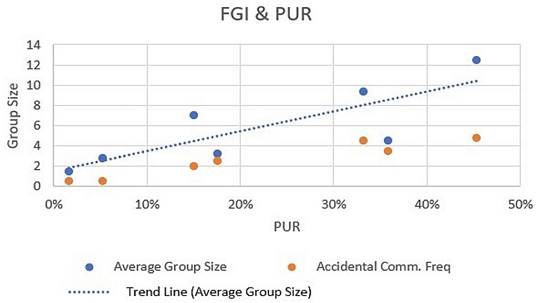
Relationship pattern between PUR and FGI outcomes across cases
In cases with low WDI and PUA, communication tended to remain in small-scale desk-proximate conversation; conversely, in cases with high WDI and PUA, multi-party discussion and open feedback occurred more frequently. This tendency was repeatedly observed regardless of whether the context was educational spaces, architectural offices, general offices, or overseas cases. This suggests that physical characteristics of wall surfaces operate as spatial variables common across diverse organizations and work environments, not limited to specific space types.
5.2. Reconceptualizing the Wall: From Partition Element to Vertical Medium
The central argument of this study is to reinterpret the wall not as a simple spatial partitioning element—as it has conventionally been perceived—but as a vertical information medium mediating communication. The accumulation and sharing of visual information through walls has a long architectural history, as seen in frescoes and friezes, demonstrating that walls have long functioned as media carrying meaning and information beyond their structural role [4,9].
Analysis results confirmed that in spaces with continuous wall surfaces, posted plans and images naturally function as the center of communication, creating an environment in which users participate in discussion while sharing the same field of vision. This means that what determines communication quality is not the presence of walls but how they are arranged and utilized. In other words, walls function not as barriers to communication but, when properly planned, as spatial devices that facilitate communication.
This wall-centered communication environment also carries significance from an environmental sustainability perspective, as it can improve communication quality without excessive reliance on digital technology or equipment.6) An approach that induces behavioral change through spatial configuration alone, without additional technical equipment, can be interpreted as a low-energy, low-technology strategy, connecting to the effects of spatial intervention proposed in environmental psychology and behavioral research [11,12].
5.3. Integrated Design Guidelines for Decision-Making
Based on the findings of this study, the following integrated design guideline framework is proposed.
First, the continuity and sufficiency of wall surfaces should be examined as a priority over layout type. Rather than the formal distinction between open-plan and partitioned configurations, whether continuous wall surfaces are secured to enable visual information posting and sharing determines communication potential.
Second, WDI and PUA can be used as comparative and evaluative indices rather than target values. This study does not require achieving specific values; rather, it proposes these indices as tools for relatively comparing and judging the communication potential of multiple design alternatives.
Third, it is important to prospectively set the intended scale of communication. Whether to center on small-scale conversation or activate multi-party discussion requires different degrees of wall continuity and pin-up-capable area. Setting the communication scale objective can serve as the starting point for wall placement and area planning.
Fourth, wall surfaces must be treated as planned elements rather than residual space. Treating walls as surfaces remaining after furniture placement makes it difficult for them to perform their function of mediating communication. Planning wall surfaces in positions with visual access to major circulation paths is essential.
These guidelines are not rules subordinate to specific space types but a common framework of thinking applicable across diverse workplace and educational environments for designers considering communication in spatial composition. They connect to Schön’s reflective practice concept, which understands design practice as a process of ‘reflection-in-action’ [10].
5.4. Scope and Limitations
This study is a case-based analysis and has limitations in generalizing results to all architectural types and organizational environments. The quality and frequency of communication are also influenced by non-spatial factors including organizational culture, work nature, and operational methods. This study does not exclude these factors but delimits its scope to demonstrating that physical spatial conditions constitute one major variable contributing to communication.
Nonetheless, the indices and design guideline framework presented in this study can serve as useful reference material for structuring communication-conscious design decision-making in similar spatial planning projects.
6. Conclusion
This study analyzed the influence of physical wall conditions on communication in design, educational, and office spaces through cross-validation of plan analysis and FGI. The results confirmed that whether communication flourishes is determined more by physical conditions such as wall continuity and pin-up-capable area than by spatial openness per se. Spaces with high WDI and PUA showed frequent multi-party discussion and open feedback, while spaces lacking these conditions showed a tendency for communication to remain at the level of small-scale, personal exchange.
These results suggest the need to reconceptualize walls not as simple partitioning elements but as vertical media enabling the accumulation and sharing of visual information. This study is particularly significant in having moved beyond the binary debate of open-plan versus partitioned arrangements to present wall continuity and area as core variables in design decision-making.
The results also carry significance from an environmental sustainability perspective. Physical pin-up and visual information sharing via wall surfaces is a spatial strategy capable of improving communication quality without unnecessary installation of additional digital equipment or excessive energy use. This can be interpreted as an environmentally friendly approach that promotes social and psychological comfort through spatial configuration itself, without relying on equipment-centered technological solutions. Furthermore, spaces actively utilizing wall surfaces can contribute to increasing spatial utilization and improving long-term spatial lifespan and adaptability by encouraging voluntary participation and feedback from users.
This study has the limitation of being a case-based analysis and was unable to fully isolate non-spatial factors such as organizational culture and operational methods. Nonetheless, the WDI- and PUA-centered analytical framework presented in this study can serve as a practical criterion for simultaneously considering communication potential and environmental sustainability in the early stages of spatial design. Future research should expand to integrate spatial configuration with environmental performance and social sustainability by additionally examining behavioral observation, usage pattern analysis, and relationships to energy use.
Notes
References
- F. Becker, Workspace: Creating environments in organizations, New York: Praeger, 1981, pp.1-250.
- F. Duffy, The New Office, London: Conran Octopus, 1997, pp.1-200.
-
A.L. Fayard, J. Weeks, Photocopiers and water-coolers: The affordances of informal interaction, Organization Studies, 28(5), 2007, pp.605-634.
[https://doi.org/10.1177/0170840606068310]

- A. Forty, Words and buildings: A vocabulary of modern architecture, London: Thames & Hudson, 2000, pp.1-300.
-
S. Harrison, P. Dourish, Re-place-ing space: The roles of place and space in collaborative systems, Proceedings of the 1996 ACM Conference on Computer Supported Cooperative Work, ACM, 1996, pp.67-76.
[https://doi.org/10.1145/240080.240193]
- K. Lynch, The image of the city, Cambridge: MIT Press, 1960, pp.1-194.
-
G.R. Oldham, D.J. Brass, Employee reactions to an open-plan office: A naturally occurring quasi-experiment, Administrative Science Quarterly, 24(2), 1979, pp.267-284.
[https://doi.org/10.2307/2392497]
-
G.M. Olson, J.S. Olson, Distance matters, Human–Computer Interaction, 15(2-3), 2000, pp.139-178.
[https://doi.org/10.1207/S15327051HCI1523_4]
- J. Pallasmaa, The eyes of the skin: Architecture and the senses, Chichester: Wiley, 2005, pp.1-120.
- D.A. Schön, The reflective practitioner: How professionals think in action, New York: Basic Books, 1983, pp.1-374.
- R. Sommer, Personal space: The behavioral basis of design, Englewood Cliffs: Prentice-Hall, 1969, pp.1-250.
-
D. Stokols, On the distinction between density and crowding, Psychological Review, 79(3), 1972, pp.275-277.
[https://doi.org/10.1037/h0032706]
- Solemma, ClimateStudio, https://www.solemma.com/climatestudio, , 2025.