User Perception of Urban Parks in Seoul and Metro Manila : A Sentiment Analysis of Google Maps Reviews
ⓒ 2026. KIEAE all rights reserved.
Abstract
This study explores how user-generated content (UGC), specifically Google Maps reviews, can be used to assess public perception of urban green spaces (UGS) in six parks across Metro Manila and Seoul. It examines how natural language processing (NLP) tools can support park management by identifying areas for improvement.
Approximately 28,000 Google Maps reviews from six urban parks, Rizal Park, Quezon Memorial Circle, and Ayala Triangle Gardens in Metro Manila, and Seoul Forest, Boramae Park, and Yeouido Park in Seoul, published from 2015 to 2024 were collected using Apify’s Google Maps Reviews Scraper. The data was processed in Dataiku DSS and analyzed using Google Cloud NLP for multilingual sentiment classification and OpenAI’s GPT-4o Mini for multi-label thematic categorization. TF-IDF keyword extraction, combined with large language model (LLM) pre-processing, was applied to reviews tagged as “Points for Improvement and Negative Perceptions” to focus on issues park users encountered.
While most reviews were positive, many expressed neutral sentiment despite high star ratings, highlighting a disconnect between linguistic tone and numeric scores. Although fewer in number, negative reviews provided actionable insights into common issues such as overcrowding, cleanliness, accessibility, parking, and construction. Thematic analysis showed that in the Philippine parks, the most mentioned themes were general appreciation, history and culture, and recreation. In Korean parks, the focus was on recreational activities, general appreciation, and nature and biodiversity. The study demonstrates how UGC, combined with AI tools, can offer insights into urban park experiences, supporting more responsive and inclusive green space planning.
Keywords:
Urban Green Space, User-Generated Content, Google Maps Reviews, Natural Language Processing, Sentiment Analysis1. Introduction
1.1. Background and Purpose of the Study
The United Nations projects that 68% of the global population will reside in urban areas by 2050 [1], underscoring the need for sustainable urban planning. One strategy in addressing the challenges of urbanization is the development and preservation of Urban Green Spaces (UGS). UGS such as parks and gardens, are vital for environmental quality, public health, and social well-being. They help reduce the urban heat island effect [2], enhance quality of life [3], and support mental and physical health outcomes [4], including reduced symptoms of depression and anxiety, improved mood and attention [5], and better overall health [6]. UGS also foster community cohesion and promote healthier behaviors through increased opportunities for social engagement and physical activity [7]. Despite the benefits of UGS, their impact depends not only on access or usage but also on user perception. Visitors’ satisfaction and emotional responses influence engagement [8], making it crucial to understand features shaping public attitudes for effective planning and management [9].While surveys and interviews remain useful, they are often time-consuming, resource-intensive, and limited in generalizability. Researchers are increasingly turning to user-generated content (UGC) as a scalable, real-time alternative for capturing public sentiment and spatial behavior [10,11]. However, research on UGC remains limited in several areas. Most studies focus on social media platforms such as Twitter, while place-based sources like Google Maps, which provide highly contextualized feedback tied to specific locations, are underexplored. Research on public perceptions of UGS outside Western contexts is also scarce, and the link between user experiences and public attitudes toward UGS is not widely examined. This study addresses these gaps by analyzing Google Maps reviews (2015~2024) for selected urban parks in Metro Manila and Seoul, focusing on negative perceptions to inform more inclusive and responsive UGS planning and management.
It addresses the following research questions: (RQ1) How do users in Metro Manila and Seoul perceive urban parks through Google Maps reviews? (RQ2) What negative perceptions and areas for improvement are most frequently mentioned? (RQ3) How do governance and urban contexts influence these perceptions?
1.2. Scope of the Study
Parks in Metro Manila and Seoul with over 5,000 Google Maps reviews were considered. Specialized venues such as zoos, conservatories, or themed attractions were excluded, as their reviews reflect specific features rather than general park use. The top three parks in each city were selected based on review volume, public accessibility, and general-use design (Table 1.). Metro Manila parks generally show higher review counts, likely due to fewer parks in the region concentrating user activity. Rizal Park and Quezon Memorial Circle are surrounded by institutional and commercial areas, while Ayala Triangle Gardens draws many reviews due to its central location within the Makati Central Business District (CBD) and its private management. Seoul’s larger parks, situated amid commercial and residential zones, have more dispersed reviews, reflecting both the availability of multiple digital platforms and varied patterns of urban park use. Additionally, 41.3% of Korean park reviews included written content, compared to 34.7% for Philippine parks, suggesting more detailed feedback from Korean users. The selected parks represent a range of scales, types, and management contexts in both cities, allowing for a meaningful comparison of user experiences and perceptions across diverse urban park environments.

Research site
Nonetheless, the high number of reviews in all selected parks indicates strong public engagement and frequent visitation. Focusing on parks with substantial reviews provides a robust foundation for analyzing public attitudes toward UGS, enhancing the reliability of the study’s findings.
2. Review of Related Literature
2.1. Urban Park Challenges in Seoul and Metro Manila
Metro Manila has experienced rapid, poorly regulated urban growth, with mixed land use and high rural-to-urban migration [12]. Weak policies and the lack of a comprehensive legal framework have led to fragmented and uneven UGS provision [13]. Governance is also fragmented, each of the 17 local government units (LGUs) manages parks independently, while the National Parks Development Committee (NPDC) oversees only a few national sites. Private developers often convert open spaces into commercial or residential projects, resulting in privately-owned parks that remain vulnerable to redevelopment. Although Presidential Decree 1216 mandates open spaces in subdivisions and the Local Government Code instructs LGUs to provide parks, no agency systematically monitors or enforces provision and management [14]. Parks like Rizal Park, Quezon Memorial Circle, and Ayala Triangle feature lawns, monuments, jogging paths, playgrounds, and event spaces, but amenities and quality vary, reflecting uneven institutional support.
In contrast to Metro Manila where LGUs manage parks independently, Seoul’s 25 districts (gu, 구) operate under the centralized coordination of the Seoul Metropolitan Government (SMG). National parks are overseen by the National Park Service under the Ministry of Environment, while urban and regional parks fall under the SMG or subordinate agencies. Neighborhood parks are widely used, particularly smaller ones that are numerous, well-distributed, and easily accessible [15]. Since the Park Act of 1967 and the creation of development restriction zones in 1971, Seoul has developed a strong legal and institutional framework for park provision, reinforced by successive policies including the 1985 and 1995 “Policy Direction of Parks and Green Spaces” studies and the 2015 Master Plan aligned with the 2030 Seoul Urban Master Plan [16]. More recently, parks have been designated as local living service facilities, with demand, supply, and management evaluated through the Right to Life Plan [17]. Despite these institutional strengths, Seoul faces challenges related to equitable distribution, connectivity of green networks, and congestion in popular destinations [16].
The contrast between Metro Manila and Seoul illustrates how governance, policy, and urban development shape park provision and management. Fragmented governance in Metro Manila contrasts with Seoul’s centralized coordination and stronger legal framework. These differences provide context for interpreting user sentiment, as park size, layout, and accessibility influence experiences. By selecting three parks of varying type and scale per city, sentiment analysis can reveal how urban context shapes perceptions of park quality and usability, offering insights for planning and management.
2.2. Big Data in Urban Planning: User-Generated Content (UGC)
Big data refers to large-scale information analyzed using advanced tools [18] and has proven useful for understanding human behavior and perception [19]. One major source is UGC, which consists of media or data shared online to inform or express opinions [20]. Unlike surveys, UGC captures people’s thoughts in their own words without preset questions, time, or geographic limits, offering broad spatial and temporal coverage for urban studies.
While UGC was initially applied in areas like product research [21,22], it is now increasingly used across diverse fields, including urban planning. In UGS research, it helps overcome the limits of traditional surveys by offering insights into how people use and perceive green spaces [23]. The growing availability of data with broad spatio-temporal coverage, along with advances in deep learning and user-friendly analytical tools, has contributed to the steady rise of big data-based studies on UGS [24].
UGC analytics have been used to measure park visitation frequency, showing that park attributes and surrounding landscape features significantly influence park use [25]. They also support the tracking of visitor feedback, sentiment, and perceived experiences over time [26]. Unlike traditional methods, UGC is not bound by temporal constraints, allowing for the identification of long-term patterns and trends. Some studies have also examined the impact of the COVID-19 pandemic on UGS use [27], highlighting UGC’s capacity to capture real-time shifts in public behavior and spatial preferences, insights often difficult to obtain through conventional research.
While much of the existing literature focuses on social media platforms [28], there is a growing recognition of the value of place-based UGC sources like Google Maps [29], where users provide location-specific feedback. These platforms are particularly valuable as users often leave detailed comments reflecting their perceptions of specific places, including issues related to cleanliness, safety, facilities, and accessibility. Despite this potential, there remains limited research that leverages Google Maps reviews to systematically analyze park management practices, identify maintenance deficiencies, or assess the overall quality of user experiences.
By utilizing Google Maps, a location-specific form of UGC, to explore public attitudes, values, and opinions, researchers can generate more responsive and user-centered strategies for park planning and management.
2.3. Sentiment Analysis
Sentiment analysis, also known as opinion mining, aims to identify and understand the emotions or opinions expressed by individuals about a specific topic, person, or place [30]. It falls under the broader field of NLP, a branch of Artificial Intelligence (AI) that focuses on computational techniques designed for the automatic analysis and representation of human language [31]. Sentiment analysis commonly uses lexical methods with sentiment dictionaries, machine learning on labeled data, or deep learning to capture complex linguistic patterns [32].
In urban planning, sentiment analysis is used to assess public perceptions of UGS, providing more than just polarity classification (positive, negative, or neutral). It allows researchers to detect recurring themes, frequently mentioned words, and emotional tones in public discourse surrounding parks and green infrastructure from large volumes of online textual data [33,34].
Recent advances in NLP and Large Language Models (LLMs) provide sophisticated tools for processing UGC. Cloud-based NLP services from providers like Google, Amazon, and Microsoft offer pre-trained models for syntax, sentiment, and entity recognition without extensive training. LLMs such as OpenAI’s GPT further enable complex language tasks with minimal supervision [35]. This study applies Google Cloud NLP and GPT-4o Mini to analyze multilingual Google Maps reviews from selected parks in Metro Manila and Seoul to better understand user perceptions.
2.4. Research Differentiation
Among the limited studies focused on non-Western urban parks, Lee & Son (2021) examined negative user feedback by filtering Google Maps reviews with star ratings of three or lower and extracting keywords from the associated comments [36]. While this approach highlighted dissatisfaction, it depended heavily on the rating system as a proxy for sentiment, which might have overlooked negative expressions in higher-rated reviews. In contrast, Shang et al. (2023) applied topic modeling to review texts, positive and negative alike, and identified thematic distributions that reflected what users discussed most frequently [37]. Unlike Shang et al. (2023), the current study applies AI-based multi-label text classification, which allows a single review to be categorized under multiple themes when relevant, capturing the complexity of user perceptions more accurately. In addition, sentiment analysis is applied across two different urban contexts without restricting the dataset to specific ratings. This broader and comparative framework enables the identification of user concerns expressed across the full spectrum of reviews and situates these perceptions within differing governance and urban development contexts, thereby extending the scope of existing research on park evaluation.
3. Methodology
The dataset includes user reviews and ratings analyzed through sentiment analysis and topic modeling using Google Cloud Natural Language Processing (NLP) and GPT-4o Mini on the Dataiku DSS (Data Science Studio) platform. Among other NLP tools, Google Cloud NLP demonstrates strong tolerance to syntactic noise, making it well-suited for processing UGC with misspellings, informal grammar, and slang [38]. GPT-4o Mini, meanwhile, was selected for its strong balance of performance and resource efficiency. Recent benchmarking [39] showed it offers the best trade-off between computational cost, accuracy, and lower environmental impact, making it ideal for large-scale NLP tasks. It also retains GPT-4’s multilingual capabilities for processing informal, multilingual content.
The research process is illustrated in Fig. 1. Reviews categorized by the language model as “Points for Improvement and Negative Perceptions” are analyzed to identify key issues raised by users. These insights will then help promote responsive, user-centered approaches to urban park planning and management.
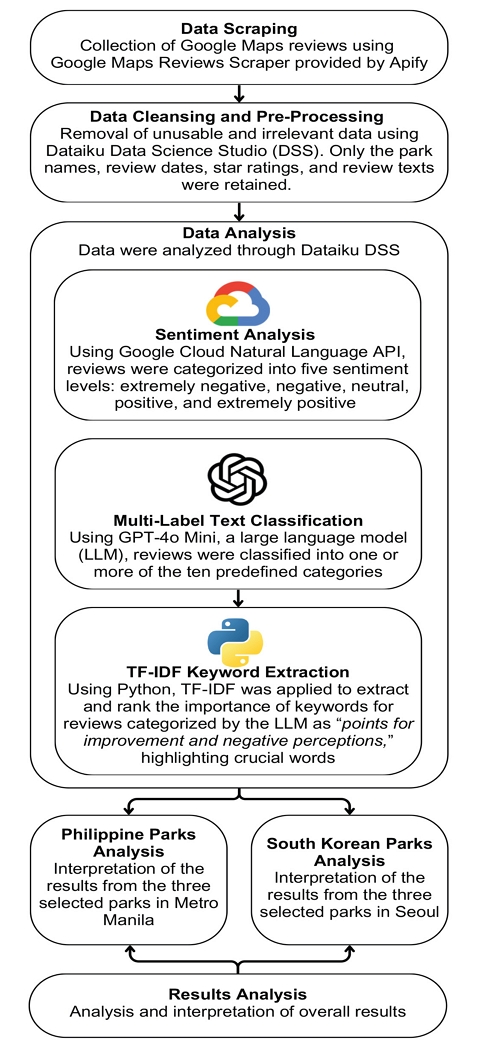
Research process
4. Research and Analysis
4.1. Data Scraping and Cleansing
Data scraping, the automated extraction of website information, was used to collect Google Maps reviews via Apify’s Google Maps Reviews Scraper. The data was then imported into Dataiku DSS, which integrates with APIs like Google Cloud NLP and OpenAI’s GPT-4o Mini.
An initial review of the data revealed that, on average, 91.51% of reviews for the three Korean parks were written in Korean, while 88.1% of reviews for the three Philippine parks were written in English (Fig. 2.). Since both Google NLP and GPT-4o Mini by OpenAI are capable of analyzing multiple languages, all reviews, regardless of language, were analyzed in this study. Although Google Maps reviews do not indicate users’ nationality, the language used offers an insight into the reviewer’s background.
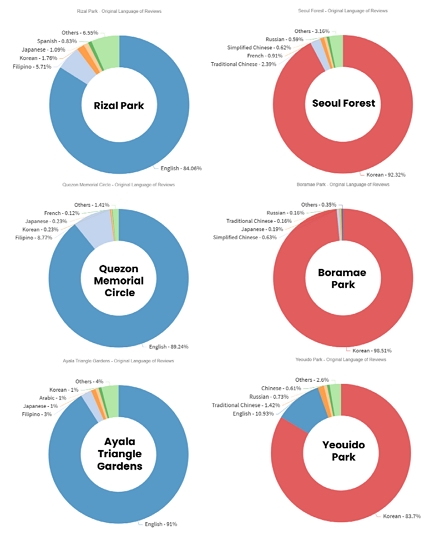
Original language of reviews
Key fields such as park name, review date, star rating, and review text were retained for analysis. Review distribution from 2015 to 2024 (Fig. 3.) shows a sharp rise around 2019, likely linked to shifting visitation during COVID-19, followed by a decline as park use stabilized. This trend reflects Geng et al.’s (2020) findings that park visits dropped during early lockdowns but later increased as residents sought outdoor spaces for well-being [40].
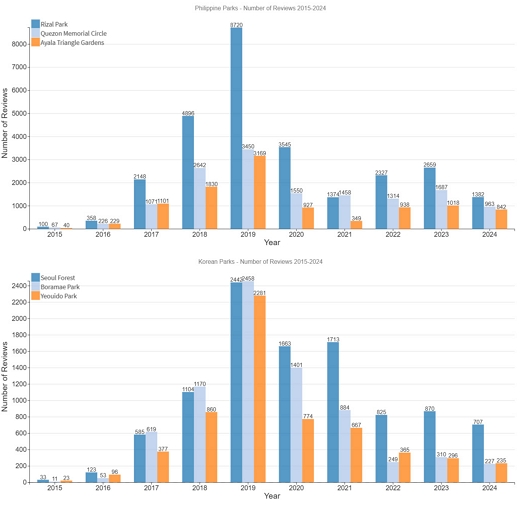
Number of reviews from 2015 to 2024 of the selected Philippine and Korean parks
When categorized by star rating, majority of the reviews of all six parks fell within the 4 to 5 star range (Fig. 4.), suggesting a generally favorable visitor perception.
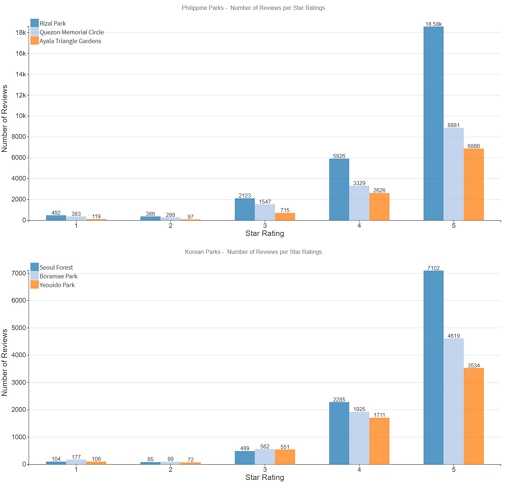
Number of reviews per star rating
4.2. Sentiment Analysis
Prior to the analysis, the dataset was filtered to exclude entries without text or with only emojis, leaving only usable reviews. Sentiment analysis was then performed in Dataiku DSS using the Google Cloud Natural Language API, which applied pre-trained NLP models across 16 languages. Each review received a sentiment score from -1 to 1 and was classified into five levels: extremely negative, negative, neutral, positive, and extremely positive (Table 2.).
Sentiment score categorization
Most reviews were highly positive, reflecting generally favorable perceptions. Parks with fewer reviews, particularly Ayala Triangle Gardens and Yeouido Park, showed higher average sentiment (Fig. 5.). However, a notable share of reviews across all parks were classified as neutral, often reflecting factual observations or mild opinions: Rizal Park (21%), Quezon Memorial Circle (21%), Ayala Triangle Gardens (18%), Seoul Forest (20%), Boramae Park (20%), and Yeouido Park (25%) (Fig. 6.).
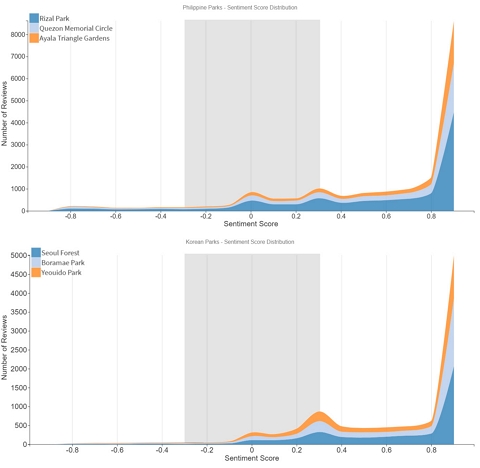
Sentiment score distribution of Google Maps reviews of the selected Philippine and Korean parks
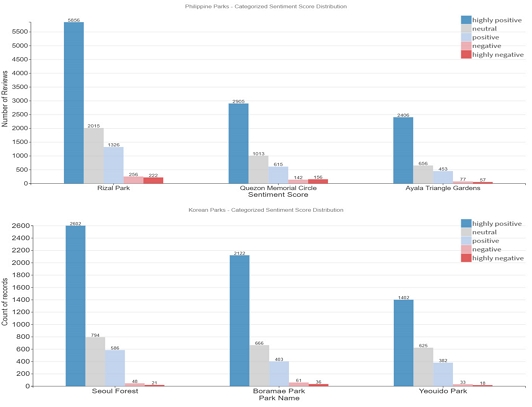
Categorized sentiment score distribution
4.3. Multi-Label Text Classification
To better understand the reviews’ context and capture the multiple dimensions of user experiences, this study employed a multi-label text classification approach, which allows each review to be tagged with multiple relevant categories, unlike single-label classification that assigns only one category per text. The classification was conducted using GPT-4o Mini integrated within Dataiku DSS, prompted to identify key themes from a sample of reviews. These themes closely aligned with those in Shang et al.’s [31] framework but were slightly refined to suit the context of this study and the features of the selected parks, resulting in ten finalized categories. Each review was classified into one or more of these categories, with “X” assigned if none applied, and representative examples were provided in the prompt to enhance accuracy and consistency (Table 3.).
Text classification and sample reviews
This classification approach was implemented using few-shot learning, where the LLM performed the task with the few examples but without prior task-specific training or fine-tuning. Providing clearly defined class labels along with representative examples enabled the model to generalize effectively and produce consistent predictions across the diverse review dataset.
The data was classified by topic and visualized using a Sankey diagram to illustrate the relative distribution of themes (Fig. 7.). The thematic breakdown for each park is presented in Fig. 8.
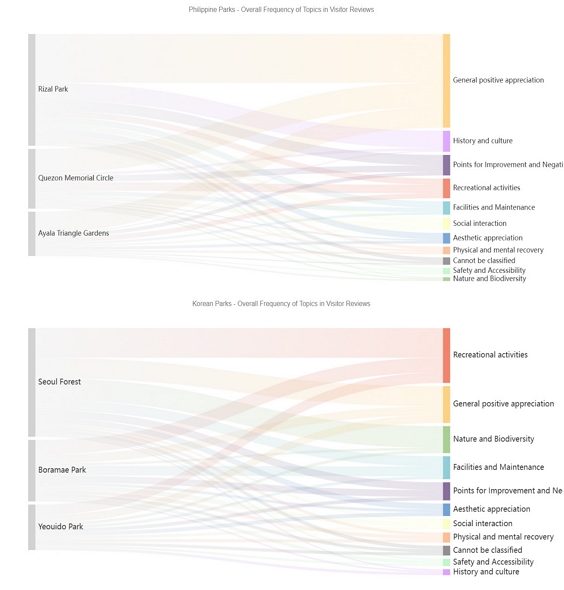
Overall frequency of topics in visitor review of the selected Philippine and Korean parks
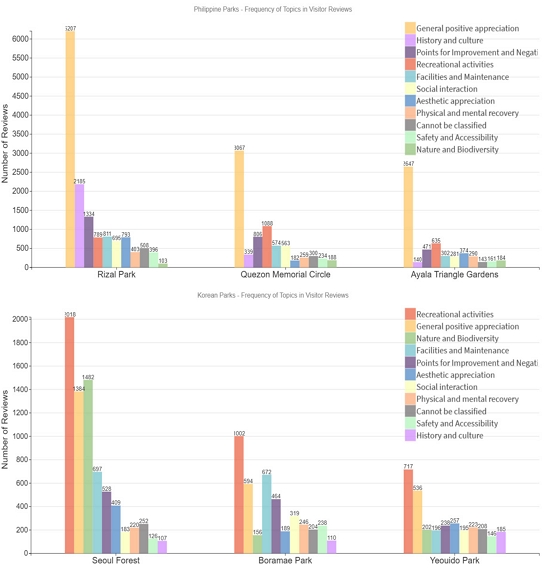
Frequency of topics in visitor reviews
4.4. Temporal Trends in User Perceptions and Park Topics
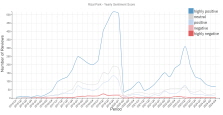
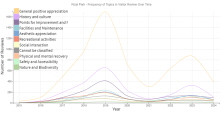
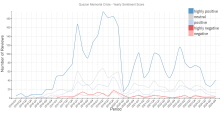
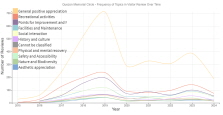
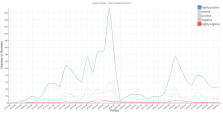
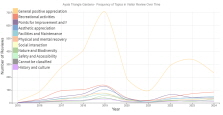
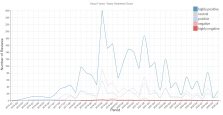
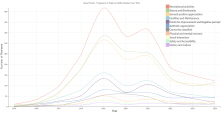
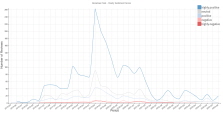
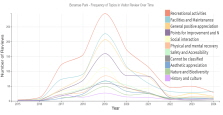
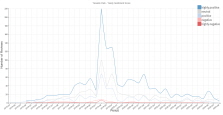
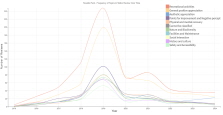
As seen in Table 4., the 10-year analysis of Google Maps reviews (2015~2024) revealed how user experiences in urban parks have evolved over time, reflecting seasonal patterns, societal events, and disruptions such as COVID-19.
Changes in sentiment and topic distribution of park reviews (2015~2024)
In Seoul, review activity peaked in autumn, with a major dip in Q2 2019 and a decline in reviews from 2022 onward, while Seoul Forest maintained relatively stable activity suggesting that larger parks continued to attract visitors. Across Seoul parks, common topics included “General Appreciation” and “Recreational Activities,” with Seoul Forest noted for “Nature and biodiversity”, Boramae for “Facilities and maintenance”, and Yeouido showing increased “Points for Improvement” during the pandemic. In Metro Manila, reviews dropped in Q4 2019 and Q1 2020, coinciding with early pandemic disruptions. Sentiment generally followed a proportional pattern, with highly positive reviews as highest, followed by neutral, though negative sentiment increased during Q1 2020. Key topics included “Points for Improvement,” consistently among the top concerns, alongside “General Appreciation” and “Recreational Activities,” while Rizal Park also reflected “History and Culture” due to its historical significance. Building on these temporal and thematic trends, the study then analyzed reviews labeled as “Points for Improvement” and negative perceptions to identify specific user concerns and priorities for park management.
4.5. TF-IDF Keyword Extraction
Reviews categorized as “Points for Improvement and Negative Perceptions” were analyzed using keyword extraction to identify common user concerns and highlight areas needing attention in each UGS. All reviews were translated into English to ensure consistency, and the analysis was conducted on Python via the Dataiku DSS platform using Term Frequency–Inverse Document Frequency (TF-IDF), a widely used method for text feature extraction in NLP and information retrieval [41]. TF-IDF combines Term Frequency (TF), the number of times a term appears in a document, with Inverse Document Frequency (IDF), which reflects its rarity across the dataset, highlighting terms that distinguish individual reviews. Higher TF-IDF scores indicate greater importance of a term in differentiating a review’s content. The TF-IDF score was calculated as follows [42]:
| (Eq. 1) |
| (Eq. 2) |
TF(t, d) represents the frequency of the word t in the document d. N denotes the total number of documents, while N(t) indicates the number of documents that contain the word t. The addition of 1 to N(t) is used to prevent division by zero in cases where t does not appear in any document.
Although some reviews consisted purely of negative perceptions or points for improvement, positive terms initially appeared frequently with high TF-IDF scores. This was due to the common structure of many reviews in both the Philippine and Korean datasets, where users often began with positive remarks before mentioning negative aspects. For example:“Seoul Forest is great no matter what season you visit; however, parking is difficult.” or “Great place to go with family, beware of mosquitoes.” To address this issue, the GPT-4o Mini model was utilized to process the text and systematically extract only the negative components of each review. After pre-processing, the resulting text emphasized only the critical part of the review such as: “Parking is difficult.”, “Beware of mosquitoes.”
This pre-processing step helped eliminate unrelated positive phrases, thereby improving the accuracy of keyword extraction by focusing only on user feedback related to issues and areas requiring improvement in urban park management. Additionally, word clouds were generated to visually highlight the most frequent terms in reviews marked as “Points for Improvement and Negative Perceptions”. Unlike TF-IDF, which emphasizes distinctive terms, word clouds reflect overall frequency, offering a quick, accessible overview of common issues.
TF-IDF analysis of “Points for Improvement and Negative Perceptions” reviews for Rizal Park highlighted top words such as park, people, crowded, hot, just, place, lot, building, homeless, rizal, area, food, need, closed, and needs (Fig. 9.). A recurring concern among reviewers was the park’s overcrowding, especially during weekends or holidays. Some reviewers also expressed discomfort due to the intense heat, most likely due to the Philippines’ tropical climate and the lack of sufficient shaded areas. Some reviews noted: “It is really hot as there is not much shade.” and “The weather could be too hot during the day and not good for a stroll.” Despite the park’s large size, there is limited tree cover and sheltered seating, making prolonged visits uncomfortable.
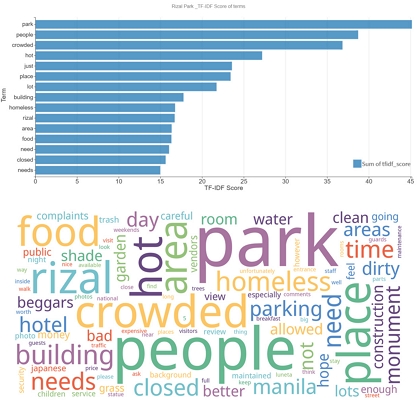
Rizal Park – TF-IDF scores and word cloud of reviews categorized as “points for improvement and negative perceptions”
The presence of homeless individuals also emerged as a safety concern for visitors: “There are homeless people staying on benches and parts of the park where there is minimal police or security visibility...” and “There are the homeless people around the park which makes you fear getting robbed⋯” These complaints about homeless people sleeping under trees have persisted since before the COVID-19 pandemic.
Another notable issue was the high-rise Torre de Manila, often called the “photobomber” of the Rizal Monument. Reviewers criticized how it disrupted the monument’s visual integrity: “That photobomber building should be taken down.” Although efforts were made to halt its construction, the absence of legal protections for visual corridors allowed it to proceed.
TF-IDF analysis of “Points for Improvement and Negative Perceptions” reviews for Quezon Memorial Circle highlighted top words such as place, crowded, construction, park, traffic, people, parking, just, dirty, area, lot, closed, clean, circle, and need (Fig. 10.). Similar to Rizal Park, a common concern among Quezon Memorial Circle visitors was the overcrowded environment, especially during weekends and holidays. Many also expressed frustration over congested traffic around the park. Parking was frequently cited as a problem, contributing to the overall inconvenience. Comments such as “Avoid this area during peak hours. It is super traffic, especially with the construction of the train station,” and “The place was packed, parking is not organized,” reflected these issues.
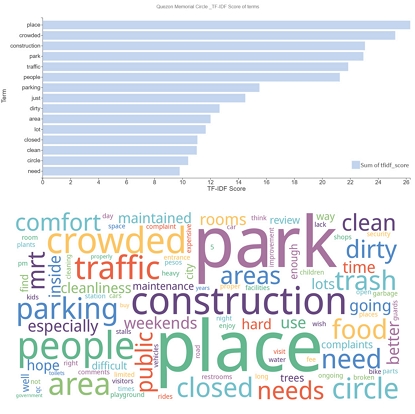
Quezon Memorial Circle – TF-IDF scores and word cloud of reviews categorized as “points for improvement and negative perceptions”
Another major point of dissatisfaction was the prolonged construction within the park, primarily due to the ongoing Metro Rail Transit (MRT) Line 7 station construction, which began in 2016. Although partial operations were initially scheduled for 2022, the opening has been postponed to 2028. As a result, renovations continue to disrupt the park experience, with several areas and facilities temporarily closed. Reviews like “Half of it looks like a construction site,” and “Lots of roads are under construction.,” illustrated the disruption.
Cleanliness was a recurring concern, with some areas poorly maintained, especially restrooms and waste disposal. Reviewers often mentioned the need for cleaner facilities, more food stalls, and seating. Food services were also criticized for limited variety, low quality, and high prices: “⋯expensive but has no taste,” and “Foods are a little bit expensive for an average earner⋯”
TF-IDF analysis of “Points for Improvement and Negative Perceptions” reviews for Ayala Triangle Gardens highlighted top words such as park, construction, crowded, place, restaurants, small, food, area, closed, just, traffic, bit, people, space, and lights (Fig. 11.). A recurring complaint among visitors was the ongoing construction, which many felt had negatively affected the park’s ambiance and accessibility. One reviewer shared, “Due to the construction ongoing within the park, it is better not to jog or run in that area,” while another noted, “It was a shame that the majority of the trees had to be relocated or cut down to accommodate the next building under construction.” These comments showed that construction activities disrupt the overall park experience.
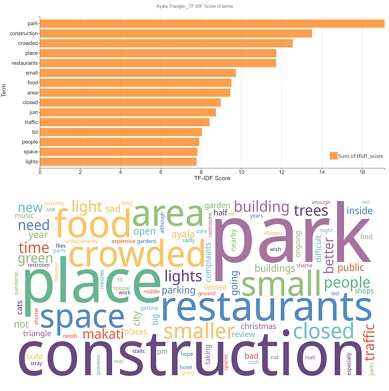
Ayala Triangle Gardens – TF-IDF scores and word cloud of reviews categorized as “points for improvement and negative perceptions”
Access to the park is often hindered by traffic congestion in Makati, with reviewers noting: “Traffic congestion in rush hour” and “Brace yourselves due to the number of people⋯ and traffic since it is in the business district.” Some also mentioned closures of park sections and cafes: “A lot of cafes in the park are now closed. Slowly it is being eaten up by buildings,” reflecting concerns over shrinking public space.
Crowding is common, especially on weekends and holidays: “The area is crowded⋯,” making it difficult to enjoy the park peacefully. Food options also drew criticism for quality, variety, and pricing: “There is a place of restaurants at the back, kind of expensive, but what do you expect.”
Seasonal lighting displays received mixed reactions, with some visitors finding them limited: “You really do not get much but just the music and the lights,” suggesting a need for more year-round attractions.
Upon analyzing the TF-IDF scores of reviews categorized under “Points for Improvement and Negative Perceptions” for Seoul Forest, the top words identified were people, parking, lot, difficult, bit, park, weekends, parking difficult, parking lot, lot people, like, good, crowded, disappointing, and better (Fig. 12.). Reviewers frequently complained about limited and inconvenient parking, citing challenges such as the difficulty of finding available spots and the distance between the parking area and the park entrance. These issues were particularly pronounced on weekends. One reviewer noted, “It is difficult to find the park parking lot as it is too small to accommodate the number of vehicles visiting on weekends,” while another remarked, “Parking spaces are still very limited, so it is better to use public transportation.” One comment highlighted broader accessibility concerns: “The subway station and parking lot are far away.”
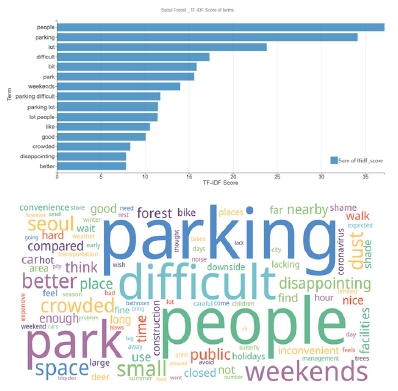
Seoul Forest – TF-IDF scores and word cloud of reviews categorized as “points for improvement and negative perceptions”
Some reviews also mentioned overcrowding, especially during peak seasons. For example, visitors shared, “It is difficult to ride a bike in the park because there are so many people,” and “There is really no place to sit, and it gets crowded.” Another advised, “Avoid weekends during the cherry blossom season as it can be very crowded.”
Upon analyzing the TF-IDF scores of reviews categorized under “Points for Improvement and Negative Perceptions” for Boramae Park, the top words were construction, people, lot, park, parking, but, lot people, inconvenient, subway, light, light rail, rail, crowded, subway constructions, light rail construction, and rail construction (Fig. 13.). A major recurring complaint concerned the ongoing construction projects in and around the park, particularly those related to subway and light rail development. Reviewers expressed frustration with statements such as: “A lot of the park is not available because of the subway construction,” and “It is currently under construction, so it is a bit inconvenient to move around.” One reviewer also noted, “Due to light rail construction, it is very inconvenient due to dust, noise, and dump truck traffic.” These disruptions were likely associated with the development of the Nangok Branch Line of the Seoul Light Rail Sillim Line, which includes planned infrastructure within and around Boramae Park. Several reviews directly linked the diminished park experience to these infrastructure works, including: “There is construction every time I go. I wish it was over quickly.”
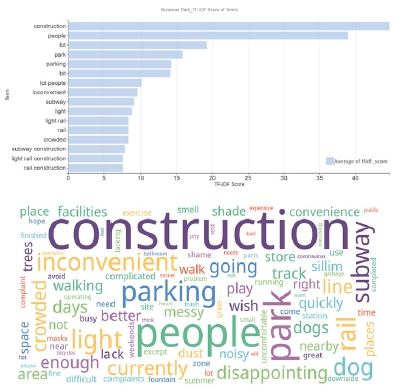
Boramae Park – TF-IDF scores and word cloud of reviews categorized as “points for improvement and negative perceptions”
In addition to construction-related issues, users also identified overcrowding as a significant concern. Reviews such as “There are so many people on weekends that it is almost saturated and there are not enough chairs to sit and rest on regular days,” “There are many elderly people or people just taking a walk, so it may be a little uncomfortable when exercising due to the roadblock,” and “Too many people and too many dogs.” reflected discomfort caused by excessive foot traffic.
Upon analyzing the TF-IDF scores of reviews categorized under “Points for Improvement and Negative Perceptions” for Yeouido Park the top words identified were people, park, lot, parking, crowded, good, place, really, bit, special, just, lot people, mosquitos, better, and places (Fig. 14.).
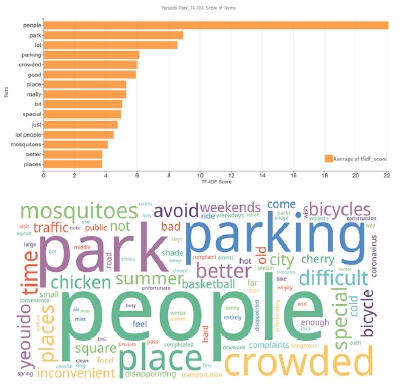
Yeouido Park – TF-IDF scores and word cloud of reviews categorized as “points for improvement and negative perceptions”
A recurring concern among reviewers was overcrowding, particularly on weekends. Comments such as “I feel like there are a lot of people and the prices have really risen,” “There are many people who leave various household waste...,” and “It is crowded on weekends because there are too many people⋯” reflected this frustration.
Parking was also frequently mentioned as a point of inconvenience. Reviewers noted, “Parking is difficult, so use public transportation,” and “If possible, give up on parking”.
Another common complaint involved mosquitoes, especially during the summer season, as seen in comments like “⋯there are many mosquitoes near the stream in the summer” and “I got bitten by a lot of mosquitoes.”
Some visitors also described the park as underwhelming or lacking a distinctive character, often using the Korean expression “그냥” (just so-so). Remarks such as “If you have a tight sightseeing schedule, you can pass this. This is just a park” and “Do not expect too much. It is just a park” highlighted this sentiment.
5. Conclusion
Using NLP tools such as Google Cloud NLP and GPT-4o Mini within Dataiku DSS, this study demonstrated how user-generated content (UGC) can reveal urban park experiences and track temporal trends. By applying multilingual sentiment analysis, multi-label classification, and TF-IDF keyword extraction specifically to reviews categorized as “Points for Improvement and Negative Perceptions,” the study identified location-specific issues and recurring themes, providing actionable insights for urban park management. Selecting three parks of varying type and scale in each city ensured representation of broader urban park conditions, allowing meaningful cross-city comparisons of user perceptions.
5.1. Key Findings
RQ1 examined how users in Metro Manila and Seoul perceive urban parks through Google Maps reviews. While most reviews were positive, a notable share were neutral despite high star ratings because they were factual or descriptive, indicating that textual analysis provides deeper insights into user experiences.
RQ2 focused on negative perceptions and areas for improvement. In Metro Manila, Rizal Park reviews frequently cited overcrowding, heat, homelessness, and the Torre de Manila’s impact on heritage views. Quezon Memorial Circle reviews emphasized MRT-7 construction, traffic, parking shortages, and maintenance issues. Ayala Triangle Gardens reflected reduced green space, commercialization, and seasonal disruptions. In Seoul, Seoul Forest reviews noted crowding and parking pressures, Boramae Park highlighted construction and seating shortages, and Yeouido Park pointed to weekend congestion, mosquito problems, and a perception of limited distinctiveness.
RQ3 considered how governance and urban contexts shape user perceptions. Metro Manila parks reflected challenges of fragmented governance, weak heritage protection, and commercialization. Seoul parks, while supported by stronger institutions and transit systems, revealed pressures from congestion, construction, and accessibility.
TF-IDF keyword extraction and LLM pre-processing confirmed these location-specific issues, linking user concerns to broader urban planning and management considerations and enabling cross-city comparison.
5.2. Implications for Urban Park Management
This study demonstrated that UGC, when processed through NLP techniques, offers a valuable, low-cost tool for urban planning and park management. It helps identify both recurring and emerging issues in urban parks. Positive reviews indicate satisfaction, but negative reviews provide actionable feedback linked to design, infrastructure, and governance.
In Metro Manila, Rizal Park could address overcrowding and heat discomfort through spatial interventions such as adding shaded areas with trees, pergolas, or canopies. Coordinating with social services to support vulnerable populations highlights the intersection of social planning and public space management. Revisiting heritage protection laws and enforcing stricter zoning around national monuments, such as preventing developments like the “photobomber” building, illustrates the impact of regulatory frameworks on user perceptions and urban heritage preservation. At Quezon Memorial Circle, mitigating MRT-7 construction impacts, improving wayfinding, and optimizing internal traffic flow demonstrate how transportation systems and spatial connectivity influence visitor experience. Upgrading public facilities and providing clear signage further links user feedback to operational and planning strategies. For Ayala Triangle Gardens, preserving green space during redevelopment and ensuring accessible, reasonably priced amenities reflect how land use priorities and spatial configuration affect satisfaction in a commercialized UGS within a dense business district. However, the lack of integrated public transport options and the surrounding institutional and commercial land uses, rather than residential neighborhoods, limit accessibility and reduce frequent visitation, unlike Seoul’s parks, which benefit from extensive transit connections and mixed-use surroundings.
In Seoul, Seoul Forest could enhance visitor experience through crowd management, refined parking logistics, and real-time crowd information, emphasizing the role of infrastructure and accessibility in shaping perceptions. Boramae Park may benefit from additional resting areas, reduced construction noise, and improved signage or updates to support wayfinding, demonstrating the interaction between urban development projects and park usability. Yeouido Park could expand landscaped areas, increase shaded zones, implement seasonal mosquito control, and introduce public art or themed gardens, illustrating how design interventions and spatial improvements address user comfort and emotional connection.
Overall, the study shows that user perceptions are shaped by surrounding land use, zoning, and governance systems. Integrating UGC analysis into planning can strengthen adaptive, user-centered, and inclusive park management aligned with urban sustainability goals.
5.3. Limitations and Recommendations
Despite the valuable insights provided by Google Maps reviews, several limitations should be acknowledged. Google Maps operates a “Local Guides” program where users earn points for contributions such as reviews, which can unlock certain perks like early access to features or event invitations, though these benefits are not guaranteed. It is reasonable to assume that most users post primarily out of a willingness to contribute to public knowledge. However, not all park visitors are willing or able to leave reviews, so the feedback represents only a fraction of park users. Nonetheless, the volume and consistency of contributions enhance the dataset’s credibility.
Furthermore, since Google does not provide information about reviewers’ nationality, quantitatively controlling for differences between local and foreign visitors was not feasible. As mentioned, based on language use, 91.51% of reviews for the three Korean parks were written in Korean, while 88.1% of reviews for the three parks in the Philippines were written in English, suggesting that most reviewers are likely locals, though this cannot be confirmed with certainty. Subtle cultural expressions may not always be correctly interpreted by NLP tools, which introduces a potential source of language-related bias. Future studies could combine cross-linguistic validation to address these concerns. Additionally, integrating UGC from other platforms such as Naver Map (in Korea), TripAdvisor, or various social media sites could provide complementary perspectives.
A brief validation of the analytical results was conducted to confirm the reliability of the sentiment and thematic classification. A random set of 100 reviews was manually checked, and the Google NLP sentiment analysis accurately classified 99 reviews, with only one ambiguous case, “lack of parking but it was perfect park,” which could be interpreted as neutral rather than positive. For GPT-5 Mini thematic classification, only two reviews had partially missing themes. Overall, the analysis demonstrated a high degree of accuracy, indicating that the classification results are robust and credible. For future studies, integrating multiple AI classification tools could further enhance accuracy and provide cross-validated results.
Incorporating digital review data into urban planning processes may help capture diverse perspectives from park users. UGC offers a scalable way to support UGS planning, providing insights that reflect user experiences, local context, and the evolving needs of the community.
Acknowledgments
This study was conducted without financial support from any public, commercial, or non-profit funding agencies.
References
- UN-Habitat, World cities report 2022: Envisaging the future of cities, United Nations human settlements programme, 2022. https://unhabitat.org/sites/default/files/2022/06/wcr_2022.pdf
-
J. Park et al., The influence of small green space type and structure at the street level on urban heat island mitigation, Urban Forestry and Urban Greening, 21, 2017, pp.203-212.
[https://doi.org/10.1016/j.ufug.2016.12.005]

-
N. Kabisch, S. Qureshi, D. Haase, Human–environment interactions in urban green spaces: A systematic review of contemporary issues and prospects for future research, Environmental Impact Assessment Review, 50, 2015, pp.25-34.
[https://doi.org/10.1016/j.eiar.2014.08.007]
-
A. Akpinar, How is quality of urban green spaces associated with physical activity and health?, Urban Forestry and Urban Greening, 16, 2016, pp.76-83.
[https://doi.org/10.1016/j.ufug.2016.01.011]
-
M. Kondo et al., Urban green space and its impact on human health, International Journal of Environmental Research and Public Health, 15(3), 2018, 445.
[https://doi.org/10.3390/ijerph15030445]
-
P. Dadvand et al., Green spaces and general health: Roles of mental health status, social support, and physical activity, Environment International, 91, 2016, pp.161-167.
[https://doi.org/10.1016/j.envint.2016.02.029]
-
R. Reyes-Riveros et al., Linking public urban green spaces and human well-being: A systematic review, Urban Forestry and Urban Greening, 61, 2021, 127105.
[https://doi.org/10.1016/j.ufug.2021.127105]
-
A. Endalew Terefe, Y. Hou, Determinants influencing the accessibility and use of urban green spaces: A review of empirical evidence, City and Environment Interactions, 24, 2024, 100159.
[https://doi.org/10.1016/j.cacint.2024.100159]
-
C. Wan, G.Q. Shen, S. Choi, Effects of physical and psychological factors on users’ attitudes, use patterns, and perceived benefits toward urban parks, Urban Forestry and Urban Greening, 51, 2020, 126691.
[https://doi.org/10.1016/j.ufug.2020.126691]
-
N. Cui et al., Using social media data to understand the impact of the COVID-19 pandemic on urban green space use, Urban Forestry and Urban Greening, 74, 2022, 127677.
[https://doi.org/10.1016/j.ufug.2022.127677]
-
Y. Sun, Y. Shao, Measuring visitor satisfaction toward peri-urban green and open spaces based on social media data, Urban Forestry and Urban Greening, 53, 2020, 126709.
[https://doi.org/10.1016/j.ufug.2020.126709]
-
R.C. Estoque, Y. Murayama, Intensity and spatial pattern of urban land changes in the megacities of Southeast Asia, Land Use Policy, 48, 2015, pp.213-222.
[https://doi.org/10.1016/j.landusepol.2015.05.017]
-
M. Sahakian et al., Green public spaces in the cities of South and Southeast Asia: Protecting needs towards sustainable well-being, The Journal of Public Space, 5(2), 2020, pp.89-110.
[https://doi.org/10.32891/jps.v5i2.1286]
- ASSURE Inc. et al., Public parks, open and green spaces: A planning & development guide, 2019.
-
J.Y. Lee et al., Factors affecting urban park utilization in Seoul: Insights from telecommunication data, Cities, 156, 2024, 105452.
[https://doi.org/10.1016/j.cities.2024.105452]
-
J. Choi, G. Kim, History of Seoul’s parks and green space policies: Focusing on policy changes in urban development, Land, 11(4), 2022, 474.
[https://doi.org/10.3390/land11040474]
- Seoul Metropolitan Government, Seoul living area plan 2030, 2018. https://urban.seoul.go.kr/view/html/PMNU20
-
B. Shahriari et al., Taking the human out of the loop: A review of Bayesian optimization, Proceedings of the IEEE, 104(1), 2016, pp.148-175.
[https://doi.org/10.1109/JPROC.2015.2494218]
-
J. Sim, P. Miller, Understanding an urban park through big data, International Journal of Environmental Research and Public Health, 16(20), 2019, 3816.
[https://doi.org/10.3390/ijerph16203816]
-
J. Krumm, N. Davies, C. Narayanaswami, User-generated content, IEEE Pervasive Computing, 7(4), 2008, pp.10-11.
[https://doi.org/10.1109/MPRV.2008.85]
-
Y. Kwark, J. Chen, S. Raghunathan, User-generated content and competing firms’ product design, Management Science, 64(10), 2018, pp.4608-4628.
[https://doi.org/10.1287/mnsc.2017.2839]
-
Y. Dong et al., Identification and evaluation of competitive products based on online user-generated content, Expert Systems with Applications, 225, 2023, 120168.
[https://doi.org/10.1016/j.eswa.2023.120168]
-
H. Guo et al., A literature review of big data-based urban park research in visitor dimension, Land, 11(6), 2022, 864.
[https://doi.org/10.3390/land11060864]
-
W. Li et al., A review of big data applications in studies of urban green space, Urban Forestry and Urban Greening, 101, 2024, 128524.
[https://doi.org/10.1016/j.ufug.2024.128524]
-
Y. Chen et al., Emerging social media data on measuring urban park use, Urban Forestry and Urban Greening, 31, 2018, pp.130-141.
[https://doi.org/10.1016/j.ufug.2018.02.005]
-
J. Sim, P. Miller, S. Swarup, Tweeting the high line life: A social media lens on urban green spaces, Sustainability, 12(21), 2020, 8895.
[https://doi.org/10.3390/su12218895]
-
Y. Huang, Z. Li, Y. Huang, User perception of public parks: A pilot study integrating spatial social media data with park management in the city of Chicago, Land, 11(2), 2022, 211.
[https://doi.org/10.3390/land11020211]
-
J.H. Huang et al., Exploring public values through Twitter data associated with urban parks pre- and post-COVID-19, Landscape and Urban Planning, 227, 2022, 104517.
[https://doi.org/10.1016/j.landurbplan.2022.104517]
-
M. Akkaya, Ö. Özçevik, E. Tepe, A machine learning application to Google maps reviews as a participatory planning tool, International Journal of Urban Sciences, 28(3), 2024, pp.379-402.
[https://doi.org/10.1080/12265934.2024.2320916]
-
M. Soleymani et al., A survey of multimodal sentiment analysis, Image and Vision Computing, 65, 2017, pp.3-14.
[https://doi.org/10.1016/j.imavis.2017.08.003]
-
K.R. Chowdhary, Natural language processing, In: Fundamentals of artificial intelligence, New Delhi: Springer, 2020, pp.603-649.
[https://doi.org/10.1007/978-81-322-3972-7_19]
- S. Poria et al., Beneath the tip of the iceberg: Current challenges and new directions in sentiment analysis research, ArXiv, Cornell University, 2020.
-
M. Ghahramani et al., Tales of a city: Sentiment analysis of urban green space in Dublin, Cities, 119, 2021, 103395.
[https://doi.org/10.1016/j.cities.2021.103395]
-
S. Huai, T. Van de Voorde, Which environmental features contribute to positive and negative perceptions of urban parks? A cross-cultural comparison using online reviews and natural language processing methods, Landscape and Urban Planning, 218, 2022, 104307.
[https://doi.org/10.1016/j.landurbplan.2021.104307]
-
L.L. Maceda et al., Classifying sentiments on social media texts: A GPT-4 preliminary study, Proceedings of the 2023 7th International Conference on Natural Language Processing and Information Retrieval, Seoul, Korea, 2023, pp.19-24.
[https://doi.org/10.1145/3639233.3639353]
-
J.K. Lee, Y.H. Son, Perception and appraisal of urban park users using text mining of Google maps review – Cases of Seoul forest, Boramae Park, Olympic Park, Journal of the Korean Institute of Landscape Architecture, 49(4), 2021, pp.15-29.
[https://doi.org/10.9715/KILA.2021.49.4.015]
-
Z. Shang et al., Comparison and applicability study of analysis methods for social media text data: Taking perception of urban parks in Beijing as an example, Landscape Architecture Frontiers, 11(5), 2023, p.8.
[https://doi.org/10.15302/J-LAF-1-020083]
-
J. Barbosa et al., Evaluating the noise tolerance of cloud NLP services across Amazon, Microsoft, and Google, Computers in Industry, 164, 2024, 104211.
[https://doi.org/10.1016/j.compind.2024.104211]
-
J.D. Workum et al., Comparative evaluation and performance of large language models on expert level critical care questions: A benchmark study, Critical Care, 29(1), 2025, 72.
[https://doi.org/10.1186/s13054-025-05302-0]
-
D. Geng et al., Impacts of COVID-19 pandemic on urban park visitation: A global analysis, Journal of Forestry Research, 32(2), 2020. pp.553-567.
[https://doi.org/10.1007/s11676-020-01249-w]
-
W. Zhuohao, W. Dong, L. Qing, Keyword extraction from scientific research projects based on SRP‐TF‐IDF, Chinese Journal of Electronics, 30(4), 2021, pp.652-657.
[https://doi.org/10.1049/cje.2021.05.007]
-
Y. Fu, Y. Yu, Research on text representation method based on improved TF-IDF, Journal of Physics: Conference Series, 1486, 2020, 072032.
[https://doi.org/10.1088/1742-6596/1486/7/072032]


 A great park for the whole family.