
Urban Space Perception through Human-Dog Walking Activities : A Photovoice Study
ⓒ 2026. KIEAE all rights reserved.
Abstract
This study investigates how humans and companion dogs perceive and navigate urban spaces during their daily walking activities, applying a more-than-human urban geography framework to understand interspecies relationships in Seoul, Korea where one-third of households own pets despite limited pet-friendly infrastructure.
Using photovoice methodology, seven dog owners in Seoul participated in a two-month qualitative study. Participants captured photographs during routine walks based on predetermined themes and engaged in focus group interviews using the PHOTO technique. Data were analyzed through ATLAS.ti software using open, axial, and selective coding processes to identify patterns in spatial perception and route selection.
Three primary factors influence urban space perception: (1) spatial factors, including preferences for natural elements and avoidance of narrow streets and harmful pavement materials; (2) social factors, encompassing spontaneous community formation among dog owners and conflicts with non-pet owners leading to self-stigmatization; and (3) psychological factors, particularly safety perception driving late-night walking preferences. Participants developed implicit social protocols, including leash length adjustment and temporal-spatial negotiations. The study reveals that human-dog pairs function as hybrid actors engaging in continuous interspecies decision-making, challenging anthropocentric urban planning. Findings emphasize the need for inclusive neighborhood environment improvements beyond dedicated pet facilities, suggesting microlevel design interventions in everyday urban spaces.
Keywords:
Photovoice, Urban Space Perception, Multispecies Coexistence1. Introduction
As of the end of 2024, 29.9% of all households in South Korea (amounting to 5.91 million) live with companion animals. equating to 15.46 million people, or more than one in four citizens. Among these households, 77.0% (4.55 million households) live with dogs, and the estimated number of companion dogs in Korea stands at 5.46 million [1]. According to the Architecture & Urban Research Institute(AURI), there are currently 123 publicly accessible companion animal spaces in Korea, including off-leash dog parks. The number of facilities translates to approximately 25,000 households per facility, reflecting an insufficiency. These facilities also tend to be located in peripheral areas of the city, adjacent to parks on the urban fringe or near unpleasant infrastructure. Beyond dog-specific facilities, there is a pressing need to improve the everyday neighborhood environments shared by both companion animal and non companion animal households, including streetscapes and landscaped communal sites within apartment complexes. Yet public complaints related to dogs in the Seoul metropolitan area frequently highlight that issues such as dogs using non-designated areas, park management, and dog walking continue to cluster around themes of conflict [2]. This suggests that what is needed is not merely the improvement of physical spaces, but a social environment for both people with and without dogs which foster mutual understanding and respect, underpinned by a culture of “pet-(et)iquette” [3].
2. Research Objectives
Prior studies on human-dog relationships have been dominated by research examining the effects of companion dogs on human health, or exploring the spatial perceptions and satisfaction levels of humans with or without dogs. The spatial scope of such studies has also been largely limited to dedicated public facilities for dogs [4,5].
The philosopher Haraway, through her books ‘Companion Species Manifesto’ [6] and ‘When Species Meet’ [7], reconceptualises the dog not through the binary of nature and culture, but as kin, an entity that has spent thousands of years engaged in a process of co-speciation with humans, developing what she calls “response-ability” through a mutual relationship of “becoming-with.” Braun extends this line of thinking to the urban scale, proposing and advocating for the concept of “more-than-human urban geography,” which positions the city as an extension of ecological environments and insists on the importance of a sustainable urbanism that transcends the human/nature divide [8]. From a more-than-human urban geography perspective, urban space is not the exclusive domain of humans but is constituted through entanglements with diverse non-human actors [9,10]. This study recognises human-dog pairs as a single hybrid agent comprising two bodies connected by a leash, and as co-constituents of the city. It attends to their walking activity as a new form of geographical and spatial practice that moves beyond conventional anthropocentric understandings of the city. The research seeks to understand the walking activity of humans and non-humans (companion dogs) as a process of ongoing multispecies negotiation and shared decision-making, investigating how they perceive and use urban space when walking together, distinctive mode of relating to a city planned primarily for humans and if implicit social protocols exist that govern their movement.
3. Method
3.1. Participatory Action Research: Photovoice
This study employs photovoice as its primary qualitative research methodology. Photovoice originated from Wang and Burris’ study in 1994 on health care vulnerability among rural women in China, and is a qualitative research methodology whose application is gradually increasing in South Korea. As its name suggests, combining the words “photo” and “voice”, it is one form of participatory action research (PAR). Photovoice is gaining recognition as a new research paradigm and an alternative to conventional mainstream frameworks for qualitatively addressing research topics that are community-based. In South Korea, its application has been growing primarily in the fields of education, gender studies, and social welfare, while its use in architecture has remained comparatively limited. Meanwhile, as emphasised by target 11.3 of the United Nations’ Sustainable Development Goals (SDGs), community and civic participation is emerging as a core element of sustainable urbanisation. Aligning with this, the need for participatory methodologies in architectural and urban space research is increasing. This study was conducted in response to both this academic context and these social demands, using the photovoice methodology, and the process of which is described in Fig. 1. [11,12].
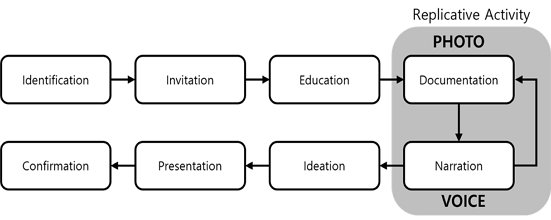
General process of photovoice research
Research participants express their perspectives and thoughts through self-taken photographs and focus group interviews. Photography allows participants to convey through images what language alone cannot capture. Particularly given the nature of this study, the photographs also carry meaning in that they can surface the voices not only of the participating people but also of the dogs themselves, non-human beings who cannot communicate in human language, through information embedded in the documented behaviours, experiences, and situations. Participants actively intervene in and drive the research process, thereby constructing one’s own domain of tangible practice. The photographs (visual data) submitted by participants and the transcribed records of the focus group interviews (oral data) are treated as qualitative data, and after going through a process of codification, are analysed and compiled into findings.
3.2. Data Collection
The study targeted a total of 10 adults aged 20 or over who lived in Seoul, kept at least one companion dog, and engaged in walks with their dog at least three times per week. The target sample size was derived by cross-referencing Wang’s theoretically ideal group size of 7~10 with studies that most closely resembled this study’s theme among prior research [13~15]. A recruitment notice was posted for a month on online community boards and the researcher’s personal social media account, and a final total of seven participants was recruited.
Prior to the orientation, the researcher briefed participants on the study’s objectives and methods, privacy protection, secure storage and disposal of data, participant benefits, anticipated side effects and precautions, and the freedom to withdraw at any time, and provided each participant with a copy of the written explanatory document covering these points. After obtaining written consent form from participants, the researcher conducted an orientation to educate participants on the specific procedures of the photovoice study and on photography guidelines including issues of portraiture rights. Through a self introduction activity entitled “Introducing Ourselves (participant and companion dog),” participants were also encouraged to form a sense of solidarity and to recognise the companion dog as an equal research participant. Given that photography would take place in everyday life, it was agreed by consensus to use mobile phone cameras for participants’ convenience. To encourage active engagement, a small booklet of activity sheets prepared by the researcher was distributed so that participants could carry it with them and note their thoughts immediately.

Implication of photovoice method for research
Participants returned to their everyday lives and began taking photographs according to specific sub-themes. The photography themes given to all participants were: “A place we love / hate, or our secret place”; “What does walking mean to us?”; and “Our promises or agreements for walking.” While themes can be decided collaboratively through dialogue with participants, in this study the researcher selected and proposed items in advance in accordance with the study’s theme and purpose, and these were confirmed with participants’ agreement. After a photography period of 2~3 weeks, participants selected the single photograph that best corresponded to the assigned theme and submitted it to the researcher; additional voluntary submissions were not restricted, though in cases of multiple submissions, participants were required to designate one photograph specifically for use in the group interview. A total of 34 photographs were collected-18 in the first photography session and 16 in the second. The submitted photographs were used in the focus group interviews.
Based on the photographs submitted by participants, the researcher conducted two focus group interviews of approximately 3 hours each, as illustrated in Fig. 2. These took the form of semi-structured interviews organised around the questions in Table 2., which were based on the PHOTO framework [12]-one of the representative questioning techniques used in group interviews. Before the group interviews began, participants spent 10 minutes individually completing a written personal questionnaire aligned with the PHOTO framework, recalling their experiences at the time of taking their submitted photographs and reflecting on their significance. During the focus group interviews, each participant presented their photograph based on written responses, with the researcher encouraging other participants to freely share opinions and engage in open discussion. For additional photographs submitted beyond the required one, the researcher conducted unstructured interviews without a formalised questioning method.
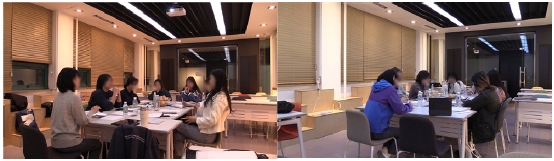
Focus group interview sessions
Framework of PHOTO for focus group discussion
3.3. Data Analysis
Focus group interviews were video-recorded and transcribed, and used alongside submitted photographs as qualitative data. The collected data were analysed through a coding process using the qualitative research software ATLAS.ti. Following open coding, axial coding was conducted using the categories of spatial (physical elements, place), social (solidarity, conflict), sensory (visual, tactile, olfactory), and affective (positive, negative), then selective coding was applied to derive findings in relation to the overarching theme of spatial perception.
4. Findings
Analysis of the data revealed that the factors influencing spatial perception during walks with companion dogs fell into three categories: spatial, social, and psychological. Positive elements (attraction factors) and negative elements (repulsion factors) were found to have a direct influence on walking activity within each category. In evaluating individual elements, the three types of perceiving subjects(participants alone, dogs alone, and participants and dogs together) were treated in an integrated manner, reflecting the fact that they are not fully independent entities but exist in a mutually constitutive relationship. Representative elements by category, as identifiable through the data collected in this study, are summarised in Table 3.
Influencing factors and example attributes
4.1. Spatial Factors
Research participants identified nearby parks as their most common everyday walking destination, attributing this to the positive influence of natural elements such as grass, soil, and waterways on both themselves and their dogs. Contact points with nature function as a kind of stepping stone usually in public green spaces like parks and especially within ordinary street environments along walking routes. One participant observed that legally mandated public open spaces (Gonggaegongji in Korean) played an important role not only in improving the urban landscape but also in enhancing the quality of dog-accompanied walks.
“Before living with a dog, those public open spaces never felt particularly valuable. But walking with a dog has made me realise how precious those small pockets of greenery in the middle of the city really are” (Fig. 3.).
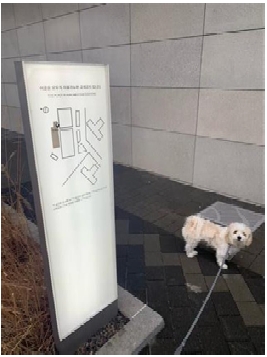
Interview material (photo taken by participant)
However, another participant, while agreeing on the positive influence of natural elements, also spoke about the ambivalence they felt toward meticulously designed landscapes and maintained gardens. Through discussion, participants arrived at the conclusion that while they discourage their dogs from entering such spaces out of concern that walking activity damages them, there is a need for spatial solutions or alternative design approaches that allow sophisticated landscaping and dog-walking to coexist.
It was also noted that individual preferences exist for specific spatial elements depending on the dog’s history and disposition, just as they do for humans. One dog, having been found and rescued by the participant in a rural field as a puppy, spent their first week as family in a rural house with abundant natural elements, where the only artificial feature was a wooden deck. Now living in the city with its owner, this dog reportedly insists on climbing every wooden deck it encounters on walks. The participant speculated that this was the influence of a positive early memory associated with that specific physical element.
On the other hand, participants cited floor surface materials and the width of streets and roads as spatial factors that negatively affected their walks. First, asphalt, the most ubiquitous road surface material, was widely regarded as something to be avoided, as it poses a risk of burns to dogs’ paws from overheating in summer and from road salt (calcium chloride) used for de-icing in winter. In the case of woven coir matting, commonly used in parks and dog parks, one participant shared an experience in which their dog’s claw caught on the material and caused injury.
Participants also collectively agreed that narrow roads or streets constituted a negative urban environment. In particular, narrow alleyways without separate pedestrian roads were predominantly perceived as dangerous, as they create intimidating encounters with people, cars, and motorcycles.
“In the city, even a 2-metre leash feels too long. When people are walking by and motorcycles approach, I often keep holding it at under 1 metre. I’m always thinking about how to get through safely. On really narrow paths where only one or two people can pass, I end up right alongside the dog, gripping the leash as short as possible” (Fig. 4.).
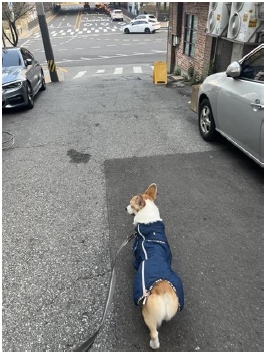
Interview material (photo taken by participant)
4.2. Social Factors
Walking with a companion dog carries social significance for both the human and the dog. This significance is amplified when casual encounters among neighbours naturally give rise to informal gatherings. This can be understood as the way in which walking activity generates spontaneous social exchanges in everyday experience that are distinct from those arising in purposefully planned spaces such as off-leash dog parks.
“There’s a void corner of the local public sports ground where we meet about 10 people every weekday at 7pm. We gather there, take off the harnesses, and have a daily evening meeting. It's their own arrangement. I originally met a neighbour from the same apartment complex by chance, and they told me they always met there at 7pm on weekdays and invited me to come along with my dog. That’s how I found out about it” (Fig. 5.).
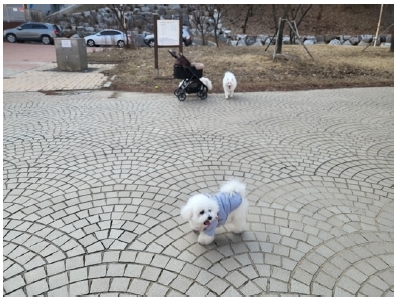
Interview material (photo taken by participant)
On the other hand, social conflict with non-dog people, through formal complaints or expressions of hostility, was a factor that generated negative perceptions of specific places or groups, caused avoidance, and had a detrimental impact on walking activity overall. Following experiences of unprovoked hostility from neighbours or passers-by, observable changes were found in the attitudes and behaviour of both participants and dogs. There was a tendency to become averse to encounters with strangers as such, or to internalise a kind of social stigma around going outside with a dog. Negative social experiences either rendered walking an uncomfortable act or resulted in the withering of engagement.
“One neighbour in Seochon apparently takes out a 1.5-litre plastic bottle filled with clear water when they go out with their dog for cleaning up after. There are apparently quite a few people who really dislike dog marking, and given that the streets are narrow and there are hanok buildings that need to be preserved in the area, having a large dog can be challenging. I myself always make sure my dog absolutely does not mark on cultural heritage sites when we pass through Changuimun, and my dog now seems to understand that it's not allowed” (Fig. 6.).
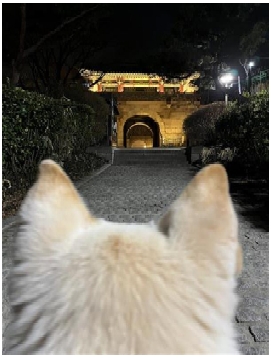
Interview material (photo taken by participant)
“I found out when I went on a summer trip with my dog that dogs aren’t allowed into national parks. I remember being caught completely off guard, assuming that because it was nature, of course we’d be able to go in together.”
4.3. Psychological Factors
Participants also shared experiences of the varying psychological states they felt across different times of day and places during their walks. In the course of the group discussions, the feeling of safety emerged repeatedly as the element that most positively shaped participants’ perception of the urban environment while walking. Coding results identified the conditions that constitute a safe and stable environment as: low noise, non-congested settings, and the absence of other people. These corresponded directly to the negative elements identified in the spatial and social factors discussed above, suggesting that a comfortable environment is essentially one defined by the absence of those negatives which equals to the complement set of negative conditions.
“I go out at night around 1am as if sneaking around. Because other dogs, drunk people, bicycles. All of these are stress-inducing things for my dog, and a good park just has to have a lot of this stuff. I have no other choice but to go late at night when they’re gone. It’s scary, but we still have to go out” (Fig. 7.).
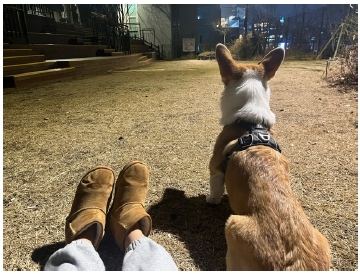
Interview material (photo taken by participant)
Factors that generated negative psychological states, such as tension accompanied by anxiety or fatigue, thus also emerged naturally through the discussions. Some participants identified noise and fast-moving people or objects (motorcycles, electric scooters, bicycles) as negatives, even the mere presence of other people. One participant, who had habitually pre-empted or blocked their dog’s exposure to negative psychological stimuli by pulling on the leash or holding the dog up in arms, shared a realisation that came through participating in this research.
“When I stopped pulling the leash and just let him navigate as he wanted, I found that instead of the wider path right there, he chose this narrow inner path as if he finds it more comfortable or safer. And I realised: I had always been stopping him whenever he wanted to go somewhere I didn't want him to go. The city my dog experiences has actually been a city under my control” (Fig. 8.).
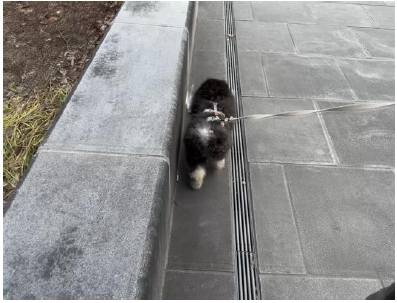
Interview material (photo taken by participant)
5. Discussion
The findings indicate that spatial, social, and psychological factors all influence urban spatial perception through walking activity. Individual elements within each category interact in complex ways, and the same element can be rendered as positive or negative depending on the context in which it is combined with other elements. These factors were also confirmed to influence route selection during walks. Decision-making around route choice was found to give priority to the human in situations of danger or conflict, while in ordinary circumstances the dog’s own preferences and desires were more strongly reflected.
Analysis of spatial factors revealed that participants’ walking activity carries the character of an ongoing negotiation between natural elements and urban infrastructure, and constitutes a form of spatial practice in its own right. The re-discovery of small-scale green spaces such as public open spaces and landscaped areas within apartment complexes offers a critical provocation to existing policy directions that have focused exclusively on expanding dedicated dog facilities. The confirmation that micro-scale design elements, such as floor surface materials and footpath widths, affect companion-dog activities implies that the qualitative improvement of everyday neighbourhood environments may in fact represent a more substantive approach.
The ambivalence observed in the social factors demonstrates that urban space extends beyond a physical environment, serving as a field in which social relationships intersect. Informal groups that form spontaneously in public spaces speak to the emergence of new forms of urban community culture originating in dog-walking, and indicate that walking activity functions as a mediating force that facilitates interaction among human-dog agent assemblages. Yet the experience of conflict with non-dog people proved to be a factor that produced immediate, tangible changes in the spatial behaviour of both participants and their dogs. Particularly in situations such as restrictions near cultural heritage sites or bans on entry into national parks, the collision between dog-walking activity and urban space reveals the challenges faced by multispecies coexistence in cities that hold historical and natural heritage.
The psychological analysis identified safety as the central finding. Notably, what participants described as safe did not align with conventional understandings of the term. Rather, they felt safest in the late hours of the night or in sparsely populated spaces. This phenomenon can be interpreted not merely as a desire to avoid people, but as a form of conflict-avoidance and risk-management strategy aimed at minimising unpredictable situations. It can also be read as evidence that being with a companion dog in the complex city creates a new form of vulnerability.
Alongside the urban spatial perception, social rules and behavioural norms, what may be referred to as a social protocol, were also identified. These manifest as tacit rules of practice, applied differently depending on space, time, and situation. Where two or more parallel walking paths exist in a park or apartment complex, for example, a spontaneous spatial separation between dog-accompanied and non-dog groups often occurs. Dog owners also exercise a kind of social flexibility by adjusting the length of the leash or picking up their dog when passing others. These behaviours can be understood as the means by which human-dog assemblages express their identity as urban citizens and negotiate their urban citizenship.
6. Conclusion
This study applied the photovoice method to explore urban spatial perception through the walking activities of humans and companion dogs. In terms of the photovoice methodology, the study demonstrated a new possibility for capturing the voices of non-human actors and fostering a sense of solidarity among members of a human-dog community. During the group interviews, participants frequently posed spontaneous questions to one another and organically led the discussion in a new direction and they also shared experiences of perceptual transformation that had arisen through their participation in the research. This affirms photovoice as a participatory action research methodology that not only serves as a data-collection tool but actively promotes critical reflection and recognition.
The findings indicate that route selection in walking is shaped by a complex intervention of spatial, social, and psychological factors, each of which carries a dual valence of attraction and repulsion. Unlike prior research on dogs in cities, which has concentrated on dedicated facilities and addressed only the health and satisfaction of humans, this study illuminates multispecies relations in everyday urban space. Photovoice was employed as a method capable of indirectly capturing the experiences of non-human actors, and its potential as a participatory and practice-oriented research method for a “more-than-human urban geography” was verified.
The limitations of this study lie in its restriction to the city of Seoul and the relatively short timeframe of the research, which made it difficult to fully capture and account for seasonal variation or the individual characteristics of participants (including the participating dogs). Future research will need to attend more carefully to the individual tendencies and habitual differences of participants (including companion dogs), as well as to diverse urban contexts. Furthermore, while this study captured the voices only from within the human-dog community, future research that incorporates people without dogs as research participants would add the dimension of contributing to social consensus-building through the research process itself. And in terms of the scope of “multispecies”, the long-term agenda for follow-up research will require expanding beyond companion dogs to include other non-human beings who share the city with humans.
In conclusion, walking with a companion dog is an ordinary everyday activity on one level, yet it is simultaneously an urban practice through which citizens continuously reinterpret and reconstitute urban space. In a context where companion-animal households are rapidly increasing and family sizes are shrinking, the city finds itself at a moment when it is required to move beyond a human-centred planning paradigm and actively seek a new urban vision for multispecies coexistence. It is expected that the micro-scale analysis of spatial perception offered by this study will provide an empirical foundation for that transition, and serve as a reference point for shaping inclusive and sustainable urban environments.
Acknowledgments
This study was approved by the Institutional Review Board(IRB) of Yonsei University(Approval Number: 7001988-202312-HR-2138-01).
References
- W.K. Hwang, N.K. Kim, Y.J. Kang, 2025 Korea companion animal report, KB Finance Group Research Institute, 2025.
-
Y.S. Yoo, Y.H. Son, K.J. Zoh, Analysis of dog-related outdoor public space conflicts using complaintt data, Journal of Korean Institute of Landscape Architecture, 52(1), 2024.02, pp.34-45.
[https://doi.org/10.9715/KILA.2024.52.1.034]

- Y.S. Yoo, E.S. Son, Current status and issues of creating public spaces for the growing companion animal ownership population, Architecture and Urban Research Institute, 2023.
- H.S. Lee, A study on perception and needs of urban park users on off-leash recreation area, KIEAE Journal, 10(2), 2010.04, pp.49-55.
-
J.G. Song, J.Y. Lee, H.S. Lee, Satisfaction with neighborhood environments for dog walking and exercise, Journal of Korean Institute of Landscape Architecture, 50(4), 2022.08, pp.34-45.
[https://doi.org/10.9715/KILA.2022.50.4.053]
- D. Haraway, The companion species manifesto: Dogs, people. and significant otherness, Prickly Paradigm Press, 2003.
- D. Haraway, When species meet, University of Minnesota Press, 2007.
-
B. Braun, Environmental issues: Writing a more-than-human urban geography, Progress in Human Geography, 29(5), 2005, pp.635-650.
[https://doi.org/10.1191/0309132505ph574pr]
- C.K. Cho, W.S. Song, Reconceptualizing photovoice as a methodology for more-than-human geographical research and pedagogy, Landscape and Geography, 35(1), 2025, pp.60-74.
- S.H. Kwon, Analysing human-dog walks to explore the possibilities of the more-than-human city (Master’s thesis), Korea: Seoul National University, 2024.
-
A.O. Latz, Photovoice research in education and beyond: A practical guide from theory to exhibition, Routledge, 2017.
[https://doi.org/10.4324/9781315724089]
- Y.B. Oh, Photovoice: Voice for social change, Korea: Kyoyookbook, 2023.07.
-
C. Wang, Photovoice: A participatory action research strategy applied to women’s health, Journal of Women’s Health, 8(2), 1999, pp.185-192.
[https://doi.org/10.1089/jwh.1999.8.185]
-
O.J. Kwon, Meaning of participation in exercise with companion dog through photovoice, The Korean Journal of Physical Education, 59(1), 2020, pp.223-240.
[https://doi.org/10.23949/kjpe.2020.1.59.1.17]
-
C.H. Lee, J.Y. Park, Exploring place identity and sustainable residency of youth migrating to local areas, Journal of Korean Institute of Landscape Architecture, 51(3), 2023.06, pp.139-152.
[https://doi.org/10.9715/KILA.2023.51.3.139]