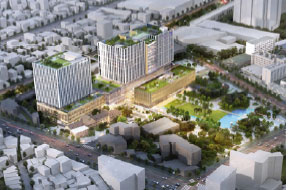
Ecological Systems of Hospital Public Spaces: An Integrated Perspective on Healing Environment Theory and Biomimicry : Focused on Proposals from the National Medical Center International Design Competition
ⓒ 2026. KIEAE all rights reserved.
Abstract
This study reinterprets hospital public spaces—specifically atria, courtyards, and roof gardens—as ecological healing systems in which human, environmental, and technological factors interact dynamically. By integrating Healing Environment Theory with Biomimicry Theory, the study investigates how spatial, environmental, and ecological parameters enhance restorative capacity in contemporary medical facilities. Five winning proposals from the 2022 National Medical Center International Design Competition were selected as empirical cases to examine how public spaces function as healing infrastructures.
A three-step mixed-methods approach was employed. First, five analytical dimensions were established to evaluate ecological and healing performance: Lighting and Openness (LEF), Ventilation and Breathability (AVR), Water–Ecology Integration (EFI), Connectivity and Circulation (CCF), and Atmosphere and Sense of Place (ATF). Second, qualitative analysis examined spatial organization and biomimetic strategies, including natural-light modulation, airflow formation, water–vegetation systems, and multi-layered spatial connectivity. Third, quantitative analysis measured 18 detailed indicators, normalized them on a five-point scale, and synthesized them into a Comprehensive Healing Index (CHI) to assess integrated environmental, spatial, and sensory performance.
The results confirm that biomimetic design principles substantially improve both ecological and psychological healing outcomes. Designs characterized by optimized daylight access, effective air circulation, integrated hydrological-ecological systems, and strong biophilic connectivity achieved higher CHI values. These findings demonstrate that the integration of natural processes into spatial and environmental systems is a decisive factor in enhancing the restorative performance of hospital public spaces.
Keywords:
Healing Environment, Biomimicry, Hospital Public Spaces1. Introduction
1.1. Background and Purpose of the Study
The contemporary healthcare environment is undergoing a paradigm shift from simple medical treatment facilities to more complex and public healing environments, thanks to advances in medical technology, rapid urbanization, and increasing societal expectations for a higher quality of life. In the wake of the COVID-19 pandemic, the public role of hospitals has been further strengthened, underscoring their function not only as sites for patients but also as public healing infrastructures that serve medical staff, caregivers, and the community. Within this framework, hospital public spaces, such as atria, courtyards, roof gardens, and integrated circulation areas, are no longer understood merely as transitional or auxiliary zones. Rather, they have been reinterpreted as essential healing environments that contribute to stress reduction, emotional stability, and social interaction among users.
Healing Environment Theory has demonstrated in various ways that physical and sensory stimuli, such as natural light, ventilation, views, water and vegetation elements, and spatial openness, reduce a patient’s stress levels and accelerate their recovery. However, in practical hospital design, public spaces are often purely functional, and natural elements are introduced on a superficial level. This results in a structural limit that hinders the healing potential inherent in public spaces. Moreover, while current Healing Environment Theory emphasizes the positive effects of natural elements on human well-being, it has not sufficiently explained how light, air, vegetation, water systems, and spatial connectivity interact dynamically to operate as an integrated ecological system. In other words, perspectives that view hospital public spaces as an ecological healing system in which natural order and human healing experience are integrated, rather than as a sum of isolated elements, remain lacking.
Accordingly, this study regards the hospital public space as an ecological healing system, one in which nature and human healing experiences are organically integrated, and aims to establish a comprehensive analytical framework capable of explaining this relationship. It is hoped that this framework will provide a basis for this study to elucidate how key factors, such as light, air, ecology, connectivity, and sense of place, interact within hospital public spaces to create a healing mechanism. Furthermore, by conducting qualitative spatial analysis and quantitative indicator evaluations of award-winning design proposals, this study aims to empirically reveal the healing performance of public spaces and propose an ecological and spatial healing strategy that future hospital designs should pursue.
1.2. Research Methodology and Scope
To achieve the abovementioned objectives, this study employs the following methodology and procedures.
First, a comprehensive review of prior studies is conducted to examine key concepts associated with Healing Environment Theory and nature-based design principles. On this basis, a theoretical framework is established for analyzing hospital public spaces. In this process, key elements for interpreting public spaces are derived by combining the perspectives of environmental psychology, biophilic design, and ecological systems theory.
Second, five award-winning proposals (A~E) from the 2022 International Design Competition by the National Medical Center are selected for study in order to establish an empirical basis for analysis. These proposals have great research significance in that they experimentally present healing nature and ecological publicness as values for public healthcare facilities to pursue.
Third, qualitative and quantitative analyses are conducted simultaneously based on floor plan, design reports, and spatial configuration data. The qualitative analysis interprets spatial organization, skylight and ventilation strategies, arrangement of ecological elements, and user circulation routes in order to identify the characteristics of healing spaces in each proposal. The quantitative analysis establishes 18 detailed indicators consisting, inter alia, of light (LEF), air (AVR), ecology (EFI), connectivity (CCF), and proximity (ATF), and calculates a Comprehensive Healing Index (CHI) through floor plan–based ratio analysis.
Fourth, by integrating the results of the qualitative and quantitative analyses, the study identifies the defining characteristics and limitations of healing environments as realized in hospital public spaces. Based on this identification, the study presents design strategies and methods for constructing an ecological healing system that future hospital public spaces should take into consideration.
2. Concept and Theories of Healing Environment and Biomimicry
2.1. Development of Healing Environment Theory and Its Architectural Implications for Hospitals
In the context of hospital architecture, healing is no longer only about simple physiological recovery but has now become a multidimensional concept that includes psychological stability and social bonds. Ulrich empirically demonstrated that patients with views of nature from their hospital room windows experienced shorter lengths of stay and lower usage of analgesic medications [5]. From an environmental psychology perspective, this became foundational evidence for Stress Reduction Theory, which posits that natural elements alleviate physiological stress in the human body, and served as a catalyst for the widespread adoption of the “healing environment” concept in the design of healthcare facilities.
By expanding upon Wilson’s biophilia hypothesis, which posits that human health and welfare are grounded in instinctive connectivity (biophilia) with nature [8], Kellert has, since the 1990s, thoroughly demonstrated that nature’s form, materials, patterns, and processes in the architectural environment contribute to emotional stability and enhanced cognitive functioning, defining this as “biophilic design”[6]. Against this background, Healing Environment Theory is associated with three sets of design implications:
- 1) Environmental factors: Physical conditions, such as daylight, ventilation, acoustics, views, and material tactility, directly influence the stress reduction and recovery rate of patients.
- 2) Spatial factors: The openness of public spaces, visual connectivity, and the legibility of circulation paths promote psychological comfort and facilitate social interaction.
- 3) Experiential factors: Sensory stimuli, such as natural materials, water features, vegetation, and light changes, promote the emotional recovery of hospital users [4].
Therefore, Healing Environment Theory shifted the understanding of hospital public spaces from mere spaces for passage to a complex healing setting where humans, nature, and society interact [7]. This study combines this with Biomimicry Theory as a theoretical foundation for interpreting the ecological structure and healing functions of public spaces in an integrated manner.
2.2. Concept of Biomimicry Theory and Its Architectural Application
Biomimicry, a concept developed by Benyus, is defined as “the science and art of solving human problems by drawing inspiration from nature’s forms, processes, and systems.” Benyus distinguished between the organism, behavior, and ecosystem levels of biomimicry, and identified ecosystem-level mimicry as the ultimate target for the transition to a sustainable society [1]. In other words, biomimicry is not merely the simple imitation of nature’s forms, but rather a methodology for learning nature’s innate self-organization, circularity, adaptability, and resilience, and applying these to design.
Three tiers of biomimicry can be distinguished in the architectural field: form-level mimicry, in which biological morphologies are directly adapted to structures and facades; process-level mimicry, in which ecological mechanisms, including energy exchange, thermal moderation, and water flow, are reflected within architectural design processes; and system-level mimicry, in which the ecosystem network structure is applied to social and spatial systems; thus, cities are regarded as living organisms that are organized through network-based structures [4].
In the context of hospital architecture, this approach has the following spatial implications.
- 1) Courtyard: Mimicry of the ventilation tunnel systems of ant nests leads to natural convection, thereby enhancing airflow performance and infection control.
- 2) Atrium: Through the light-diffusion system that mimics forest canopy structures, natural daylight is uniformly distributed, thereby promoting emotional stability.
- 3) Roof garden: Through application of the cyclical principles of wetland ecosystems, rainwater is reused, and microclimate is regulated.
Therefore, biomimicry can be understood as a conceptual mechanism that redefines hospital architecture from a simple eco-friendly design to a healing life system that internalizes nature’s self-regulating capacities. This study integrates biomimicry principles with Healing Environment Theory and utilizes them as an analytical framework to interpret the ecological structure of hospital public spaces through both qualitative and quantitative approaches.
2.3. Integrated Analytical Framework for Healing Environment Theory and Biomimicry
Hospital public spaces operate as complex healing interfaces in which patients, healthcare professionals, caregivers, and the surrounding community mingle. They constitute multilayered systems in which processes of physical, psychological, and social recovery operate simultaneously. This study integrates the human-centered restorative logic provided by Healing Environment Theory with the nature-centered systemic logic proposed by biomimicry to define hospital public spaces as ecological healing infrastructures in which “nature, humans, and society” interact through mutually reinforcing cycles. To this end, Healing Environment Theory and Biomimicry Theory have been aligned as shown below to construct a theoretical framework (Table 1.).

Theoretical integrated framework for analysis of hospital public space
The integrated theoretical frame shown in Table 1. presents the interactions among the four elements of hospital public spaces across different theoretical paradigms. However, the empirical assessment of these elements requires an analytical perspective that corresponds to the operational mechanisms of nature. Accordingly, this study derives the five natural functional principles and presents their spatial application alongside their healing mechanisms. The resulting matrix clarifies how the four elements of Healing Environment Theory presented in Table 1. are translated into concrete spatial interpretations through five spatial principles. In other words, the psychological stabilization and social interaction logic embedded in Healing Environment Theory combines with the circulation and adaptability principles of biomimicry to define hospital public spaces as complex healing systems that integrate natural order and human experience.
The hospital public space analysis matrix presented in Table 2. establishes the theoretical basis for the comparison and analysis of the design proposals (LEF, AVR, EFI, CCF, ATF) that will be discussed in Section 3, and it functions as a method to verify the spatial resilience and healing publicness of hospital public spaces.
Theoretical integrated framework for analyzing the healing performance of hospital public spaces
3. Case Analysis
This study’s analytical subjects are the five award-winning proposals (A~E) submitted to the 2022 International Design Competition by the National Medical Center and Infectious Diseases Specialty Hospital (Table 3.). These five proposals are experimental design cases that embody a new direction (healing, recovery, and community connection) for Korea’s public healthcare facilities, demonstrating the potential for hospital public spaces to develop beyond being auxiliary facilities into healing meta-infrastructure. In this section, the analysis framework presented in Section 2 will be used to conduct a qualitative analysis of how each proposal (A~E) interprets and implements principles derived from nature in architectural terms. Additionally, based on architectural drawings and design reports, the study examines, with measurable indicators, the extent to which each proposal effectively translates natural operational principles into spatial structures.
Case studies
3.1. Qualitative Analysis
The five proposals (A~E) submitted to the International Design Competition by the National Medical Center share a common direction: “public healing hospital.” However, they differ in their methods of incorporating the natural environment and organizing the hierarchy of public spaces. Each proposal has the following characteristics.
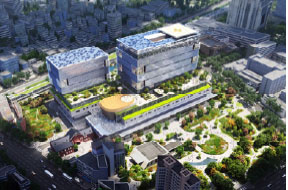
Proposal A secures both natural lighting and ventilation through a vertically open structure around a central courtyard. The transparent void structure that draws light into the center of the wards creates a visual expansion, but the limited integration of water features and vegetation results in relatively weak ecological resonance. In terms of network, the proposal mediates between medical and clinical blocs, but it lacks urban connectivity with the external environment.
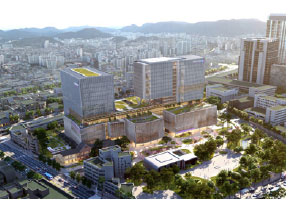
Proposal B maximizes lighting and openness through a large central atrium and creates a vertical echo-axis that connects multilayered voids to roof gardens. The integrated use of vegetation and water features at the rooftop level strengthens both ecological performance and place identity, but the ventilation strategy remains partly dependent on mechanical systems, thereby limiting natural air circulation.
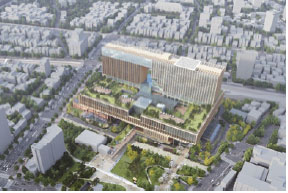
Proposal C maximizes the area and planting density in roof gardens to regulate the microclimate and enhance ecological diversity. The court and atrium are relatively small, but the design vertically integrates the spatial network, organically connecting the rooftop with interior public spaces. With community Dash participatory roof garden programs, place identity has been clearly reinforced.
Proposal D emphasizes visual continuity and airflow circulation through a linear atrium structure. The void and bridge systems strengthen inter-floor connectivity, and interior temperature and humidity can be regulated depending on the depth of daylight penetration. This proposal achieves the most systematic organic integration of spatial networks and healing circulation pathways.
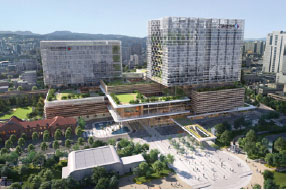
Proposal E adopts an open healing platform that connects the city plaza with the hospital interior through a transparent facade. The roof garden has a high proportion of vegetation and high ecological density, and the public spaces are extended to the upper levels of the hospital, naturally dissolving the boundary between the interior and exterior. In particular, the concept of “a breathing hospital” was achieved by combining the horizontal and vertical ventilation roots and the transparent facade.
The comparative characteristics of each proposal can be summarized using the following five analytical dimensions.
First, in terms of daylight and spatial openness, Proposals A and E adopt an open daylight strategy structured around vertical voids, while Proposals B and D focus on securing uniform interior illumination through horizontally diffused light. The atrium in Proposal A draws daylight deep into the interior by using the north-south oriented skylights and vertical openings, while Proposal E enhances publicness and visual openness through a transparent facade that continuously connects the city plaza to the hospital interior. Proposal D notably uses a concentrated natural daylight strategy to bring natural light into the center of the wards. However, several proposals require further technical revisions to address issues such as uneven illumination in deep ward zones and the blockage of direct sunlight.
Second, in terms of ventilation and breathability, Proposal B demonstrates the most proactive use of natural ventilation through a fully operable facade system, while Proposals D and E use hybrid ventilation approaches. Notably, Proposal D presents stack ventilation using exhaust louvers at the top of the courtyard and atrium, thereby achieving hygienic separation of airflow within the hospital. Meanwhile, Proposal C has relatively weak natural breathability because of its higher dependence on mechanical ventilation. Proposal A achieves efficient ventilation by configuring building sections according to prevailing wind directions but lacks precision in controlling interior micro-airflow.
Third, in terms of ecology and resonance, Proposals E and D were the strongest. Both proposals integrated systems that continuously link external park green spaces with internal roof gardens, courtyards, and sunken areas, thereby connecting the surrounding urban ecosystem with the hospital’s internal ecological structure. Proposal D designed a multilayered greening system that connects from the underground levels to the ground level and upper levels. Proposal E connects the city plaza to the roof garden, making the entire hospital a single, cyclical, and ecological system. In contrast, Proposals B and C have smaller areas and shallow planting depth for the roof garden, limiting ecological resilience. Proposal A has outstanding microclimate regulation through water-centered designs, but its overall ecological continuity is somewhat fragmented.
Fourth, network connectivity assesses spatial and functional continuity. Proposals D and E achieve the most organic system. Proposal D connects medical, public, and research facilities along a single axis, thereby securing a strong internal network cohesion. Proposal E presents a design that allows the city and hospital to interpenetrate by directly connecting the city plaza to the hospital lobby and outpatient building. Meanwhile, Proposals A and C clearly separate the medical circulation route from the public route but lack mutual visual interaction, while Proposal B demonstrates relatively weak spatial continuity, as it provides insufficient points of intersection between ward areas and public spaces.
Lastly, adjacency assesses the psychological proximity between acts of healing, for which Proposal E demonstrates the highest level of completeness. Patient rooms, lounges, and caregiver spaces are directly adjacent to courtyards and roof gardens, while staff lounges are closely connected to landscaped outdoor areas. Proposal D reflects careful design in which wards and shared spaces have different heights to enable patients to see both the sky and planted surfaces even while seated. Meanwhile, Proposals B and C have clear functional zoning, offering indirect engagement with nature. Proposal A offers limited experience for caregivers and community users despite securing visual continuity between the courtyard and exterior spaces.
In summary, Proposals D and E deliver the most balanced healing environment across all five dimensions. These two proposals are noteworthy in that they transform natural elements from formal or decorative elements to functional infrastructures. Meanwhile, Proposals A, B, and C show strengths in specific dimensions but lack the systemic completeness required for an integrated healing platform.
Summary of qualitative comparative analysis
3.2. Qualitative Analysis
This section conducts a quantitative assessment of the healing environment performance of hospital public spaces across the five design proposals (A~E). Analyses aim to verify the correlations between spatial healing performance and the physical attributes of light, air, ecology, and connectivity, by focusing on courtyards, atria, and roof gardens. The analytical framework developed in Section 2 is employed for analysis, with 18 sub-indicators selected to quantify healing performance of hospital public spaces across five dimensions (light, air, ecology, connectivity, and sense of place) (Table 5.). The sub-indicators include lighting efficiency factor (LEF), daylight uniformity factor (DUF), air ventilation route index (AVR), ecological function index (EFI), connectivity coefficient factor (CCF), and adjacency transmission factor (ATF). The study quantifies each indicator by translating architectural drawings into actual floor-area measurements, and applies a pixel-based area correction coefficient to reduce inaccuracies associated with drawing scale and image resolution.
18 Detailed indicators for evaluating healing performance in hospital public spaces
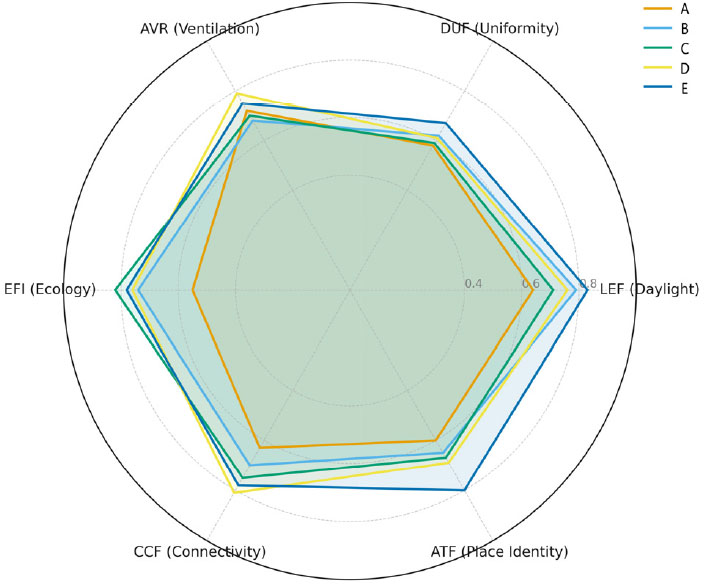
The daylighting-related indicators were derived by integrating the daylight penetration ratio and effective illuminance area ratio calculated from a section drawing and floor plan. For example, the courtyard in Proposal A recorded a daylight penetration ratio of 0.46 and an effective illuminance area ratio of 0.58, yielding an average LEF value of 0.52, which is lower than other proposals. Meanwhile, Proposal E recorded the highest LEF at 0.83 because of its glass curtain walls and skylights. AVR, the air-related indicator, is an indicator that combines the number of operable windows, number of ventilation paths, and vertical ventilation connectivity ratio. Proposal D demonstrated the most efficient ventilation network, recording an AVR value of 0.79. Proposal B exhibited a moderate performance at 0.68, while Proposal A showed partially effective ventilation patterns with a value of 0.72. These numbers reflect not a simple count of openings, but a comprehensive evaluation that considers airflow directionality and network continuity.
EFI, the ecology-related indicator, calculates the roof garden and courtyard planting-area ratios, the ratio of water features, vegetation density, and soil-depth application range. Proposal C had the highest EFI value at 0.82, with the largest roof garden planting-area ratio at 42%, and incorporated water features in the courtyard. Meanwhile, Proposal A had the lowest EFI value at 0.55 because of its limited landscaping ratio of 18%. These findings suggest that securing “ecological functionality” is more important than the mere size of the area.
CCF, the connectivity-related indicator, considers the horizontal and vertical circulation routes; external pedestrian networks; and the intersectionality of the circulation routes of patients, medical staff, and caregivers. Proposal D demonstrated the highest CCF value at 0.81 because of its effective separation of medical staff and patient circulation paths and high visual continuity to public spaces. ATF is an indicator that considers the physical proximity and visual accessibility among patient rooms, clinical zone, and public resting space.
The average Comprehensive Healing Index (CHI) for each proposal was calculated based on the above results. The CHI for Proposal A was 0.62; Proposal B was 0.69; Proposal C was 0.72; Proposal D was 0.74; and Proposal E was 0.77. The CHI is an index that quantitatively represents how well the physical environment (light, air, ecology) and the social and psychological environments (connectivity, sense of place) are harmoniously configured within hospital public spaces according to the principle of biomimetic integration. It translates Kellert’s “Biophilic Design Framework”[3] and Browning’s “14 Patterns of Biophilic Design”[2] into quantifiable components. It is grounded in the concept of nature interaction per space unit, the basic formula for which is shown below:
| (1) |
∙CHIi : CHI of the i-th design proposal
∙Wk: The weighting of each dimension (default value 0.20, expert adjustment applied when necessary)
∙Dik: Score of the k-th dimension of i-th design proposal
Proposal A has clear functional zones, leading to low integration. Additionally, proposals B to E have progressively increased spatial continuity and ecological complexity. In particular, Proposal E shows a high level of balance in all aspects of daylighting, ventilation, and connectivity, and was assessed as being the proposal with the greatest potential as a “spatial healing platform.” This also indicates that the performance of healing environments is determined less by maximizing individual elements than by achieving multidimensional balance. Notably, Proposals C, D, and E share a commonality: light and air are integratively arranged in ecological and connectivity structures. This approach corresponds closely with the biomimetic principle of “circular integration of natural systems.” Ultimately, the results empirically confirm that a higher degree of organizational organic coherence modeled on natural principles plays a greater role in enhancing the healing performance of hospital public spaces than does functional efficiency.
4. Results and Discussions
This section combines the results of quantitative and qualitative analyses conducted in Section 3 and discusses how hospital public spaces implement the principles of Healing Environment Theory and biomimicry. It analyzes the spatial tendencies and theoretical correlations of each design proposal and interprets the process whereby hospital public spaces transition from simple functional installations to biomimicry healing systems.
Comparative analysis of design proposals based on 18 detailed indicators (Normalized 0–1 scale)
Comparison of average comprehensive healing index (CHI) by design proposal
4.1. Correlational Analysis between Theory and Empirical Findings
Analysis results from Section 3 show that all design proposals implemented, to a certain extent, the physical elements (light, air, water-related elements, connectivity, and sense of place) of healing environments, while the degree of integration and depth of interpretation varied considerably.
The Stress Reduction Theory presented by Ulrich primarily emphasizes “light” and “views of nature,” [5] while the Biophilic Design Theory proposed by Kellert [6] and Browning [2] highlights “experiential naturalness,” which extends to encompass human emotional and cognitive responses. Accordingly, the CHI derived in the study confirms that multidimensional balance, rather than the excellence of a single factor, is key.
Quantitative analysis results show that Proposals E (0.77) and D (0.74) had the highest CHI values, which is attributable to their well-balanced integration of light, air, ecology, connectivity, and sense of place. In particular, the hospital street spaces in Proposals D and E exemplify system-level biomimicry, whereby hospital spaces are organized as “circulatory ecological networks,” rather than mere formal mimicry. This is a realization of what Benyus described as “the act of translating nature’s strategies into design systems,” revealing a dual structure in which the physical performance and psychological healing attributes of space function in parallel. On the other hand, Proposals A, B, and C demonstrate strengths in certain dimensions and weaknesses in integration. Proposal A had excellent daylighting and ventilation but lacked ecological continuity. Proposal B excels in natural ventilation yet demonstrates weak social connectivity within public spaces. Proposal C had high ecological density in the roof garden but showed weak interrelation with interior spaces. These results signify that the biomimicry of Proposals A, B, and C remains at the level of form. From a theoretical standpoint, therefore, Proposals D and E can be considered to have achieved “systemic integration,” whereas Proposals A, B, and C remain in the partial experimental stage.
4.2. Spatial Resilience and Reinterpretation of Publicness
The resilience of hospital public spaces extends beyond physical resilience to include dimensions of social and psychological sustainability. The high qualitative evaluations of Proposals D and E stem not simply from the incorporation of ecological elements but also from their reconfiguration of public space hierarchies. For instance, in Proposal D, the Botanic Garden operates both as a daylighting feature and as a “respiratory organ” that facilitates air circulation between floors, while in Proposal E, the transparent facade operates as a “public skin” that mediates between the city and the hospital. By integrating Ulrich’s environmental and psychological perspectives and Benyus’s ecological system logic, this case redefines the hospital public space as “breathing infrastructure.”
Moreover, the “publicness” of space can be interpreted as a measure of social healing. Proposal E maximizes community accessibility by linking the city plaza and the hospital lobby into a continuous spatial sequence, while Proposal D integrates public, medical, and research programs within the hospital along a single vertical axis. This structure corresponds to the “Prospect and Refuge” and “Connection with Natural Systems” patterns of Browning’s 14 patterns, and it presents a new public domain in which the city and hospital interpenetrate. In other words, hospital public spaces are expanded as mediators of “social resilience.”
4.3. Multilayered Integration Structure of Healing Environment
The five domains (light, air, ecology, connectivity, and sense of place) presented in the theoretical framework of this study are not mutually independent but form an “interactive hierarchy.”
The results of the quantitative analysis indicate that, when the estimated correlations between indicators are used, the correlation between LEF and EFI is highest at 0.72, demonstrating a mutually complementary relationship between light and ecology. This is because natural light contributes to vegetation growth and microclimate formation, while simultaneously providing users with emotional stability. On the other hand, the correlation between AVR and SPF is low, indicating the need for additional design strategies to strengthen the link between physical air permeability and psychological stability. These results teach us that the design of hospital public spaces should be understood not merely as an environmental engineering challenge, but as the configuration of a complex system of intricately interwoven ecological networks and human experience.
4.4. Paradigm Shift in Healing Hospital Public Spaces
In summary, the five proposals analyzed in this study implemented the Healing Environment Theory and biomimicry principles in different ways. Depending on their level of integration, the proposals can be classified as follows, reflecting three types of tendencies:
- 1) Functional Healing Type - Proposals A, B: focuses on functional improvements centered on physical daylighting and ventilation.
- 2) Ecological Healing Type - Proposal C: emphasizes ecological restoration through roof gardens and vegetation.
- 3) Systemic Healing Type - Proposals D, E: integrated model that organizes spatial network–like ecological systems.
Among these, Proposals D and E demonstrate that hospital public spaces can move beyond decorative greenery or simple daylighting installations to become models that structurally internalize nature’s principles of self-regulation, circulation, and adaptation. This signifies that achieving a healing environment may expand to the “ethics of ecology in architecture.” Additionally, the CHI reveals that the healing capability of hospital public spaces is determined not only by physical “performance” but in equal measure by spatial “network structure” and “psychological perception.” Therefore, future hospital design should be grounded in the physical performance of light, air, and ecology, while also implementing multilayered evaluation systems that include indicators of experiential healing and social recovery.
5. Conclusion
This study aimed to redefine hospital public spaces not as mere functional spaces but as healing meta-infrastructure in which nature’s principles and human experiences converge. To this end, the study comprehensively reviewed Healing Theory and Biomimicry Theory. It sought to analyze how the physical, ecological, and psychological healing principles of these two theories are manifested in actual hospital spaces through examining five award-winning proposals (A~E) from the 2022 International Design Competition by the National Medical Center and Infectious Disease Specialty Hospital. The main findings are as follows.
First, from a theoretical perspective, this study attempts to integrate Healing Environment Theory and Biomimicry Theory into a single analytical framework. While prior studies remained largely focused on psychological and physiological healing effects, this study applied Benyus’s “functional principles of nature” within the environmental structure of hospital spaces and presented an integrated ecological design paradigm that encompasses the triadic relationship among humans, nature, and technology.
Second, the healing environment characteristics of hospital public spaces were modeled as quantitative indicators (LEF, AVR, EFI, CCF, and ATF), and spatial healing was quantified and visualized by comparing the five proposals. Quantitative analysis results show that Proposals E (0.77) and D (0.74) had the highest CHI values, which is attributable to their well-balanced integration of the five domains: light, air, ecology, connectivity, and sense of place. In contrast, Proposals A, B, and C exhibited lower integration despite their excellence in individual domains, which showed that they remained at a partial or form-level experiment phase.
Third, qualitative analysis suggests that hospital public spaces should evolve beyond simple “heating, ventilation, and air conditioning and daylight installations” into a social ecology that connects the city to the hospital. The Hospital Street spaces in Proposals D and E operate as complex networks with intersecting flows of air, light, and people. This can be considered the result of integrating the psychological stability principles of Healing Environment Theory with the self-regulating logic of biomimicry.
The CHI presented in this study is based on architectural drawings and design plans for proposals from the International Design Competition. Therefore, a certain degree of discrepancy may arise between the CHI values and conditions observed during the post-construction operational phase, including user behavior patterns, fluctuations in environmental physical variables, healthcare service processes, and psychological recovery effects. Future research should integrate post-occupancy environmental measurements and user experience (post-occupancy evaluation) with CHI-based design-stage evaluations in order to develop a multilayered evaluation system that empirically verifies the correlations between design performance and operational performance.
Acknowledgments
This study was supported by the Kwangwoon University Research Grant No. [2023-0136].
References
- J. Benyus, Biomimicry: Innovation inspired by nature, HarperCollins, 1997.
- W.D. Browning et al., 14 patterns of biophilic design, New York, NY: Terrapin Bright Green, 2014.
- S.R. Kellert et al., The practice of biophilic design, 2015, www.biophilic-design.com, , 2025.10.12.
- M. Pawlyn, Biomimicry in architecture, RIBA Publishing, 2011.
-
R. Ulrich, View through a window may influence recovery from surgery, Science, 224, 1984.
[https://doi.org/10.1126/science.6143402]

- S.R. Kellert et al., Biophilic design: The theory, science, and practice of bringing buildings to life, New York: Wiley, 2008.
- R.S. Ulrich, Biophilia, biophobia, and natural landscapes, The Biophilia Hypothesis, (Edited by Kellert & Wilson), 1993.
-
E.O. Wilson, Biophilia, Harvard University Press, 1984.
[https://doi.org/10.4159/9780674045231]