
A Network-Based Thermal Control Strategy for Improving the Operational Sustainability of School Annex Buildings
ⓒ 2025. KIEAE all rights reserved.
Abstract
This study focuses an examination of the formulation and efficiency of supply air control mechanisms, designed to concurrently improve energy efficiency and thermal comfort within a complex space in a school annex building. The major aim is to establish control strategies that systemically reconcile these dual priorities, thereby encouraging the optimal use of existing buildings.
Through the use of computational simulations spanning a one-week duration, the investigation assesses two advanced control systems using adaptive and neural network-based algorithms in comparison to a standard thermostat.
The findings reveal substantial reductions in energy use: the adaptive model provides roughly a 4.2% decline in weekly average energy use, while the network algorithm, incorporating an Artificial Neural Network, yields a more pronounced decrease of 6.9%. These efficiencies are fundamentally rooted in the algorithms’ capacity to reduce system overshoot and mitigate operational signal volatility. Additionally, both developed models exhibit markedly higher performance in maintaining thermal comfort homeostasis compared to the traditional thermostat. The ANN-driven algorithm emerges as especially beneficial, confirming its enhanced capability to curtail unnecessary energy use through flexible controls for complex spaces like school annex buildings.
Keywords:
School Annex Building, Energy Use, Thermal Comfort, Adaptive Control, Artificial Neural Network1. Introduction
1.1. Research Purpose
This study focuses on the crucial function of an optimized supply air control system in addressing the environmental demands of both existing and prospective school annex buildings. The core goal extends beyond simple energy efficiency to incorporate strategies for establishing and maintaining acceptable standards of indoor thermal comfort. The approach is methodological, concentrating on formulating control paradigms that achieve a simultaneous equilibrium between energy savings and user comfort. A central tenet of this research is maximizing the operational use of the school annex buildings, thereby lessening the requirement for constructing new facilities. Specifically, the investigation evaluates the performance of the suggested control system under shifting operational demands, assessing its effectiveness across various temporal and spatial conditions that involve fluctuating heating and cooling loads. Special emphasis is placed on situations that promote building flexibility, such as the efficient use of the service area, to improve resource administration and operational agility.
1.2. Research Objectives and Methods
The study is structured around several objectives aimed at enhancing the performance of existing school annex buildings:
- 1) To numerically determine the energy usage and evaluate the attainable indoor thermal comfort when a retail and a food service are integrated into existing structures, utilizing computational simulation models.
- 2) To employ simulation tools to analyze the correlation between energy consumption and thermal comfort across a spectrum of diverse operational parameters.
- 3) To examine and propose solutions for improving space utilization within these areas, explicitly supporting sustainable school management.
Following a detailed presentation of the methodology and the analysis of the simulation outcomes, this paper will feature a critical examination of its limitations and strengths. The concluding section will outline prospective avenues for future inquiry, highlighting the necessity of expanding the data collection to bolster the statistical reliability and overall robustness of the findings.
2. Literature Review
2.1. HVAC Control
Continuous studies have been dedicated to optimizing indoor thermal conditions to enhance user mental and physical comfort, simultaneously aiming to boost productivity and workability within building spaces. Given that the remodeling or reconstruction of spaces consumes significant time and material resources, unlike the manufacturing of smaller products, the efficient operation of indoor space is a critical factor throughout the building's lifecycle. Optimizing these thermal conditions is particularly important for increasing user work efficiency, leading to numerous studies focused on improving Heating, Ventilating, and Air Conditioning (HVAC) system performance. Various software solutions have been integrated into existing physical HVAC devices to effectively manage the dynamic indoor thermal quality, which shifts constantly based on user psychological and physical states as well as external climatic conditions [1~3]. Historically, the Proportional-Integral-Derivative (PID) technique provided control before the advent of modern computer technology. Subsequently, the Fuzzy Inference System (FIS) offered a methodology to effectively address the limitations inherent in deterministic control problems. The FIS was often preferred due to its operational clarity, implementing deterministic algorithms with an understandable engineering approach [4,5]. This clarity is vital because internal conditions may be manually adjusted by users based on psychological or emotional states, overriding mechanically calculated optimal settings. The FIS remains relevant across various fields through continuous algorithmic upgrades, performing efficiently in situations involving ambiguous interpretation at specific boundary conditions [6,7]. Specifically, simulation results indicate that FIS models, when supplemented with additional control methodologies and without replacing existing control facilities, are quite effective for indoor thermal control in small or older buildings [8~10].
Another approach for effective HVAC system control involves programming a schedule into the system based on anticipated external weather or occupant schedules. This method requires the collection of long-term data to ensure statistical validity. This programmable method has been favored, particularly in facilities like schools and business buildings, where occupant schedules can be predicted with relatively high probability [11,12]. Given the difficulty of finding valid regression models in traditional ways for such large datasets, many approaches utilize Artificial Neural Network (ANN) models in this phase. By collecting large amounts of data across diverse building types, the ANN can be employed to analyze the correlation between building size, room count, envelope type, and weather conditions, enabling the establishment of effective construction or operation plans. Furthermore, statistically improved data derived from various ANN models can facilitate the development of highly effective system control that responds adaptively to unexpected situations [13,14]. Research frequently focuses on modifying and supplementing the internal structure of the ANN model to optimize its application to specific architectural models. These structures are often refined by adjusting variables and parameters within optimization algorithms, contingent on available hardware resources such as processing speed and computational accuracy. A major challenge, however, is that large-scale data are essential for the effective control of power-generating mechanical facilities, but in many countries, such data are highly confidential or restricted for commercial use by third parties. To address this constraint, continuous development of various inner structures and parametric functions within the ANN is being pursued to increase statistical reliability even with limited datasets [15,16]. Confirming the precise control performance of both major and minor mechanical components necessitates a stringent time interval for both simulation and experimental investigations; consequently, numerous studies have achieved high precision, operating at the level of several seconds [16,17]. Control strategies designed to mitigate overshooting during system activation and deactivation cycles, triggered by the temperature set-point, have been validated as highly effective for enhancing energy performance. To bolster the statistical validity when training models on large historical datasets, commercial facilities are predominantly utilized to ensure data volume and reliability [18,19]. Despite significant research efforts concentrating on improving the operational efficiency of the mechanical and electrical components essential for precise control, it is posited that residual opportunities or inherent weaknesses for further energy conservation within the overall system operation still exist.
2.2. School Annex Buildings
The primary characteristics of main school buildings fundamentally dictate the design and operational needs of their annexes, particularly concerning energy consumption, operation, and architectural planning. Main school buildings typically exhibit a high, long-duration base load during the academic year. Energy use is characterized by substantial demand for HVAC (heating being dominant in temperate climates), driven by strict minimum fresh air ventilation standards mandated by codes per student density. Electrical load includes extensive task lighting and significant power for IT infrastructure [20]. The operational schedule is generally predictable and non-stop during school hours, leading to predictable, though high, daily energy profiles. Operational complexity is high, centered around safety, security, and predictable scheduling. Key operational tasks include managing daily high-volume student flow, maintaining strict access control, and providing high-density food service. Operations are generally centralized, often using a Building Management System (BMS) to control the entire facility from a single point, ensuring consistent temperature and air quality across diverse zones [21]. Main school buildings are characterized by a highly specialized, departmentalized floor plan. The architecture must accommodate large, fixed spaces (gymnasiums, cafeterias, auditoriums) alongside numerous small, repetitive spaces (classrooms). Circulation paths must handle peak-hour traffic efficiently and safely. Service areas, such as the main kitchen, boiler rooms, and administrative offices, are often large and centrally located to support the entire campus [22,23]. School annex buildings, whether newly constructed or repurposed, possess characteristics that are often a derivative or intensification of the main building’s needs, particularly focusing on flexibility and specialized use. School annex buildings, whether new construction or repurposed existing structures, possess distinct architectural, operational, and energy characteristics driven by their educational and often mixed-use functions [22,23]. Energy consumption is notably impacted by their highly discontinuous and specialized occupancy patterns, which often include evening or weekend programs distinct from the main school schedule, leading to significant HVAC loads, particularly for heating due to large internal volumes and mandatory fresh air ventilation requirements. Architecturally, the floor plan is typically defined by a need for adaptable, multi-functional spaces that can rapidly transition from classrooms to temporary retail, food service, or community facilities, often requiring greater structural flexibility and a robust, accessible service area to manage logistics, utilities, and high-density, peak-hour usage. Operationally, the primary challenge lies in achieving a dynamic balance between rigorous energy efficiency and consistent indoor thermal and air quality standards, necessitating advanced, localized supply air control strategies and high-performance building envelopes to manage transient internal gains and reduce overall operational complexity and cost.
3. Research Method
3.1. Building Model
The U.S. Energy Information Administration’s Commercial Building Energy Consumption Survey (CBECS) has been provided as a major source for research across several sectors by documenting the energy consumption patterns of public, commercial, and residential buildings. This comprehensive report specifically quantified the Energy Use Intensity (EUI) for fourteen primary building categories. However, while providing detailed data on these established types, the survey neglects any corresponding information regarding annex buildings in several types of large-scale schools [24,25]. Therefore, to predict the energy consumption levels of the spaces, the EUIs of similar building types are properly utilized such as Food Sales, Service, and Others [24,25].
The school annex building is typically composed of office, commercial, dining hall, and restrooms. It is common to configure, by using CBECS report, retails, food sales, and services. Based on the size of the average value of service areas in three school annex buildings in New York, USA, Fig. 1. shows a newly planned example for a school annex building that consists of office, food service, and restroom. Table 1. shows the geometry information of walls, roofs, doors, and windows constituting buildings in the service area. For a simulation input for outdoor conditions, the Central Park Area in New York from the EnrgyPlus V9.5 weather data provided by the US Department of Energy was utilized. The time period was selected from 00:00 on December 24th to 24:00 on December 30th. This period requires high heating and low cooling loads in the middle of winter.
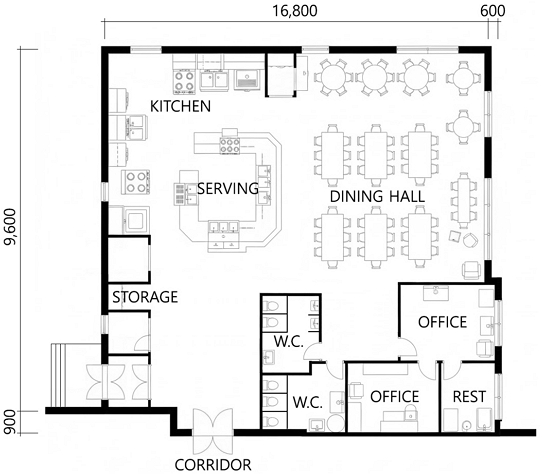
Floor plan of a school annex building

Geometry information of a designed temporary building
3.2. Thermal Control Method
The energy use of the model is calculated by formulating a straightforward energy balance based on thermal dynamics. This involves summing the heat input from the HVAC supply air system and subtracting the heat transfer across the envelopes of the school annex buildings. This energy exchange as the temporal change in the target indoor temperature can be described by an equation as follows [26].
| (Eq. 1) |
where, hout and hin are the heat transfer coefficients (W/m·K), k is the transmission coefficient (W/m·K), A is the area (m2), D is the depth of envelope (m).
The Predicted Mean Vote (PMV) index, standardized by EN ISO 7730 and introduced by Dr. P. O. Fanger, serves as the primary metric for assessing occupant thermal comfort [27]. The simulation module utilizes six distinct variables as inputs to determine the PMV level: Dry bulb temperature; Relative humidity; Indoor air speed; Mean radiant temperature; Metabolic rate; Clothing insulation. In order to time and cost effective simulation works, the followings were assumed to reduce the calculation complexity inside: The indoor air speed is fixed at 0.1 m/s. The mean radiant temperature is approximated as the dry bulb temperature, though with a one-hour time delay. The metabolic rate is held constant at 1.2 Met (normal working activity), and the clothing insulation is set to 1.2 clo (normal clothing)[27,28].
| (Eq. 2) |
| (Eq. 3) |
where, M is the metabolic rate and L is the thermal load.
By combining an adaptive algorithm with the thermostat control, the possibility of improving the thermal comfort level and reducing energy use is examined. The basic operation and flow of this adaptive algorithm are shown in Fig. 2.
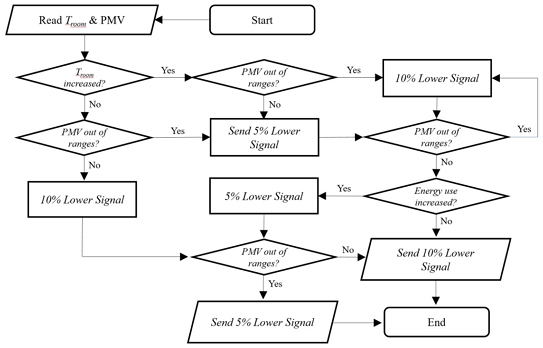
Adaptive control algorithm for heating air supply
For example, after the calculation of indoor temperature and PMV value under given simulation conditions, in the case of heating control, the change in the PMV value is confirmed when the indoor temperature is higher than the previous calculated result. If the PMV value is within the setting comfort range (-1<α<1) , the signal value in the previous simulation step is reduced by 10%. In this case, if the PMV value is still in a comfortable status within the range, the signal value is additionally reduced by 5% point and sent to the supply air system. If the PMV value is calculated over +1 in which people inside feel somewhat hot, the signal lowered by 10% is sent to the supply air system again to complete the adaptive process. This flow of signal control is composed of one module to operate independently for heating and cooling, respectively.
Then, the result of the adaptive algorithm is trained by the ANN for a network algorithm. This network is specifically structured as a multilayer perceptron (MLP), a type of fully connected network renowned to deal with complex non-linear mapping problems [29,30]. The typical MLP utilizes a three-layer design of Input, Hidden, and Output Layers for mapping the data. The fundamental operation involves each neuron calculating a crucial intermediate value, (nc), defined as the sum of its inputs (x1, ⋯, xk) multiplied by their weights (wai), plus an added bias (θb). This value is then passed through a non-linear activation function (gd) to produce the layer’s output [29,30]. The training of this network model was conducted using the scaled conjugate gradient algorithm over 1,000 iterations, with a setting of one epoch per iteration. The model’s performance was statistically significant, achieving a high R2 value for both controlled variables: 0.99532 for mass flow rate and 0.99147 for supply air temperature. The adaptive process and the ANN algorithm for an entire simulation model were combined in the Matlab and Simulink applications as described in Fig. 3.
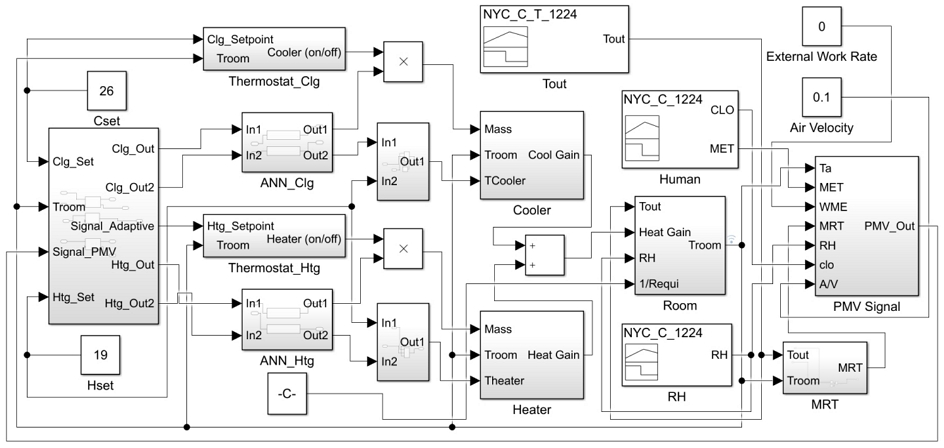
Simulation block model
4. Results and Discussion
Fig. 4. shows the outside temperature from 0:00 on December 24th to 24:00 on December 30th in the area of Central Park in New York as a simulation input. As can be seen from the outside temperature distribution graph, it can be seen that most of the cold weather continues below 0℃ except for December 24th and 25th. However, on December 31st, the outside temperature rises sharply again and reaches around 10℃. The performance of adaptation algorithms and network algorithms is evaluated by confirming the correlation between effective indoor temperature control and energy consumption according to the unpredictable outside temperature situation. A general thermostat maintains the indoor temperature effectively, but repeats on/off according to the upper and lower dead-band range based on the set temperature to regularly produce some errors. Fig. 5. accurately shows the indoor temperature control pattern using this thermostat. Based on the indoor set-point temperature of 19℃ in winter, the rise and fall are repeated between 18℃ and 20℃ according to the dead-band range ±1℃. While this operating principle has the advantage of reducing energy use, it is highly likely to be disadvantageous in maintaining the homeostasis of thermal comfort according to temperature changes. Fig. 6. is the result of indoor control combining an adaptive algorithm. As can be seen from the figure, as the goal is to efficiently control the indoor temperature within the PMV set value, it can be seen that the indoor temperature control pattern of the adaptive algorithm is effectively controlled between 19℃ and 19.5℃. Fig. 7. shows the results of learning this with an artificial neural network to create and control a more sophisticated regression model. It can be seen that the indoor temperature is controlled very effectively compared to the thermostat or adaptive control, which is expected to have a very high performance in maintaining the thermal comfort. However, in the case of a thermostat, when the indoor temperature rises to a certain level, the system is turned off to prevent additional energy use, whereas control through a network algorithm is accompanied by continuous energy use to keep the indoor temperature constant regardless of changes in the outside air. This can cause an increase in energy use. Fig. 8. and Fig. 9. show what signals are produced in the heating air supply system through an adaptation algorithm. In Fig. 8., the volume control pattern of the heating air supply can be confirmed, and in Fig. 9., the temperature control pattern of the heating air supply can be confirmed. It can be seen that a very complex control process has been performed to keep the indoor temperature within the setting value depending on the outside temperature. In particular, it can be inferred that the planned adaptive algorithm is working very precisely to reduce energy use while continuously maintaining the indoor temperature within the setting value from the 26th to the afternoon of the 30th. As can be predicted from the indoor temperature result graph, it can be easily expected that this operation may be effective in maintaining the homeostasis of thermal comfort, but it is likely to increase energy use. Fig. 10. and Fig. 11. show that the control through the artificial neural network algorithm is operating with a more complex internal structure. In the case of adaptive algorithm, a control pattern showing a correlation in which the temperature decreases as the volume increases can be seen, and in the case of network algorithm, volume and temperature controls are controlled in the form of a similar pattern. This can be interpreted as a contradictory control pattern of the adaptive algorithm that performs precise control by volume and temperature while keeping the total energy use similar, and the network algorithm that makes the change in energy use relatively large and controls the change in energy use by operating the volume and temperature in a similar pattern.
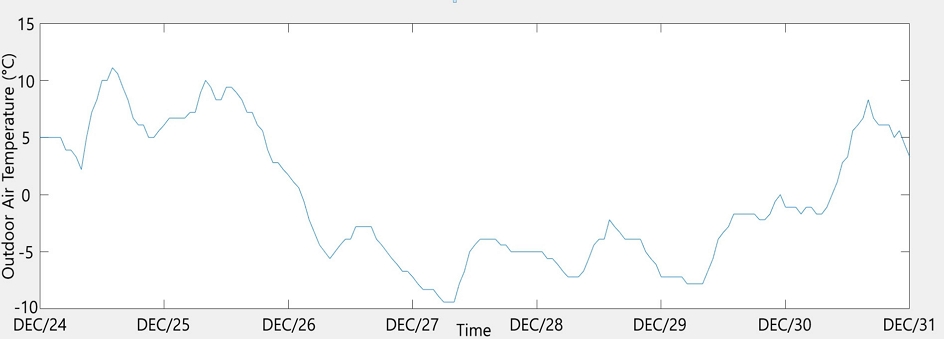
Outdoor air temperature of the Central Park area in New York City
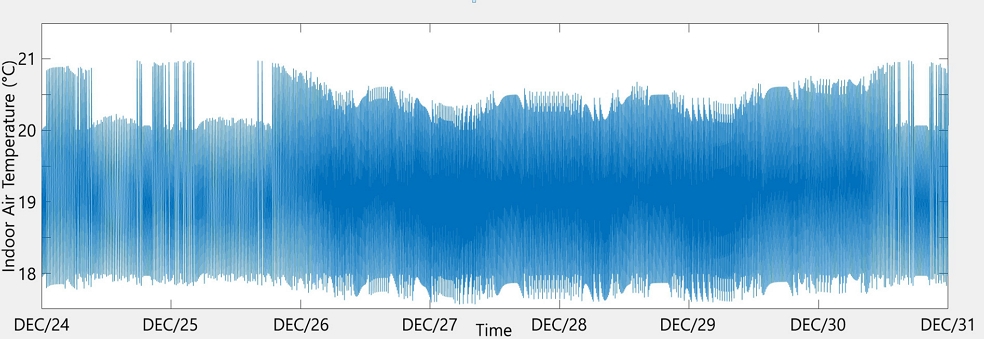
Indoor air temperature controlled by the thermostat
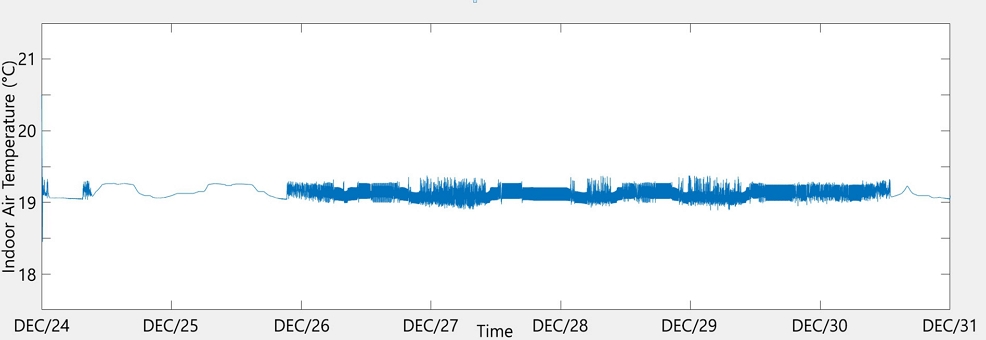
Indoor air temperature controlled by the adaptive algorithm
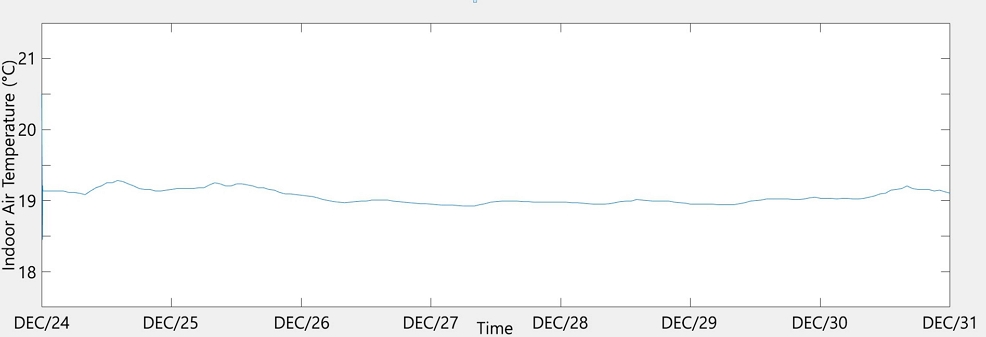
Indoor air temperature controlled by the network algorithm
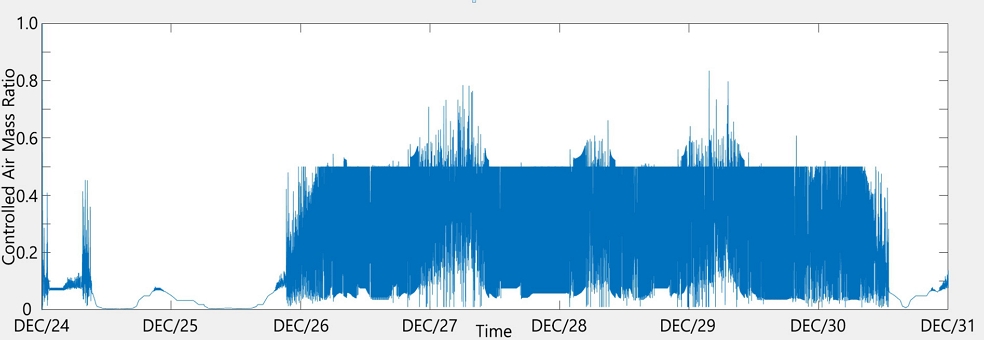
Ratio of controlled air mass for heating in the adaptive algorithm
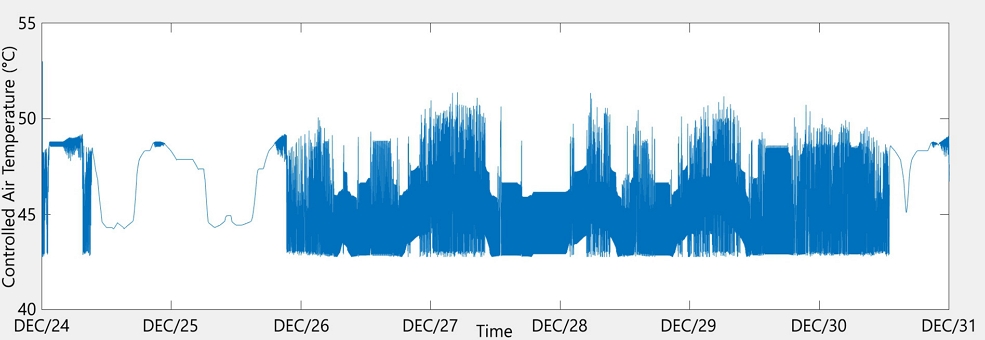
Temperature of controlled air for heating in the adaptive algorithm
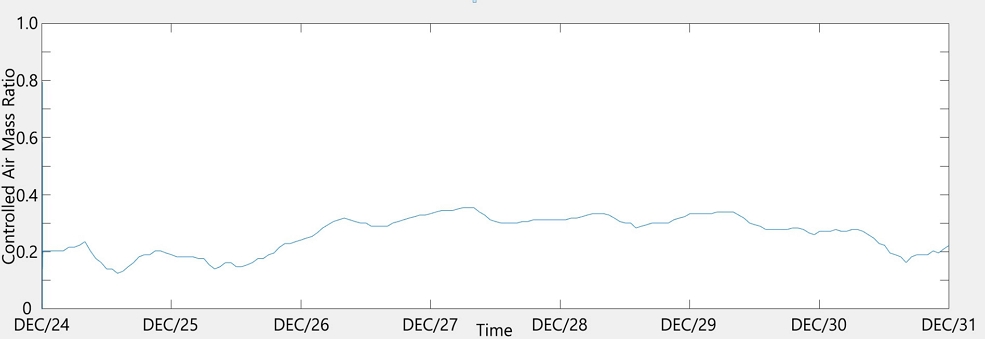
Ratio of controlled air mass for heating in the network algorithm
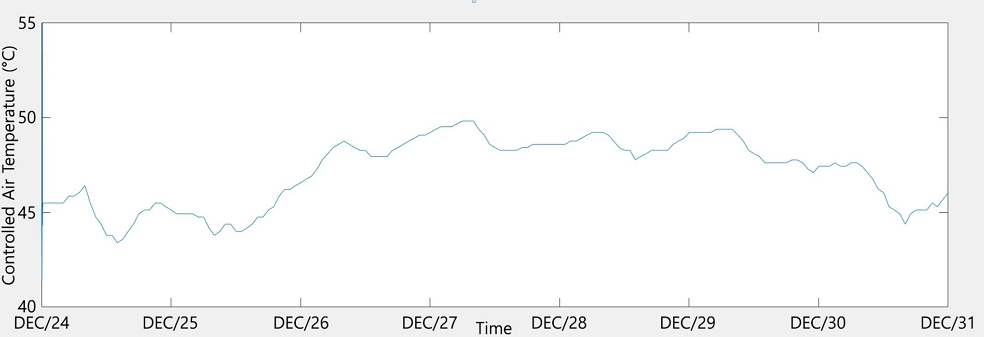
Temperature of controlled air for heating in the network algorithm
In Table 2., Table 3., Table 4., and Table 5., control results can be intuitively compared by the CvRMSE value of each control system. As can be seen from the indoor temperature control and PMV homeostasis maintenance results, the high performance of the adaptive model and the network model is confirmed. In particular, the network algorithm is confirmed to have higher efficiency in maintaining PMV homeostasis than the performance of the temperature control results. Nevertheless, when comparing the energy use in Table 5., it is possible to achieve an energy use reduction effect of about 6.9% compared to the thermostat and an energy saving effect of about 2.8% compared to the adaptive algorithm. It can be expected that the network algorithm will work effectively in complex buildings and facilities that consist of several space types of distinctly different energy use patterns such as office, food service, and restroom.
Comparison of the temperature controlled
Comparison of the PMV
Comparison of the signal controlled
Comparison of the energy use
5. Conclusion
This study investigated the efficacy of advanced supply air control strategies in simultaneously addressing the environmental demands and the imperative for sustained indoor thermal comfort within school annex buildings. The core methodological objective was achieved by developing and evaluating control paradigms that strike a critical equilibrium between energy savings and user comfort, thereby maximizing the operational utility of current structures and minimizing the need for new construction.
The investigation quantified the performance of an adaptive algorithm and an ANN learning algorithm against a conventional thermostat under fluctuating heating and cooling loads, informed by highly variable external temperature data. The adaptive algorithm demonstrated effective indoor temperature control, maintaining the temperature more tightly between 19℃ to 19.5℃ to meet the PMV set value. The complex, precise control of supply air volume and temperature indicated an effective balance between energy reduction and thermal stability. The ANN algorithm achieved the most effective and sophisticated indoor temperature control, confirming its very high performance in maintaining thermal comfort homeostasis. This higher performance is quantitatively supported by the lower CvRMSE values observed for PMV maintenance, where the network algorithm exhibited higher efficiency than the temperature control results. Despite the network algorithm’s continuous operation to maintain a constant indoor temperature, which could theoretically increase energy use compared to the thermostat, as a result, it demonstrated significant net energy savings.
A critical examination of the results suggests that while the numerical value confirms the high performance of the adaptive and network algorithms, the complexity of the control signals in the learning model warrants further investigation into its long-term stability and maintenance. Future follow-up studies should focus on expanding the data collection across various seasons and facility types, then they strengthen the statistical reliability and overall robustness of the findings. In addition, they need to explore the network algorithm’s application in real-time controls for actual school annex buildings.
References
-
G. Huang, et al., State of the art review on the HVAC occupant-centric control in different commercial buildings, Journal of Building Engineering, 96, 2024, 110445.
[https://doi.org/10.1016/j.jobe.2024.110445]

-
A. Kusiak, M. Li, F. Tang, Modeling and optimization of HVAC energy consumption, Applied Energy, 87(10), 2010, pp.3092-3102.
[https://doi.org/10.1016/j.apenergy.2010.04.008]
-
B. Paris et al. Hybrid PID-fuzzy control scheme for managing energy resources in buildings, Applied Soft Computing, 11(8), 2011, pp.315-319.
[https://doi.org/10.1016/j.asoc.2011.05.052]
-
J. Ahn, S. Cho, D. Chung, Analysis of energy and control efficiencies of fuzzy logic and artificial neural network technologies in the heating energy supply system responding to the changes of user demands, Applied Energy, 190, 2017, pp.222-231.
[https://doi.org/10.1016/j.apenergy.2016.12.155]
-
E. Barbadilla-Martun et al., Analysing the indoor temperature ranges for an efficient control of HVAC systems, Energy and Buildings, 301, 2023, 113681.
[https://doi.org/10.1016/j.enbuild.2023.113681]
-
J. Ahn, Network based control methodology for improving the indoor thermal environment of sales shops in traditional markets during the change of seasons, KIEAE Journal, 24(6), 2024, pp.61-67.
[https://doi.org/10.12813/kieae.2024.24.6.061]
-
H. Yan et al., Further development of a thermal comfort based fuzzy logic controller for a direct expansion air conditioning system, Applied Energy, 219, 2018, pp.312-324.
[https://doi.org/10.1016/j.apenergy.2018.03.045]
-
R. Qi et al., Adaptive control: A tutorial, Fuzzy System Identification and Adaptive Control, 1, 2019, pp.55-74.
[https://doi.org/10.1007/978-3-030-19882-4_3]
-
J. Moon, J. Ahn, Improving sustainability of ever-changing building spaces affected by users’ fickle taste: A focus on human comfort and energy use, Energy and Buildings, 208, 2020, 109662.
[https://doi.org/10.1016/j.enbuild.2019.109662]
-
F. Langner et al., Experimental evaluation of model predictive control and fuzzy logic control for demand response in buildings, Applied Energy, 401(A), 2025, 126666.
[https://doi.org/10.1016/j.apenergy.2025.126666]
-
B. Grillone et al., A data-driven methodology for enhanced measurement and verification of energy efficiency savings in commercial buildings, Applied Energy, 301, 2021, 117502.
[https://doi.org/10.1016/j.apenergy.2021.117502]
-
S. Zhou et al., A comprehensive review of the applications of machine learning for HVAC, Decarbon, 2, 2023, 100023.
[https://doi.org/10.1016/j.decarb.2023.100023]
-
X. Liu, Z. Gou, Occupant-centric HVAC and window control: A reinforcement learning model for enhancing indoor thermal comfort and energy efficiency, Building and Environment, 250, 2024, 111197.
[https://doi.org/10.1016/j.buildenv.2024.111197]
-
J. Ahn, D. Chung, S. Cho, Performance analysis of space heating smart control models for energy and control effectiveness in five different climate zones, Building and Environment, 115, 2017, pp.316-331.
[https://doi.org/10.1016/j.buildenv.2017.01.028]
-
A. Borodinecs et al., Assessment of HVAC performance and savings in office buildings using data-driven method, Clean Technology, 6(2), 2024, pp.802-813.
[https://doi.org/10.3390/cleantechnol6020041]
-
G. Gokhale, B. Claessens, C. Develder, Physics informed neural networks for control oriented thermal modeling of buildings, Applied Energy, 314, 2022, 118852.
[https://doi.org/10.1016/j.apenergy.2022.118852]
-
J. Ahn, S. Cho, Anti-logic or common sense that can hinder machine's energy performance: Energy and comfort control models based on artificial intelligence responding to abnormal indoor environments, Applied Energy, 204, 2017, pp.117-130.
[https://doi.org/10.1016/j.apenergy.2017.06.079]
-
L. Di Natale et al., Physically Consistent Neural Networks for building thermal modeling: Theory and analysis, Applied Energy, 325, 2022, 119806.
[https://doi.org/10.1016/j.apenergy.2022.119806]
-
P. Pandey, B. Dong, Prediction of window opening behavior and its impact on HVAC energy consumption at a residential dormitory using Deep Neural Network, Energy and Buildings, 296, 2023, 113355.
[https://doi.org/10.1016/j.enbuild.2023.113355]
-
M. Raatikainen et al., Intelligent analysis of energy consumption in school buildings, Applied Energy, 165, 2016, pp.416-429.
[https://doi.org/10.1016/j.apenergy.2015.12.072]
-
Y. Ye et al., Energy-saving potential evaluation for primary schools with occupant-centric controls, Applied Energy, 293, 2021, 116854.
[https://doi.org/10.1016/j.apenergy.2021.116854]
- L. Sung, J. Ahn, A study on the characteristics of indoor space in the teachers’ office of spatial restructuring in Busan metropolitan office of education, Journal of the Regional Association of Architectural Institute of Korea, 26(6), 2024, pp.53-60.
-
T. Mustapha et al., From perception to prediction: A comparative study of thermal comfort assessment techniques in school facilities, Energy and Buildings, 313, 2024, 114233.
[https://doi.org/10.1016/j.enbuild.2024.114233]
- J. Ahn, Development of energy performance metrics for airport terminal buildings using multivariate regression modeling (Doctoral dissertation), USA: North Carolina State University, 2016.
-
J. Ahn, S. Cho, D. Chung, Development of a statistical analysis model to benchmark the energy use intensity of subway stations, Applied Energy, 179, 2016, pp.488-496.
[https://doi.org/10.1016/j.apenergy.2016.06.065]
- University of Oxford, Basics of thermodynamics, https://www.physics.ox.ac.uk, , 2025.10.13.
-
T. Cheung et al., Analysis of the accuracy on PMV - PPD model using the ASHRAE Global Thermal Comfort Database II, Building and Environment, 153, 2019, pp.205-217.
[https://doi.org/10.1016/j.buildenv.2019.01.055]
-
J. Grabe, Potential of artificial neural networks to predict thermal sensation votes, Applied Energy, 161, 2016, pp.412-424.
[https://doi.org/10.1016/j.apenergy.2015.10.061]
- K. Priddy, P. Keller, Artificial neural networks: An introduction, Bellingham, Washington: SPIE Press.
-
H. Maier et al., Exploding the myths: An introduction to artificial neural networks for prediction and forecasting, Environmental Modeling & Software, 167, 2023, 105776.
[https://doi.org/10.1016/j.envsoft.2023.105776]