
A Learning Predictive Model for Improving the Performance of Indoor Thermal Controls and Energy Use for Temporary Buildings
ⓒ 2025. KIEAE all rights reserved.
Abstract
For economic reasons, several temporary buildings have been planned and built in urban areas. Therefore, in addition to the consideration for material properties and recycling issues, it is time to investigate the sustainable method for improving the thermal comfort of users and the performance of energy use.
By utilizing the characteristics of temporary buildings commonly used in industry, this study aims to develop a control model that can maintain the quality of indoor thermal comfort and suppress the increase in excessive energy use. The improved control patterns are calculated by combining a conventional thermostat model with an adaptive process that analyzes the changes in human factors. By learning the control patterns as input variables, a predictive model is developed and its control performance is analyzed.
As compared to the conventional thermostat model, the performance of the learning predictive model is improved by about 63% for the consistency of thermal comfort and by about 8% for the reduction of energy use, respectively. The result confirms the possibility that significant energy savings can be achieved while maintaining the usability of temporary buildings where the operational economy is prioritized.
Keywords:
Temporary Building, Energy Use, Thermal Comfort, Adaptive Control, Artificial Neural Network1. Introduction
1.1. Research Purpose
For existing and future temporary buildings, an effective supply air control strategy can be quite an important study aim to enhance several environmental issues. Beyond energy efficiency, it also examines approaches to maintaining acceptable levels of thermal comfort. The proposed methodology is directly related to strategies that balance energy efficiency and indoor thermal comfort while maximizing the use of existing temporary facilities, thereby reducing the need for new construction. In particular, the study evaluates control performance under varying heating and cooling loads across different temporal and spatial conditions, focusing on scenarios where a single space is utilized in place of multiple smaller ones.
1.2. Research Objectives and Methods
The study objectives are as follows:
- 1) To estimate energy consumption and indoor thermal comfort through simulation when classrooms are operated within existing temporary buildings.
- 2) To assess, using simulation techniques, the relationship between energy consumption and indoor thermal comfort under various operating conditions.
- 3) To explore methods for improving space utilization that contribute to sustainable school management, particularly in response to the anticipated decline in the school-age population.
Following the presentation of the methodology and simulation results, the study discusses its strengths and limitations. Finally, it considers the potential for several future studies, particularly in expanding the dataset to improve statistical robustness and reliability.
2. Literature Review
2.1. HVAC Control
The Heating, Ventilating, and Air Conditioning (HVAC) system is one of the basic components that enables people to rest, work, and perform several activities in the building inside. Various theoretical studies and practical technologies have been developed to operate this system effectively. As a main approach, by analyzing air flow based on fluid mechanics, various systems have been designed, especially, for the effective cooling and heating air supply and ventilation. Related technologies are necessarily applied to mini-mize heat transfer by increasing thermal resistance of the building envelopes and to maintain desired indoor temperature according to the mechanical setting values of thermostats [1~3]. The demands for precise techniques to improve the energy efficiency of the HVAC systems have been increased as the awareness of energy crises and environmental issues becomes more common. Among them, the Proportional-Integral-Derivative (PID) control has been a very useful tool when computing hardware was not highly developed, enabling mathematically intuitive understanding of internal structure and calculation processing. In addition, due to the clear deterministic signal processing, it has been widely used in situations where mathematical engineering solutions are important. As a result, it is possible to effectively solve model based control methods and to find physical errors that frequently occur in real situations [4,5]. Especially, the model predictive control has been preferred to efficiently manage energy use in operation and maintenance levels. In addition to this aspect, it has been frequently utilized to investigate mathematical and engineering solutions in terms of controlling major components of the heating and cooling systems [6,7].
However, as the size of buildings became larger and the number of buildings for complex purposes was increased, many situations requiring more precise and detailed control occurred. In this situation, the development of the Fuzzy Inference System (FIS) was accelerated. In the thermal system control, there are many situations in which precise controls at the decimal point may not have much meaning. In addition, since there are several types of ambiguous situations where it was difficult to make a clear decision, the performance of thermal models that have to determine an input value as one precise number may have low statistical validation. In this situations, the FIS calculated very effective output results which reflects the real world [8,9]. These PID and Fuzzy Inference control methods were often regarded as highly effective solutions in the field of deterministic models responding to several situations when there is a lack of existing data in thermal system controls. The FIS model effectively suppresses the overshooting and the excessive up-and-down of control signals in the operation of the system. It is confirmed to result in improved homeostasis in the indoor temperature control by reducing the control errors more than 50%, but it shows the possibility of the increase in energy use [10,11]. Therefore, rather than investigating the comprehensive control performance in the FIS algorithm, several studies describes how close it is to the target values and accurately it produces control patterns [12,13].
The rapid development of computing hardware such as processor, memory, terminal, and power supply, has made it possible to use large amounts of data that were previously difficult to process. A data-driven method is quite useful to identify saving opportunities using building meter data and utility bills without observing systems inside. There are several algorithms dealing with huge data, which virtually quantify the value of thermostat setting, modify the HVAC scheduling change, detect occupancy patterns, and predict the heat load between building envelopes. Using the data, the studies for the HVAC system can classify them according to their savings potential, and find that more than 400 commercial buildings show that the median energy saving rate by use of reducing base loads and changing operational schedules [14~16]. Machine learning has great potential to access large amounts of high-quality data due to advances in information technology and sensor equipment. Even though the fast development of machine learning methods, several challenges remain before it becomes widely adopted in the industry, especially, in HVAC system control, optimization, and fault detection [17,18].
Among them, the artificial neural network (ANN) algorithm is a smart and tricky approach that has benefited the most from the development of machine learning methods. It has become possible to effectively explain various mathematical and engineering complexity problems and multivariate causal relationships, especially, between the HVAC components [19,20]. The most basic phase of the heat transfer is to determine the correlation between heat gain from an internal heat source by calculating the heat loss at exterior wall, roof, and fenestration that make up the building envelope. Therefore, heat sources, such as stoves, fireplaces, and boilers, commonly used in architectural engineering have been the main targets for control strategies since the development of HVAC systems. To effectively supply heating and cooling air, damper (or valve) controls for fuel and heat supply have played an important role. As technologies became more advanced, studies of HVAC systems have been diversified even in major and auxiliary components such as boilers, fans, blinds, and partitions. Setting the time interval of simulation and experimental studies needs to be very tight in order to confirm the control performance of the components, large and small, and, as a result, several studies have realized high precision at the level of several seconds [21,22]. The control method to improve energy performance by reducing overshooting when the system is on or off by the set-point temperature is confirmed to be very effective. For increasing the statistical validity of learning large amounts of existing data, commercial facilities are mainly used to secure the size and reliability of the data [23,24]. However, several studies have focused on improving the operational efficiency of mechanical and electrical components required for precise control, and it can be assumed that there are some rooms or weaknesses to save energy.
2.2. Temporary Buildings
As an industrial and technical understanding of temporary buildings, modular building is one of the preferred building types to save initial costs and to optimize operational plans on site. There is a strong tendency to dispose them after using specific purposes for the short time, so in order to increase sustainability in accordance with socio-economic demands, they have been often referred to as modular buildings in recent years. According to a report, the market size of the global modular construction was valued at USD 84.63 billion in 2023, and it can be increased by about 1.8 times by 2032 [25]. In response to these socio-economic demands for temporary buildings, several studies and technologies have focused on the demand analysis, the selection of materials, the economic feasibility of the technology used in manufacturing, and the possibility of future recycling. Another studies have dealt with reducing the side effects that may occur in the scale of a district and a city in terms of sustainable urban planning and aesthetics [26]. In addition, if temporary buildings are affected by unpredictable natural disasters or used in different use, the lifespan and the use efficiency can be reduced. Therefore, many studies have been conducted on how to increase the structural stability and duration of use of the temporary buildings in these various emergency situations [27]. However, it is confirmed that comprehensive studies are very insufficient in the viewpoint of energy costs in operation processes, especially energy use in precise controls to maintain thermal comfort levels for workers and visitors.
3. Research Method
3.1. Building Model
The energy use in public, commercial, and residential buildings have been surveyed in the Commercial Building Energy Consumption Survey from the U.S. Energy Information Administration, and many studies have cited this report in various fields. Based on the report, the Energy Use Intensity (EUI) information of 14 major building types has surveyed, however, there is no any information of temporary buildings [28]. Therefore, in order to predict the EUI of temporary buildings, the EUIs of similar building types are properly combined. According to the report, the value is 731.4kWh/m2·year (232.0kBtu/sf·year) for Food Sales, 202.1kWh/m2·year (64.1kBtu/sf·year) for Retail, 161.4kWh/m2·year (51.2kBtu/sf·year) for Service, and 430.0kWh/m2·year (136.4kBtu/sf·year) for Others [28]. In the case of food sales, the reason why the value is high can be to use stoves, microwaves, and refrigerators. In the case of others, since it is highly likely that a wide variety of buildings are included, a detailed analysis of the types of buildings included in the survey can be required.
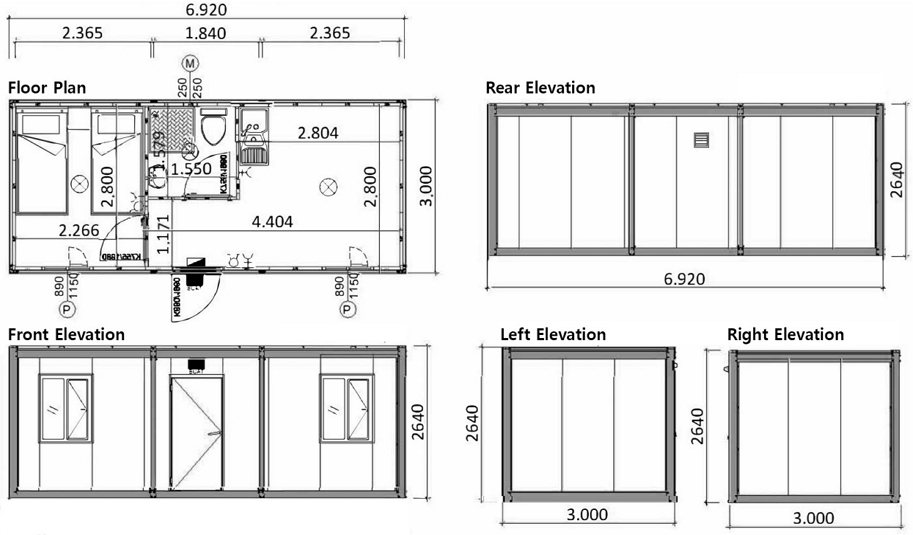
As temporary buildings are typically used for office on construction site, ticket offices, fast food sales, newspaper sales, and souvenir sales, it can be assumed that Retail and Service are the most similar types of buildings. Since the average value of the two types of values can be seen as about 180kWh/m2·year, this value can be assumed as a starting point of EUI for temporary buildings. According to the design manuals, the shape and size of the widely preferred temporary buildings are used like Fig. 1., Fig. 2., and Table 1. In order to obtain more realistic results, the outdoor temperature as an input is based on the actual climate data of the city of Incheon. The reason why Incheon is chosen is that it is quite large with a population of nearly 3 million, and is adjacent to the capital city of Seoul, international business district, coastal retail district, amusement park, professional baseball stadium, and international airport. The temperature data is extracted from weather data provided by the website of EnergyPlus V9.5. The time period was selected from June 15th to September 15th, because this period includes highly cooling required in mid-summer and weak heating required in the change of seasons.

Typical exterior of actual temporary buildings
Conceptual thermal model

Geometry information of a designed temporary building
3.2. Thermal Control Method
To calculate the energy use of the model, the total energy use per unit time is calcu-lated in a simple thermodynamic equation using the heat gain from the supply system and the heat loss through the building envelopes. By converting this process as the change in controlled temperature per unit time, an equation for building a simulation module can be described as follows [29].
| (Eq. 1) |
where, hout and hin are the heat transfer coefficients (W/m·K), k is the transmission coefficient (W/m·K), A is the area (m2), D is the depth of envelope (m).
The PMV index which was developed by Dr. P. O. Fanger and standardized by EN ISO 7730 is utilized to quantify the level of thermal comfort [30]. The Predicted Percentage of Dissatisfied (PPD) is preferred as an auxiliary indicator of the PMV. It can be converted using the PMV equation, and its expression is 100% for fully dissatisfied and 0% for fully satisfied in thermal comfort, respectively. In this simulation model, six variables are used as inputs for a block module to calculate the PMV level: dry bulb temperature, relative humidity, indoor air speed, mean radiant temperature, metabolic rate, and clothing insulation rate. For an effective simulation execution, it is assumed that indoor the air speed is 0.1m/s, the mean radiant temperature is the same as the dry bulb temperature with a 1 hour delay, the metabolic rate is a fixed value of 1.2 (working normally), and the clothing insulation rate is 1.0 (clothing lightly in mid-summer).
| (Eq. 2) |
| (Eq. 3) |
where, M is the metabolic rate and L is the thermal load.
The thermal model and adaptive process results are fed into the Artificial Neural Network (ANN) learning model. This ANN is structured as a multilayer perceptron (MLP), which is a fully connected multi-layer neural network. MLPs utilize more than one layer of artificial neurons (nodes) to handle complex classification and regression problems. The most common MLP configuration is a three-layer, fully connected backpropagation model: Input Layer (Receives the initial data), Hidden Layers (Process the data received from the input layer), Output Layer (Produces the final results). The core mechanism involves each neuron calculating a weighted sum of its inputs (x1,⋯,xk) multiplied by corresponding weights (wai). A bias term (θb) is then added to this result (nc), which is subsequently passed through an activation function (gd) [31]. To train the predictive learning model, the scaled conjugate gradient algorithm was employed, running for 1,000 iterations at 1 epoch each. The model’s performance was statistically significant, achieving a high R2 value for both controlled variables: 0.99032 for mass flow rate and 0.98847 for supply air temperature.
The method of sending appropriate control signals into a system in certain situations has been studied very widely in the deterministic viewpoint. When the system operates over a certain period of time, the difference in two control signals before and after and the derivative of the difference have been preferred to determine the increase or decrease of the next control signal. And these approaches have been applied into in several algorithms to construct the initial deterministic structure. Even though its statistical significance can be lower than more advanced methods such as machine learning and artificial neural networks that use huge amount of data to find regression models, it is still widely preferred because of its clear mathematical and engineering characteristics to manage control results and subsequent control directions.
For maintaining indoor thermal comfort, a deterministic process utilize the results of five different variables related to thermal comfort and energy use as input variables: difference of occupant, derivative of the difference of occupant, difference of PMV value, derivative of the difference of the PMV, derivative of the energy use. Then, by adopting the fuzzy algorithm, the output values of heating and cooling supply air are adjusted by summing the weights specified in each range according to the designed configuration like fuzzy membership functions. At this time, the total output value is combined by use of two elements: mass flow rate, temperature. Then, the adaptive process optimizes the output values whether they are within or outside in designed ranges for energy use. For example, if the number of workers and visitors does not meet a required number, and this increase or decrease rate do not exceed a certain designed range, the output is decreased by 20% to reduce energy use regardless of other conditions. However, in the next simulation phase, if the conditions of the occupant related and the comfort related values are increased while the rate of change in energy use is within a certain designed range, the output is decreased by 5% (i.e., do not reduce the output signal too much because the number of users is increasing as compared to the previous phase). In addition, No adjustment is made if all the conditions are within the designed ranges. This adaptive process is conceptually described in Fig. 3.
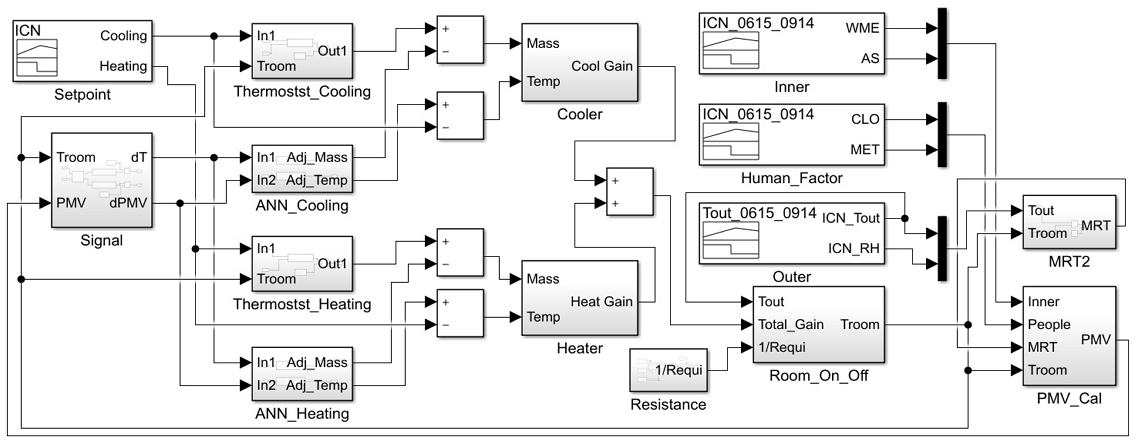
Simulation block model
4. Results and Discussion
As indicated in Fig. 4., Fig. 5. and Fig. 6., it can be seen that the thermostat model is controlled very regularly according to the set-point temperature. In particular, a consistent control pattern is confirmed in the intensive heating period in the morning from June 15th to July 8th and the intensive cooling period at daytime from July 20th to August 13th. Highly effective controls are performed according to the set-point temperature in the period requiring a high level of cooling and heating at the same time from June 16th to 19th, and September 9th to 11th. A characteristic identified in the thermostat model is that the temperature fluctuates according to the dead-band setting of ±1℃ based on the set-point temperature of 22℃ for heating and 26℃ for cooling. When the indoor temperature reaches 21℃, heating starts and is maintained until 23℃ is reached (the dead-band upper limit), and then the operation stops. When the outdoor temperature exceeds 27℃, the process for cooling starts until indoor temperature reaches 26℃. However, at that point, the supply of cooling does not completely stop, but the supply is gradually decreased, and the supply completely stops when it reaches 25℃. From this point on, the indoor temperature rises, and when the temperature reaches 27℃ again, the cooling system turns on again. This process is performed in the same way in the opposite case between heating and cooling. Once again, it is confirmed that the thermostat model controls indoor temperature regularly and mechanically according to the process.
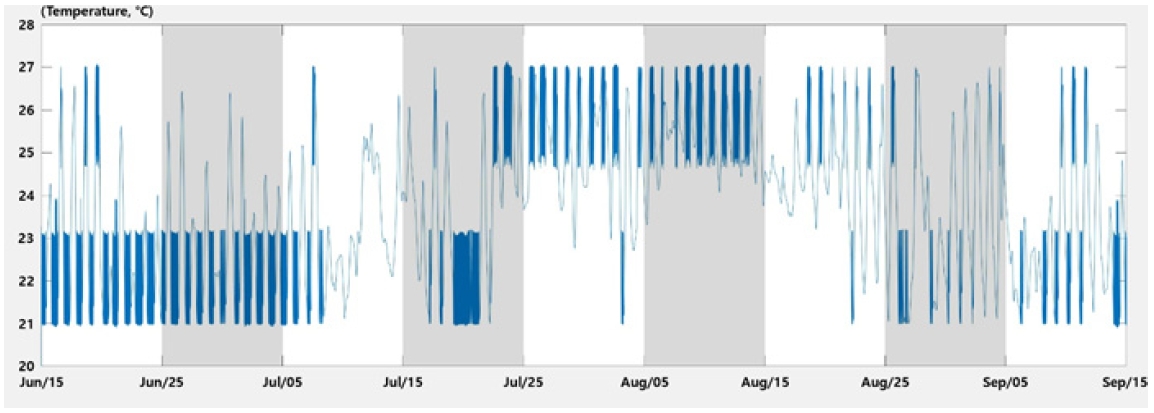
Indoor temperature controlled by the thermostat model
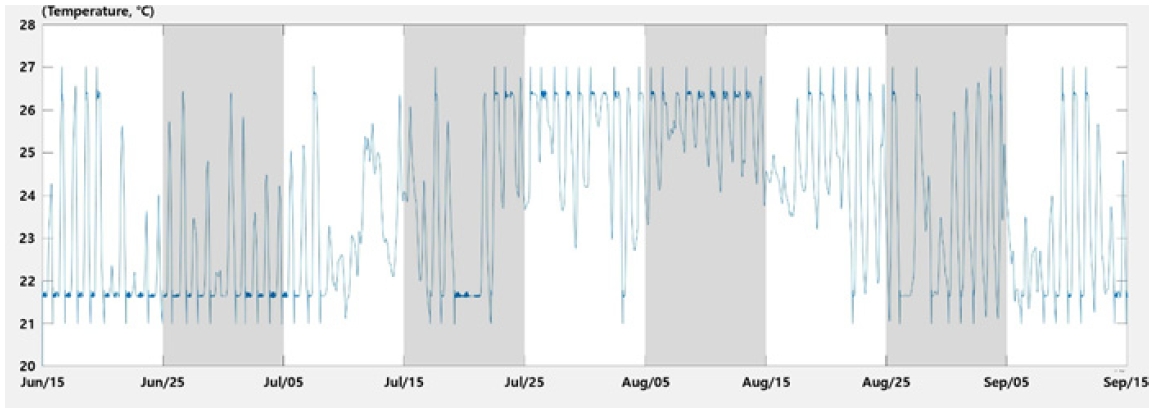
Indoor temperature controlled by the adaptive model
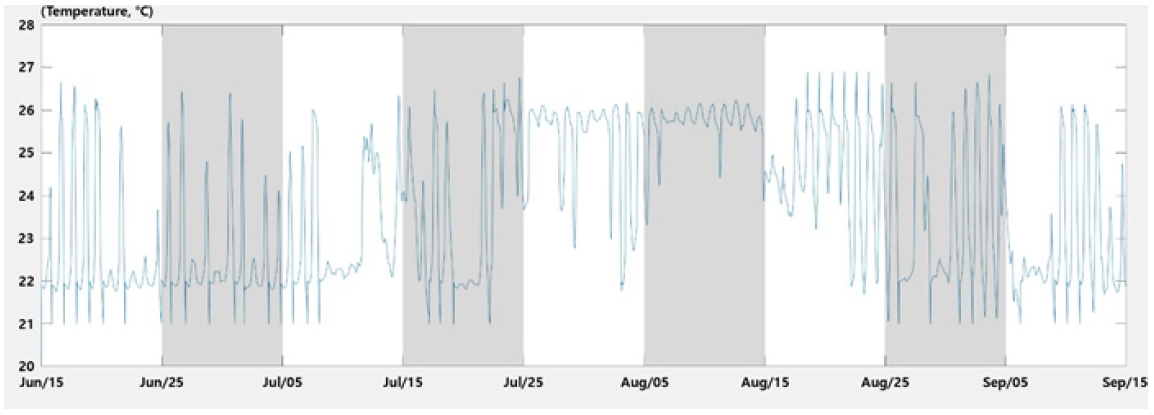
Indoor temperature controlled by the predictive model
As shown in the Fig. 5., the adaptive model performs improved controls that significantly reduce the amount of fluctuations identified in the thermostat model. This control characteristic is expected to have a high effect on maintaining the consistency of the thermal comfort, but it is also expected to be disadvantageous in terms of unnecessary energy use. However, the fact that overshooting in the early stages of system operation, which was not largely highlighted in the thermostat control, is expected to be disadvantageous in terms of both maintaining thermal comfort and energy use. Considering this aspect, the advantage of learning predictive model is easily confirmed in Fig. 6. Overshooting is rarely seen in the intensive cooling period from July 25th to August 14th. Although its performance can be found only by comparing numerical results with the thermostat model, it can be inferred that it would have improved as compared to the adaptive model.
In Table 2. and Table 3., it is numerically confirmed that the predictive performed effectively. In particular, it can be seen that the control efficiency and energy consumption performance are significantly improved compared to the adaptive model, which can be attributed to the effective suppression of overshooting and control up and down in several areas.
Comparison of the thermal comfort
Comparison of the energy use
5. Conclusion
This study investigates the performance of the proposed control model for temporary buildings to improve user’s thermal comfort without compromising the operational energy efficiency. By combining a conventional thermostat model and an adaptive process, the model improves output signals by analyzing the situations of an occupant size and a thermal comfort level. Then, the result data input into learning algorithm, and a predictive model is developed. Finally, the performance of the three different control models is compared in terms of the consistency of maintaining thermal comfort and the reduction of energy use. As a result, the learning predictive model effectively maintain the consistency of thermal comfort by about 63%, and reduce the energy use by about 8%, respectively. Considering the performance results, the proposed model has an advantage that significant energy savings can be achieved while increasing the usability in specific building types where its operational economy is important. However, in the process of analyzing the performance improvement, it is judged that more thermal dynamics need to be utilized, the statistical validity should be increased by using more variables and data, and some unexpected problems that are difficult to theoretically be identified can be analyzed by applying into actual buildings. Regarding these, the summary of this study is as follows:
- 1) Since the number of temporary buildings is expected to increase, an improved operation method can be required for human related issues.
- 2) The adaptive process can help to increase the effectiveness of deterministic problems between thermal comfort and energy use.
- 3) Learning predictive model has an advantage to maintain the consistency of thermal comfort while effectively reducing energy use.
A follow-up study will be conducted to reinforce the strengths and to supplement the weaknesses above, and include a regression model analysis on several aspects of control patterns and energy supply. If this human-centered control method is effectively combined with various studies dealing with urban planning, material development and recycling issues, it is expected that the spectrum of methodology to improve the sustainability of temporary buildings can be expanded.
References
-
D. Mckoy et al., Review of HVAC systems history and future applications, Energies, 16(17), 2023, 6109.
[https://doi.org/10.3390/en16176109]

-
T. Olatunde et al., Review of energy-efficient HVAC technologies for sustainable buildings, International Journal of Science and Technology Research Archive, 6(2), 2024, pp.12-20.
[https://doi.org/10.53771/ijstra.2024.6.2.0039]
-
J. Ahn, S. Cho, and D. Chung, Analysis of energy and control efficiencies of fuzzy logic and artificial neural network technologies in the heating energy supply system responding to the changes of user demands, Applied Energy, 190, 2017, pp.222-231.
[https://doi.org/10.1016/j.apenergy.2016.12.155]
-
B. Paris et al., Hybrid PID-fuzzy control scheme for managing energy resources in buildings, Applied Soft Computing, 11(8), 2011, pp.315-319.
[https://doi.org/10.1016/j.asoc.2011.05.052]
-
E. Barbadilla-Martun et al., Analysing the indoor temperature ranges for an efficient control of HVAC systems, Energy and Buildings, 301, 2023, 113681.
[https://doi.org/10.1016/j.enbuild.2023.113681]
-
J. Ahn, Thermal control strategy for the sustainable use of large classrooms responding to user demands in a school building, Buildings, 14(12), 2024, 3809.
[https://doi.org/10.3390/buildings14123809]
-
P. Michailidis et al., Model-free HVAC control in buildings: A review, Energies, 15, 2023, 7124.
[https://doi.org/10.3390/en16207124]
-
F. Behrooz, et al., Review of control techniques for HVAC systems - Nonlinearity approaches based on fuzzy cognitive maps, Energies, 11(3), 2018, 495.
[https://doi.org/10.3390/en11030495]
-
R. Qi et al., Adaptive control: A tutorial, fuzzy system identification and adaptive control, 1, 2019, pp.55-74.
[https://doi.org/10.1007/978-3-030-19882-4_3]
-
J. Moon, J. Ahn, Improving sustainability of ever-changing building spaces affected by users’ fickle taste: A focus on human comfort and energy use, Energy and Buildings, 208, 2020.
[https://doi.org/10.1016/j.enbuild.2019.109662]
-
J. Hernandez et al., A Fuzzy-based building energy management system for energy efficiency, Buildings, 8(2), 2018, 14.
[https://doi.org/10.3390/buildings8020014]
-
J. Zhao, Y. Shan, A Fuzzy Control Strategy Using the Load Forecast for Air Conditioning System, Energies, 12(12), 2020, 4947.
[https://doi.org/10.3390/en13030530]
-
M. Abuhussain et al., Adaptive HVAC system based on fuzzy controller approach, Applied Sciences, 13, 2023, 11354.
[https://doi.org/10.3390/app132011354]
-
A. Khalilnejad et al., Data-driven evaluation of HVAC operation and savings in commercial buildings, Applied Energy, 278, 2020, 115505.
[https://doi.org/10.1016/j.apenergy.2020.115505]
-
S. Zhou et al., A comprehensive review of the applications of machine learning for HVAC, Decarbon, 2, 2023, 100023.
[https://doi.org/10.1016/j.decarb.2023.100023]
-
J. Ahn, D. Chung, S. Cho, Performance analysis of space heating smart control models for energy and control effectiveness in five different climate zones, Building and Environment, 115, 2017, pp.316-331.
[https://doi.org/10.1016/j.buildenv.2017.01.028]
-
X. Liu, Z. Gou, Occupant-centric HVAC and window control: A reinforcement learning model for enhancing indoor thermal comfort and energy efficiency, Building and Environment, 250, 2024, 111197.
[https://doi.org/10.1016/j.buildenv.2024.111197]
-
A. Borodinecs et al., Assessment of HVAC performance and savings in office buildings using data-driven method, Clean Technology, 6(2), 2024, pp.802-813.
[https://doi.org/10.3390/cleantechnol6020041]
-
Q. Yin et al., A review of research on building energy consumption prediction models based on artificial neural networks, Sustainability, 16(17), 2024, 7805.
[https://doi.org/10.3390/su16177805]
-
P. Michailidis et al., Artificial neural network applications for energy management in buildings: Current trends and future directions, Energies, 17(3), 2024, 570.
[https://doi.org/10.3390/en17030570]
-
J. Ahn, S. Cho, Anti-logic or common sense that can hinder machine’s energy performance: Energy and comfort control models based on artificial intelligence responding to abnormal indoor environments, Applied Energy, 204, 2017, pp.117-130.
[https://doi.org/10.1016/j.apenergy.2017.06.079]
-
J. Ahn, Network based control methodology for improving the indoor thermal environment of sales shops in traditional markets during the change of seasons, KIEAE Journal, 24(6), 2024, pp.61-67.
[https://doi.org/10.12813/kieae.2024.24.6.061]
-
B. Gao et al., Pump-valve combined control of a HVAC chilled water system using an artificial neural network model, Energies, 16(5), 2023, 2416;
[https://doi.org/10.3390/en16052416]
-
P. Pandey, B. Dong, Prediction of window opening behavior and its impact on HVAC energy consumption at a residential dormitory using Deep Neural Network, Energy and Buildings 296, 2023, 113355.
[https://doi.org/10.1016/j.enbuild.2023.113355]
- J. Ahn, Development of energy performance metrics for airport terminal buildings using multivariate regression modeling, Doctoral dissertation, North Carolina State University, 2016.
- SAMAN portable, our products, https://www.samanportable.com, , 2019.
- Global shelter sector, Technical guidance for container homes, https://sheltercluster.org, , 2023.
-
J. Ahn, S. Cho, D. Chung, Development of a statistical analysis model to benchmark the energy use intensity of subway stations, Applied Energy, 179, 2016, pp.488-496.
[https://doi.org/10.1016/j.apenergy.2016.06.065]
- University of Oxford, Basics of Thermodynamics, https://www.physics.ox.ac.uk, .
-
T. Cheung et al., Analysis of the accuracy on PMV - PPD model using the ASHRAE Global Thermal Comfort Database II, Building and Environment, 153, 2019, pp.205-217.
[https://doi.org/10.1016/j.buildenv.2019.01.055]
-
P. Braspenning, F. Thuijsman, A weijters, artificial neural networks, Berlin: Springer, 1995.
[https://doi.org/10.1007/BFb0027019]